

No Hyperfast Travel
With the acquisition of gravity control technologies utilizing magnetic monopoles in the late 20th century, it was hoped that traversable wormholes and superluminal warp drives would become a reality during the 21st century. That is, devices capable of conveying persons, equipment, and information across interplanetary distances, effectively travelling faster-than-light (FTL), though nothing locally would be moving FTL (hence the phrase hyperfast travel).
Unfortunately, both traversable wormholes and superluminal warp drives cannot exist, since quantum gravity forbids the propagation of information at FTL both locally and globally. Causality is an inviolable principle of our observable universe. All superluminal behaviors are mere correlations, as documented in quantum phenomena like entanglement.
Terminology
Throughout this article the phrase 'hyperfast travel' is used instead of the phrase 'faster-than-light travel'. This is to reflect the original inspiration behind spacetime shortcuts rooted in General Relativity: they provide effective FTL travel. Hence the term 'hyperfast' is used, as coined by Miguel Alcubierre in 1994.
When the speed of light (c) is mentioned, it always refers to the speed of light in the vacuum, unless stated otherwise. It is the vacuum velocity that is invariant and sets the bounds on causal propagations and particles. Furthermore, all equations discussed assume c = 1.
Physics of Hyperfast Travel
Flux Energy Condition (FEC)
As a corollary of Special Relativity and Quantum Field Theory, superluminal propagations and tachyonic particles are forbidden. This can be taken to imply that no transfer of a material's momentum (i.e., its pressure) can be of a greater magnitude than its energy density (ρ² ≥ p²). This rule was referred to as the Flux Energy Condition (FEC), which if true would prohibit all hyperfast travel metrics. The FEC can be intuitively grasped in that, it posits that one cannot offload onto gravity the work of passing through spacetime faster than what is allowed by Special Relativity, since General Relativity holds that gravitational frames are indistinguishable from inertial frames (i.e., the equivalence principle).
Tachyons in Special Relativity
Just by looking at the math of Special Relativity, while nothing with real positive mass (like ourselves) can reach or surpass lightspeed locally, if one envisions a particle with a negative mass squared term (-m², or an imaginary invariant mass, √-1) these "tachyons" always travel FTL or have spacelike worldlines. While the mathematics of Special Relativity allow for such bizarre phenomena, Quantum Field Theory does not. In the interest of understanding the Flux Energy Condition, let's look at some of the bizarre behavior of superluminal tachyons anyway, relying only on Special Relativity.
Let's make use of the energy-momentum relation from Special Relativity (E² - p² = m², where p is momentum), where for particles with positive real mass always include the (spatial) momentum as part of their total energy density (E² = p² + m²). For massless particles, their energy is equal to their momentum (E² = p²). What of superluminal particles, or spacelike tachyons with a negative mass squared term (-m²)? Well, the momentum is greater than the total energy density (E² - p² < 0). This again confirms the spacelike nature of tachyons, since there is a spacelike or superluminal flow of momentum. So, we can map these relationships in terms of a space-time diagram, where E represents the temporal axis, and p represents a spatial axis. Causality is bounded into the past and future "light-cones" (the top and bottom shaded regions of the diagram below), with the superluminal "elsewhere" outside of the light-cones (transparent right and left regions). Let's summarize:
- Timelike or Real Mass: E² > p²
- Lightlike or Massless: E² = p²
- Spacelike or Tachyonic: p² > E²
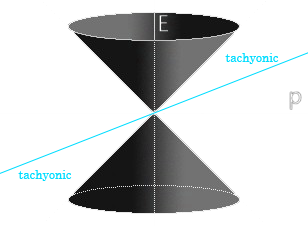
The sequence of spacelike separated events is frame-dependent. Meaning, what appears as a positive energy tachyon moving forward in time, in another frame of reference, appears as a negative energy tachyon moving backwards in time. So, what is a tachyon emitter in one frame of reference is a tachyon receiver in another. Causality only holds within light-cones (where E² ≥ p²).
Let's examine another key component of the math of Special Relativity: the Stress Energy Tensor (Tμν). The Stress Energy Tensor mathematically "maps" the energy-momentum distribution in spacetime. The four-by-four matrix below accounts for this distribution across time and our three spatial dimensions (0, 1, 2, 3), such that one can translate between different frames of reference while preserving the same properties and laws of physics (i.e., Lorentz Invariance).
It is typical to interpret the components of the Stress Energy Tensor in the terms of a perfect fluid, allowing one to import the relations above regarding energy and momentum. So, 'ρ' is the relativistic energy density (the time-time component or T00) and each 'pn' is the pressure or the spatial momentum flux perpendicular to each spatial dimension:
- Timelike Flux: ρ² > pn²
- Lightlike Flux: ρ² = pn²
- Spacelike Flux: pn² > ρ²
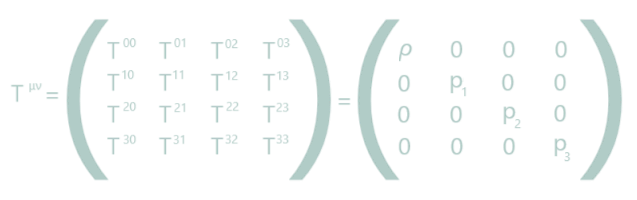
One should now be able to see that there are certain "energy conditions" implied by these correlations within the mathematics of Special Relativity. By invoking the equivalence of inertial mass and gravitational mass, the Stress-Energy Tensor becomes the source of spacetime curvature in General Relativity. It must be noted, that the relationship between the metric tensor (gμν) and the Stress-Energy Tensor (Tμν) is highly nonlinear. This relation between spacetime geometry and energy-momentum distribution imputes relativistic energy conditions to General Relativity. Now, to Quantum Field Theory's understanding of tachyons.
Tachyonic Quantum Fields
Quantum fields with a negative mass squared term, tachyonic fields, do not have localized excitations that propagate at superluminal speeds (i.e., no superluminal particles). Instead, tachyonic fields are a vacuum instability, and decay through an exponential cascade of energies into a (more) stable vacuum. This aspect of Quantum Field Theory was confirmed in 2013 with the discovery of the Higgs Boson at CERN, since tachyon condensation is the mechanism by which the Higgs field potential reached its current Vacuum Expectation Value of 246 GeV. Since every particle is an excitation of a quantum field, and not even tachyonic fields have superluminal excitations, we can say with confidence that Quantum Field Theory forbids superluminal behavior.
Tachyonic fields have other restrictions in Quantum Field Theory. For example, a tachyonic field must be a scalar or spin-0 field. To allow for higher spin would preclude the field from having a negative mass squared term (i.e., -m²), and would cease to be tachyonic entirely.
Furthermore, tachyonic fields have a hill-shaped potential (∩) instead of the valley-shaped potentials (∪) of non-tachyonic fields. So, unless a boundary from below is added (as is the case in the Higgs Field potential, though this renders the field non-tachyonic), tachyons will exponentially produce excitations of ever-greater negative energy densities, destabilizing the vacuum. This is why early string theories (i.e., bosonic string theories) were rejected: they posited the presence of tachyonic fields, which we clearly do not observe.
We can finally express our energy condition, the Flux Energy Condition (FEC), in as a rule for perfect fluids: ρ² ≥ p². That is, if this inequality is violated, one then has an energy-momentum distribution where pressure propagates momentum at superluminal velocities. The FEC is physically equivalent to asserting that the speed of sound cannot be superluminal. That is, pressures and their disturbances must obey relativistic limits. However, this inequality ignores a fundamental principle of quantum physics: the Heisenberg Uncertainty Principle.
Quantum Energy Conditions
As a consequence of the Heisenberg Uncertainty Principle, both spacelike momenta and negative energy densities must be allowed, but these quantum violations of the FEC are tightly constrained in a mature quantum theory (including quantum gravity). The constraint can be understood as follows: no superluminal propagation of information can occur. Only mere correlations (e.g., entanglement) can occur within spacelike intervals.
Hence, no hyperfast travel schemes are permitted by quantum information theory. The quantum versions of the energy conditions, such as the flux energy condition, very tightly constrain exotic matter, preventing the FTL transfer of information.
Hyperfast Travel Schemes
Traversable Wormholes
That traversable wormholes require the dominance of repulsive gravitation can be easily understood with the following analysis. Normally, positive mass-energy warps spacetime such that light-rays converge after passing near a massive object (e.g., a star). However, light-rays initially parallel inside a spherical wormhole's throat must diverge upon exiting: repulsive gravity is what keeps a wormhole open or traversable (i.e., Raychaudhuri's Theorem). That is, a wormhole is made traversable by the dominance of a repulsive gravitational effect along their radial (r) coordinate. Without this negative radial pressure or radial tension (-p = τ), wormholes will close or "pinch off" faster than lightspeed particles could ever traverse them.
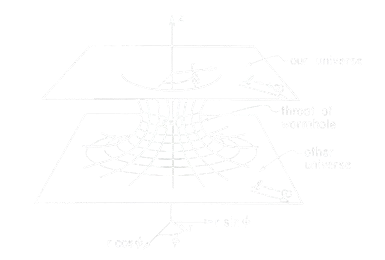
It's important to note that there were already regions of repulsive gravity within all black hole metrics except the Schwarzschild metric, but these were sourced and offset by an equal positive energy density (e.g., the angular momentum that exerts a repulsive gravity below the inner Cauchy horizon of the Kerr metric has a positive energy density, same for the electric charge of the Reissner–Nordström metric). Hence, black holes were never traversable wormholes. Truly traversable wormholes need an overwhelmingly negative radial pressure (p < -|ρ|), which in some accelerated frames of reference the energy density also becomes negative (ρ < 0). See the flare-out condition below, note: the zero subscripts mean these are various values at the center of the wormhole's throat (ℓ0).
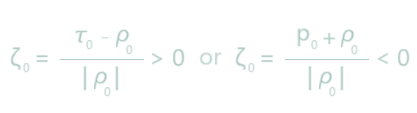
Now, by simply looking at the exoticity function from Morris-Throne's 1988 paper (above), we can tinker with the values such that the magnitude of the pressure can be significantly reduced and remain traversable when the energy density is allowed to be negative (ρ < 0) in the wormhole's rest frame. While not noticeable from the formula above, allowing a negative energy density also allows one to significantly shrink the volume of the exotic material required to create and sustain a wormhole, making practical traversability easier to attain.
However we warn against attempts to avoid FEC violations by shifting the burden onto a large negative energy density, as an alternative approach to satisfying the flare out condition. This ignores the context we've described surrounding wormholes and black holes. Without violating the FEC, one has an unstable wormhole: even the slightest perturbation will cause the wormhole to pinch off and collapse, as the repulsive gravitation is too generalized.
The role of a negative radial pressure is highlighted by looking at the exoticity function as the energy density approaches zero (limρ → 0 ζ = ∞). That is, a wormhole with a vanishing energy density allows for even the smallest amounts of negative radial pressure to push exoticity (ζ) to infinity. A wormhole will not be traversable unless the flare-out condition is fulfilled in virtue of an excessive radial tension. The negative stress-energy must cancel out attractive gravitation in a very specific way to keep a wormhole traversable.
Superluminal Warp Drives
The first warp drive metric, by Alcubierre, works by relocating a "bubble" of spacetime by expansion at the back of the bubble and contraction at the front of the bubble. The negative energy density in the bubble's walls are perpendicular to the direction of motion. That is, perpendicular to the expansion and contraction. This means that where the magnitude of the energy density is largest, the metric obeys the Flux Energy Condition. Yet, where the expansion and contraction become their strongest in the direction of motion, there is a minimal energy density and thus, an overwhelming positive or negative pressure (p² > ρ²), the sign of the pressure depending on whether it is the expansive or contractive end.
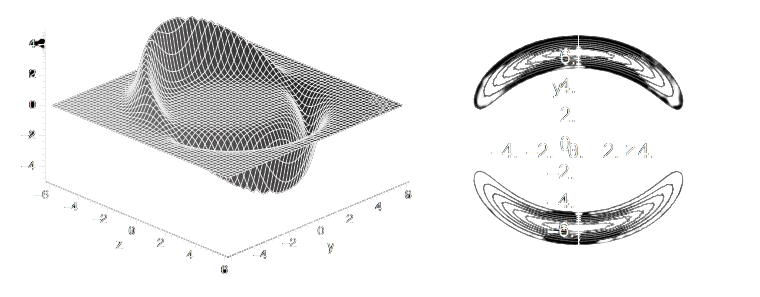
While warp drive metrics have been constructed that avoid the expansion/contraction dynamic, the pressures at the front and back ends still exceeds the energy densities' magnitudes there. Like with wormholes, one may be tempted to rely on an overwhelming negative energy density and bypass FEC violations. However, the situation with warp drives is even worse than that of wormholes.
Without excessive anisotropic pressures (p < -|ρ|, at one end of the warp bubble and |ρ| < p, at the other end), the warp field will not be propulsive. Yes, negative stress-energies (ρ + p < 0) are required to have the repulsive gravity to make spacetime move counter to its normal tendencies. However, a negative energy density (ρ < 0) merely allows the warp bubble to keep up with the superluminal pressures (p² > ρ²). This is evident by comparing the left diagram in the above image (asymmetric spacetime curvature) with the right diagram (symmetric distribution of negative energy density). The negative energy density does absolutely nothing on its own: it merely provides the means to accelerate to "warp speed" without needing propellant (since rocket propulsion cannot enable hyperfast travel).
So, superluminal warp drives require both a violation of the Flux Energy Condition (at both ends of the warp bubble) and an absolutely negative energy density throughout the entire warp bubble's walls.
References
General Physics
Original Usenet Physics FAQThe Physics Stack Exchange
Hyperfast Travel
Morris-Thorne Wormhole (1988)Alcubierre Warp Drive (1994) / (Free Version)
Natário Warp Drive (2002) / (Free Version)
Wormholes Limρ → 0 ζ (2003) / (Free Version)
The Flux Energy Condition (2011) / (Free Version)
Wormholes, Warp Drives and Energy Conditions (2017) ADM Mass and Warp Drives (2023) / (Free Version)
Warp Factory Analyses of Warp Metrics (2024) / (Free Version)
Warp Factory Subluminal Warp Metric (2024) / (Free Version)