
Rihsama Council of Scholars
Organization • Government (Meritocracy) • Headquarters: Nahrim
Role in Nahrim: The Council governs the nation of Rishama from Nahrim. Municipal authority over the capital itself is delegated to the Wali (currently Safiya al-Khazeen), while the Council focuses on national and international policy.
Quick Facts
| Field | Detail |
|---|---|
| Type | Scholar‑led national council (secular) |
| Headquarters | The Great Scriptorium & Hall of Proof, Nahrim (Scholar’s Arc) |
| Leader | Kelse Dogan, Presiding Scholar (Chair) |
| Seats | Nine (the Nonet) — to mirror the nine months of the Marthian year |
| Selection | Public examinations and peer review; appointment formalized by the Hall of Proof |
| Term | Renewable terms; peer re‑confirmation every Qiyuan season day |
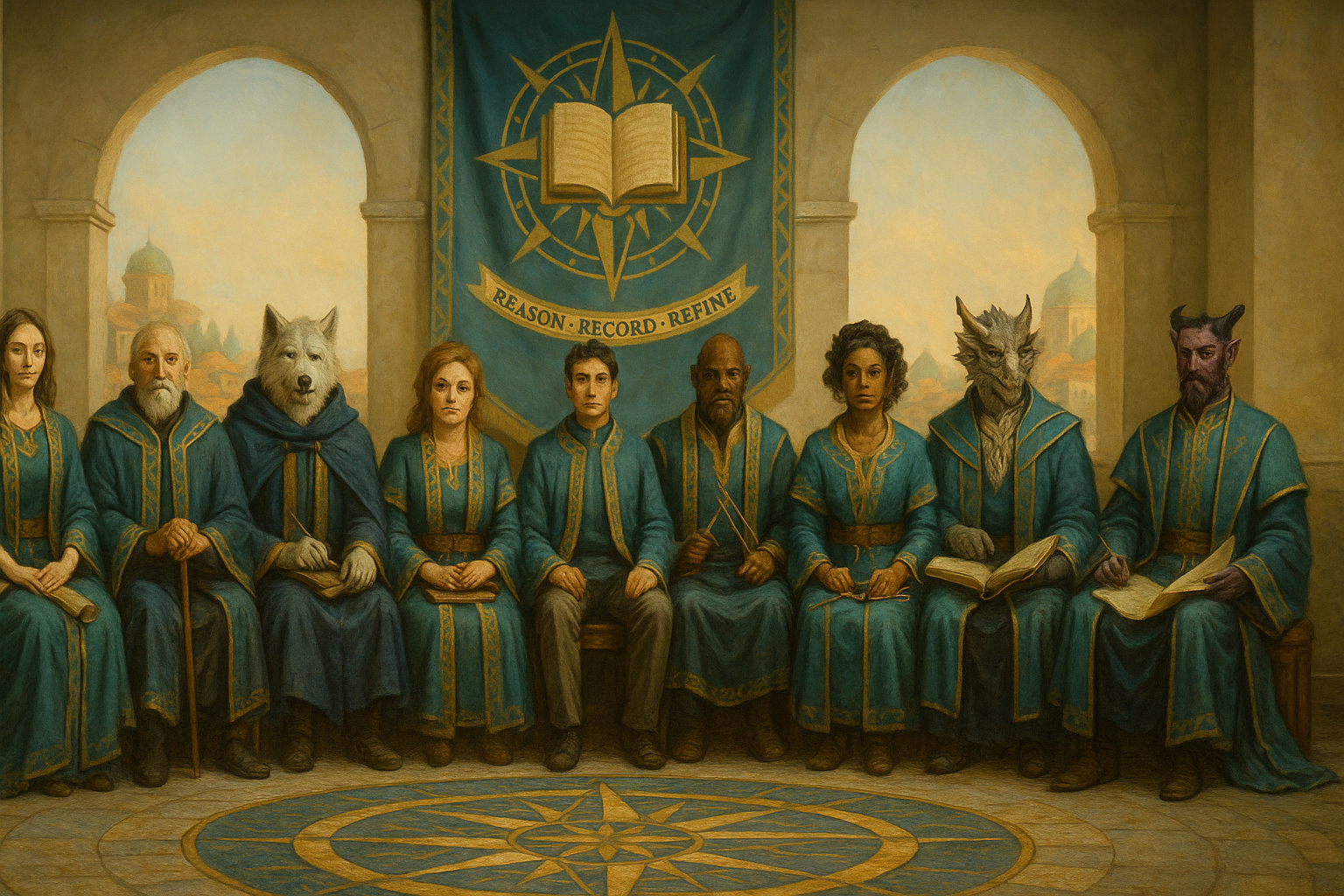
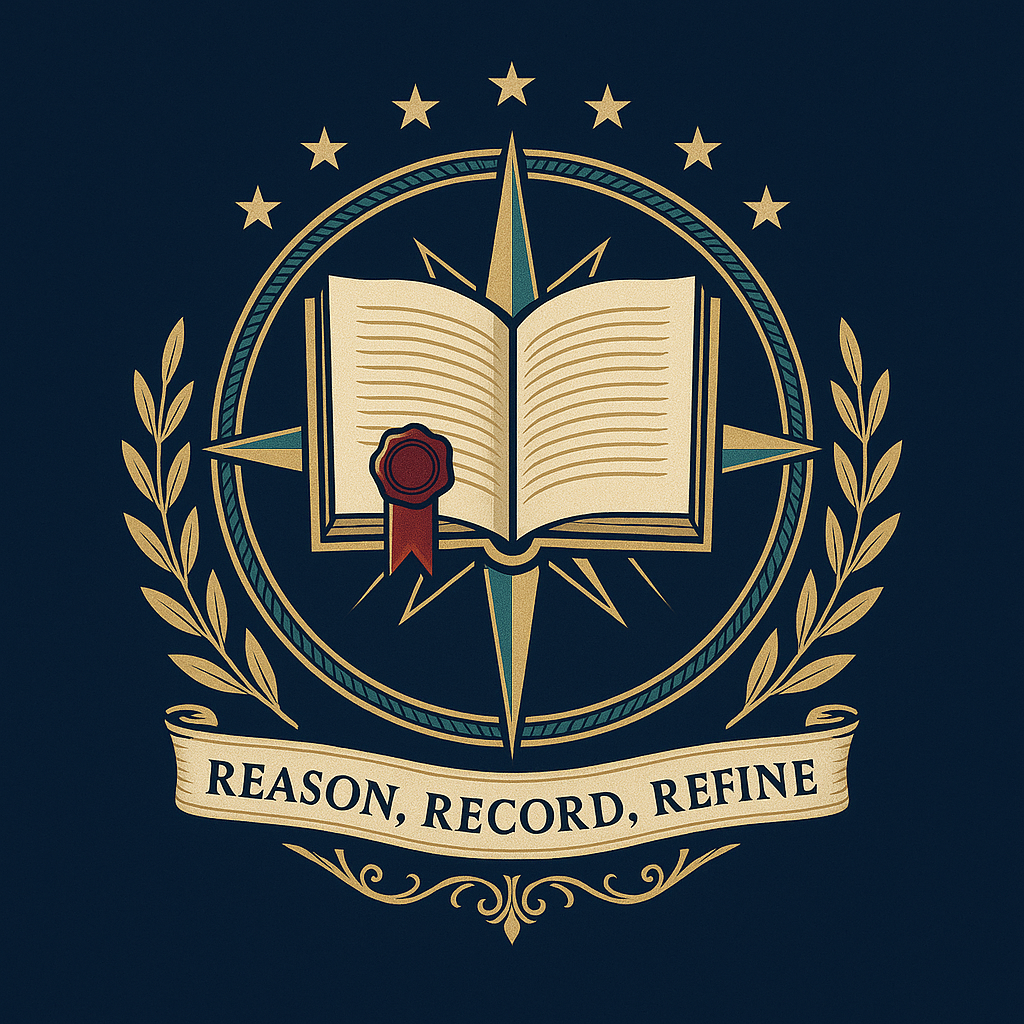
| Symbol | Open codex over a wind‑rose; motto ribbon: “Reason, Record, Refine” |
| Languages | Rihsami High Script (official), Trade‑tongue |
Canon boundary: The Undying maintain major archives in Rishama but do not rule; formal cooperation agreements limit intelligence‑sharing to legal warrants and public scholarship.
Mandate
- Steward national law, budget, standards of scholarship, and inter‑state diplomacy.
- Charter and audit universities, archives, and academies (including magewright colleges and windwright guilds).
- Oversee strategic infrastructure (e.g., the elevated harbor & lock complex, wind‑lift code, postal and beacon networks).
- Negotiate treaties, tariffs, and extradition compacts; maintain permanent legations abroad.
- Maintain a strict separation between state policy and city governance (the Wali’s domain).
Jurisdiction & the Wali of Nahrim
The Council: national laws, foreign policy, national treasury, standards, and interprovincial disputes.
The Wali: municipal ordinances, harbor operations, lift scheduling, policing, sanitation, emergency response.
Joint Protocol: in disasters or siege, the Council may declare a Scholastic Emergency, seconding national engineers to the Wali while preserving civilian command.
Composition (The Nonet)
Each seat is tied to a portfolio; the Chair assigns working groups (“colleges”) as needed.
- Presiding Scholar (Chair) — agenda, arbitration, external representation. (Currently Kelse Dogan.)
- Collegium of Law & Records — codification, courts, evidence standards.
- Collegium of Treasury & Trade — tariffs, coinage, merchant charters.
- Collegium of Works & Windwrights — locks, bridges, wind‑lifts, public works.
- Collegium of Arcana & Natural Philosophy — research ethics, arcane licensing.
- Collegium of Education & Examinations — national exams, university charters.
- Collegium of Health & Civic Welfare — clinics, plague codes, waterworks.
- Collegium of Diplomacy & Legations — embassies, treaties, envoys.
- Collegium of Signals & Security — military, beacons, couriers, counter‑sabotage (civilian).*
How Members Are Chosen
The Four Proofs (public, anonymized where possible):
- Proof of Mind — logic, jurisprudence, and policy modeling.
- Proof of Work — design or implement a fix for a real civic bottleneck within 33 days.
- Proof of Word — write and defend a paper before adversarial peers; plagiarism = lifetime ban.
- Proof of Character — open‑books audit of finances and conflicts of interest.
Candidates who pass are ranked. Vacancies are filled from the list after peer interrogatories and a final vote of the sitting Council.
Powers & Procedures
- Edicts & Codes — simple majority (5/9).
- Treaties & Tariffs — supermajority (7/9).
- Scholastic Emergency — 7/9 + Wali’s assent.
- Impeachment/Recall — 6/9 after public inquiry; automatic disqualification for falsified research or bribery.
- Transparency — minutes published weekly; redactions require 7/9 and sunset after one month unless renewed.
Facilities
- Great Scriptorium — atrium stacks, sealed vaults, and a public reading floor; copyists and truth‑clerks.
- Hall of Proof — debate amphitheater; rotating examination chambers; Oath of Uncolored Ink is sworn here.
- Legation Row — guest pavilions for foreign envoys; joint Undying annex with strict data‑access protocols.
Current Agenda (52 AT)
- Harbor Capacity Act — expand upper docks; standardize capstans and quay depths across major ports.
- Lift Code Revision — national safety code for wind‑lifts; certification for foreign caravans entering Nahrim.
- Academic Integrity Charter — national policy against forged seals, falsified theses, and predatory endowments.
- Neutrality Doctrine — reaffirm Rihsama’s non‑alignment amid rising Beekeeper activity; tighten export controls on siege‑useful research.
Relationships
- Wali of Nahrim (Safiya al-Khazeen — close cooperation; no interference in municipal staffing or courts.
- The Undying — shared respect for knowledge; access limited to public stacks unless warrants are issued.
- Lelien Empire — formal ties via Lelien Dogan Defne; careful boundary between scholarship and imperial politics.
- Dravis, Arya, and others — tariff and research exchange treaties; case‑by‑case technology controls.
Notables
- Kelse Dogan — presiding scholar; pragmatic, surgical thinker, famous for The Paper That Saved a Bridge.
- Safiya al‑Khazeen (ally) — Wali of Nahrim; engineer‑magistrate, champion of the No‑Gate Doctrine.
Quote: “We steer by proof, not by pride.” — Kelse Dogan, opening the Qiyuan session.

Comments