
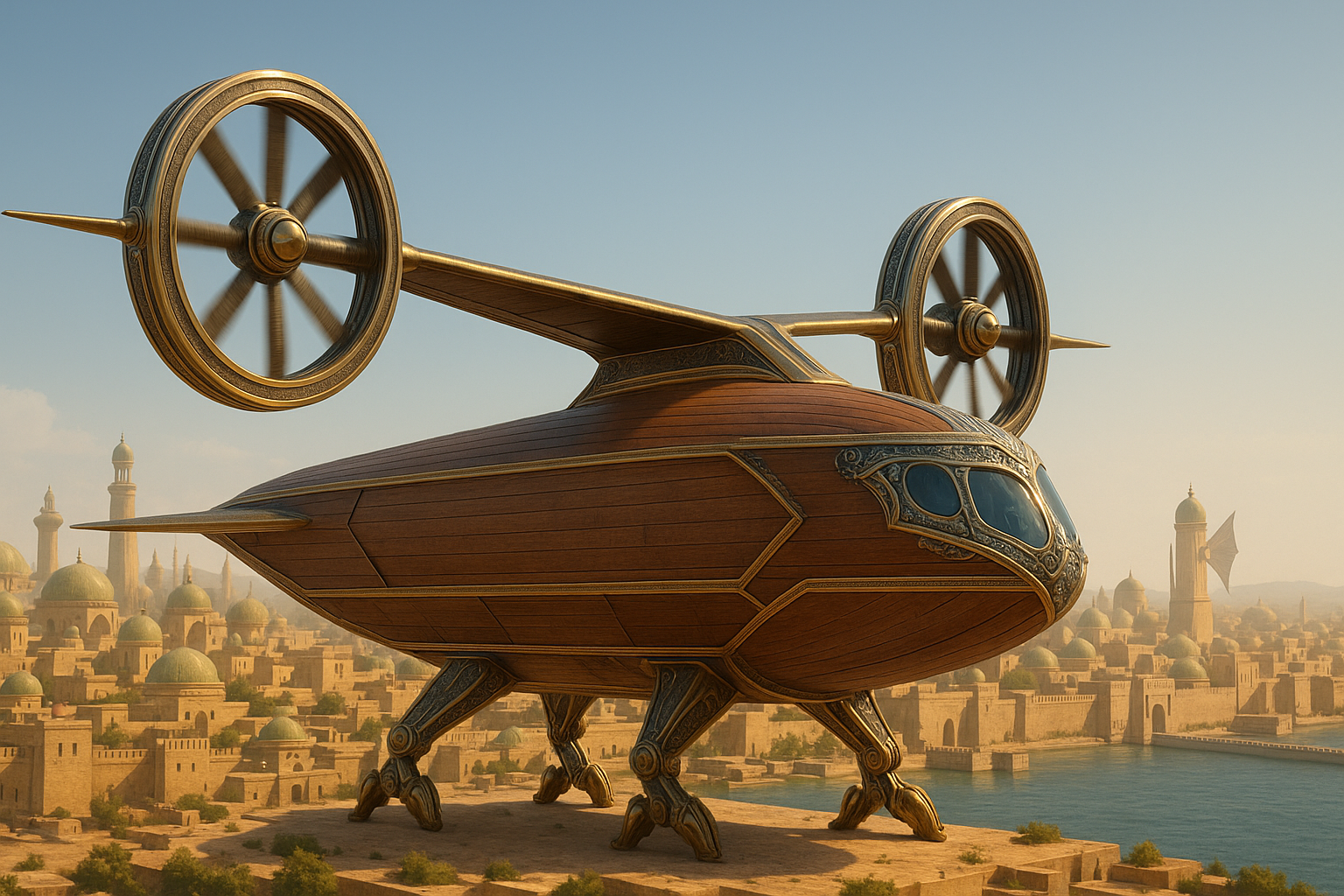
Anemoi Fanwing
Vehicle • Wind‑Powered Tilt‑Rotor • Designed in Rishama (Foundry of Anemoi) • Era: 45 AT
Overview
A compact, fully wind‑powered fan‑wing craft using wingtip ring‑fans and variable vanes to fly without combustion. Built for couriers, scouts, and short‑haul logistics out of Nahrim ’s workshops.
Quick Facts
| Field | Detail |
|---|---|
| Type | Twin fan‑wing tilt‑rotor (wind‑powered) |
| Crew | 2 (pilot + engineer) • seats up to 4 with light cargo |
| Endurance | Ideal winds: 2–3 days aloft; typical sorties: 6–10 hours |
| Emergency Store | Internal wind‑accumulators keep flight for ~1 hour with no wind |
| Cruise / Ceiling | 60–90 knots • 9,000–12,000 ft, weather permitting |
| Takeoff/Alight | STOVL; can skiff on calm seas using belly skids and spray strakes |
How It Works
- Wingtip Ring‑Fans. Each wing ends in a banded ring housing a multi‑blade fan. In forward flight they act like propulsors; in slow/vertical modes they tilt to bite clean air. Fans are driven by wind‑turbine clutches along the wing spar.
- Turbine Trains. Pop‑up ram turbines along the dorsal spine harvest airstream and back‑drive a compact flywheel/bell‑spring bank. Mechanical linkages route power to the ring‑fans through gear differentials for yaw and balance.
- Safiya Pattern Controls. A Rihsami “windwright” layout: dual tillers for fan tilt, a pitch wheel for collective, and foot bars to splay ring‑vanes.
Materials & Look
Wooden primary fuselage with brass and steel cladding at stress points; glazed cockpit canopy; copper runic tracery along gearboxes for motive regulation and overspeed quench. Finish ranges from lacquered teak to salt‑bleached ash depending on theater.
Roles
Courier runs, lighthouse and Pharos inspection, coast‑patrol, survey/photography, medevac from wind‑lift terraces, and fast liaison between harbor locks and inland towers.
Operations & Limits
- Best Case: Strong, steady quartering wind; fans sip power—days aloft possible with glide rests.
- Typical: Mixed winds—6–10 hours on a sortie is normal.
- No Wind: ~1 hour on mechanical accumulators; then a controlled descent or glide landing is mandatory.
- Hazards: Crosswind rotor stalls, salt ingress in fan ring bearings, and katabatic shears near Arya lane.
Variants
- Survey Mk IIS: Belly scrying pod; extended dorsal turbines; slower top speed.
- Patrol Mk IIP: Light arbalest and signal‑kite rack.
- Transport Mk IIT: No cargo capacity but can carry eight passengers comfortably. Can transport twelve passengers in an emergency but will suffer from reduced speed, maneuverability, and flight times.
- Medevac Pack: Side litter clamps; stabilizer fins for smooth hover.
- Combat Mk IIIA (experimental:) Four chemical or incendiary bombs. Dual side-mounted arbalests. Range amplifier for onboard spellcasters (spells with a range other than touch or self can be cast at ten times their normal range. This technology is volatile and any fire, lightning, thunder, or acid damage dealt to this craft has a five percent chance to detonate it outright in a one hundred foot explosion. This technology is also incredibly secret and pilots and crew are geas-bound to destroy the craft rather than let it fall into enemy hands.
Game Use (optional)
- Proficiency: Air vehicles (windcraft) or custom Windwright’s Tools.
- Skill Checks: Launch/land DC 12 in fair winds; +4 in gust fronts or rotor wash; overspeed quench on Nat 1 prevents cascade failure but locks one fan (disadvantage to checks until repaired).

Comments