
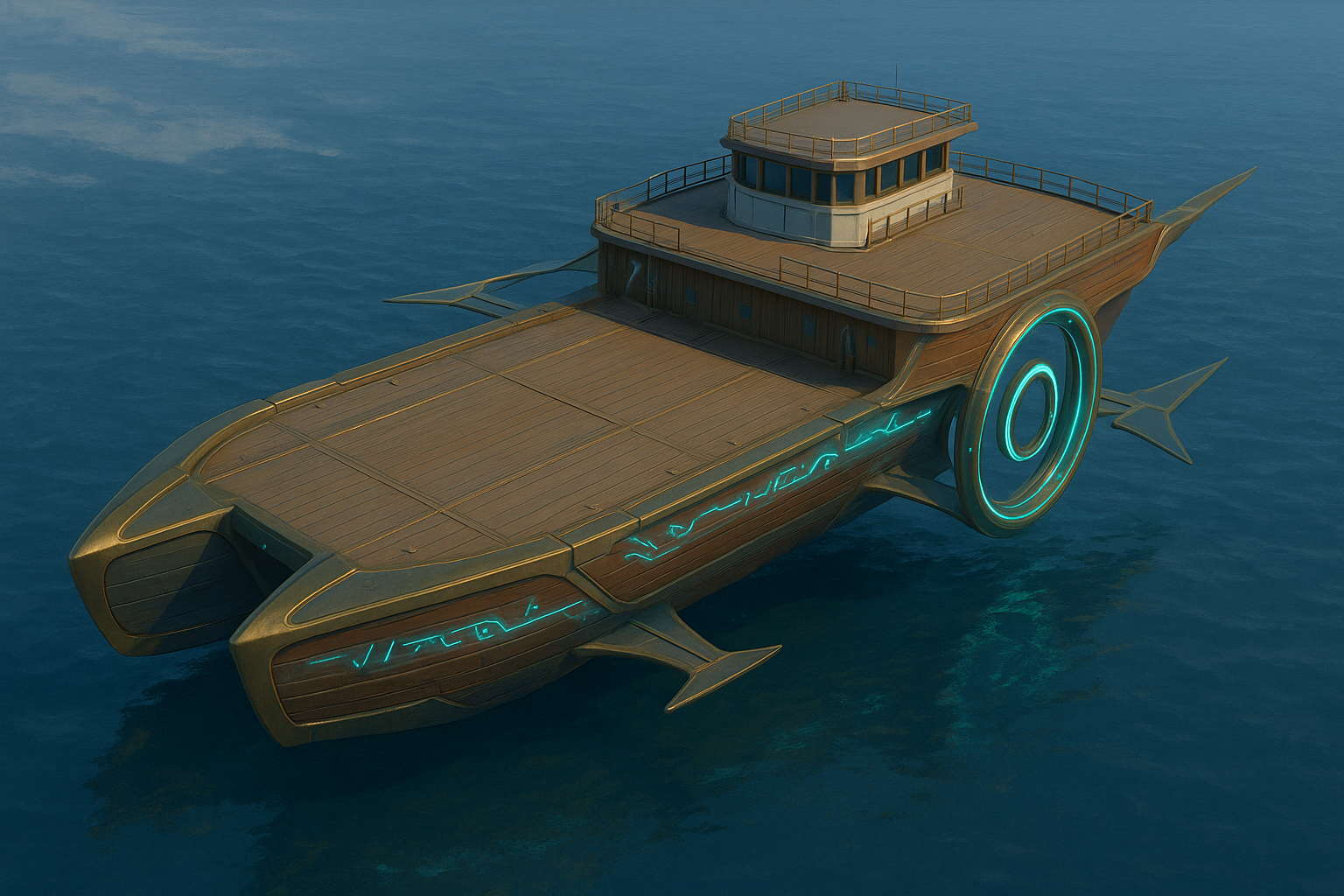
Aetherline “Keystone” Airship
Overview
This joint-venture between the Lelien Empire and Thalasseia is intended to prioritize speed and cargo capacity and to provide an alternative to high-priced Dwarrven air transport. It was developed to streamline trade between the two nations as they have materials useful to the other but a separated by a large distance. Designed by Thalasseian Aeromancers and Lelien artisans, it incorporates technology gleaned from the remains of Castor Malachite's failed attempt of conquest. Some claim that the technology was finalized without enough testing, but the designers and engineers maintain that the ships are the pinnacle of safety - as long as routine inspections and maintenance are performed.
A Keystone airship is driven by a central Heart Rune that pressurizes aether and feeds it through inlaid runic channels (“veinwork”) across the hull—much like circuits. The system powers lift veils (rune-cloth that generates upwash), impulse vanes (vector thrust), and trim runes (stability, silence, shock-damping). Return lines recapture spent aether to improve endurance and limit its arcane signature.
Another key feature are the catamaran-styled twin keels. Rather than having to make infrastructure specifically for flying vessels, the designers elected to ensure that the ships were capable of sea landings and could be accessed by traditional docks.
The Aegis Cradle (core shielding)
The Heart Rune (“Keystone”) sits midships inside a coffin-shaped, multi-layered cradle:
- Inner bottle: tempered spell-glass;
- Jacket: void-basalt shock shell;
- Cage: ribbed aurichalcum;
- Cofferdam: oak-iron with pressure baffles;
- Shatter-lines: sacrificial seams vent upward/outward on failure;
- Quench taps: flood the bottle with rune-brine for emergency shutdown;
- Isolation latches: physically open the vein network, leaving the ship in glide.
Design Intent & Safety Doctrine
The cradle is engineered so that even a direct detonation adjacent to the Keystone vents upward and outward through shatter-lines and baffles, preventing a chain-flash into the veinwork. A truly catastrophic hull-ending event should not occur unless normal maintenance is skipped or safety interlocks are bypassed (broken red seals, defeated isolation latches, disabled quench taps, or a cracked bottle left in service).
Captain’s note: “If the seals are intact, we glide. If they’re not, we pray.”
Standard Frame (Keystone Sloop)
- Length: 32–38 m; Beam: 7–9 m; Draught: shallow skids / belly keels
- Crew: 8–14 (liftwright-captain, aether engineer, 2 helms, 2 riggers, 2–6 deckers)
- Payload: 20–30 t or 30 passengers
- Cruise: 30–40 kn in still air (faster in streams)
- Endurance: 36–72 h per charge; recharge via tower aeroglyph gantries or portable wind-cranks
Deck Plan (at a glance)
- Aegis Cradle amidships, under an armored ring
- Keel bus → port/starboard buses → spar branches (veinwork)
- Lift veils on yards; impulse vanes aft and under-keel
- Engineer’s bay (quench taps, isolation latches, shunts)
- Ballast cells (air-brine) for trim and quick descent
Operating Notes
- Spool-up: 40–90 s from cold; engineer tunes harmonics to ambient wind.
- Turning: Helm feathers impulse vanes while engineer biases vein shunts (differential thrust).
- Stealth: Reef veils, run trim-silence, drift on ballast—near silent.
- Storm mode: Veils reefed, vanes locked, ballast flooded; maintain minimal thrust.
Variants
- Courier Sloop: light hull, oversized veils; fastest, least armored.
- Lock Gunboat: shortened hull, double cradle armor, lens-bastion dazzler + sirocco battery.
- Sky-Lorry: fat hull, twin vein trunks, external cargo truss; slow but efficient.
Crew Roles
- Liftwright-Captain: Helm doctrine & command; signs the aether log.
- Aether Engineer: Core tuning, shunts, quench/isolations.
- Helm (2): Course and vane trim.
- Riggers (2): Veils & ballast.
- Deckers / Marines: Watch, repel, cargo.
Aesthetic
Arabian-inspired hull lines and galleries; bronze-and-teal veinwork flows like calligraphy. The Aegis ring is a sober dark-iron belt around the waist—plain, ominous, reassuring.

Comments