
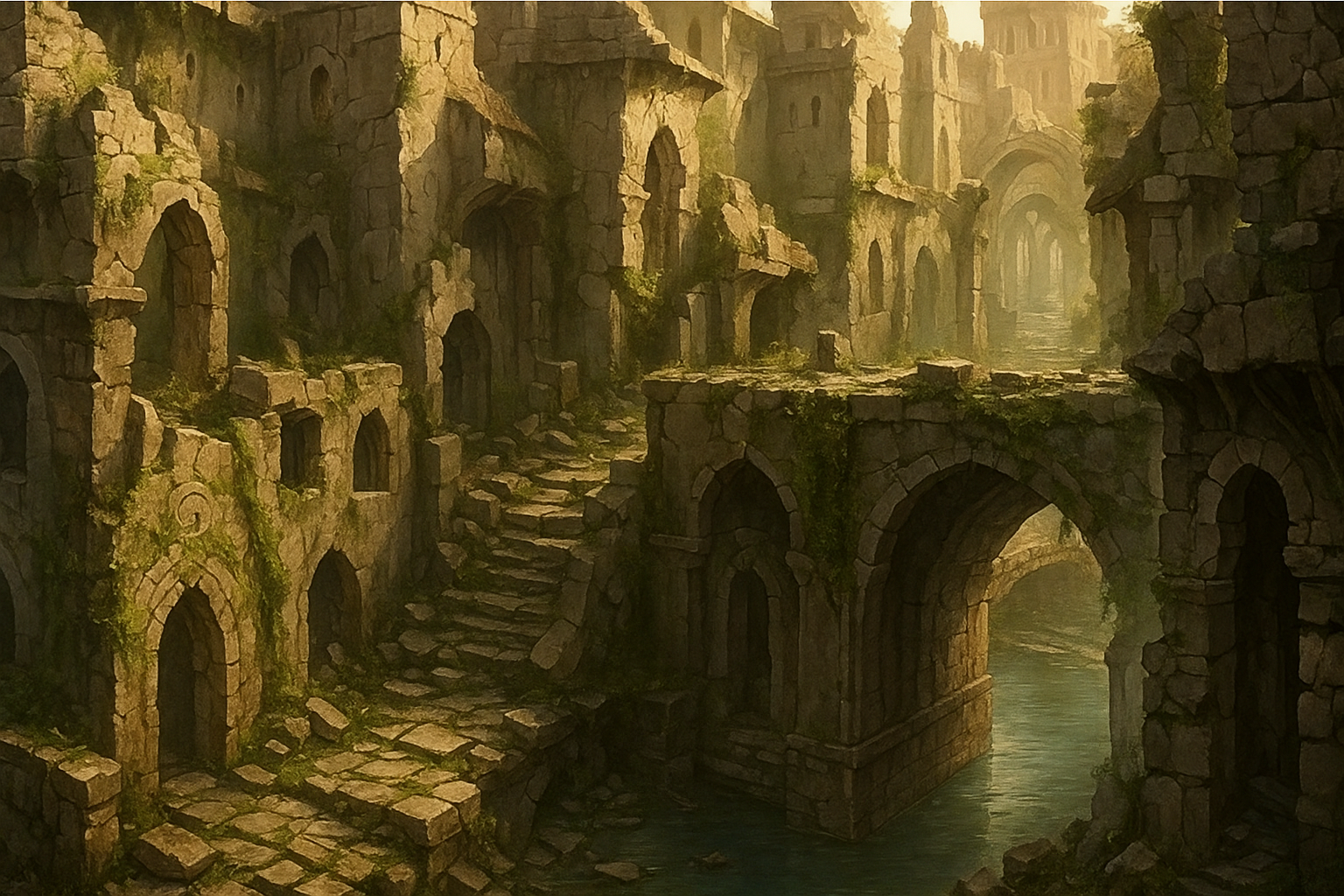
Saercumar
A City of Merchants
Saercumar was originally a small trading post that rapidly developed into a bustling city within a century. The city's leaders have ensured that the infrastructure is efficient and well-maintained to support the thriving trade.
Government
The city was initially ruled by a trade consortium, later the aristocratic oligarchy called the Ucbea governed it. The Ucbea divided the functions of government among the oligarchic families. The Posomati Tieiraci managed the courts and the judicial system, the Telvi Thelarii oversaw the treasury and financial system, the Pelai Drini were in charge of the docks and collection of customs on goods flowing through the city, the Wili Gaeni had control over the city watch and the jails, and the Obeccai Iali provided for the maintenance of the city's infrastructure.
The aristocrats were actively involved in overseeing their respective areas of government, but they relied heavily on professional civil servants to carry out the day-to-day tasks. The civil servants were responsible for all the mundane aspects of governance, such as collecting taxes and supervising jobsites where the city wall is being repaired, under the direction of the aristocrats.
This city's management approach worked well. All essential aspects were accounted for.
Defences
Fortifications
The city was protected by a massive stone wall, which was ten feet thick and thirty feet high. Along the top of the wall, there was a wooden walkway that is guarded by wooden embrasures. There were three gates that allowed entrance into the city: the Capital Gate, which was located on the eastern side of town, the Chalk Gate, which was located on the western side, and the River Gate, which connected the city proper to the Docks District. All three gates were usually open, but could be closed quickly if necessary. The city had two watchtowers, one on the northern side that stands at sixty-five feet tall and another on the southern side that stands at fifty-one feet tall.
Districts
Administrative District
This district had a focus on government and civil matters. It was also the home to the five Noble Houses, whose members were virtually the only residents of the district.
The Bastion
This massive fortress dominated the center of town. It was the home to the city's garrison and their training grounds. It was also the location of the Watchers' offices and the city jail.
Chalkhewer's District
Generally, this district was the homes and taverns of the city's chalk miners and loggers.
Docks District
This district focused on the river trade into, out of, and through the city.
This warren of fisher's homes and businesses lay outside the walls of the city proper, along the shoreline of the Abbavi River.
The Green
This vast expanse north of Empire Street from the Chalk Gate to the wall of the Northtower District was devoted to crops and grazing. The idea was that it would help provision the city in the event of siege.
Market District
This district was a hub for goods and services of a retail nature.
Merchant District
Like the Market District, this district was dedicated to business. Unlike it, the Merchant District focused on luxury goods, and commercial goods (wholesalers) and commercial services.
Northtower
This residential district was located on the north side of town and was home to many of the middle and lower class residents of the city.
The Travelers' District
This was a residential district. It got its name from the fact that it also was the locus of the city's hospitality industry.
Warehouse District
This district was butt-ugly. It was simply filled with warehouses for the goods that merchants and traders brought through the city.
The Westbottoms
The Westbottoms was an ad hoc communal area outside the city wall between the Cambacci River, the Chalk Gate, the Imperial Highway, and the Docks District, where newcomers lived until they established a more permanent home within the city walls (hopefully).
History
Mercantile Origins
In 1351 LE, a group of merchants calling themselves the Catena Wamur̂ Badirum (Prosperous People), founded a trading post where the Imperial Highway crosses the Balviar̂ at the Balviâr Confluence. The nexus of three navigable branches of waterway, as well as a maintained and guarded highway, made for ideal placement of such a settlement. It grew quickly and prosperously.
In 1374 LE, three members of the Catena Wamur̂ Badirum were discovered, each independently engaging in some form of corrupt business or government practices, all within a week of each other. The noble houses whose business thrived in Saercumar banded together and created a municipal legislature, backed by a small army of mercenaries in their employ for the purpose. They ousted the remaining members of the consortium, taking control of the municipal government themselves. They petitioned the Catbalus of Calpi to endorse their legislature, which they called the Ucbea. The Catbalus, controlled as it was by the same noble houses, immediately assented to their request and the government of the settlement fell to rule by the aristocracy.
Beginning in 1426 LE, Dragondust, an illegal narcotic, has been finding its way into the city. It is highly addictive and an underground black market has been established for the sale of it. It isn't clear who is driving this trade, or if they have motives beyond profit. A number of theories have been advanced, but no firm evidence exists of the why's and wherefore's.
In 1430 LE, a coven of powerful vampires attempted to take over the city. They were defeated in a bold counterattack aided by the Saints of Fate.
In 1431 LE, following the assassination of Qupinor Lâinus of Saercumar (formerly Lâinus Telvus Thelarius), Tola Eppova Qulila Ativia violated a direct command from the R̂oldavus. In retribution for her fiancee, Lâinus's, assassination, she razed the city, leaving none alive.
Maps
-

Saercumar
RUINED SETTLEMENT
16 Besped, 1431 LE

Comments