
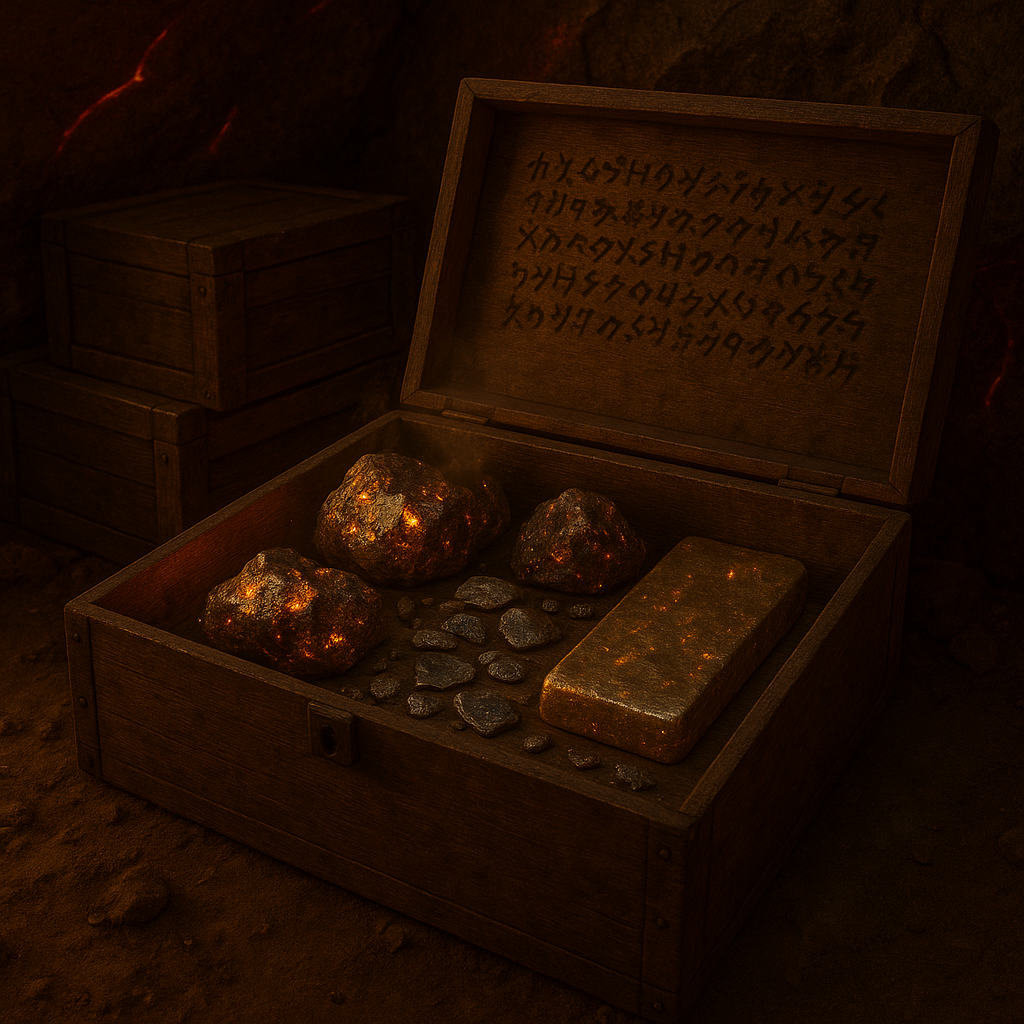
Ignissium
Properties
Material Characteristics
Gold appearance with ember-like nodules embedded throughout mottled, naturally occurring metal that smolders perpetually. Has a magical conductivity rating of 9 out of 10.
Physical & Chemical Properties
When coming in contact with water will create visually violent sparks that produce soft popping sounds but produces no heat or risk of fire. The metal is slightly warm to the touch even when subjected to extreme cold.
Geology & Geography
Originally unearthed in the heart of the Dormant Pyre, an extinct volcano in Steinflügel, Ignissium has since been discovered beneath most of Beaumont's topsoil layers. The ore is harvested using enchanted evaporation rigs and immediately sealed in insulated crucibles to prevent blinding sparks and excessive smoking.
History & Usage
History
Ignissium was discovered some time around the year 611 when explorers were investigating the throat of a dormant volcano. In the decade following its discovery Ignissium was found in every corner of Beaumont, leading eventually to the realization that the supercharged metal was actually a byproduct of the second Great Dying. Throughout the rest of the 7th century the material was renowned as "divine metal" causing its price to spike despite being common just beneath early Beau's feet.
Everyday use
Ignissium's unmeltable properties make it ideal for high-heat and high-friction applications such as eternal engines, beacon cores, BRN docents and sacred or eternal flames. Additionally, chipped and dusted Ignissium is a common ingredient in pyrotechnical devices such as fireworks, stage sparklers and airship afterburners.
Industrial Use
Ignissium is commonly acquired by the Beaumont Royal Navy for use in military craft, weapons and Pægan defense systems. Contracts are intentionally kept top secret but what information has been made public confirms the metal's use in heat shields, energy weapon barrels and conductors and exomachine cores.
Refinement
Ignissium can only be worked within suppression fields, ideally in evaporation chambers and shaped with graviton clamps. As long as the material does not come in close contact with pseudo or anti-gravitation applications, Ignissium will retain its refined shape indefinitely.
Byproducts & Sideproducts
While the sparks emitted from Ignissium are inert and pose no fire threat, they are capable of being captured in specialized chambers. These sparks can then be transformed into fire motes which are commonly used in consumer grade ever-burning candles, bulbs as well as weatherproof flashlights and lanterns.
Reusability & Recycling
Ignissium can be reshaped with the use of commercial graviton clamps but is unable to be recycled and is one of the only materials that cannot be alloyed with Tinverium.
Distribution
Trade & Market
Ignissium can be extracted by amateur and professional miners alike due to its abundance beneath topsoil. Due to this, market prices vary widely though most industrial and many commercial gravismiths will only accept material purchased wholesale.
Type
Ore
Value
3 silver per gram
Rarity
Very common
Color
golden with glowing spots
Melting / Freezing Point
Does not melt
Density
515 lb/ft³