
Fluxgold
Properties
Material Characteristics
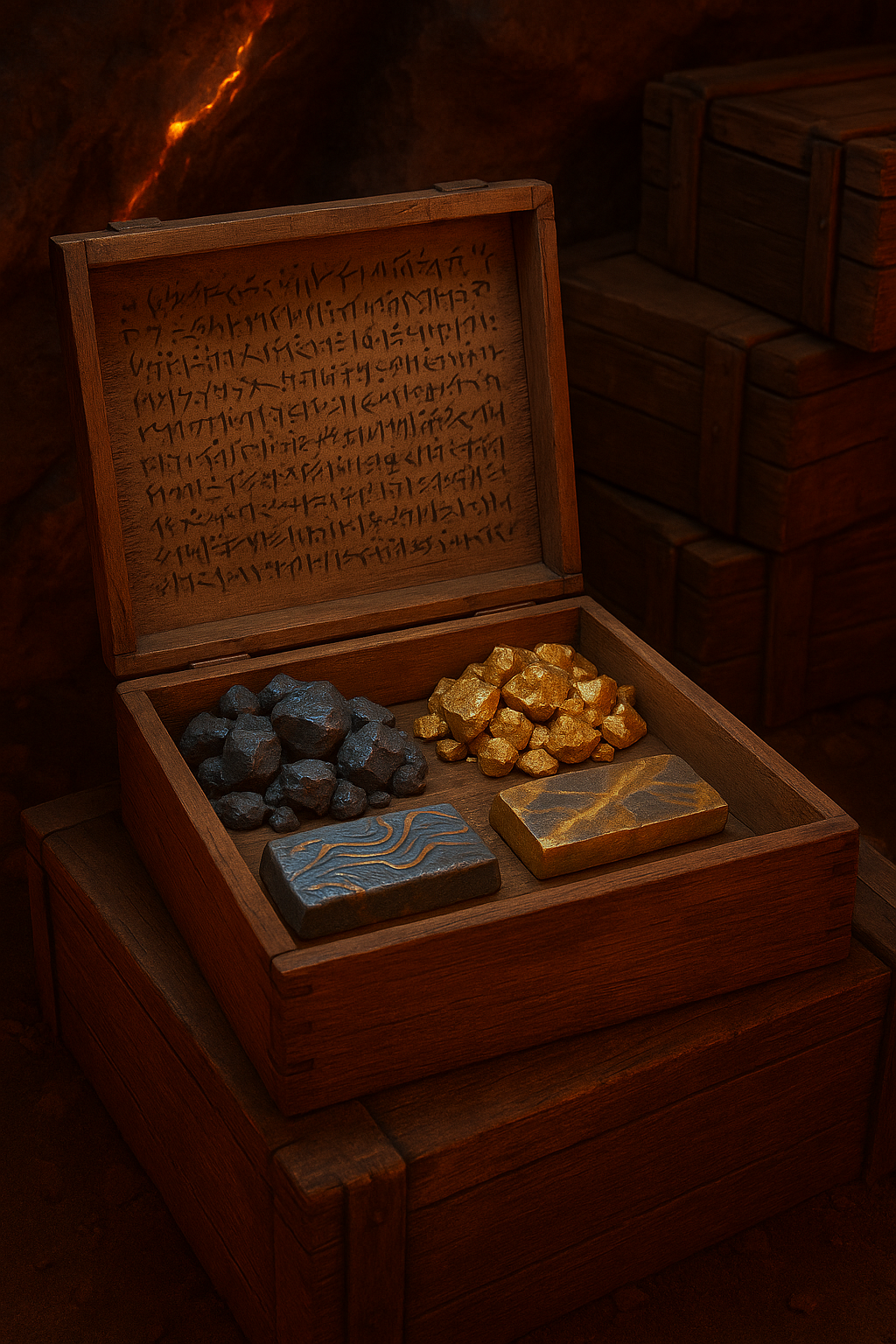
Golden semi-solid that hardens as it moves closer to its melting point, turns black if heat is cut before fully melting. Depending on the alloy structure, Fluxgold will either provide a rich golden hue or retain a darker, almost bluish hue. If not properly sealed after refining the material will separate and return to its natural state. Has a magical conductivity rating of 9 out of 10.
Geology & Geography
Harvested in Amberflow deltas of Beaumont's deserts, Fluxgold appears as liquid metal streaming through riverbeds during rare alchemical floods. Due to its density it often surfaces and requires limited to no excavation or mining.
History & Usage
Discovery
Fluxgold was discovered in 902 during the first recorded alchemical flood in Parodia which caused a gold rush to flock to the region. Beaus quickly discovered the material that rose to the desert surface was not gold however when local alchemist shops exploded in a violent matter, leaving craters in the desert floor still visible to this day.
Everyday use
Fluxgold is both highly conductive and very receptive to mana making it ideal for electromagical applications such as adaptive conduits, morphic seals, quantum computers and transformer relays.
Refinement
Fluxgold can be refined following most other alloyed materials' standards but must first meet its melting point otherwise it will revert to its raw form over time. Traditional refining techniques include phase‑stabilization with cryopyre runes and tiered thermal neutralizing.
Byproducts & Sideproducts
Glyph oil can be harvested from material improperly smelted which is sold to environmental alchemists who use the material to absorb mana spills. Recent studies in the past decades have attempted to convert glyph oil into glyphstones which have seen success in absorbing mana from manabogs.
Reusability & Recycling
Fluxgold is infinitely reusable when re-smelted however, due to its high melting point the alloyed material is always lost.
Distribution
Trade & Market
Fluxgold is typically sold in desert regions due to its availability in those regions. While improperly smelted Fluxgold has limited usage, niche markets seek out seeping materials for discount prices and commission high-temperate smiths to smelt pure bars for quick profits.
Type
Ore
Value
90 gold per gram
Rarity
Uncommon
Color
coal-black and gold
Melting / Freezing Point
5200° T
Density
1180 lb/ft³