
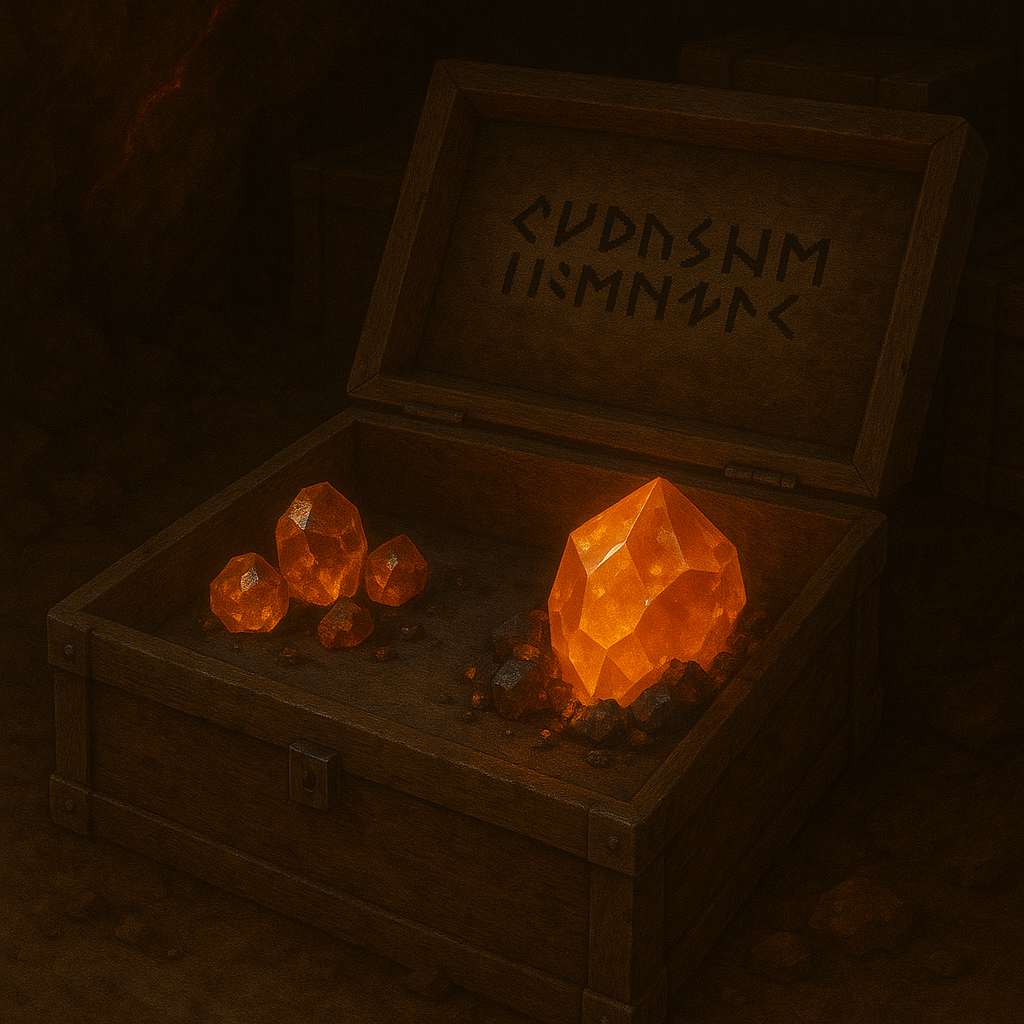
Cinderslag
Properties
Material Characteristics
Char-black ore veined with molten amber that glows from within, pulsing like trapped embers. Despite the amber-like parts of the ore appearing more mineral than ore, the two parts of the ore structure are chemically identical. Has a magical conductivity rating of 6 out of 10.
Geology & Geography
Cinderslag is excavated from any volcanic tunnels, summits or vents and does not vary in quality between active, dormant or extinct volcanoes. Cinderslag grows like crystalline amber around smoldering lava pockets and continually sloughs off slag, making its collection an ongoing but sustainable process.
History & Usage
Discovery
Cinderslag was an ore identified during the volcano delving escapades of the 7th century, specifically registered as a unique material in 609. Early Cinderslag harvesting included removing the crystal-like structures but was later reduced to harvesting the slag due to the remarkably short time between harvests if the central structure was left in-tact.
Everyday use
Cinderslag is well-regarded as a permanent solution to heat retention and is frequently found in BRN siegebreakers, high‑temperature industrial tools, magma skiffs. Residential uses include heat coils, boilers and furnaces, firerocks for fireless fireplaces and heat pearls made from pumice glass, a byproduct.
Industrial Use
Trains, subways, airships and busses often equip Cinderslag heaters for infinite, energy-free heating solutions. Larger cities and metropolises mix small amounts of refined metal into sidewalks, walkways and catwalks for frost-free and ice-free solutions.
Refinement
Cinderslag requires obsidian crucibles otherwise it is susceptible to premature bonding and can ruin furnaces with boil-over. Smiths hammer while it is still red‑veined to retain the signature amber glow, but buyers less concerned with the luster can request cold hammering to dull the metal to a charcoal black.
Byproducts & Sideproducts
Over-processed material creates beads of a pumice-like material called heat pearls which are sold for copper-on-the-pound as lightweight heat sources. In recent centuries, heat pearls have grown in popularity and are quickly becoming a side product of the already globally useful metal.
Reusability & Recycling
Cinderslag can always be re-processed to create heat pearls; scrappers often seek out the material to remelt for this purpose.
Distribution
Trade & Market
Cinderslag can be bought wherever common smithy supplies are sold though the quality of products vary depending on the recipients proximity to a volcano. Cinderslag is considered a seasonal ore and its price often increases during the off-season.
Type
Ore
Value
6 gold per gram
Rarity
Uncommon
Color
amber with jet-black lumps
Melting / Freezing Point
4400° T
Density
625 lb/ft³