

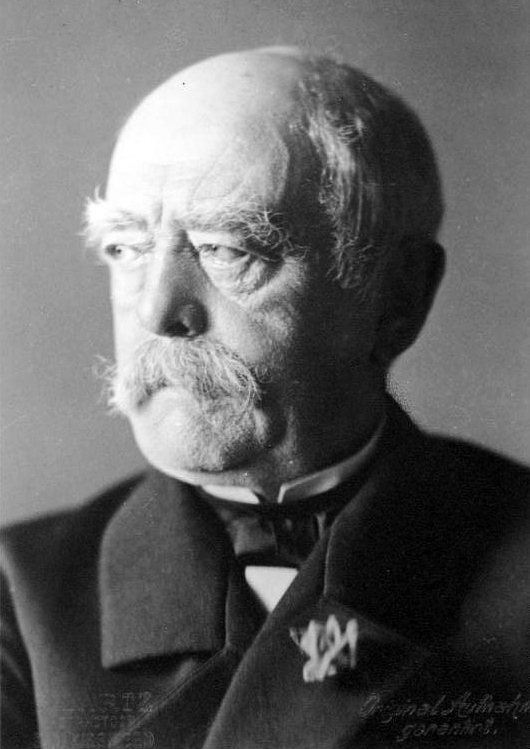
Otto von Bismarck
Otto von Bismarck was a Prussian politician, becoming the first Chancellor of the German Empire upon its declaration prior to the Berlin Conference in 1884 until his dismissal in 1890. He served the first three German Emperors.
Bismarck was the chief architect behind the formation of the German Empire, negotiating terms with Austria in regards to the Schleswig-Holstein War against Denmark. When that was finished, he declared the terms of the treaty broken by Austria, beginning the Austro-Prussian War. However, he did not anticipate Russia's involvement in the conflict. To compensate, he offered terms to Sweden, carving up the Baltic region. Prussia was successful, gaining prominence in Livonia, Courland, and Lithuania.
Following the war, when Prussia created the North German Confederation in 1867 with Bismarck as Chancellor. He attempted to reach across the aisle, to his counterparts in the South German Confederation. He met with Johann von Lutz, Minister-President of Bavaria and de facto Chancellor of the South German Confederation, assuring autonomy for Bavaria.
Bismarck made very considerable concessions to Bavaria, such as allowing Bavaria to retain their own postage and military, all of which would come under Prussian control only in times of war. He also painted Austria as the more unstrustworthy ally, as demonstrated by their involvement in the Ukrainian War. These terms were accepted, and the German Empire was declared prior to the Berlin Conference, with Bismarck as the first Chancellor.
"Be polite; write diplomatically; even in a declaration of war one observes the rules of politeness.Otto von Bismarck
During his service to Germany, Bismarck clashed with the brash Kaiser Wilhelm II. Bismarck championed what he termed "Realpolitik", wishing to maintain a delicate balance within Europe. Wilhelm, on the other hand, preferred a more forceful approach. These disagreements led to Wilhelm forcing Bismarck to resign.
Social
Reign
Preceeded by: Office Established
Succeeded by: Leo von Caprivi
Contacts & Relations
Wilhelm I
Friederich III
Wilhelm II


I love it, a great introduction to the man. Since you are an alternate history setting I do wonder if his near deathbed prediction will end up being as spot on as it was in real life, the infamous "some damn fool thing in the Balkans". The man was an impressive figure, truly one of those who can be held up as an example of the 'Great Person' theory of history, where sometimes there is just the person, larger than life for better or worse who in their moment truly basically pens the history books for a short time. I'd argue Bismarck was such a figure.
Yes, he definitely was, and if he hadn't been forced to resign by Wilhelm II, things could certainly have turned out differently. I like the quote ;).
Here are my Entries for the water continent Ulűri̋qi̋