

The Red Weeping
Among the fractured ice cliffs and volcanic scars of the Frostheim Mountain Range lies a phenomenon so unsettling, so starkly unnatural, that even seasoned explorers speak of it only with caution. Known as The Red Weeping, this waterfall of iron-rich, blood-colored meltwater emerges from beneath the permafrost of the northern slopes, staining the snow and stone in rusty rivulets that seem to bleed from the mountain itself.
The Red Weeping pours from a narrow crevasse halfway up the western face of Mount Torsten, of the infamous mountains known as The Triplets. At first glance, it resembles fresh blood cascading down ice—a sight that has given rise to dozens of legends among giants, trappers, and prospectors. In truth, most scholars speculate that the coloration comes from heavily-oxidized mineral outflow trapped beneath ancient glacial ice. Yet the flow’s warmth, the metallic tang in the air, and the way it pulses—stronger at certain lunar alignments—have led others to believe that the phenomenon is something far older and far stranger than geology.
The surrounding snowfields have been permanently stained a dull, ruddy hue, and the ground near the source never fully freezes, even in the deepest winter. As a result, the area draws unusual—and dangerous—wildlife year-round: frostboars, winter wolves, and even the occasional troll wander close, drawn by the warmth or curious about the scent. Giant clans of the Triplets consider the Red Weeping a place of omens, believing it to be the wound of a long-slain titan whose blood still seeps into the world.
Despite its foreboding appearance, the Red Weeping has become a minor destination for the boldest members of the Royal Society for the Exploration of the Natural and Physical World. Several expeditions have attempted to descend into the crevasse from which the Weeping flows, hoping to determine its true source. None have reached the chamber below; the ice tunnels shift unpredictably, and avalanches are common along the western face of Torsten. One team reported hearing “echoes” beneath the flow—hollow, resonant sounds like distant drums or heartbeats—though their instruments detected no seismic activity at the time.
For travelers, the Red Weeping serves as both warning and lure. It marks the border of troll and goliath territory, and many refuse to pass near it for fear of drawing the ire of the mountain’s inhabitants. Yet its eerie beauty—red water spraying against blue-white ice in the constant twilight of Northguard—makes it one of the most striking natural wonders in all of Kermoria.
Some claim the falls grow brighter during certain nights when Katamba hangs full in the sky. Others whisper that those who drink from the Weeping experience vivid dreams of figures walking beneath the ice. But all agree on one thing:
the mountain bleeds for a reason, and none alive today truly understand why.
The Red Weeping pours from a narrow crevasse halfway up the western face of Mount Torsten, of the infamous mountains known as The Triplets. At first glance, it resembles fresh blood cascading down ice—a sight that has given rise to dozens of legends among giants, trappers, and prospectors. In truth, most scholars speculate that the coloration comes from heavily-oxidized mineral outflow trapped beneath ancient glacial ice. Yet the flow’s warmth, the metallic tang in the air, and the way it pulses—stronger at certain lunar alignments—have led others to believe that the phenomenon is something far older and far stranger than geology.
The surrounding snowfields have been permanently stained a dull, ruddy hue, and the ground near the source never fully freezes, even in the deepest winter. As a result, the area draws unusual—and dangerous—wildlife year-round: frostboars, winter wolves, and even the occasional troll wander close, drawn by the warmth or curious about the scent. Giant clans of the Triplets consider the Red Weeping a place of omens, believing it to be the wound of a long-slain titan whose blood still seeps into the world.
Despite its foreboding appearance, the Red Weeping has become a minor destination for the boldest members of the Royal Society for the Exploration of the Natural and Physical World. Several expeditions have attempted to descend into the crevasse from which the Weeping flows, hoping to determine its true source. None have reached the chamber below; the ice tunnels shift unpredictably, and avalanches are common along the western face of Torsten. One team reported hearing “echoes” beneath the flow—hollow, resonant sounds like distant drums or heartbeats—though their instruments detected no seismic activity at the time.
For travelers, the Red Weeping serves as both warning and lure. It marks the border of troll and goliath territory, and many refuse to pass near it for fear of drawing the ire of the mountain’s inhabitants. Yet its eerie beauty—red water spraying against blue-white ice in the constant twilight of Northguard—makes it one of the most striking natural wonders in all of Kermoria.
Some claim the falls grow brighter during certain nights when Katamba hangs full in the sky. Others whisper that those who drink from the Weeping experience vivid dreams of figures walking beneath the ice. But all agree on one thing:
the mountain bleeds for a reason, and none alive today truly understand why.
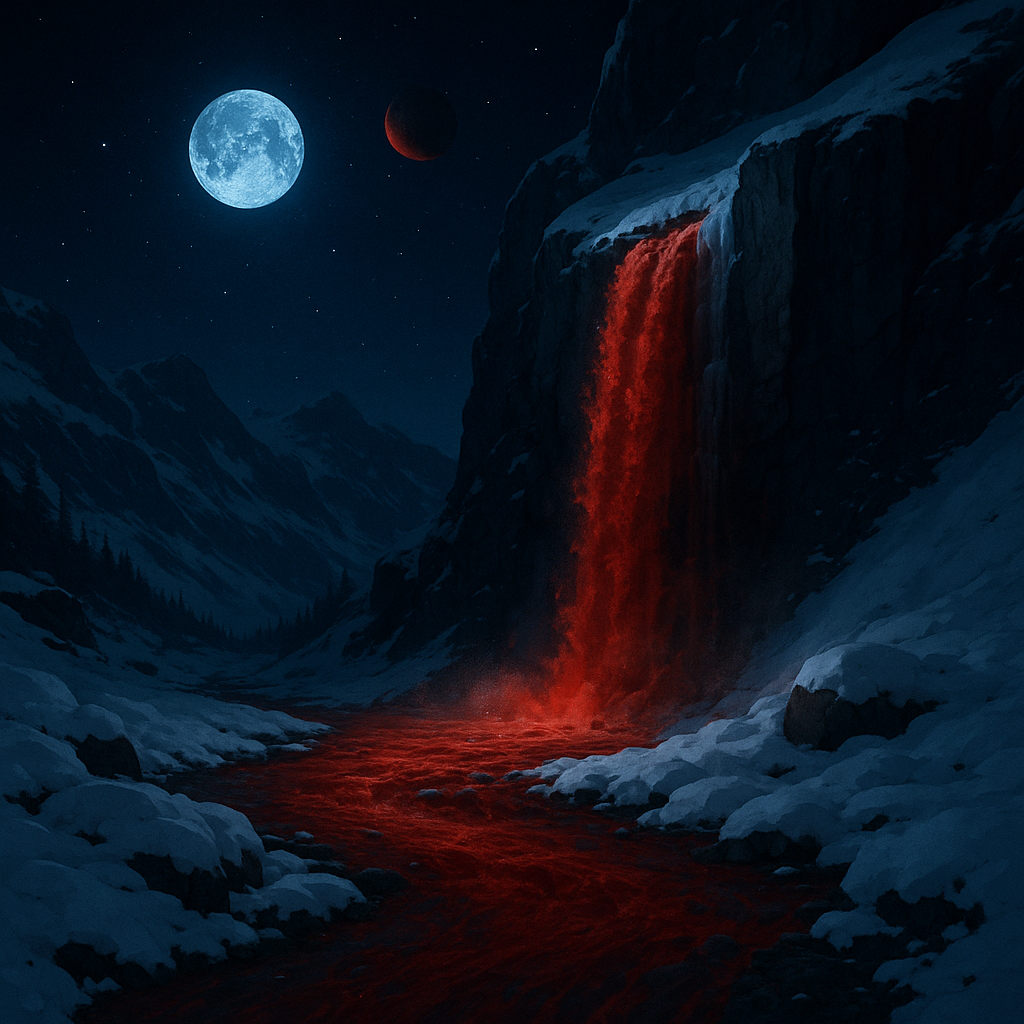
“The locals call it the Red Weeping, but standing before it under the triple moons… it felt less like a waterfall and more like the mountain itself remembering something it would rather forget.” -Victoria Pendrake
Type
Waterfall
Inhabiting Species

Comments