

Ironvein Remora
The Ironvein Remora is a pale, sightless crustacean-like parasite found clinging to the frozen cliffs and mineral-rich ice flows surrounding The Red Weeping in the Frostheim Mountain Range. These unsettling creatures thrive on the iron-saturated meltwater that stains the glacier, carving through ice with rasping mandibles to drink the warm, briny runoff at its source. Their segmented shells glow faintly red along the underplates, a result of long-term mineral absorption that gives them their name.
Though small and slow-moving in the cold, Ironvein Remoras are far from harmless. Drawn to heat and vibration, they will attempt to latch onto living creatures with unnerving determination, mistaking warm bodies for “mobile vents” of mineral-rich moisture. Their initial bite is rarely fatal, but their grip is shockingly strong, and their instinctive burrowing behavior has maimed more than one careless explorer. Found in clusters of three to six, these remoras are a constant hazard near the Red Weeping’s runnels and frozen pools—silent, sightless predators born of iron and ice.
Though small and slow-moving in the cold, Ironvein Remoras are far from harmless. Drawn to heat and vibration, they will attempt to latch onto living creatures with unnerving determination, mistaking warm bodies for “mobile vents” of mineral-rich moisture. Their initial bite is rarely fatal, but their grip is shockingly strong, and their instinctive burrowing behavior has maimed more than one careless explorer. Found in clusters of three to six, these remoras are a constant hazard near the Red Weeping’s runnels and frozen pools—silent, sightless predators born of iron and ice.
Basic Information
Anatomy
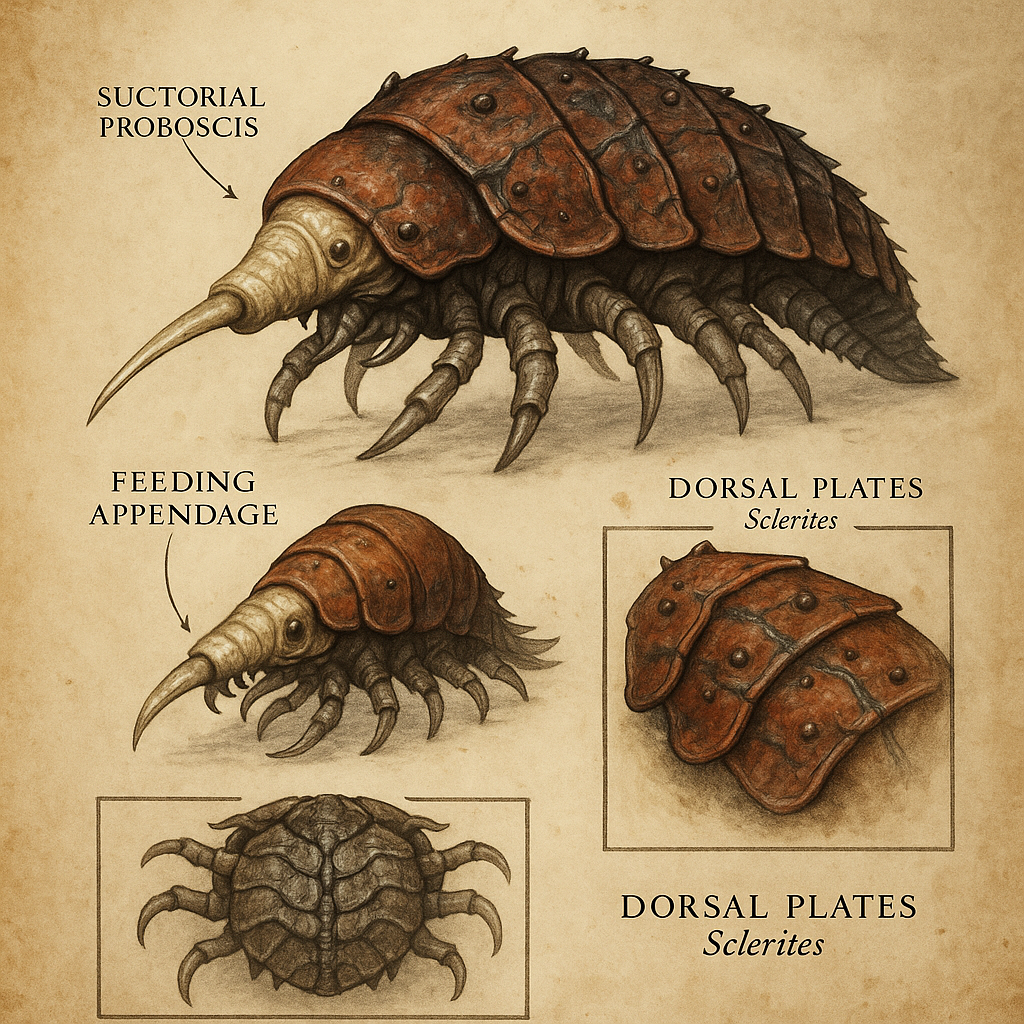
Ferriremora glacialis possesses a low, armored profile adapted to life clinging against ice, stone, and mineral-rich meltwater flows. Its body is divided into nine overlapping chitinous plates, each ridged and serrated, creating a natural rasping surface that helps the creature anchor itself to frozen surfaces even during heavy winds or shifting glacial movement. These plates are dull white on the exterior to blend with ice, but their underside glows a faint, ruddy red—bioluminescence created by iron-rich compounds circulating through translucent tissues just beneath the shell.
The remora has six short, powerful limbs, each ending in a three-pronged hook-like claw capable of puncturing ice as easily as flesh. The joint structure is surprisingly muscular for its size, allowing it to cling with tremendous force; a fully grown adult can support its weight inverted, even on glass-smooth ice. Beneath the armored plates lies a dense but flexible exoskeleton layer that flexes as the creature moves, giving it a disturbingly silent, gliding gait.
At the fore lies a triangular, eyeless head designed for parasitic feeding. A ring of sensitive setae detects heat and vibration, guiding the remora toward mineral-rich water or living hosts. The mouth consists of a pair of interlocking calcified mandibles shaped like curved, serrated chisels. These mandibles can carve shallow grooves in glacial ice within moments, or latch onto warm flesh with a vice-like grip. Once attached, a long, barbed hematophagic proboscis extends from within the mouth cavity, capable of piercing hide and drawing mineral-laden fluids or blood in equal measure.
Internally, Ferriremora glacialis houses a primitive but surprisingly efficient circulatory system, rich with iron-binding proteins that give its tissues their rust-red color. Its digestive tract is short and specialized, adapted to process both dissolved minerals and organic fluids with equal efficiency.
Though small—rarely longer than eight inches—their dense musculature and overdeveloped forelimbs make them far stronger than their size suggests. More than one explorer has underestimated a remora’s ability to anchor itself to a limb, only to discover its grip requires a crowbar—or an amputation—to break.
The remora has six short, powerful limbs, each ending in a three-pronged hook-like claw capable of puncturing ice as easily as flesh. The joint structure is surprisingly muscular for its size, allowing it to cling with tremendous force; a fully grown adult can support its weight inverted, even on glass-smooth ice. Beneath the armored plates lies a dense but flexible exoskeleton layer that flexes as the creature moves, giving it a disturbingly silent, gliding gait.
At the fore lies a triangular, eyeless head designed for parasitic feeding. A ring of sensitive setae detects heat and vibration, guiding the remora toward mineral-rich water or living hosts. The mouth consists of a pair of interlocking calcified mandibles shaped like curved, serrated chisels. These mandibles can carve shallow grooves in glacial ice within moments, or latch onto warm flesh with a vice-like grip. Once attached, a long, barbed hematophagic proboscis extends from within the mouth cavity, capable of piercing hide and drawing mineral-laden fluids or blood in equal measure.
Internally, Ferriremora glacialis houses a primitive but surprisingly efficient circulatory system, rich with iron-binding proteins that give its tissues their rust-red color. Its digestive tract is short and specialized, adapted to process both dissolved minerals and organic fluids with equal efficiency.
Though small—rarely longer than eight inches—their dense musculature and overdeveloped forelimbs make them far stronger than their size suggests. More than one explorer has underestimated a remora’s ability to anchor itself to a limb, only to discover its grip requires a crowbar—or an amputation—to break.
Biological Traits
Ferriremora glacialis exhibits surprisingly stable biological traits for a creature inhabiting such an extreme environment. Adults typically reach 6–8 inches in length, though some exceptional individuals grow as long as a foot, usually in deeper, hotter melt-channels closer to geothermal fissures. Their bodies are compact and heavy for their size, averaging 1–2 pounds, most of which is dense muscle designed for continuous clinging and rasping against ice or stone. Despite their brutish anatomy, remoras are long-lived for small crustaceans; specimens recovered from deep-ice cores suggest a natural lifespan of 12–15 years, with some elders surviving over two decades in sheltered subglacial cavities where predators are scarce.
Sexual dimorphism in the species is subtle but present. Females tend to be slightly larger, with broader abdominal plates to accommodate clusters of mineral-rich eggs, while males possess longer, more pronounced setae around the head—specialized sensory filaments used during mating chases beneath the ice. In rare “iron-bloom seasons” when minerals are especially concentrated, a small percentage of males develop vividly rust-red underplates, a coloration believed to be a mating signal rather than a survival trait. Juveniles resemble miniature adults but lack the hardened mandible ridges and bioluminescent underglow, which only emerges after their second molt.
Subspecies variation is minimal, though isolated pockets of remoras have adapted to specific meltwater chemistries. Those living near volcanic vents develop darker, basalt-colored plates, while individuals inhabiting pure glacial channels remain ghost-pale. These micro-adaptations do not appear to affect behavior, only appearance and tolerance to mineral saturation. Regardless of these differences, all remoras share one alarming trait: an instinctive attraction to warm, iron-rich fluids, whether they flow from stone… or from living flesh.
Sexual dimorphism in the species is subtle but present. Females tend to be slightly larger, with broader abdominal plates to accommodate clusters of mineral-rich eggs, while males possess longer, more pronounced setae around the head—specialized sensory filaments used during mating chases beneath the ice. In rare “iron-bloom seasons” when minerals are especially concentrated, a small percentage of males develop vividly rust-red underplates, a coloration believed to be a mating signal rather than a survival trait. Juveniles resemble miniature adults but lack the hardened mandible ridges and bioluminescent underglow, which only emerges after their second molt.
Subspecies variation is minimal, though isolated pockets of remoras have adapted to specific meltwater chemistries. Those living near volcanic vents develop darker, basalt-colored plates, while individuals inhabiting pure glacial channels remain ghost-pale. These micro-adaptations do not appear to affect behavior, only appearance and tolerance to mineral saturation. Regardless of these differences, all remoras share one alarming trait: an instinctive attraction to warm, iron-rich fluids, whether they flow from stone… or from living flesh.
Additional Information
Uses, Products & Exploitation
Ferriremora glacialis cannot be domesticated — their instincts override any attempt to control them — but their unique biology makes them objects of dangerous fascination. While their flesh is foul, the roe of gravid females is considered a rare northern delicacy, and their fluids and chitin are prized by alchemists for anti-freeze compounds and iron-binding properties. Harvesting them is perilous, however, and most sane people wisely leave the remoras clinging to the ice where they belong.
“I once believed Ferriremora glacialis to be merely an unpleasant curiosity—until one of the creatures affixed itself to poor Marrec’s wrist. We tried boiling water, alcohol, even fire. Nothing.”
“In the end, it took a crowbar, four very motivated friends, and a string of curses that would make a troll blush. Marrec lost two fingers and—by his own admission—his fondness for all crustaceans.”
“Should you encounter one of these ghastly things clinging to a glacier, my scholarly advice is simple: admire it from afar. If it admires you in return, run.”
— Victoria Pendrake, Notes from the Northern Marches
“In the end, it took a crowbar, four very motivated friends, and a string of curses that would make a troll blush. Marrec lost two fingers and—by his own admission—his fondness for all crustaceans.”
“Should you encounter one of these ghastly things clinging to a glacier, my scholarly advice is simple: admire it from afar. If it admires you in return, run.”
— Victoria Pendrake, Notes from the Northern Marches
Scientific Name
Ferriremora glacialis
Geographic Distribution

Comments