

The Maze
The Maze of Muspari stands alone on the desert flats southeast of the city proper, a hulking mass of sandstone walls etched with ancient sigils that shimmer faintly under moonlight. Though the great sandstone bulwarks of Muspari are carved with wards meant to repel fiend, celestial, and spirit alike, the Maze bears no such protections. Instead, it is a place where Musparans willingly surrender themselves to the whims of something older than their recorded history—a labyrinth that shifts without warning, breathes with the desert heat, and reacts as though it possesses a will of its own. To the Tribes, the Maze is not merely stone and shadow, but a living crucible through which every warrior must pass in order to be shaped.
Each night at sundown, the Tribes gather before the outer gates in solemn procession, bearing incense, weapons, and the ritual drums that keep time with their heartbeat. Through rites older than Muspari itself, the priesthood calls down both Celestial radiance and Infernal shadow, drawing spirits of Light and Dark into the twisting corridors beyond. To outsiders, this ritual seems like madness—summoning angels and fiends merely to battle them—but to the Musparans it is sacred duty. By overcoming beings of both purity and corruption, a warrior proves themselves capable of walking the delicate path between extremes. It is said that the Maze tests not strength alone, but courage, fear, pride, and sacrifice; no two warriors see the same halls, for the Maze shifts in response to the soul that enters it.
Those who emerge at dawn are forever changed. Some return bearing scars, visions, or newfound purpose; others stagger out only to collapse in exhaustion. Many never return at all, their bodies absorbed into the Maze’s shifting geometry or their spirits claimed by the powers summoned within. Yet to the Musparans, such fates are neither shameful nor tragic. The Maze is the heartbeat of their culture, a teacher, a judge, and a spiritual forge—one that shapes the warriors who defend the Jewel of the Desert. Few outsiders ever walk its corridors, fewer still survive, and none leave without understanding why Muspari holds the Maze as the holiest of its mysteries.
Each night at sundown, the Tribes gather before the outer gates in solemn procession, bearing incense, weapons, and the ritual drums that keep time with their heartbeat. Through rites older than Muspari itself, the priesthood calls down both Celestial radiance and Infernal shadow, drawing spirits of Light and Dark into the twisting corridors beyond. To outsiders, this ritual seems like madness—summoning angels and fiends merely to battle them—but to the Musparans it is sacred duty. By overcoming beings of both purity and corruption, a warrior proves themselves capable of walking the delicate path between extremes. It is said that the Maze tests not strength alone, but courage, fear, pride, and sacrifice; no two warriors see the same halls, for the Maze shifts in response to the soul that enters it.
Those who emerge at dawn are forever changed. Some return bearing scars, visions, or newfound purpose; others stagger out only to collapse in exhaustion. Many never return at all, their bodies absorbed into the Maze’s shifting geometry or their spirits claimed by the powers summoned within. Yet to the Musparans, such fates are neither shameful nor tragic. The Maze is the heartbeat of their culture, a teacher, a judge, and a spiritual forge—one that shapes the warriors who defend the Jewel of the Desert. Few outsiders ever walk its corridors, fewer still survive, and none leave without understanding why Muspari holds the Maze as the holiest of its mysteries.
Purpose / Function
To the Musparans, the Maze exists for a singular and sacred reason: to temper the soul. Its twisting corridors and shifting geometry are not obstacles but instruments—tools wielded by an intelligence older than even the desert sands that surround it. Every warrior who enters does so knowing that the Maze is not merely a physical place, but a spiritual crucible designed to strip away weakness, pride, and fear until only the truest nature of the individual remains. Through nightly trials against foes drawn from both radiance and shadow, Musparans seek to prove their worth not to gods, but to the Maze itself, whose judgment is held as final and absolute. This belief is so deeply rooted that a warrior who refuses the Maze’s test is considered untempered—unfinished—and unworthy of bearing arms in defense of the city.
Yet the Maze serves purposes far beyond personal refinement. It is the bedrock upon which Musparan society, religion, and governance rest. The priesthood claims that the shifting labyrinth is the physical manifestation of a cosmic truth: that all things must walk the narrow path between extremes. By summoning celestials and fiends into its depths each night, the Musparans re-enact a primordial struggle between Light and Shade, ensuring that neither force gains dominance over the mortal world. The Maze thus becomes a fulcrum—a place where cosmic tensions are bled off and balanced through ritualized combat. The tribes believe that if the nightly trials ceased, the desert itself would fall into disorder, the skies would darken, and the world would tilt irreversibly toward either blinding purity or suffocating corruption.
The Maze also fulfills an undeniably practical function. The warriors trained within its shifting halls are among the most disciplined and deadly fighters in all of Kermoria. Its unpredictable geometry hones instincts that no conventional training ground could ever replicate. A Musparan who survives a dozen nights in the Maze can navigate ambushes, illusions, magical distortions, and planar anomalies with ease—skills that have saved the city from invasion more than once. It is no coincidence that Muspari’s elite spear companies and dune skirmishers are feared across the Velakan Desert; they are shaped by a force that tests them more harshly than any mortal enemy ever could.
Finally, though few dare to say it openly, many scholars—both Musparan and foreign—suspect that the Maze’s purpose may be far older and more complicated than its current role as a proving ground. Its stone bears no tool marks, its inscriptions predate known Musparan script, and its foundations have never shifted despite centuries of desert storms that have swallowed entire caravans. Some claim the Maze was built during the earliest centuries of the Old World, before the great civilizations fell and the deserts consumed their bones. A handful of scholars go further, whispering that it might be the oldest still-standing structure on the continent—untouched, unruined, and somehow awake after ten thousand years.
If those theories are true, then the Maze’s original purpose may have had little to do with warrior trials, tribal religion, or Musparan tradition. It may once have been a fortress, a research engine, a prison, a planar anchor, or something far stranger. But whatever its creators intended, the Maze has long since become something more: a living covenant between the Musparans and the forces that shape the world. Its purpose endures not because it was written, but because it is lived—every night, in blood and light, until the sun rises once again over the endless desert.
Yet the Maze serves purposes far beyond personal refinement. It is the bedrock upon which Musparan society, religion, and governance rest. The priesthood claims that the shifting labyrinth is the physical manifestation of a cosmic truth: that all things must walk the narrow path between extremes. By summoning celestials and fiends into its depths each night, the Musparans re-enact a primordial struggle between Light and Shade, ensuring that neither force gains dominance over the mortal world. The Maze thus becomes a fulcrum—a place where cosmic tensions are bled off and balanced through ritualized combat. The tribes believe that if the nightly trials ceased, the desert itself would fall into disorder, the skies would darken, and the world would tilt irreversibly toward either blinding purity or suffocating corruption.
The Maze also fulfills an undeniably practical function. The warriors trained within its shifting halls are among the most disciplined and deadly fighters in all of Kermoria. Its unpredictable geometry hones instincts that no conventional training ground could ever replicate. A Musparan who survives a dozen nights in the Maze can navigate ambushes, illusions, magical distortions, and planar anomalies with ease—skills that have saved the city from invasion more than once. It is no coincidence that Muspari’s elite spear companies and dune skirmishers are feared across the Velakan Desert; they are shaped by a force that tests them more harshly than any mortal enemy ever could.
Finally, though few dare to say it openly, many scholars—both Musparan and foreign—suspect that the Maze’s purpose may be far older and more complicated than its current role as a proving ground. Its stone bears no tool marks, its inscriptions predate known Musparan script, and its foundations have never shifted despite centuries of desert storms that have swallowed entire caravans. Some claim the Maze was built during the earliest centuries of the Old World, before the great civilizations fell and the deserts consumed their bones. A handful of scholars go further, whispering that it might be the oldest still-standing structure on the continent—untouched, unruined, and somehow awake after ten thousand years.
If those theories are true, then the Maze’s original purpose may have had little to do with warrior trials, tribal religion, or Musparan tradition. It may once have been a fortress, a research engine, a prison, a planar anchor, or something far stranger. But whatever its creators intended, the Maze has long since become something more: a living covenant between the Musparans and the forces that shape the world. Its purpose endures not because it was written, but because it is lived—every night, in blood and light, until the sun rises once again over the endless desert.
Architecture
The architecture of the Maze defies easy classification, for it behaves less like a constructed edifice and more like a living organism shaped from stone. At its simplest, the Maze appears to be a vast labyrinth of sandstone corridors carved into the desert floor southeast of Muspari. Yet a closer inspection reveals no tool marks, no seams between blocks, and no identifiable joints—only continuous sweeps of stone that seem to have flowed into form like molten glass. Scholars speculate that the Maze was never built at all, but rather grown, sculpted by forces predating Musparan civilization. The sandstone walls are smooth as bone and warm to the touch, pulsing faintly during the height of night when the Maze shifts its internal structure. Tribesfolk speak of these pulses with reverence, claiming they are the Maze “breathing.”
Despite the permanence of its outer shell, the interior is in constant flux. At sundown each night, as the priesthood completes the summoning rites and the final ward of invitation is lifted, the Maze stirs. Walls slide noiselessly across the sand; floors tilt and relevel; archways vanish only to reappear in impossible orientations. It may contract into tight, twisting warrens one night and expand into cavernous halls the next. Some passages spiral in tight corkscrews that test endurance, while others stretch impossibly long—far longer than the Maze’s footprint should allow—creating the unsettling impression that the interior obeys rules beyond Euclidean space. Priests claim the Maze moves according to the spiritual needs of the tribes, forming paths tailored to the hearts of those who enter. Warriors learning to navigate its depths memorize dozens of “configurations”: the Twenty-Six Known Labyrinths, the Nine Uncertain Paths, and the dreaded Three Forbidden Forms, which even the priesthood hesitates to name.
Illusions are woven seamlessly into this architecture, blurring the boundary between physical structure and metaphysical test. A corridor may appear well-lit only to extinguish into utter darkness after three steps. A doorway may open into a familiar chamber—one the warrior knows they passed hours ago—yet subtle details will mark it as wrong. Some walls appear solid but melt under touch, revealing hidden passages; others appear open but will shatter bones like granite. The Maze conjures heat haze, mirages, phantom sounds, shifting shadows, and echoes of footsteps that are not one’s own. In the deeper sections, light bends in unnatural ways, creating spirals of shimmering air that disorient even seasoned tribesfolk. The Maze is notorious for generating “false companions”—illusions of one’s fellow warriors, companions long dead, or figures from childhood—each designed to test resolve, loyalty, or the ability to discern truth from deception.
Beyond mere illusions, the Maze is known to blur the border between planes. Certain chambers serve as stable anchor points for the celestials and fiends summoned nightly; others seem to drift in and out of adjacent realities. In these spaces, gravity may shift sideways, sound may lag behind speech, or the air may vibrate with unseen whispers. These planar anomalies give rise to the infamous Mirage Rooms, chambers where vision, magic, and even one’s own thoughts may be distorted. Some warriors describe standing in a corridor where their shadow is cast upward toward the ceiling, or witnessing flickers of impossible light that do not correspond to any celestial body in the night sky. The Maze uses these distortions to judge the adaptability and focus of those within, forcing them to trust not their senses but their training and will.
Despite the chaos within, certain architectural themes recur. The Pillars of Dawn, towering stone columns etched with ancient runes, are believed to mark the heart of the Maze. The Spearwalks, narrow elevated passages no wider than a man’s shoulders, test balance and courage. The Salt Rifts, fissures in the stone filled with crystallized white salt, disrupt extraplanar creatures and serve as defensive sanctums for exhausted warriors. The Mirror Halls are among the most feared sections, where the Maze conjures reflections of the challenger—some twisted, some aspirational, some wholly alien—to confront the inner self. No matter the configuration, every feature of the Maze exists to challenge a different facet of the soul: fear, temptation, pride, doubt, rage, compassion, loyalty, and resolve.
The entrance and exit of the Maze are fixed—massive bronze gates inscribed with wards of invitation and dismissal—but nothing between them is static. The walls bear subtle grooves, patterns, and sigils that seasoned warriors learn to interpret as “tells,” indicating potential shifts or identifying false paths. These markings are not carved by tools but appear naturally as the Maze evolves, suggesting that it communicates through geometry itself. Priests and scholars record these shifting patterns as scripture, believing the Maze speaks to the Tribes through these cryptic signs. Maze-runners often describe moments of sudden clarity where a sigil seems to glow faintly or a path “feels” correct, as though the Maze is guiding—or goading—them toward their next trial.
Ultimately, the architecture of the Maze is inseparable from its purpose. It is a living test, a place where stone responds to spirit and where the physical realm bends to reflect the shape of a warrior’s inner world. Every corridor, chamber, and shifting wall exists to measure the balance between Light and Shade within the heart. Musparans do not fear the Maze; they fear failing to understand it. For in its architecture lies the blueprint of their faith, the crucible of their society, and perhaps a whisper of ancient truths long buried beneath the desert sands.
Despite the permanence of its outer shell, the interior is in constant flux. At sundown each night, as the priesthood completes the summoning rites and the final ward of invitation is lifted, the Maze stirs. Walls slide noiselessly across the sand; floors tilt and relevel; archways vanish only to reappear in impossible orientations. It may contract into tight, twisting warrens one night and expand into cavernous halls the next. Some passages spiral in tight corkscrews that test endurance, while others stretch impossibly long—far longer than the Maze’s footprint should allow—creating the unsettling impression that the interior obeys rules beyond Euclidean space. Priests claim the Maze moves according to the spiritual needs of the tribes, forming paths tailored to the hearts of those who enter. Warriors learning to navigate its depths memorize dozens of “configurations”: the Twenty-Six Known Labyrinths, the Nine Uncertain Paths, and the dreaded Three Forbidden Forms, which even the priesthood hesitates to name.
Illusions are woven seamlessly into this architecture, blurring the boundary between physical structure and metaphysical test. A corridor may appear well-lit only to extinguish into utter darkness after three steps. A doorway may open into a familiar chamber—one the warrior knows they passed hours ago—yet subtle details will mark it as wrong. Some walls appear solid but melt under touch, revealing hidden passages; others appear open but will shatter bones like granite. The Maze conjures heat haze, mirages, phantom sounds, shifting shadows, and echoes of footsteps that are not one’s own. In the deeper sections, light bends in unnatural ways, creating spirals of shimmering air that disorient even seasoned tribesfolk. The Maze is notorious for generating “false companions”—illusions of one’s fellow warriors, companions long dead, or figures from childhood—each designed to test resolve, loyalty, or the ability to discern truth from deception.
Beyond mere illusions, the Maze is known to blur the border between planes. Certain chambers serve as stable anchor points for the celestials and fiends summoned nightly; others seem to drift in and out of adjacent realities. In these spaces, gravity may shift sideways, sound may lag behind speech, or the air may vibrate with unseen whispers. These planar anomalies give rise to the infamous Mirage Rooms, chambers where vision, magic, and even one’s own thoughts may be distorted. Some warriors describe standing in a corridor where their shadow is cast upward toward the ceiling, or witnessing flickers of impossible light that do not correspond to any celestial body in the night sky. The Maze uses these distortions to judge the adaptability and focus of those within, forcing them to trust not their senses but their training and will.
Despite the chaos within, certain architectural themes recur. The Pillars of Dawn, towering stone columns etched with ancient runes, are believed to mark the heart of the Maze. The Spearwalks, narrow elevated passages no wider than a man’s shoulders, test balance and courage. The Salt Rifts, fissures in the stone filled with crystallized white salt, disrupt extraplanar creatures and serve as defensive sanctums for exhausted warriors. The Mirror Halls are among the most feared sections, where the Maze conjures reflections of the challenger—some twisted, some aspirational, some wholly alien—to confront the inner self. No matter the configuration, every feature of the Maze exists to challenge a different facet of the soul: fear, temptation, pride, doubt, rage, compassion, loyalty, and resolve.
The entrance and exit of the Maze are fixed—massive bronze gates inscribed with wards of invitation and dismissal—but nothing between them is static. The walls bear subtle grooves, patterns, and sigils that seasoned warriors learn to interpret as “tells,” indicating potential shifts or identifying false paths. These markings are not carved by tools but appear naturally as the Maze evolves, suggesting that it communicates through geometry itself. Priests and scholars record these shifting patterns as scripture, believing the Maze speaks to the Tribes through these cryptic signs. Maze-runners often describe moments of sudden clarity where a sigil seems to glow faintly or a path “feels” correct, as though the Maze is guiding—or goading—them toward their next trial.
Ultimately, the architecture of the Maze is inseparable from its purpose. It is a living test, a place where stone responds to spirit and where the physical realm bends to reflect the shape of a warrior’s inner world. Every corridor, chamber, and shifting wall exists to measure the balance between Light and Shade within the heart. Musparans do not fear the Maze; they fear failing to understand it. For in its architecture lies the blueprint of their faith, the crucible of their society, and perhaps a whisper of ancient truths long buried beneath the desert sands.
Defenses
Unlike the fortified cities of the northern kingdoms, the Maze of Muspari boasts no battlements, no arrow slits, no towers, and no guardians stationed at its gates. It does not need them. The Maze’s only defense is itself—its shifting architecture, its maddening illusions, and the ancient, semi-sentient presence that dwells within its sandstone bones. Warriors do not speak of “entering” the Maze so much as being admitted by it, for every change in the Maze’s structure is deliberate, purposeful, and aware. To walk within its walls is to be judged by something older than the Tribes, older than Muspari, older perhaps even than the recorded ages of the world.
Musparan tradition teaches that the Maze’s protections arise not from mortal construction, but from pattern—the codified understanding of the ways its halls twist, reconfigure, and reveal their dangers. Over thousands of years, the priesthood has catalogued the Maze’s shifting behavior into what they call the Thirty-Eight Forms, arranged into three categories: the Twenty-Six Known Configurations, the Nine Uncertain Paths, and the dreaded Three Forbidden Forms. These distinctions are more than academic; they form the backbone of training, strategy, and survival within the Maze. Every warrior learns to recognize the subtle shifts in sound, air, and sensation that herald a form’s arrival, for to misread a configuration is often fatal.
The Known Configurations are patterns so frequently repeated that generations of warriors have internalized their rhythms and dangers. Forms such as the Ram’s Spiral, the Twin Crescents, the Hall of Breath, and the Eightfold Crossing are the backbone of martial instruction. Though always deadly, the Known Forms behave predictably enough that disciplined warriors can navigate them with practiced skill. Even so, the Maze seldom reveals a pure expression of any form; walls drift, illusions intrude, and planar echoes warp expected pathways. The Known Forms are familiar—never safe.
Far rarer and far more unpredictable are the Nine Uncertain Paths. These configurations appear irregularly, sometimes centuries apart, and never manifest identically twice. Scholars debate whether the Uncertain Paths are transitional states, unfinished thoughts of the Maze itself, or deliberate trials reserved for warriors who draw its particular attention. The Glassfall Corridor, the Veiled Turn, and the Ashen Wane are among the most frequently whispered of these forms, though survivors rarely agree on their details. Encountering an Uncertain Path is taken as a sign that the Maze is watching closely—whether with approval or hunger remains unclear.
The most feared manifestations of the Maze are the Forbidden Forms, configurations so extreme that the priesthood considers their arrival an omen. These are not trials; they are calamities, where the Maze ceases to test warriors and instead devours them. When a Forbidden Form manifests, the outer gates lock, the wards fall silent, and all intervention—mundane, magical, or divine—fails.
A hellish configuration drowned in blinding radiance, where sandstone glows like molten gold and air ripples with Celestial fury. Celestials summoned within the Sun’s Maw appear in states of uncontrollable zealotry, treating all mortals as impurities to be purged. It is said the Sun’s Maw does not test courage but humility, and that pride burns quickest of all.
A labyrinth of absolute shadow, where light falters, flame gutters, and fiends pour endlessly from smoke-filled fissures. Sounds distort wildly—some amplified to deafening echoes, others swallowed entirely. The Midnight Coil tests the warrior’s ability to resist despair, temptation, and the seduction of forbidden power. Those who survive speak of whispers that knew them better than they knew themselves.
The rarest and most terrible form is the Silent Shape—a null zone where magic fails, planar entities cannot manifest, and even the Weave feels distant. No illusions. No summons. No light. No sound. Only the Maze, and the warrior, and the crushing weight of absolute isolation. The Silent Shape tests nothing except identity—what remains when all power, faith, and purpose are stripped away. Many who enter it leave changed. Many do not leave at all.
Priests deny it. Scholars debate it. Warriors whisper of it only in private, when the desert winds are still. They say there exists a configuration that is not truly a maze at all: a straight corridor, bathed in soft light, with no threats, no illusions, and no twists. A simple walk from entrance to exit.
No one alive has seen it. No records mention it. But the legend persists.
Musparans claim that only a warrior who has achieved perfect balance—between Light and Shade, courage and fear, humility and strength—may glimpse the Lonely Path. They say it is not a trial but a farewell, walked by a soul that no longer needs to be tested.
Whether real or comforting myth, the Lonely Path is the only form the Maze would never use as a defense—for it is meant not to challenge, but to release.
Musparan tradition teaches that the Maze’s protections arise not from mortal construction, but from pattern—the codified understanding of the ways its halls twist, reconfigure, and reveal their dangers. Over thousands of years, the priesthood has catalogued the Maze’s shifting behavior into what they call the Thirty-Eight Forms, arranged into three categories: the Twenty-Six Known Configurations, the Nine Uncertain Paths, and the dreaded Three Forbidden Forms. These distinctions are more than academic; they form the backbone of training, strategy, and survival within the Maze. Every warrior learns to recognize the subtle shifts in sound, air, and sensation that herald a form’s arrival, for to misread a configuration is often fatal.
The Twenty-Six Known Configurations
The Known Configurations are patterns so frequently repeated that generations of warriors have internalized their rhythms and dangers. Forms such as the Ram’s Spiral, the Twin Crescents, the Hall of Breath, and the Eightfold Crossing are the backbone of martial instruction. Though always deadly, the Known Forms behave predictably enough that disciplined warriors can navigate them with practiced skill. Even so, the Maze seldom reveals a pure expression of any form; walls drift, illusions intrude, and planar echoes warp expected pathways. The Known Forms are familiar—never safe.
The Nine Uncertain Paths
Far rarer and far more unpredictable are the Nine Uncertain Paths. These configurations appear irregularly, sometimes centuries apart, and never manifest identically twice. Scholars debate whether the Uncertain Paths are transitional states, unfinished thoughts of the Maze itself, or deliberate trials reserved for warriors who draw its particular attention. The Glassfall Corridor, the Veiled Turn, and the Ashen Wane are among the most frequently whispered of these forms, though survivors rarely agree on their details. Encountering an Uncertain Path is taken as a sign that the Maze is watching closely—whether with approval or hunger remains unclear.
The Three Forbidden Forms
The most feared manifestations of the Maze are the Forbidden Forms, configurations so extreme that the priesthood considers their arrival an omen. These are not trials; they are calamities, where the Maze ceases to test warriors and instead devours them. When a Forbidden Form manifests, the outer gates lock, the wards fall silent, and all intervention—mundane, magical, or divine—fails.
The Sun’s Maw
A hellish configuration drowned in blinding radiance, where sandstone glows like molten gold and air ripples with Celestial fury. Celestials summoned within the Sun’s Maw appear in states of uncontrollable zealotry, treating all mortals as impurities to be purged. It is said the Sun’s Maw does not test courage but humility, and that pride burns quickest of all.
The Midnight Coil
A labyrinth of absolute shadow, where light falters, flame gutters, and fiends pour endlessly from smoke-filled fissures. Sounds distort wildly—some amplified to deafening echoes, others swallowed entirely. The Midnight Coil tests the warrior’s ability to resist despair, temptation, and the seduction of forbidden power. Those who survive speak of whispers that knew them better than they knew themselves.
The Silent Shape
The rarest and most terrible form is the Silent Shape—a null zone where magic fails, planar entities cannot manifest, and even the Weave feels distant. No illusions. No summons. No light. No sound. Only the Maze, and the warrior, and the crushing weight of absolute isolation. The Silent Shape tests nothing except identity—what remains when all power, faith, and purpose are stripped away. Many who enter it leave changed. Many do not leave at all.
The Rumored Thirty-Ninth: The Lonely Path
Priests deny it. Scholars debate it. Warriors whisper of it only in private, when the desert winds are still. They say there exists a configuration that is not truly a maze at all: a straight corridor, bathed in soft light, with no threats, no illusions, and no twists. A simple walk from entrance to exit.
No one alive has seen it. No records mention it. But the legend persists.
Musparans claim that only a warrior who has achieved perfect balance—between Light and Shade, courage and fear, humility and strength—may glimpse the Lonely Path. They say it is not a trial but a farewell, walked by a soul that no longer needs to be tested.
Whether real or comforting myth, the Lonely Path is the only form the Maze would never use as a defense—for it is meant not to challenge, but to release.
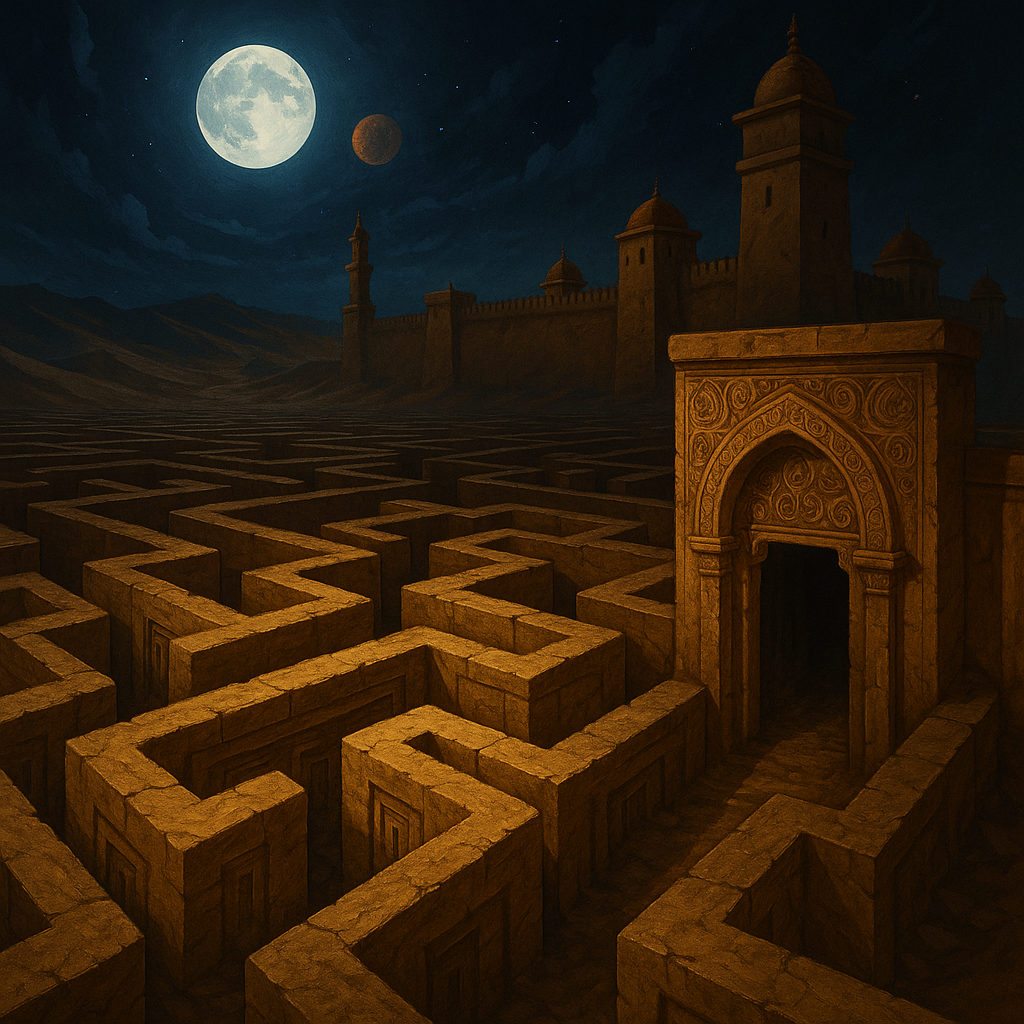
“I wasn’t permitted to set foot inside the Maze during my brief stay in Muspari—quite sensibly, I’m told, as I lack both the training and the requisite death-wish. But even from the outskirts, watching its walls shift like breathing stone, I understood why the tribes treat it not as a structure, but as a living covenant. No scholar truly observes the Maze; the Maze observes you.” - Victoria Pendrake
Founding Date
Unknown, but sometime in the earliest part of The Old World
Type
Battlesite / Battlefield
Parent Location

Comments