

Dunshade Manor
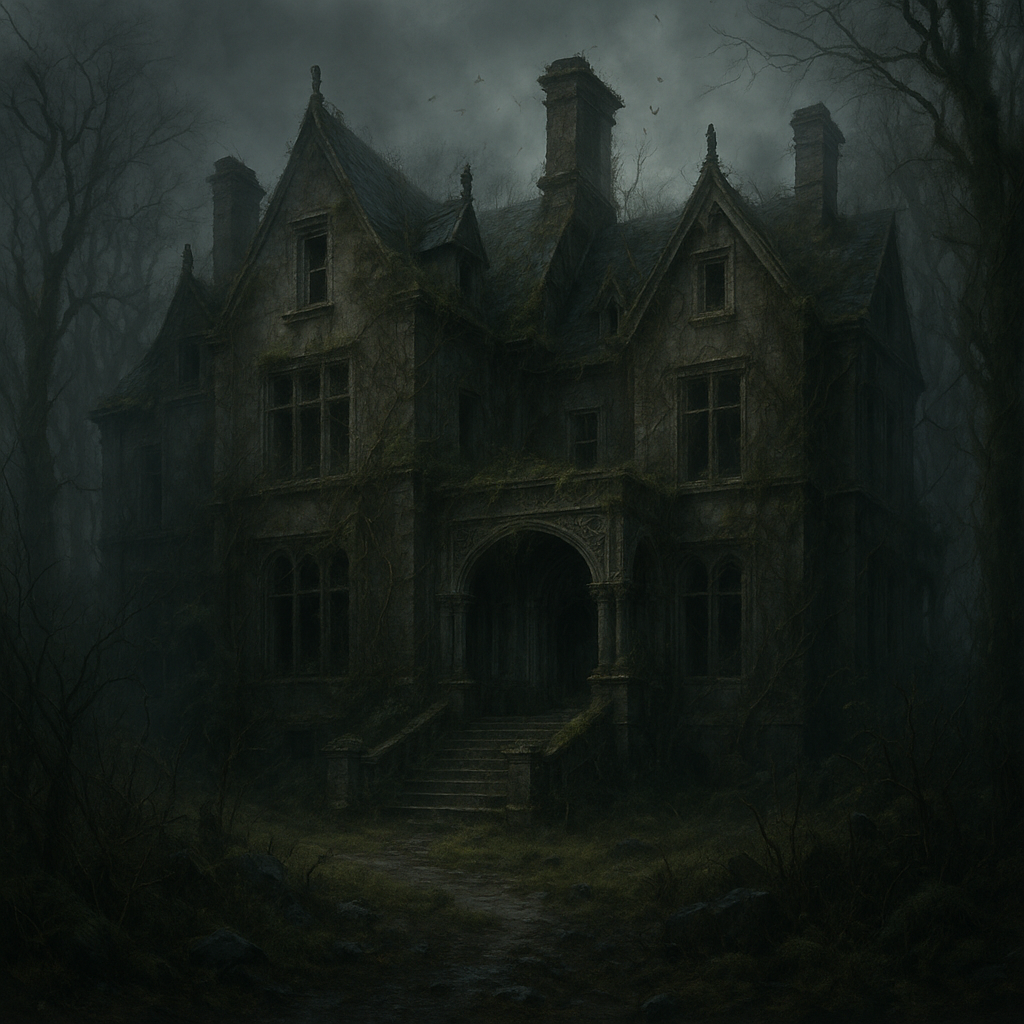
Dunshade Manor stands like a rotting wound at the heart of the Dunshade Moor, a blackened silhouette wreathed in perpetual mist. Once the estate of Lord Dunshade — the infamous vampire whose name has become synonymous with cruelty in Therengian folklore — the manor has long since been reduced to ruin. Its crumbling towers and collapsed wings are strangled by thorny briars, its windows gape like eyeless sockets, and the surrounding air carries the heavy stillness of a place that remembers too much.
Though the vampire lord was defeated generations ago, the manor never truly died with him. Superstitions cling to the ruins like fog to the moors; villagers swear they see figures in the windows, lights drifting through the halls at night, and shadows moving where none should be. The structure has partially sunken into the damp peat, its cellars now flooded and its great hall choked with moss, but somehow its presence feels unbroken — as if the land itself resents the intrusion of the living.
For those who venture inside, the manor is a labyrinth of shifting gloom. Some claim the interior changes with the mist: stairways that were open one moment are gone the next, and rooms seem to breathe and stretch as if the house were alive. It is said that Lord Dunshade’s crypt lies somewhere beneath the manor, and that the old vampire’s hatred lingers in the stone, feeding on the fear of those foolish enough to enter.
Though the vampire lord was defeated generations ago, the manor never truly died with him. Superstitions cling to the ruins like fog to the moors; villagers swear they see figures in the windows, lights drifting through the halls at night, and shadows moving where none should be. The structure has partially sunken into the damp peat, its cellars now flooded and its great hall choked with moss, but somehow its presence feels unbroken — as if the land itself resents the intrusion of the living.
For those who venture inside, the manor is a labyrinth of shifting gloom. Some claim the interior changes with the mist: stairways that were open one moment are gone the next, and rooms seem to breathe and stretch as if the house were alive. It is said that Lord Dunshade’s crypt lies somewhere beneath the manor, and that the old vampire’s hatred lingers in the stone, feeding on the fear of those foolish enough to enter.
Architecture
Dunshade Manor’s architecture carries the kind of quiet, arrogant grandeur that only the oldest forest estates can possess. It was never meant to be a fortress bristling with battlements or towers of war, but a manor of control and beauty, built to dominate the land softly, the way ivy conquers a stone wall. When it was whole, the manor was defined by its long galleries and its intimate relationship with the surrounding moor and forest — it wasn’t a structure set against the wilds but entangled with them.
The central hall remains the most striking feature even in ruin. Once an open-beamed space framed by vaulted wooden arches, it was designed to draw the forest inside — tall, narrow windows once filled with stained glass looked out into the fog-shrouded pines, and the polished limestone floors were set with a flowing mosaic of leaves and constellations. Today, those same arches are warped and split, moss growing along their grain. The stained glass has long since shattered, but the lead tracery still clings to the stone like the skeleton of a long-dead bird.
The eastern wing, partly collapsed into the wet peat, was built lower and more intimately: a series of solariums and reading halls facing what was once a carefully cultivated grove. Now that grove has grown wild, spilling back into the structure — birch roots pierce the paving stones, and entire trees rise through what were once drawing rooms. Visitors speak of wind sighing through these broken walls like voices in a language older than the Empire.
The western veranda tells another story: built of pale marble and slender colonnades, it overlooks what was once a reflecting pool and terraced gardens. The pool has become a stagnant black mirror, and the marble columns lean inward as though bending beneath the weight of centuries. In the moonlight, their reflected shapes blur with the mist, making it difficult to tell where the stone ends and the moor begins.
Beneath the manor, cellars and servant passages twist downward — less elegant but just as old. These were carved directly into the bedrock, lined with brick that has since cracked from frost and root intrusion. Some of these corridors are said to lead nowhere now, as if the house itself has sealed off parts of its past.
There is no single moment of ruin here; Dunshade Manor is slowly folding back into the land that bore it. The architecture was meant to impress without shouting — arches meant to frame fog, glass meant to catch muted dawn light, stone meant to hold the chill and the hush of the moor. What remains isn’t just a ruin; it’s a conversation between craft and decay, a house that is not so much abandoned as it is being gently, patiently reclaimed.
The central hall remains the most striking feature even in ruin. Once an open-beamed space framed by vaulted wooden arches, it was designed to draw the forest inside — tall, narrow windows once filled with stained glass looked out into the fog-shrouded pines, and the polished limestone floors were set with a flowing mosaic of leaves and constellations. Today, those same arches are warped and split, moss growing along their grain. The stained glass has long since shattered, but the lead tracery still clings to the stone like the skeleton of a long-dead bird.
The eastern wing, partly collapsed into the wet peat, was built lower and more intimately: a series of solariums and reading halls facing what was once a carefully cultivated grove. Now that grove has grown wild, spilling back into the structure — birch roots pierce the paving stones, and entire trees rise through what were once drawing rooms. Visitors speak of wind sighing through these broken walls like voices in a language older than the Empire.
The western veranda tells another story: built of pale marble and slender colonnades, it overlooks what was once a reflecting pool and terraced gardens. The pool has become a stagnant black mirror, and the marble columns lean inward as though bending beneath the weight of centuries. In the moonlight, their reflected shapes blur with the mist, making it difficult to tell where the stone ends and the moor begins.
Beneath the manor, cellars and servant passages twist downward — less elegant but just as old. These were carved directly into the bedrock, lined with brick that has since cracked from frost and root intrusion. Some of these corridors are said to lead nowhere now, as if the house itself has sealed off parts of its past.
There is no single moment of ruin here; Dunshade Manor is slowly folding back into the land that bore it. The architecture was meant to impress without shouting — arches meant to frame fog, glass meant to catch muted dawn light, stone meant to hold the chill and the hush of the moor. What remains isn’t just a ruin; it’s a conversation between craft and decay, a house that is not so much abandoned as it is being gently, patiently reclaimed.
History
Early Foundations
Long before it became a name of dread, Dunshade Manor began as a noble hunting estate in the outer reaches of what would become Therengia. Records from The Old World — fragmentary though they are — suggest the manor was commissioned by House Vahren in the early years of the First Imperial Expansion, when wealthy families carved estates from the wild to display their dominion over nature. The site was chosen deliberately: a high rise of earth in the middle of the moors, ringed by forest and overlooking ancient druidic standing stones that predated the Empire by centuries.
The original structure was elegant rather than defensive: vaulted galleries of pale stone, arched windows meant to frame the morning mists, and terraced gardens fed by rain channels and a reflective pool. Vahren was known for patronizing architects who built into the land rather than on top of it, which gave Dunshade its distinctive intertwined with the forest design. Even in its youth, the manor felt old — a deliberate affectation meant to evoke timelessness.
The Age of Opulence
For nearly two centuries, Dunshade Manor served as a retreat for nobility, scholars, and poets. Court records from Therenborough's predecessor capital, Throne City, speak of autumn festivals, masked balls, and lavish hunts across the moorlands. The gardens were renowned for their sculpted birches and moonlit ponds, and there are passing mentions in old journals of strange lights in the standing stones, which the family dismissed as swamp gas or poetic fancy.
But time eroded both the fortunes of House Vahren and the manor itself. When the bloodlines began to thin, the estate passed into the hands of lesser cousins, minor nobles more interested in spectacle than stewardship. Repairs slowed. The gardens overgrew their neat terraces. Parts of the eastern wing were allowed to sink into the damp earth rather than be raised again.
The Vampire’s Reign
Lord Dunshade appeared in this era of decline, a foreign noble whose origins are lost in rumor. Some claimed he was a distant Vahren cousin returned from exile; others whispered he had no bloodline at all, only a will to claim. He purchased the estate at a time when its windows were already cracked, the gardens choked, and the moors reclaiming what they once held.
Under Dunshade, the manor did not rise — it darkened. He preserved much of the structure’s original elegance, even expanded it below ground, carving crypts, cellars, and hidden galleries beneath the foundations. But he shuttered its windows and filled its halls with veiled servants and nightborn guests. The great hall that once opened to moonlight became a shadowed place of silk and silence, its grand celebrations warped into blood-drenched rites. Over a generation, the manor became synonymous with fear in the surrounding lands.
The Fall and the Slow Return
When Dunshade was finally defeated, the Empire made no effort to restore the manor. They left it to rot, considering the land tainted and unfit for habitation. But unlike castles built of hard granite, Dunshade was an estate of the forest — its stones porous, its beams wood, its gardens still living. Over the years, the forest crept inward. Walls buckled under creeping birch roots, roofs collapsed into mossy nests, galleries became overgrown tunnels.
And yet, the structure persists. The foundations remain firm beneath the moor, the architecture stubbornly holding shape even as nature gnaws at its bones. Travelers say the manor still looks “too deliberate” to be a ruin — as though the land remembers the shape it once took and refuses to let it fade entirely.
Legacy
Today, Dunshade Manor exists as a place between eras: neither alive nor dead, neither forgotten nor fully remembered. To some, it’s just a ruin wrapped in fog and superstition. To others, it’s a place where the past is still listening, still waiting to be disturbed. Its architecture whispers of old splendor, its ruins hint at lingering malice, and its very stones seem to breathe with the slow patience of a place that knows it will outlast them all.
Tourism
No sane soul seeks Dunshade Manor, but the moors don’t only draw the sane. A steady trickle of thrill seekers, wanderers, would-be heroes, and outright lunatics still find their way into the fog, compelled by rumor, greed, or some darker fascination. The journey itself is a warning — a narrow, half-forgotten road that dissolves into peat and briar, unmarked by milestones and never patrolled. Locals in Therenborough know better than to offer guidance, and those who claim to be guides are either desperate or mad.
The first and most common visitors are adventurers and treasure hunters. They come armed to the teeth, convinced the crypt beneath the manor still holds the vampire lord’s hoard. The stories are half-truths, warped by time: yes, Dunshade collected gold, jewels, and rare curiosities, and yes, the Imperial forces seized what they could. But whispers insist the greatest treasures — heirlooms, cursed relics, pieces of forgotten magic — were never found. Every expedition that vanishes only makes the rumors stronger.
Then come the scavengers and black marketeers. Dunshade’s name itself is worth coin; bits of stone chipped from the manor, scraps of embroidered fabric, rusted fixtures pried from the walls — all are hawked in smoke-filled basements as “authentic relics of the vampire’s court.” Most are worthless, but that hardly matters. The myth sells better than the truth. For some, picking apart the manor is a profession, a dangerous one with a high body count.
Far stranger are those who come not for gold but for the vampire. There exists, even now, a niche subculture of the morbidly curious: scholars and romantics who idolize Dunshade as a tragic figure, thrill seekers who want to stand where “a real vampire once walked,” and cultists who whisper prayers to something they hope still sleeps beneath the ruined halls. A few are simply foolish. A few are genuinely dangerous. Not all return from their vigils in the fog, and not all who return are entirely themselves.
And then there are the broken ones — doomsayers, spirit-talkers, amateur necromancers — people drawn to Dunshade Manor not by treasure or history but by the pull of a place that whispers to the wrong kind of heart. They arrive alone, carrying trinkets and charms and muttering half-remembered rites. Some are found days later, delirious and frostbitten, speaking of “voices in the stone” and “eyes in the halls.” Many more are not found at all.
No one visits Dunshade Manor by accident. Those who go know the risk, or are too enthralled to care. The moors offer no safety, the manor no welcome, and the Imperial crown pretends the place does not exist. Yet still they come, night after night, to scratch at the bones of a house that has learned how to wait.
The first and most common visitors are adventurers and treasure hunters. They come armed to the teeth, convinced the crypt beneath the manor still holds the vampire lord’s hoard. The stories are half-truths, warped by time: yes, Dunshade collected gold, jewels, and rare curiosities, and yes, the Imperial forces seized what they could. But whispers insist the greatest treasures — heirlooms, cursed relics, pieces of forgotten magic — were never found. Every expedition that vanishes only makes the rumors stronger.
Then come the scavengers and black marketeers. Dunshade’s name itself is worth coin; bits of stone chipped from the manor, scraps of embroidered fabric, rusted fixtures pried from the walls — all are hawked in smoke-filled basements as “authentic relics of the vampire’s court.” Most are worthless, but that hardly matters. The myth sells better than the truth. For some, picking apart the manor is a profession, a dangerous one with a high body count.
Far stranger are those who come not for gold but for the vampire. There exists, even now, a niche subculture of the morbidly curious: scholars and romantics who idolize Dunshade as a tragic figure, thrill seekers who want to stand where “a real vampire once walked,” and cultists who whisper prayers to something they hope still sleeps beneath the ruined halls. A few are simply foolish. A few are genuinely dangerous. Not all return from their vigils in the fog, and not all who return are entirely themselves.
And then there are the broken ones — doomsayers, spirit-talkers, amateur necromancers — people drawn to Dunshade Manor not by treasure or history but by the pull of a place that whispers to the wrong kind of heart. They arrive alone, carrying trinkets and charms and muttering half-remembered rites. Some are found days later, delirious and frostbitten, speaking of “voices in the stone” and “eyes in the halls.” Many more are not found at all.
No one visits Dunshade Manor by accident. Those who go know the risk, or are too enthralled to care. The moors offer no safety, the manor no welcome, and the Imperial crown pretends the place does not exist. Yet still they come, night after night, to scratch at the bones of a house that has learned how to wait.
“I once met a young woman in the Therenborough taverns with hands raw from digging through the peat around the manor walls. She hadn’t found gold. She hadn’t found Dunshade’s crypt. But she swore she heard a voice calling her name from inside the stone. ‘It’s not what you find there,’ she told me, ‘it’s what finds you.’” - Victoria Pendrake
RUINED STRUCTURE
The Old World
The Old World
Type
Estate
Parent Location

Comments