
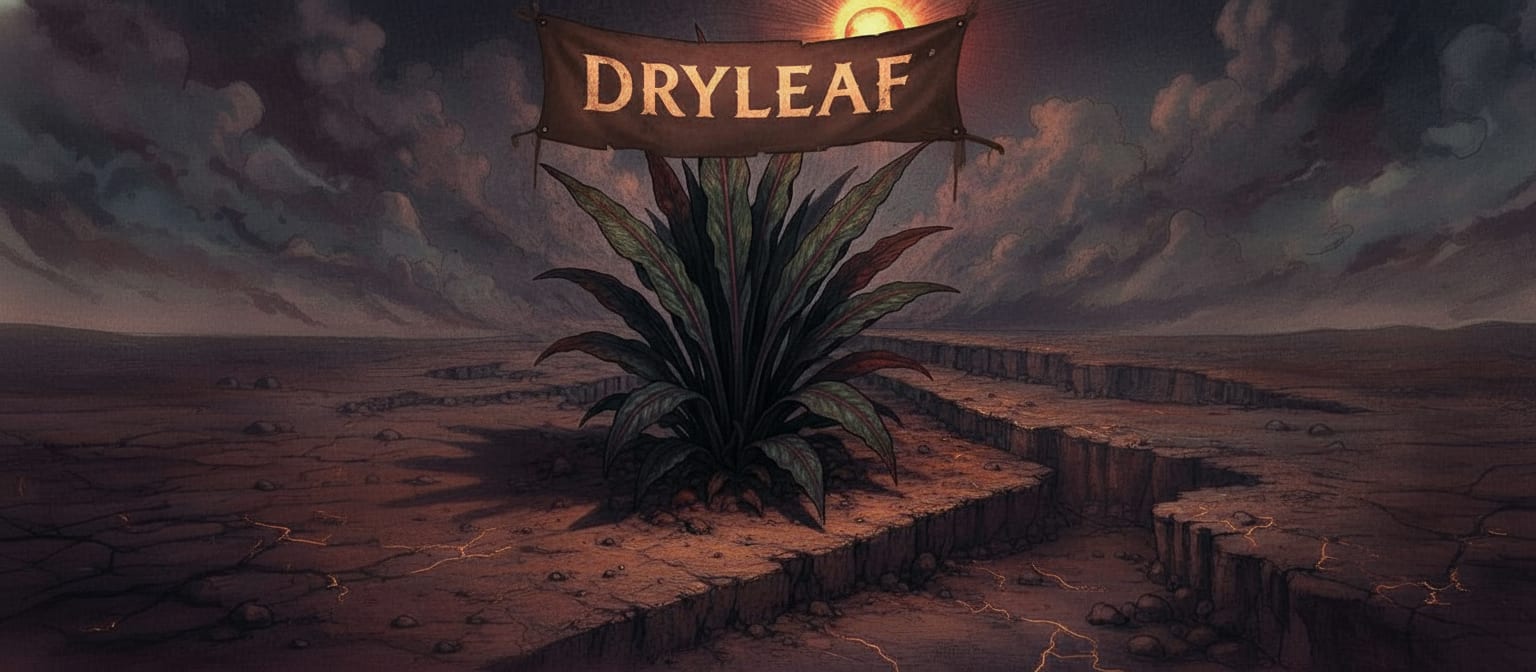
Dryleaf
Dryleaf is a medicinal and utility plant grown for its tough, fibrous leaves, which can be dried, ground, or steeped for teas, poultices, and simple remedies. It also serves as a minor flavoring herb and, in larger quantity, a raw material for rough, low-grade paper and binding cord.
Basic Information
Anatomy
Dryleaf forms low clumps of elongated leaves with a central rib and fibrous structure. Fresh leaves are leathery to the touch, with a dull, gray-green color. As the name implies, they dry readily once harvested, holding their shape and potency for long periods. The plant pushes up inconspicuous flower stalks when allowed to grow undisturbed, but most terrace-grown stands are harvested before it spends much energy on flowering.
Biological Traits
It can spread both by seed and by division of the root clumps. In Sameb, farmers often propagate it by breaking and replanting sections of mature plants because this is faster and more predictable than seeding. Seed lines are maintained in small plots for long-term security. The crop shows modest variation between lines—some lean more toward medicinal strength, others toward fiber quality.
Growth Rate & Stages
Dryleaf starts as a small rosette, then gradually builds a thicker crown of leaves over time. Growth is steady rather than fast, and it can be harvested leaf by leaf rather than all at once. If allowed, it eventually shifts energy into flower stalks and seed production, after which the central clump weakens and is usually replaced.
Ecology and Habitats
It prefers consistent but not excessive water and does well in beds that are slightly less enriched than those used for high-demand crops like Needlegrain. In Sameb, it’s often planted on terrace edges, paths, and marginal spaces where more sensitive plants would struggle. Outside of cultivated beds, it has limited staying power; without supplemental water, it slowly declines.
Biological Cycle
Dryleaf is perennial under ideal care but is usually managed as a short-lived perennial in Sameb, replaced every few years. Leaves are harvested throughout its life, and sections of the root mass are divided off to start new patches when older clumps get woody or sparse.
Comments