
Clayroot
Clayroot is a starchy root vegetable grown as a bulk calorie source alongside Needlegrain. It fills the role of potatoes or similar tubers in Sameb’s cuisine and stores well when kept cool and dry.
Basic Information
Anatomy
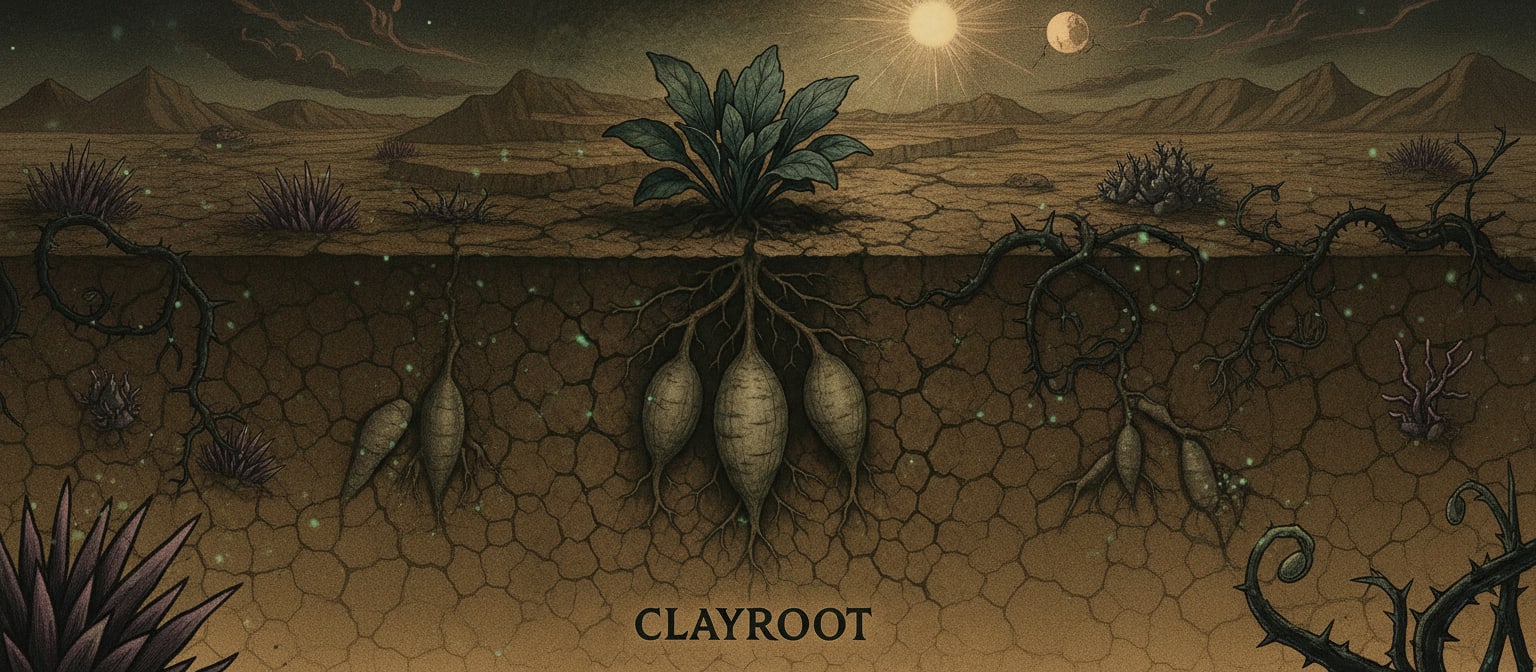
Above ground, Clayroot is unimpressive: a modest cluster of dull green leaves with a slightly bluish cast. Below the surface, it forms several thick, spindle-shaped roots with pale gray skin and off-white flesh. The texture is firm when raw, softening into a dense, slightly sticky consistency when cooked.
Genetics and Reproduction
Clayroot can be grown from seed, but in practice farmers usually propagate it vegetatively by planting cut sections of root that contain viable buds. This keeps traits consistent and speeds up establishment. Different lines exist with minor differences in flavor and storage life, but most of the variability is informal and family kept.
Growth Rate & Stages
The plant spends its early growth building leaf mass and fine roots. As the season progresses, it deposits energy into the storage roots, which gradually thicken. Harvest happens once the tops begin to yellow and collapse, signaling that the roots are mature. Enriched, irrigated soil allows a relatively quick turnaround compared to its original form, making it fit into Sameb’s tighter cycles.
Ecology and Habitats
Clayroot beds are kept deep and loose to allow the roots to expand. The crop handles heat reasonably well as long as the soil stays moist at depth, which the terraces and fertilizer support. It does not handle prolonged dryness or compacted soils; outside of managed beds, it quickly fails.
Biological Cycle
After harvest, smaller roots and fragments are kept for the next planting, while the main bulk is moved into storage pits or cool rooms. Fields are rotated to other crops to prevent soil exhaustion and reduce disease pressure, since continuous Clayroot planting in the same beds tends to invite rot.
Comments