
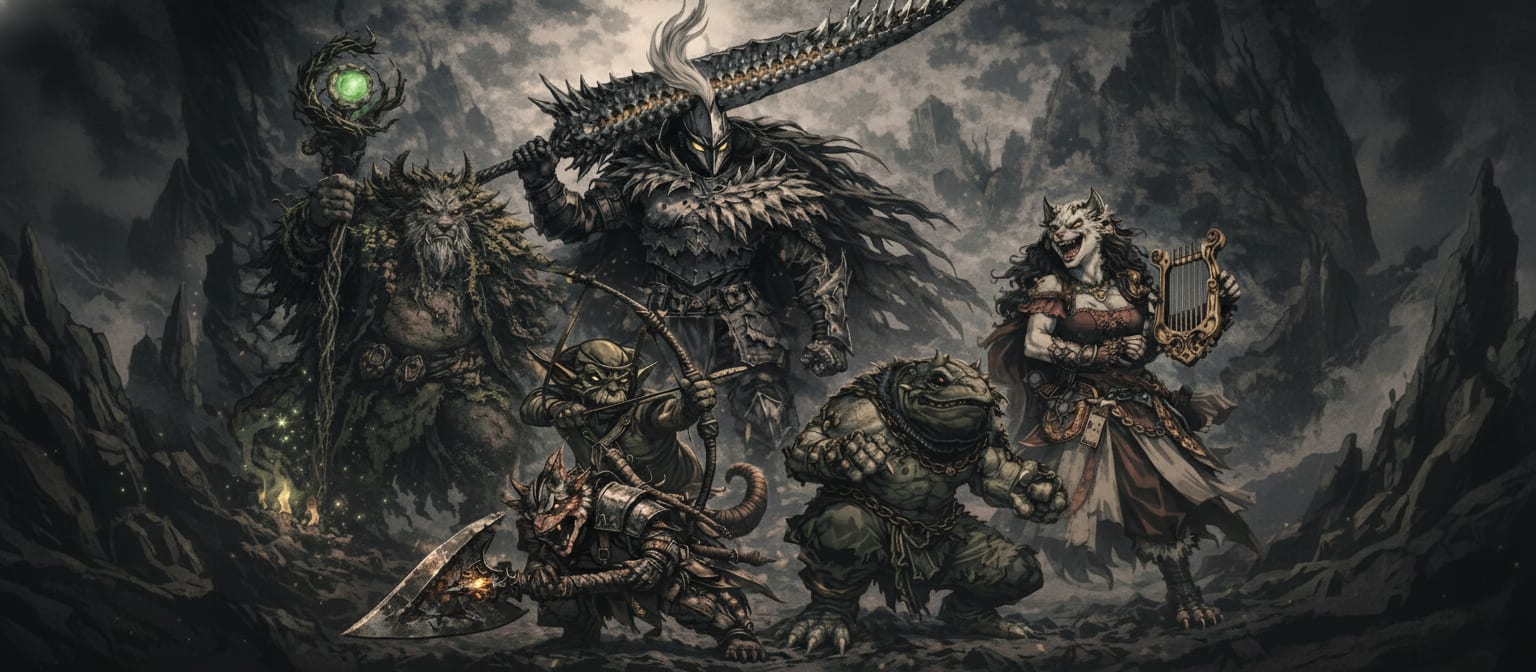
A Tale of Monsters
When the Abericlase fell and the territories went dark, it was adventurers who first went in search of answers, as they always had when the world presented a mystery sharp enough to wound it. Some were driven by coin, others by reputation, and more than a few by the simple refusal to remain idle while something vast and terrible reshaped the order of things. They entered the temples with the confidence born of long habit, believing that whatever lay beyond the sealed thresholds would, in time, yield to steel, magic, or resolve. None of them returned. Others followed in their wake, nonetheless, persuaded by rumor, pride, or the belief that failure was a flaw of execution rather than a warning. As years passed, the temple gates ceased to be places of anxious watching and became instead points of quiet record-keeping, where names were noted, crossed through, and set aside.
In Cabrycg, the capital of the Kragthor Territory it was eventually said that the fault might not lie in bravery at all, but in the expectations carried by those who entered. If the world had changed beyond recognition, then perhaps it was unwise to entrust its reckoning to those who still believed it could be reasoned with. It was in this pride the adventuring group known as the Second Measure was assembled: Skrit One-Eye, whose arrows were said never to wander; Heshka of the Broken Reed, who sang songs that unsettled even her own kind; Urum-Vel, a toad folk monk for whom patience was a discipline rather than a virtue; Mirefather Kol, a druid who listened for wisdom in decay; Rikkit Ash-Scar, whose anger had proved more reliable than mercy; and, at their center, a figure known only as Vellisar, encased in armor that seemed unwilling to remain still and bearing a weapon whose nature few cared to question. They were what was assembled to answer the call because if you can't send heroes to defeat monsters, then perhaps the answer was to send in something worse than the monsters. And so, they did. The group set out to Cerulea Tower in the Mystara Territory far north of the city they called home.
Days passed as the group traveled the well-trodden roads until one night it was cut short early because Skrit decided she did not like how sound was carrying. The ground still held firm where they made camp, though only just, and beyond the low rise the soil lightened in color and texture, as if it had been thinned rather than worn. The territory of Mystara lay ahead of them, close enough that even a party of monsters couldn't help but feel slightly on edge. The fire was built somewhat large and was almost too much in the heat of a warm summer's night as the symphony of insects slowly began as the sun dipped down behind the trees on the horizon. Rikkit chewed dried meat and complained quietly about the taste. Heshka tuned her harp, then untuned it again, then rested her chin on her hands and watched the sparks drift upward and vanish too quickly.
After a long while, Skrit stated, “We could still turn back.” No one answered immediately. It wasn’t a suggestion so much as a statement of fact, and facts did not require agreement.
Rikkit snorted. “You going to tell the city that? Because I’m not.”
“I didn’t say we should,” Skrit replied. “Just that we could.”
Heshka laughed softly, “I like that better than most speeches I’ve heard.”
Rikkit glanced at her. “You sing at funerals, don’t you?”
“Only the ones that don’t admit they’re funerals yet.”
Rikkit shook his head and spat into the dirt. “Figures. End of the world and we get a singer.”
Heshka’s grin widened. “You’re welcome.”
For a time after that, the fire was the only thing willing to make noise. It crackled softly, consuming wood that Kol had chosen with care, and the sparks rose just far enough to vanish into the dimness beyond the camp. Skrit watched the dark the way some people watched water, attentive to movements that might never come.
Urum-Vel shifted his weight, the motion so slight it barely registered. “Turning back,” he said, “is easier before the first wrong step.”
Rikkit snorted again. “Everything’s a wrong step to you.”
Before Urum-Vel could answer, metal moved and was just enough to remind them that Vellisar was there. The armor adjusted itself, plates settling as if the fire’s warmth had reached somewhere deeper than the surface. For a moment, no one spoke, and Skrit realized that until then, she had been unconsciously measuring the space where Vellisar sat, the way one does with something heavy resting on uncertain ground.
“We could turn back,” Vellisar said at last.
Their voice was quieter than Rikkit had expected. It was not hollow or distorted. It was more restrained, as if every word had been weighed before it was allowed out.
Rikkit blinked. “That’s it?”
Vellisar inclined their head a fraction. “Yes.”
Heshka studied them over the rim of her cup. “You sound like you’ve done that before.”
There was a pause. Long enough that Skrit wondered if Vellisar would answer at all.
“I have,” Vellisar said.
Kol, who had been listening to the soil with one hand pressed flat against the ground, looked up then. His eyes lingered on Vellisar longer than was polite. “And did it help?”
The armor stilled completely. Even the faint movements ceased.
“It changed what survived,” Vellisar replied.
Rikkit picked at a notch in his axe handle with his thumb. “That supposed to make me feel better?”
“No,” Vellisar said. “It is only meant to be true.” Urum-Vel inclined his head slightly, as if acknowledging a point made well enough. “Expectation shapes attention. Attention shapes outcome.”
Skrit exhaled slowly and nodded once, more to herself than to the group. “Then we’ll decide in the morning,” she said.
The fire burned lower. Somewhere beyond the edge of the light, the Mystara territory waited, neither urging them forward nor offering to stop them, content to let the choice belong to those foolish enough to believe it was theirs.
They entered the Mystara territory at first light. By the time Cerulea Tower rose before them, pale against a sky that refused to settle into any familiar hue, they no longer tried to measure how long they had been walking. Inside, there were no trials in the way stories used the word. No guardians stepped forward. No puzzles demanded cleverness. The space within the tower unfolded gradually, leading them inward without corners or thresholds they could point to afterward. At its heart, they were met not by a mechanism, nor by the Abericlase, but by someone that waited just for them. It spoke of the world not as something ruined, but as something incomplete, of the Abericlase not as an instrument of salvation or destruction, but as a conclusion long deferred, and of the suffering they knew not as an argument against ending, but as the cost of continuing. Nothing in what was said demanded belief and no amount of insight could prove otherwise. The terms were set plainly before them and asked whether they were willing to act upon them now that they understood the shape of the choice.
Once they withdrew there was no words spoken and no gesture agreed upon. They all simply turned and one by one found the way out and emerged from the temple, carrying a single coin that had been gifted to them. They all stood at the threshold of the tower still with no words spoken, but each of them had come to an understanding about what the world truly was. It was not something they were willing to finish, and this world was something that shouldn't be ended abruptly. All of the life that existed was not incomplete and it was a story that should continue on, regardless of what the gods wanted, after all...why would they care about saving the world and the words of gods...they were still monsters, and they had earned their existence.
Comments