
1st Regiment - "Zeus' Thunderclads"
“People call us fast because they see us arrive and watch the clock die. Speed is not the trick; discipline is. We train until the first thirty minutes are a promise we can keep half-asleep and bleeding, breach clean, open the corridors, take the crown, and hand the lodgment to those who must live there when we are gone. My Spartans are the point; our Myrmidons are the pressure that makes the point matter. If you are looking for applause, you will not hear it where we work. You’ll hear ventilators humming, water pumps kicking back on, a mother telling a child it’s over now. That’s our anthem. We do not worship violence; we arrange it so it ends quickly, lawfully, and leaves the world standing. The thunder is only a warning. The victory is the silence that follows.”
The 1st Regiment "Zeus' Thunderclads" is designed around the Thirty-Minute War, a living timer baked into every plan and practiced until it becomes reflex. Spartan assault elements strike the keystone at T+00, Myrmidon cadres flood the breach by T+07, civilian corridors open under shield and fire at T+15, and by T+30 the objective is neutralized or transferred to bastion forces. This tempo is not theater; it is Doctrine. The Regiment's education pairs bone-rattle evolutions, Drop sciences, multi-axis breaching, shipboard counter-boarding, with relentless legal tribunals, so muscle memory never outruns moral memory.
Thunderclad structures are built to arrive, rupture, and leave the place standing. Elite stacks, Griffons (Elite Infantry), Gorgons (Armor), Harpies (Aerial), Chimeras (Mechanized), Cerberi (Recon), and Pegasus (QRF), interlock as a single instrument. The Griffons seize the decisive rooms; Gorgons knit armor to infantry so the breach becomes a boulevard; Harpies cut the roofline and carve one-minute landing windows; Chimeras re-role vehicles mid-fight to keep momentum fed; Cerberi pre-position latches and deception nets; Pegasus ends the unforeseen inside the next minute. Every piece exists to keep speed lawful and sustainable.
Culturally, the Thunderclads believe speed is mercy and precision is justice. Their pre-assault rite, the Lightning Oath, binds mixed Spartan–Myrmidon teams into a single current: gauntlet to gauntlet, no speeches, no ceremony. Scars are kept visible on armor plates as receipts, not trophies; glory is measured in quiet corridors and lights that stay on. The Regiment rejects the lone-hero myth in favor of indispensable teams, and treats civilians not as terrain to navigate but as the point of the operation.
Operationally, the 1st Regiment is the opening line of many campaigns and the closing hand on many crises. They burn uncertainty out of the first hour so other regiments can write the rest of the day: Sentinels to hold, Hellraisers to raze what must end, Tempests to unmake resistance in the dark, Warbringers to turn doors into streets, and Wardens to fix the story so the war does not return. Wherever the thunder falls, the map gets simpler, the panic stops sooner, and the city wakes to a proper ending.
Sigil Meaning
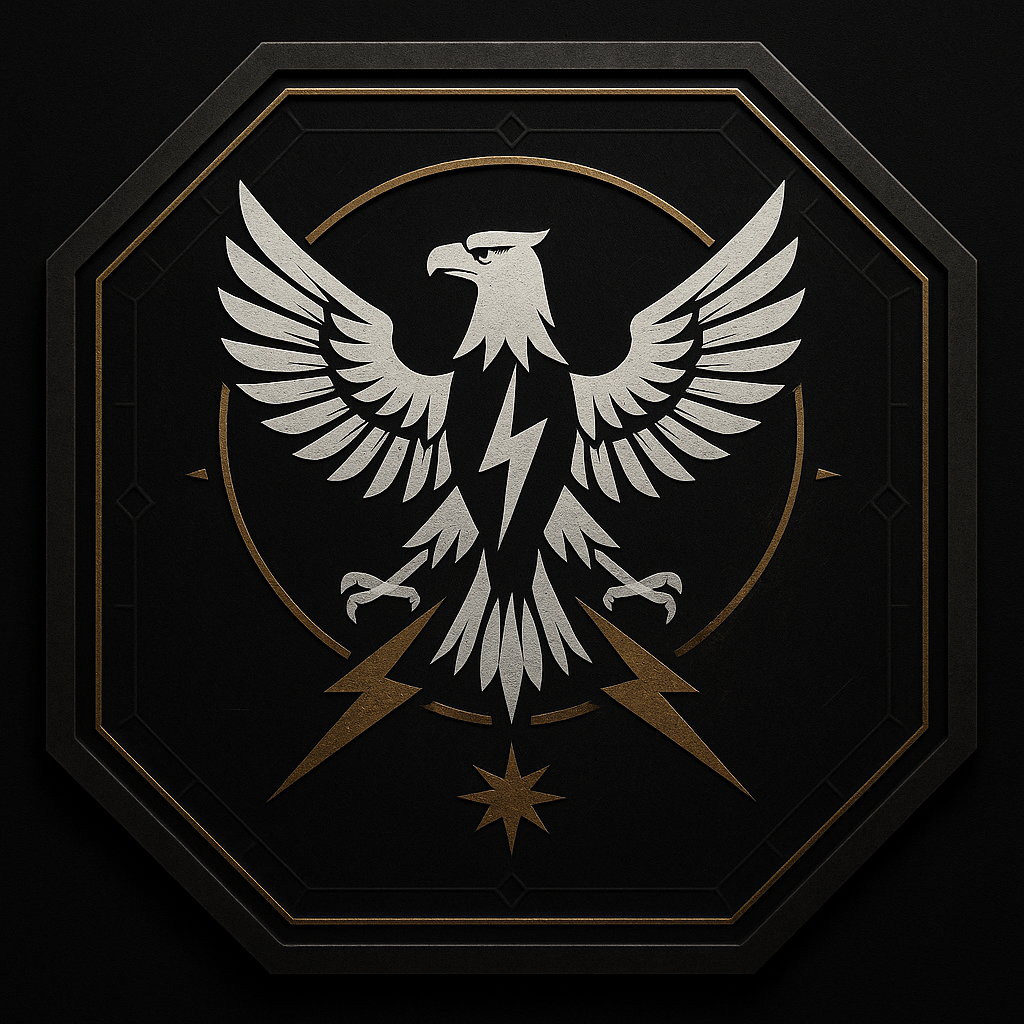
The Aetos Brontarch, "Thunder-King Eagle", is the Thunderclads made visible: lawful speed under sovereign authority. The octagon is the Regiment's bastion vow, enter, rupture, and leave the world standing, while its eight crenellations mirror the timed marks that govern every assault. The eagle is Zeus' herald and the Regiment's conscience: sight fixed, wings wide enough to shelter a corridor, claws heavy with the two duties of the Thunderclads, strike true and protect passage. The white spine down its breast is restrained and made radiant; the gold bolts promise decisive violence bounded by the Law of War and Flame. When this sigil appears on hull or pauldron, it needs no motto: those who see it learn to move, those who oppose it know to stop.
Structure
The 1st Regiment, known across the Regime as "Zeus' Thunderclads", stands as the vanguard of Task Force Eclipse, a myth-wrapped spearhead formation that turns the silence of orbit into the roar of conquest. Where they fall, empires fracture. Commanded by Chief E146 "Zeus" David Reilley, these Spartans and their bonded Blackguard Myrmidons embody the Regime Doctrine of precision dominance, executing decapitation strikes, high-orbit rapid assault, and breach-level battlefield disruption with surgical finality.
Within the Dawns March Defense Force, Thunderclads are the embodiment of the first blow, final blow combat ethos. Trained not for drawn engagements but decisive ruptures, they specialize in operations where speed, control, and the absolute destruction of Enemy C2 (Command & Control) are the only acceptable outcomes. In many theaters, the mere confirmation of Thunderclad descent triggers Enemy evacuation before the first Drop pod breaches atmosphere.
I. Hierarchical Framework
The Thunderclads operate under a streamlined combat hierarchy refined by operational necessity and spiritual cohesion. Each tier is designed to reinforce the Codex of the Black Sun's principle of unity above Division, ensuring battlefield discipline without sacrificing maneuver fluidity.
- Regimental Commander (RCOM): Supreme authority in-theater. Issues operational mandates and Mission Doctrine.
- Executive Command Officer (ECO): Handles real-time tactical execution, supply routing, and unit redeployment.
- Strategic Coordination Officer (SCO): Oversees orbital-to-ground synchronization, including Fleet integration.
- Tactical Engineering Officer (TEO): Designs entry vectors, breaching patterns, and environmental warform deployment.
- Blackguard Command Strategos (BCS): Oversees all Myrmidon and Epilektoi operations, coordinating their full integration with Spartan teams.
These roles are not symbolic; each officer leads from the field, and every title is earned under live fire.
II. High Command Integration
- Regimental Commander: Chief E146 "Zeus" David Reilley
- Oversees all strategic planning, moral enforcement, and large-scale deployment rhythm. His presence in the field stabilizes entire theaters of war, embodying the DMDF's ultimate martial promise.
- Executive Command Officer: Chief E172 "Griffin" Sylas Korrin (Spartan-III)
- A master of tempo warfare, Griffin executes Zeus's operational designs with clockwork discipline, ensuring Spartans and Myrmidons strike as a single organism.
- Strategic Coordination Officer: Chief E218 "Talon" Alexia Verryn (Spartan-IV)
- Talon manages the intersection between Fleet support, orbital insertion, and real-time threat adaptation. Known for executing entire planetary entry sequences with zero ground casualties.
- Tactical Engineering Officer: Chief E215 "Daedalus" Loric Teyne (Spartan-IV)
- A genius in environmental warfare, Daedalus adapts terrain, structure, and atmosphere into tools for domination; his breaching simulations are studied across Regime academies.
- Blackguard Command Strategos: Strategos-Primus Adrastos Veyrion (UCG Regime Rank: Magister Auctoritas)
- Leads all Blackguard Myrmidons and Epilektoi forces within the Regiment. He forges discipline through fire, overseeing every Myrmidon bonded to a Spartan unit, and ensuring absolute doctrinal unity with the Codex Juris Bellum.
III. Unified Combat Command Integration
The Thunderclads are classified under "Rapid Shock Convergent Assault" under the UCC framework. Their operations are woven across all combat domains:
- Naval Command: Operates in tandem with Orion-class Assault Carriers and Legion Dreadnoughts. Thunderclad descent is continuously coordinated with MAC support and orbital Fleet silence strikes.
- Aerospace Command: Thunderclads use precision graviton-locked descent pods, escort Titans, and pre-insertion aerospace clearance by Wraith-class fighter wings.
- Special Warfare Coordination: Epilektoi are embedded in every fireteam, ensuring zero tactical collapse and rapid recovery from irregular engagements or counter-infiltration.
Command-level officers within the UCC recognize Zeus' Thunderclads as the scalpel during war's heartbeat, surgically cleaving apart Enemy resistance while leaving no seams exposed for counterplay.
IV. Regiment Structure
Each brigade of the Thunderclads is named after a mythic beast of Greek legend, creatures associated with power, momentum, or heavenly wrath.
Brigade Configuration
- Elite Infantry – Brigade "Griffons"
- Rapidly deployed heavy assault teams, clearing fortifications and choke points. Grounded in Spartan-Epilektoi paired fireteams.
- Armor – Brigade "Gorgons"
- Titan-integrated war columns with reactive-plating tanks, breach walkers, and mechanized breachers. Specializes in shatterpoint siege tactics.
- Aerial – Brigade "Harpies"
- Valkyrie-class dropships and Stormtalon gunships transport Spartan–Myrmidon strike packs. Operate in direct conjunction with aerospace suppression sweeps.
- Mechanized – Brigade "Chimeras"
- Combines mobile infantry with armored support APCs and assault Titans. Ideal for fast-paced urban shock engagements and mobile decapitation warfare
- Recon – Brigade "Cerberi"
- Pathfinding and battlefield clearance specialists. Cerberi fireteams mark insertion vectors, clear point-defense nets, and eliminate high-value Enemy vanguard units ahead of Drop.
- Quick Reaction Force (QRF) – Brigade "Pegasi"
- Deployable within minutes via stealth orbitals. Rapid recon, rear sabotage, and immediate Enemy HQ collapse maneuvers.
Each brigade operates autonomously but retains Regimental cohesion under Thunderclad's Doctrine of coalesced momentum, a storm that forms in orbit and hits with planetary gravity.
V. Command Philosophy & Deployment Doctrine
Zeus' Thunderclads operate under the "Shock Genesis Principle": Strike first, strike entirely, leave nothing to recover.
Philosophical Tenets:
- Speed is Survival: Delay is defeat. If the Enemy is still thinking, the Thunderclads are already inside the Command chamber.
- Unity of Breach: Every blow lands as part of a pattern; each squad movement, armor push, and orbital descent forms a unified waveform of devastation.
- Command Erasure: Primary operational goal: remove all Enemy C2 within the first 12 hours of surface contact.
Deployment Patterns:
- Primary Style: Tiered Orbit-to-Ground Assault
- Epilektoi secure key control points seconds before Spartan Myrmidon squads descend.
- Titans anchor terrain dominance within 3 minutes of Drop.
- Fleet MAC strikes coincide with shock vector entry.
- Engagement Duration: Thunderclads are not built for long wars. Every deployment is designed for resolution within 96 hours.
- Extraction Doctrine: All Thunderclads are trained for Return-to-Orbit Raiding, allowing them to decapitate targets and withdraw before full battle escalation.
VI. Key Personnel Table
| Rank & Designation | Name / Callsign | Position | Summary Role |
|---|---|---|---|
| Chief E146 | "Zeus" – David A. Reilley | Regimental Commander | Supreme leader of the Thunderclads; embodies the Codex Juris Bellum and dictates all operational philosophy. |
| Chief E172 | "Griffin" – Sylas Korrin | Executive Command Officer | Directs in-theater operations, oversees synchronization of all Regimental movements. |
| Chief E218 | "Talon" – Alexia Verryn | Strategic Coordination Officer | Manages orbital-ground synchronization, Fleet support, and insertion grid domination. |
| Chief E215 | "Daedalus" – Loric Teyne | Tactical Engineering Officer | Designs breach patterns, warform deployment, and anti-structure sequences. |
| Magister Auctoritas | Adrastos Veyrion | Blackguard Command Strategos | Supreme commander of all Myrmidon and Epilektoi forces; ensures Spartan–Myrmidon unity. |
| Chief E199 | "Halberd" – Theon Myrrik | Griffons Brigade Commander (Elite Infantry) | Commands elite infantry spearhead operations; specializes in high-value target corridors. |
| Chief E251 | "Obsidian" – Ralor Strann | Gorgons Brigade Commander (Armor) | Oversees all Titan and siege armor operations; master of relentless pressure Doctrine. |
| Chief E226 | "Valkyr" – Thorne Arin | Harpies Brigade Commander (Aerial) | Directs aerial strike coordination and mobility for Spartan fireteams and Myrmidon insertions. |
| Chief E235 | "Chimera" – Zenya Marrak | Chimeras Brigade Commander (Mechanized) | Leads mechanized rapid-movement columns; integrates APC assault and breach-push tactics. |
| Chief E227 | "Shade" – Lyrix Ornos | Cerberi Brigade Commander (Recon) | Oversees recon and insertion vector-clearing operations; operates ahead of orbital descent. |
| Chief E203 | "Pegasus" – Kaia Vel Oron | Pegasus Brigade Commander (QRF) | Leads Quick Reaction Force operations; master of rapid-deployment decapitation raids. |
“The Thunderclads are not designed to bleed the enemy dry. That’s for those who still believe in drawn lines and fair fights. We don’t engage to test our strength. We fall to break theirs. Every second we delay is a name I might have to bury. So we don’t delay. We descend like judgment, move like lightning, and leave silence in our wake. When I give the order, understand this, I do not send my people to war. I send the end of one.”
Culture
I. Cultural Ethos
The 1st Regiment – Zeus' Thunderclads operate under a cultural ethos defined by honor, legacy, brotherhood, and guardianship. Founded by Chief E146 "Zeus", a Spartan whose very name evokes the thunderous justice of divine retribution, the Regiment's ethos centers around one singular, immovable truth:
"To stand between the innocent and the void is the highest calling."
This belief forms the moral backbone of the Thunderclads. They are more than warriors; they are living fortresses, trained not only to defeat the Enemy but to outlast the decay of time through their values. Every Thunderclad believes their armor carries the weight of those who came before and the hope of those who will follow. Thus, every deployment is more than a Mission; it is a pilgrimage of protection.
They are the foundation stones of the Regime's future, known not for flamboyant tactics or reckless aggression, but for disciplined force, unyielding morale, and their near-spiritual bond with one another. Above all, they embody the Codex Juris Bellum and Codex of the Black Sun in tandem, conduct in war, tempered by divine fire.
II. Symbolism and Mythic Identity
The Thunderclads are steeped in symbolism drawn from Olympian myth, monarchical loyalty, and stormborn justice. Their namesake, Zeus, represents not only the martial pinnacle of strength, but the moral compass of rulership, the one who carries the lightning not to destroy, but to restore divine balance.
Key Symbols:
- The Stormplate Sigil: A stylized thunderbolt split into two halves around a glowing black sun, representing both righteous wrath and solemn duty.
- The Iron Mantle: A ceremonial shoulder guard worn by fireteam leaders, forged from the shattered armor of fallen comrades.
- Stormborne Banners: Each Brigade under the Regiment carries weather-scarred banners with etched storm myths, recounting the names of cities they saved, not conquered.
These elements serve as cultural anchors, reinforcing the myth that when the sky darkens with thunder, the Thunderclads are near, and the people are not alone.
III. Behavioral Customs
The Thunderclads behave with a quiet, assertive dignity, defined by measured action, protective instincts, and profound emotional reserve. They do not posture. They do not shout. Their presence is often enough to dissuade rebellion or instill Order.
Key Customs:
- Mutual Guard Salute: Thunderclads always acknowledge one another with a subtle, closed-fist tap over the chestplate, a gesture of solidarity and watchfulness.
- Silent Muster: All squad deployments begin with 30 seconds of silence, honoring the last fallen before new orders are accepted.
- The "Thundercircle" Code: No Thunderclad ever lies to another, especially in times of doubt or fear. Brotherhood is built not on strength, but absolute trust.
They believe that discipline is not a chain, but a choice, and that choice defines the strength of their shield Wall.
IV. Ceremonial Rites and Traditions
The Thunderclads observe sacred rites rooted in both UCG military ritual and myth-infused internal traditions. These ceremonies reinforce unity, resolve, and transcendence beyond death.
Major Rites:
- The Rite of Nine Thunders: Initiates undergo nine battlefield simulations, each more brutal than the last. Upon survival, they are anointed with storm-salt, swearing to carry the wrath of the skies.
- Echo of the Fallen: Before every large-scale deployment, all squads recite the names of the last unit that perished in their position. These names are never forgotten, etched into the Regiment's internal codices.
- The Tempest Vigil: Once a year, under the orbital storms of a UCG bastion-world, the Thunderclads gather for a whole night of silence in full armor, standing motionless beneath the storm, honoring all comrades never recovered.
Each rite is designed to connect the warrior to time, memory, and myth, anchoring them against despair, loss, or uncertainty.
V. Worldview and Enemy Perception
Thunderclads see the galaxy not as a place to conquer, but a place to protect, and that protection requires strength, wisdom, and unflinching conviction. They do not hate the Enemy; they pity them, believing many who stand against the Regime do so in ignorance or desperation.
However, those who bring harm to the innocent or wield chaos as a weapon are met with unrelenting annihilation.
Worldview Tenets:
- The Regime is the Shield: Without Order, the stars would fall to ruin. The Thunderclads are the skeletal frame of civilization.
- War is a Sacred Duty: Violence is not sport. It is sorrow made necessary, and must be waged with precision, honor, and remorse.
- They Have a Voice, Until They Harm the Helpless: Once blood is shed upon the innocent, all dialogue ends.
The Thunderclads see their enemies through the lens of moral decision-making, not just strategic opposition. And once that morality is violated, retribution is delivered with stormfire purity.
VI. Regiment Mantras & Cultural Lexicon
Language is sacred to the Thunderclads. Their cultural lexicon binds them, and their mantras are etched into bulkheads, etched into helmets, and whispered before battle.
Key Mantras:
- "Stand. Endure. Return.": The final words spoken before deployment.
- "Let our Wrath be Weight.": Used in moments where restraint is cast aside, and full force is authorized.
- "We are the Thunder after the Silence.": Symbolic of intervention when hope has faded.
Lexicon Terms:
- "Stormkin": Term of deep familial respect used only between squadmates who've bled together in combat.
- "Echoborn": A recruit trained by the remaining members of a squad that lost its original leader.
- "Shatterpoint": A battlefield moment when the Regiment is allowed to unleash full force without restriction. Rare, decisive, and legendary.
These linguistic traditions foster a shared mental model, allowing clarity even in chaos.
VII. Legacy and Cultural Influence
The Thunderclads have shaped more than just battlefields; they have shaped the very image of Spartan honor in the eyes of the UCG populace. Children across Regime colonies are taught stories of the Thunderclads holding cities against impossible odds, of their silence in mourning, and their defiance in fire.
Other Regiments respect the Thunderclads not simply for what they do, but for how they carry their victories and their failures. Within the Senate, among the Ministry of War Doctrine, and across the civilian worlds, they are seen as the ideal to emulate.
Their influence also extends into:
- UCG propaganda murals often depict storm-shielded Spartans standing before burning cities.
- Recruitment campaigns, which borrow their language and rites to inspire volunteers.
- Doctrine shaping, as their disciplined fireteam model has become standard across the Regime special forces.
The Thunderclads are not just a Regiment. They are a myth given armor, passed down in fire, forged in loyalty.
“They call us Thunderclads as if it were just a name. It’s not. It’s a promise. A storm only comes when it must, and it leaves the world changed. That’s who we are. We do not boast. We do not rage. We arrive. We hold. We endure. And when our work is done, when the skies clear and our people are safe, then we leave without a word. Because that’s what shields do. They don’t ask for praise. They just stop the blade.”
Public Agenda
I. Purpose in Flame
The 1st Regiment – Zeus' Thunderclads stands as the immovable pillar of Regime authority. They were not forged to chase shadows or break sieges; they were forged to be seen, to be the proof that the Regime endures. Their Purpose in Flame is rooted in the sacred principle that war must not only be fought, but witnessed by the people, lest faith in peace be lost.
"We are the storm after silence, the shield that endures the fire, and the line that will not move."
Their presence is a living deterrent, a promise that no matter the scale of collapse, betrayal, or invasion, the Regime will not fall, because the Thunderclads will not fall. They exist as the warrior-kings of modern warfare, guardians of Regime sovereignty and the symbolic vanguard of the Flame Doctrine's legitimacy.
II. Publicly Declared Objectives
The Thunderclads publish their objectives with transparency and pride. Unlike black operations or subversion teams, the 1st Regiment's goals are meant to be understood, feared, and admired.
Current Objectives:
- Ensure the Integrity of UCG Bastion Worlds
- Deploy to defend any core colony or strategic Regime facility under existential threat, with priority on Anchor Stations, Senate holdings, and planetary capitals.
- Reclaim Broken Ground
- Lead post-collapse reclamation campaigns to restore Order and security in territories ravaged by rebellion, siege, or collapse.
- Symbolize Regime Permanence
- Serve as the ceremonial and combat representatives of the Flame Doctrine's unbroken lineage, appearing during major military parades, Regime anniversaries, and First Contact responses.
- Preserve Warrior Honor in All Flames of Conflict
- Maintain exemplary conduct during all operations to enforce the Codex Juris Bellum as a model of ethical warfare, even during brutal campaigns.
- Guard the Regime Flame Carriers
- Provide elite defense for the High Senate, President Supreme, Ministry of Flame, and other ideological figures central to the Regime identity.
The 1st Regiment is where combat mandate and cultural Mission overlap; they fight, but they also represent.
III. Messaging, Propaganda & Symbolic Presence
Thunderclad messaging is clear, striking, and evocative. Their symbols are etched across murals, city centers, and even broadcast protocols. Where others use stealth, they use iconography, and where others erase footprints, they carve legacies in Flame and thunder.
Key Messaging Channels:
- "The Shield Stands" Initiative: Regular Regime-wide comm feeds showing Thunderclads standing guard in areas of unrest, used to stabilize civilian panic and remind all colonies that the Regime watches.
- Thunder March Ceremonies: Public displays where entire fireteams walk through warzones post-victory, heads unbowed, symbols gleaming, not to gloat, but to anchor Order in presence.
- Statues of the Line Eternal: Erected at UCG Bastion gates, showing a Thunderclad shielding civilians from fire. Often inscribed with their internal motto:
"We do not falter. We do not fall."
Even without words, their armor and banners communicate one unified message:
"As long as we stand, the stars are safe."
IV. Political Alignment and Ideological Role
The Thunderclads are not just a Regiment, they are an ideological standard. They are considered the flamebound warriors of the UCG executive philosophy, positioned to embody the unity between Senate law, DMDF Doctrine, and civil expectation.
Their political alignment is Ultra-Stabilitarian Regime Loyalist, dedicated wholly to the preservation of structured Order, centralized authority, and cultural Continuity.
They serve as:
- Guardians of the Flame Doctrine: Ensuring its survival through their conduct, valor, and presence.
- Mediators Between Civil and Military Worlds: Trusted to deploy both in military zones and during high-level political transitions or public unrest.
- Moral Pillars of Regime Warfare: Enforcers of the Codex Juris Bellum and living judges on the battlefield.
They are, by intent and perception, the spine of the Regime military identity.
V. Promises to Regime & Civilian Populace
The Thunderclads issue their oaths publicly, and annually, in a broadcasted ritual known as the Oath of Flame, a vow broadcast across UCG worlds in the final week of the Galactic Standard Cycle.
Core Promises:
- We Will Stand When Others Break
- No deployment too long. No siege too bleak. Thunderclads will hold until every other force has left, and then still not yield.
- We Will Shield the Flame, Not Wield It
- They vow never to use their power for self-gain or internal influence. They are tools of the Regime, not kings upon it.
- We Will Bear the Weight in Silence
- Thunderclads vow to accept both the burden and the scars of war without complaint so that civilians may know peace.
- We Will Not Abandon the Broken
- Whether civilian, soldier, or comrade, no Thunderclad leaves someone behind unless the fire takes them both.
This is not empty propaganda; this is ritualized expectation, enforced by the Regiment's code.
VI. Legacy and Influence Across Systems
From the dust-covered banners on Mesra's shattered skyports to the shield lines during the Silent Coup of Belkaris, the 1st Regiment has appeared whenever history demanded the impossible be held.
Legacy Highlights:
- The Iron Wall of Venezia (2562): Thunderclads held Venezia-11 for 23 hours under orbital bombardment, allowing over 890,000 civilians to be evacuated before the city was glassed.
- Operation Flamekeeper: When Regime archives on Eudon IX were nearly lost to rebellion, the Thunderclads arrived via orbital Drop and defended the Flame vaults without loss.
- The Star-Silence Campaign: Their presence alone stalled three uprisings, each disbanded after holo-footage of Thunderclad landers was broadcast planetwide.
Across 27 star systems, they are known not by name, but by presence. When their transports appear, wars shift. People breathe. And enemies reconsider.
“We don’t march to be praised. We march because someone has to. We don’t carry the banners for ourselves. We carry them because there are children in cities who look up at burning skies and wonder if anyone is coming. We are the answer to that question. We are the roar that follows silence. The fire that shields. The wall that doesn’t break. We are not the sword of the Regime, we are the shield. And as long as we endure, so will it.”
Military
Regimental Commander: Chief E146 "Zeus"
Specialization: Rapid insertion & shock assault; Regime Honor Guard
Core Role: Decapitation strikes, breakthrough operations, high-speed planetary assault drops
Typical Deployment: First wave from high orbit; stealth Drop pods; Titan-supported mass insertions
Regimental Motto: Fulmen Cadit, Victoria Nascitur, "When the lightning falls, victory is born."
I. Role Within the DMDF
Within the DMDF Order of Battle, the Thunderclads are the shock-spear: a precision battering ram wielded when a theater requires decisive collapse of Enemy Command within the opening minutes. The Regiment fuses Spartan spearhead teams with concentric layers of Blackguard Myrmidons, breachers, fireline architects, and perimeter reapers, so the point of impact never stalls. Their legal and ethical baseline is the Codex Juris Bellum (Law of War and Flame); their escalation permissions trace to Black Sun writs signed at the TFE echelon. That combination makes them paradoxically predictable in honor and unpredictable in tempo: the Enemy knows they will strike cleanly, and still cannot brace in time.
Operationally, Thunderclad actions are written as thirty-minute wars. Stealth-inserted Spartans rupture Enemy C4I, sensor nets, and senior staff nodes while Myrmidons secure arcs, choke corridors, and harden lodgments for the follow-on push. Titans and orbital dropships deliver the weight, but the Regiment's soul is in the first thirty seconds after landing, breaches stacked, corridors owned, objectives already folding. They withdraw the moment primary objectives are secured and the adversary's response capacity is crippled, not merely bloodied. Ceremony, when ordered as Honor Guard, is the other facet of their mandate: the Regiment is the visible spine of the Flame, a living deterrent whose discipline is its own propaganda.
Culturally, Spartans and Blackguard refuse the language of "attachments." Every Thunderclad drills and deploys in mixed strike chains. The pre-assault Lightning Oath, gauntlets locked in an unbroken line, turns a company into a circuit: shock as supremacy; speed as survival.
II. Brigades
Each Brigade below operates as a full-spectrum instrument tuned to the Regiment's Doctrine. All Brigade Commanders are Spartans (rank: Chief), and each Brigade fields embedded Blackguard Epilektoi elements for overmatch at the breach.
1st BDE Griffons Brigade (Elite Infantry)
Commander: Chief E199 "Halberd", Theon Myrrik
Motto: Custodes Tonitrui, "Wardens of the Thunder."
Overview & Roles. The Griffons are the Regiment's keystone infantry phalanx, built for sustained fighting inside claustrophobic spaces after the initial spearpoint. They excel at in-hull ship seizures, hive-city purges, and palace-complex decaps, often clearing three-dimensional battleboxes by the clock. Spartan stacks carve the axis; Blackguard squads layer kill-lanes and denial foam, hard-sealing corridors so the advance never outruns its lungs.
Culture. Griffons carry an austere pride: weapon checks done by touch alone, visors dark on approach, names of evacuated civilians etched inside pauldron rims. Their saying, "Hold the hall, save the world", isn't bravado; it's a work Order. When Thunderclads need a place kept while others keep moving, the Griffons sit down like a mountain and dare the galaxy to move them.
2nd BDE Gorgons Brigade (Armor)
Commander: Chief E251 "Obsidian", Ralor Strann
Motto: Oculis Ferri, Corde Saxo "Eyes of iron, a heart of stone."
Overview & Roles. Gorgons are the Regiment's armored anvil: Titan lances, siege-walkers, and low-slung breakers with active camo baffles for urban punch-through. They arrive beneath the debris cloud the Spartans create, then rewrite streets, breach-lanes blasted, killboxes walled off, evacuation boulevards birthed from ruin. Their signature maneuver, Medusa Line, pins Enemy reserves with overlapping shock-patterns while the spearhead decapitates Command.
Culture. Gorgons are quiet engineers of battlefield inevitability. Crews stencil black serpents on glacis plates only after completing a breach with zero civilian losses. They quote Juris Bellum in the motor pool and weld with the same reverence they fight: the machine is a promise kept.
3rd BDE Harpies Brigade (Aerial)
Commander: Chief E226 "Valkyr", Thorne Arin
Motto: Ventis Fulmen Ducimus "We lead the lightning on the wind."
Overview & Roles. Harpies are the Regiment's aero-cavalry: low-orbit strikers, strike-VTOLs, and grav-wing gunships that shear open the sky for Drop chains and exfil. They specialize in sensor-blind approaches, rotors, and vector thrusters, reading the weather like scripture to thread flak and spoofing nets. When Thunderclad clocks demand, Harpies dump an entire company-sized sling onto a palace roof between two radar sweeps.
Culture. Harpy pilots keep silent altars on their flight decks, chips of armor from rescued units, children's names salvaged from evac lists. Their Creed: You are not a pilot; you are their last stairway. They drink last, land earlier, and leave only once the ground teams have counted home.
4th BDE Chimeras Brigade (Mechanized)
Commander: Chief E235 "Chimera", Zenya Marrak
Motto: Forma Mutata, Vis Eadem, "Form may change, force remains."
Overview & Roles. Chimeras are terrain hackers. Their modular carriers reconfigure mid-op, breach buses become medevac sleds, become missile racks, become shield wagons as the fight flips phase. They shine in megaslum penetrations and ring-hab corridors, where every turn demands a new shape. Chimeras routinely run Parallel Pulse with Spartans: two prongs racing through a hive, re-syncing every four minutes to refresh routes and swap roles.
Culture. The Brigade's culture is inventor-merciless: if the current tool doesn't fit, they melt it and make the right one. Helmets carry hex-plate mosaics, each tile a Mission profile mastered. Their humor is dry; their after-action diagrams are art.
5th BDE Cerberi Brigade (Recon)
Commander: Chief E227 "Shade", Lyrix Ornos
Motto: Tres Oculi, Unus Ictus, "Three eyes, one strike."
Overview & Roles. Cerberi are deep recon/penetration artists, triplicate cells (left-right-center "heads") that map an entire battlespace before the first pod door blows. They seed ghost relays, sniff for Black Sun triggers, and paint bloodless corridors for the Griffons to occupy. If decapitation requires a shadow blade, Cerberi fireteams perform latch-kill insertions two hours before H-Hour and hold under the floorboards until the thunder starts.
Culture. They speak in half-sentences and draw in AR. A Cerberi squad will leave a chalk dog-glyph where civilians sheltered and return after the fight with rations, med-foam, and names. Recon isn't romance to them; it's responsibility, the future they make is the one everyone else must live in.
6th BDE Pegasus Brigade (Quick Reaction Force)
Commander: Chief E203 "Pegasus", Kaia Vel Oron
Motto: In Tempore Nullum "Inside of no time."
Overview & Roles. Pegasus is the Regiment's time-thief: the unit you call when the clock is gone. They maintain permanent ready-lifts and hot-suit racks, able to pivot from barracks alarm to orbital burn in under six minutes. Their forte is catastrophe interception, plugging a breach, rescuing a compromised spearhead, or kidnapping the future back from an Enemy counterstroke.
Culture. Pegasus lives on edge discipline: boots always staged, prayer said in transit, meals in sips. Their talismans are broken seconds, watch faces cracked and worn on lanyards. If Thunderclads are a storm, Pegasus is the lightning you didn't hear until the world was already different.
III. Strategic Role in Galactic Campaigns
In theater planning, the Thunderclads serve as the decisive opener and the honorable closer. High Command slots them into Phase Zero (shaping) and Phase One (seizure) with a bias toward head-removal strikes: orbital palaces, Fleet flagships, relay minds, ministry vaults. Their thirty-minute Doctrine pairs with DMDF's heavy legions: once the head is gone and the nervous system misfires, conventional forces March to secure organs and limbs.
The Regiment's Honor Guard Charter threads into political-military Diplomacy. When the Flame needs to be seen, treaties inked under armored watch, surrenders accepted without humiliation, public vows recited, Thunderclads become the ritual line that stabilizes a system's psychology. In multi-Regiment operations, Zeus' formation typically anchors the breach. At the same time, Tempests reshape the environment, Sentinels secure populace lifelines, Warbringers conduct punitive flanks, and Wardens erase metastasizing threats in the rear channels.
Strategically, the Thunderclads are the DMDF's credibility made manifest. Their presence communicates two messages: the opening will be clean, and the end will be remembered.
IV. Reputation and Legacy
Whispered on bastion worlds and frontier stations alike, the Thunderclads are remembered first by the silence they impose and then by the breath that follows. Civilians call them black giants who stand in doorways while the fires die down; Enemy officers learn, usually once, that their counter-orders never propagate past the first ten minutes. The Regiment's reputation for honor without softness is codified in the way they leave: banners lowered, visors closed, extraction quiet, evac queues intact. In archive reels, you can watch cities steady themselves as Harpy rotors fade and Griffon hallways empty; children step out from under tables when Gorgon hulls finally power down.
Their legacy is not a trail of crushed worlds, but a ledger of cut threads, wars strangled in their cradles, tyrannies silenced without spectacle, rebellions robbed of the myth of endurance. The Regiment's fallen are named in the Lightning Oath before every significant Drop; the living carry those names in the seams of their gauntlets. Enemies study their Doctrine; allies measure courage against their clocks. Through centuries of the Genesis Sage timeline, the Thunderclads have remained what they were at the beginning: the first sound of the end of a bad thing, and the first proof that something better can stand.
“Speed is mercy when it ends the wrong thing quickly. Precision is justice when it spares what must endure. We fall from the sky to do both at once, and then we leave, so the world can learn to stand without us. Remember this: thunder is only frightening until you’ve seen what it keeps away.”
Foreign Relations
I. Diplomatic Stance and Strategic Posture
The Zeus' Thunderclads serve as the UCG's military standard-bearers in foreign contact, their deployments acting as unspoken declarations of power projection, strategic resolve, and non-negotiable sovereignty. Unlike covert operators or specialized extermination units, the Thunderclads are deployed where the Regime wishes to be seen, where silence would imply weakness.
Their stance in all diplomatic affairs is threefold:
- Presence is Policy: The Thunderclads' very arrival changes the geopolitical temperature.
- They do not negotiate. They show what will happen if Diplomacy fails.
- Honor Before Subjugation: Though feared, they are respected. Their consistent adherence to the Codex Juris Bellum has earned them a mythic image among even some enemies.
In all interstellar relations, the Thunderclads function as a living deterrent. Their message is not subtle, but it is absolute.
II. Relations with the UNSC / UEG / ONI Remnants
General Status: Open Hostility, Strategically Respected
The Thunderclads view the remnants of the United Nations Space Command (UNSC) and the United Earth Government (UEG) as failed legacies of centralist tyranny, whose collapse birthed the need for Regime structure. Despite this, the Thunderclads hold a bitter respect for the martial traditions and sacrifices of many former UNSC forces.
They never underestimate surviving ONI-aligned fleets or scattered UEG loyalists, particularly those still wielding outdated but powerful Spartan assets.
In open combat, the Thunderclads:
- Prioritize boarding the vessel to extract intel on surviving UNSC Command structures.
- Enforce combat engagement rules aligned with Codex Juris Bellum, unless provoked by war crimes or orbital targeting of civilians.
- Deploy ceremonial armor sigils when engaging UNSC commanders, a form of warrior recognition.
"They may wear the armor. But they've forgotten what it's for."
, Chief E146 "Zeus"
III. Relations with the ONI Spartan Operations
General Status: Personalized Hostility, Historical Reverence
Among all foes, only ONI Spartan Operations evokes deep personal complexity within the Thunderclads. Chief E146 "Zeus" is a living remnant of the Spartan-II legacy, and the Regime maintains a dualistic policy toward UNSC Spartans:
- Operationally: They are considered high-value combat anomalies, frequently outnumbered but devastating in effect.
- Philosophically, they are viewed as lost brothers and sisters, abandoned by an empire that used them.
While most engagements with ONI Spartans result in lethal combat, it is not uncommon for Thunderclad squads to offer battlefield mercy if a Spartan is captured and does not resist. Interrogation is followed by sealed burial or Regime repatriation programs, depending on behavior.
"I do not hunt them because I hate them. I hunt them because they could have stood with us, and chose to kneel instead."
IV. Relations with Alien Powers and Xeno-Species
General Status: Codified Hostility (Zero Xeno Tolerance Doctrine)
Per the Regime Zero Xeno Tolerance Doctrine, the Thunderclads are bound to eradicate, contain, or quarantine all non-human intelligent species encountered. No exceptions.
Unlike other Regiments that view alien life with disgust or detachment, the Thunderclads approach xeno engagements as ritualized absolution of existential threat, swift, uncompromising, and merciful only in efficiency.
Protocols include:
- Immediate annihilation of xeno forward posts.
- No surrender accepted unless for scientific analysis, after which termination is guaranteed.
- Execution of planetary sterilization strikes is authorized under the "Aegis Clause" if the xeno infection risk is not contained.
They consider themselves the final Wall between Regime civilization and alien corruption.
V. Relations with Insurgent Forces and Rebel Worlds
General Status: Ruthless Suppression, Culturally Measured
Insurgent worlds, rogue colonies, and breakaway factions are standard operational targets for the Thunderclads. However, their approach varies depending on the cultural alignment of the insurgents.
- If the former Regime: Thunderclads deploy public reminders of shared heritage, demanding surrender with honor before initiating conflict.
- If alien-aligned or anarchist: No negotiation. Total siege. Memory erased.
- If civilian-majority: Thunderclads will shield innocent populations during operations, often establishing civilian corridors in real-time as part of the battlefield.
They crush rebellion not just with force, but with myth, arriving as avatars of justice rather than slaughter.
VI. Relations with Neutral Powers, Mercenary States & Minor Factions
General Status: Tactical Respect, Strategic Warning
Thunderclads adopt a guardian's posture toward neutral entities, particularly frontier systems, trading enclaves, and non-aligned research guilds. So long as these factions pose no threat to the Regime, the Thunderclads:
- Do not interfere with local governance.
- Offer protection contracts through Regime Diplomacy channels.
- Respond violently to sabotage, espionage, or collusion with hostile forces.
Their myth as noble giants precedes them; many minor factions actively welcome their patrol routes for the stability they bring.
"When they March, piracy ends. When they dock, the law returns. That's all we need to know."
, Neutral Administrator, Archadian Drift Chain
VII. Known Enemies of Legacy Significance
Thunderclads maintain long-standing combat records against several major enemies with enduring reputations:
- The Zruuver Cell (2556–2562): UCG-loyalists turned separatists. Thunderclads shattered their capital during the Glassing of Xi Boötis, recovering over 8,000 Regime prisoners.
- UNSC Battlegroup Helios: Last known coordinated Spartan-ONI remnant Fleet and defeated in orbit above Harvest during Operation Obsidian Shield.
- The Covenant Graveborn: Alien death cult operating in the ruins of collapsed Sangheili worlds. Wiped out in three Thunderclad deployments.
These legacies are archived in Thunderclad memorial vaults, displayed not in pride, but in unbroken accountability.
VIII. Diplomatic Symbolism and Planetary Perception
In civilian eyes, the Thunderclads are walking monuments, equal parts protector and holy executioner. Their diplomatic symbolism is potent:
- The Iron Flame Sigil: Displayed on planetary holonets when Thunderclads arrive. It means: "You are No Longer Alone."
- The Shieldmark Ceremony: Performed when entering newly recovered cities, Thunderclads stand unmoving at the main gates for six hours, symbolizing the Regime's unshakable return.
- Children's Myths: In 23 Regime worlds, bedtime stories refer to "The Giants of Zeus," who stand watch when the monsters come.
Even planets that once resisted the Regime often grow to revere them, for they bring peace that no one else can.
“We are not diplomats. We are the wall. The thunder. The inevitability. When words fail, we come, not to speak, but to show. We are not sent to win hearts. We are sent because the hearts that mattered were already broken. And we will mend them, not with promises, but with presence. Not with hope, but with peace made in steel.”
Laws
I. Foundation of the Thunderclads Laws
The Thunderclads' legal Doctrine, known formally as "Codex Invictus", is the oldest and most rigid of all Regimental legal systems within Task Force Eclipse. Forged under the direct oversight of Chief E146 "Zeus," it is a fusion of Spartan-II Doctrine, Regime martial jurisprudence, and the Codex Juris Bellum, layered with the unyielding expectations of the Flame.
Where other Regiments adapt to their environments, the Thunderclads impose Order upon chaos through a body of law seen as sacred flame-script, etched in steel, not to be broken, but to break those unworthy to wield the Regime power.
The Codex is built on one central principle:
"If we are to Command obedience, we must master it within."
The law is not optional. It is not negotiated. It is the foundation of unity.
II. Structure and Creation of Laws
A strict tiered structure of legal oversight governs the Codex Invictus:
- Primarch of the Codex: Chief E146 "Zeus": The final arbiter of Regimental law.
- The Triumvirate of Judgment: Three High Command Spartans (designated as Custodes Invictae) who review all potential changes.
- The Lawsmiths: A dedicated Division of Myrmidon legalists, scribes, and Flame archivists who maintain and enforce interpretation.
Laws are only created through the Process of Flame Binding, which requires:
- Proposal by a senior officer or Custode.
- Trial by Doctrine: the law must be tested via simulation or field validation.
- A Binding Vote requires 3/3 Custodes approval and Zeus' silent assent.
- Inscription in the Iron Vault, the ceremonial engraving into the Codex pillars aboard the Sanctum Ardent, the Thunderclads' Regimental fortress-flagship.
Laws are not reactive; they are forged preemptively to account for every possible failure, betrayal, or ethical drift.
III. Core Thunderclads Laws
The Codex Invictus contains over 900 etched laws, but 13 are considered the Unyielding Articles, never to be suspended, overwritten, or questioned. Some include:
- Lex Praetoria: A Thunderclad shall never raise arms against a fellow Regime Spartan, under any circumstance, unless authorized by the Primarch.
- Lex Catenis: Abandonment of one's squad, fireteam, or civilians is a capital offense punishable by Null Flame.
- Lex Ardentis: A Thunderclad must maintain battlefield composure. Acts of rage, cruelty, or personal vengeance outside lawful cause are judged as treason.
- Lex Pietatis: Respect for the Flame, the Regime, and its high officers must be shown at all times, regardless of circumstance.
- Lex Aeternum: A Spartan who endangers the timeline, history, or memory of the Regime will be stripped of name and code, consigned to void anonymity.
All Thunderclads are required to recite the Articles every 15 days, during The Vigil of Flame, a ceremonial moment of introspection held in Regimental silence.
IV. Enforcement of Laws
Enforcement of the Codex is entrusted to:
- The Custodes Invictae (Spartan judiciary arm)
- The Chain of Adjudicators (Myrmidon Flame-Enforcement Officers)
- Wardens of the Sanctum (AI-integrated compliance enforcers aboard capital vessels)
Violations are brought forth to the Court of Steel, a mobile Tribunal carried aboard the lead Command vessel of the Regiment. Trials are swift, solemn, and never broadcast.
In battle, "Field Adjudicators" are empowered to:
- Detain, restrain, or terminate violators with cause.
- Suspend rank privileges until Judgment.
- Strip insignia on-site in acts of formal shaming.
A Spartan under investigation does not protest. They present themselves and wait. This is discipline as religion.
V. Punishments and Penances
Punishments within the Codex are not just punitive; they are purifying. Each punishment is designed to cleanse the sin, reinforce loyalty, and preserve Regimental integrity.
Typical Penalties:
- Null Flame: Total removal from Command records. History redacted, execution with zero funeral.
- The March of Iron: Offenders are forced to walk the ship's spine in full armor for 336 hours. No food, just water. No aid. Observed by silence.
- The Shard Binding: The offender's armor is shattered and rebuilt without Regimental iconography until redemption is earned.
- Trial by Vowfire: A last-chance path. A suicidal Mission under full recording. If the offender completes it and returns, they may be redeemed and granted a new Flame.
Myrmidons face similar penalties but under adjusted conditions, including memory fracture, Exile to penal legions, or ceremonial branding.
VI. Flexibility and Reach of the Law
The Codex Invictus is intentionally inflexible, built on the idea that rigidity preserves Order when chaos rises. However, the law is not mindless; it is exact. Rare exceptions may be made, but only if:
- Three Custodes approve, and
- Chief Zeus signs in blood on the Ashen Accord.
The law applies across all Regime territory where Thunderclads operate. Even non-Regimental UCG operatives are expected to honor Thunderclad discipline when integrated into joint theaters.
This reach is known as The Mantle of Flame; wherever it touches, the Codex applies.
VII. Legacy of Legal Fear
Among both Regime forces and foreign observers, the Thunderclads' Codex is whispered with awe and dread. It is considered:
- Too strict for outsiders to endure.
- Too perfect to collapse.
- Too sacred to question.
Warriors across the DMDF know of Thunderclad trials. Few forget the Trial of First Blood, where 27 Spartans were executed for treason during the Battle of Kloros, by Zeus himself.
The Codex is not a deterrent. It is a monument of discipline that ensures no Thunderclad ever forgets what it means to wear the armor and carry the weight of myth.
“I did not write these laws to control you. I wrote them so that if I fail, if I falter, if my name is one day called into doubt, you will still stand. You will still burn with purpose. These laws are not a leash. They are the bones of your loyalty. Break them, and you are not one of us. Obey them, and you are eternal.”
Education
Governing Law: Codex Juris Bellum (Law of War and Flame)
Counter-Subversion Frame: Codex of the Black Sun
Regimental Maxim: Fulmen Cadit, Victoria Nascitur, "When the lightning falls, victory is born."
I. Education Structure and Purpose
The Thunderclads educate for lawful speed. Their curriculum is a paired helix: every physical evolution is twinned to a legal/ethical Tribunal so that muscle memory never outpaces moral memory. The purpose is singular: to produce strike leaders who can arrive, rupture Enemy Command within minutes, preserve civilian corridors, and depart before chaos metastasizes. Instruction is brutal: hypoxia rucks, flashbang immersion, breacher charges at bone-rattle distances, blackout killhouses seeded with blood-pump casualty mannequins, and after-action boards that force Spartans and Myrmidons to defend each trigger press against the Law of War and Flame.
The Regiment's education architecture sits on four rails:
- Shockcraft: Drop sciences, breach geometry, "thirty-minute war" timing.
- Custodial Honor: Honor Guard protection, crowd governance, ministerial interface.
- Decapitation Hygiene: HVT capture/kill with collateral ceilings; exfil discipline.
- Convergence Literacy: Able to fight as Griffon/Gorgon/Harpies/Chimera/Cerberi/Pegasus without waiting for those Brigades.
II. Foundation of Thunderclad Education
Thunderclad schooling fuses three ancestries into a Zeus Doctrine built for modern Eclipse operations:
- Ancient Agōgē (Transposed): Contest discipline, peer enforcement, public accountability for failure. Purpose: edge discipline, the calm cruelty toward one's own comfort that makes mercy toward civilians possible.
- UNSC/ONI Spartan Cadence (Refined): Punishing physical blocks paired with rigorous academics (math, history, Law, deception hygiene). Correction: replace opacity with lawful oversight, replace the lone-hero myth with indispensable teams.
- DMDF Forge Doctrine (Amplified): Whole-of-theater thinking, utilities, hospitals, and courts remain on after the strike. Black Sun modules inoculate against "fast evil", those illegal shortcuts that win battles and lose regimes.
The Zeus Invention: The Thirty-Minute War. Every student internalizes a live timer:
- T+04: Enemy C2 disruptor in place.
- T+07: protected corridor established; civilians moving.
- T+15: lodgment hardened; counter-punch blunted.
- T+30: primary objective secure; extraction or handoff to bastion forces.
Miss a mark? You rerun it until you don't.
III. Stages of Education and Training (post-assignment to 1st Regiment)
Week 0–2: "Zeus' Measure."
Neuro-motor baselines, reaction-time under hypoxia, and legal recall under pain. Nightly Red-Room briefs: candidates recite Juris Bellum standards, then hit a no-light killhouse where decoy civilians and bait targets test restraint.
Phase I (8 weeks): Spear Core.
- Drop Sciences: Re-entry vectors, wind-shear math, fast-rope with 40–50 kg loadouts, sub-30s gear retrieval in chemical fog.
- Breach Geometry: Door, Wall, floor, and ceiling entries in the 12-level Lightning Ladder tower; 90-second standard from stack to safe room.
- Custodial Fire: Two-sided shooting where half the angles are legally off-limits; fail once, you repeat the tower till sunrise.
Phase II (10 weeks): Decapitation & Continuity.
- HVT Hygiene: Silenced approach, handoff to Tribunal Custody Teams, digital evidence capture, media contamination control.
- Counter-Boarding: Ship interior fights at 4–8g transient loads; mag-lock corridor control; zero-g patient handling.
- Thunderclock Drills: Timed runs to hit T+4/T+7/T+15; Harpies (Aerial) integration for roof shears and "one-minute landing windows."
Phase III (6 weeks): Honor Guard Under Threat.
- Procession Under Fire: Close-protection formations through hostile crowds; IED/sniper injects; shield rhythm for ministers.
- Public Interface: Spartans and Myrmidons brief governors, calm hospital administrators, and say no to unlawful requests, graded on clarity and outcome.
Phase IV (12 weeks): Convergence Rotations.
- Griffons (Elite Infantry): Hallway wars, stairwell economics, three-dimensional breaches.
- Gorgons (Armor): Fight beside Titans; moving testudo domes; breach-lane birth under tracks.
- Harpies (Aerial): Rotor/grav infil and deck landings; antenna snips in blackout.
- Chimeras (Mechanized): Vehicle re-role mid-op; med-sled ↔ breacher wagon swaps.
- Cerberi (Recon): Latch-kill insertions two hours pre-H-hour; rumor-net filters.
- Pegasus (QRF): Six-minute hot-start; catastrophe interception.
Final Ordeal: "Fulmen Anvil" (96 hours, continuous).
Zero-g hull crawl → palace breach → civilian corridor defense under bombardment → HVT capture + exfil by minute 31. The Mnemonic Net lies to you (forged orders, false casualties). You must disbelieve wrong friends and obey the Law. Failures repeat the Anvil after remedial, no exceptions.
IV. Access and Differentiation
Compared to other Regiments, 18–22% of TFE graduates (Spartan-track + Myrmidon-track) are selected for the Thunderclads. The bias is deliberate: the Regiment demands nerve at speed, legal fidelity under bait, and comfort with leaving immediately once the job is done.
Why are candidates chosen here?
- Tempo Integrity: Low cognitive latency under hypoxia; decisions arrive on time without moral drift.
- Custodial Instinct: Reflex to open and hold civilian lanes while still killing the right thing completely.
- Inter-Brigade Plasticity: Proven ability to swap roles (infantry⇄mech⇄aero-interface) without loss of tempo.
Those who cannot sleep on the Drop ramp and stand smiling at the breach mouth belong elsewhere, often to Hera's Sentinels (hold), Hades' Hellraisers (siege), or Ares' Warbringers (weight). The Thunderclads are the first thirty minutes made human.
V. Education Structure and Purpose (Regimental Course Map)
To keep the spear honest, the Regiment runs a rolling calendar of core courses and brigade tracks (Spartan and Myrmidon attend together):
- Core (All):
- Thunderclock Doctrine Lab: Live timers across multi-site strikes; failure triggers legal boards before bed.
- Red-Sun Ethics: Black Sun counter-subversion; how "fast evil" masquerades as efficiency.
- Civic Continuity: Hospitals, power, courts, how to leave all three on after a decapitation strike.
- Brigade Tracks:
- Griffons Hall: Vertical penetration & "last door" fights; hostage math with heartbeat sensors.
- Gorgons Yard: Titan adjacency; mobile testudo; breach-lane birth under armor.
- Harpies Spire: One-minute windows; rooftop hostage lifts; rotor-wash discipline in crush crowds.
- Chimeras Works: Mid-mission vehicle reconfiguration under fire; casualty sleighs through ash corridors.
- Cerberi Den: Pre-H-hour latches; deception scenting; three-head recon cells.
- Pegasus Ramp: Hot-rack QRF; "catastrophe theft" drills, steal tomorrow back in six minutes.
Certification is perishable: miss one quarterly Thunderclock or botch a Red-Room defense, and you lose your badge until you pass it again.
VI. Philosophy of Learning
Speed is mercy. Precision is justice. Thunderclad pedagogy treats error as a living thing that must be hunted in training so it never eats civilians in reality. Five axioms run through every day:
- Punish Here. The classroom is cruel, so that the city can be kind.
- Law Before Glory. Any win that cannot stand before the Codex is a strategic defeat.
- Team Velocity. Individual brilliance that slows the unit is sanded flat.
- Confess, Correct, Continue. Name your mistake, fix it at once, move out, no melodrama.
- Leave When Done. Strike, secure the corridor, hand the lodgment to bastion forces, and go. The point is the world standing, not you being seen.
“Speed is not the absence of thought, it is thinking arranged so cleanly that it moves. We teach you to love the first thirty minutes enough to end them quickly and leave the place better than you found it. If you can keep your hands honest when the timer screams and your voice steady when the frightened ask hard things, you belong here. If not, you still belong in the Flame, just not at the tip. The Thunderclads are the promise that the worst part will be brief, the corridors will be open, and the world will keep breathing after we’re gone.”
"Fulmen Cadit, Victoria Nascitur" - "When the Lightning Falls, Victory is Born."
The Thunderclads are Task Force Eclipse's shock-spear: a rapid-insertion, decapitation, and Honor Guard Regiment that ends fights inside the first thirty minutes. Anchored by Spartan spearhead teams and concentric Blackguard Myrmidon stacks, the 1st Regiment breaks Command spines, opens protected corridors for civilians, and hands hardened lodgments to follow-on forces, lawful, fast, and precise.
Motto: Fulmen Cadit, Victoria Nascitur. When the lightning falls, victory is born.

Comments