

Triboar (/ˈtraɪbɔːr/ TRY-bore)
Triboar, nicknamed the Town Where Only Gwaeron Sleeps, was a proud trading town in the North. It was a lively crossroads frontier town full of the hustle and bustle of roaming merchants, caravanners, and other travelers. Some locals called it "the Gateway to the North", but other towns claimed this title too.
Demographics
In the mid-to-late 14th century DR, Triboar was a town with a population of around 2500 individuals. In the late 15th century DR, almost half of the residents lived in the farms and ranches located beyond the town itself, mostly in the north and east.
Government
The town was ruled by a democratically elected Lord Protector, with elections held every seven years in winter. The lord protector swore an oath to protect Triboar. Their task was to command the town's militia and to settle disputes. The town's legal system was called the 'Lord's Decrees' and the lord protector had the power to make, amend, or remove decrees at will. The lord protector's banner displayed three black boars running toward its head, on a blood-red background. This commemorated the story of a traveler once killing three boars in one day, which gave Triboar its name. One hung over the entrance to the Tower of the Lord Protector. Its insignia showed three boars face-on as if charging the viewer. A 50-gp platinum badge was given to emissaries of the Lord Protector.
The veteran warrior Faurael Blackhammer served as lord protector during the mid-to-late 14th century DR. He'd held the role for three decades by 1357 DR, and was one of the most noteworthy leaders of the North, until he was killed in 1369 DR fighting the tanar'ri of Hellgate Keep. Following him was Jalimin Frindos, a retired adventurer and aide to Faurael.
In the late 15th century DR, the lord protector was a Harper and retired adventurer by the name of Darathra Shendrel, who held the role by the Year of the Scarlet Witch, 1491 DR. Her Harper connections were not public knowledge, but she had a reputation for fairness and sensible governance. There was also a sheriff; until he retired around 1481 DR, this was Big Al Kalazorn.
Defences
In the mid-to-late 14th century DR, the town maintained a well-armed militia. When pressed, they could quickly rally together some fifty fighters in a night and raise this to three hundred by highsun the following day. The regular militia served as part of the Twelve, a twelve-strong mounted patrol force, in tenday-long rotations. They guarded and policed the town, patrolled the roads around it, and enforced the Lord's Decrees. If many adventurers or caravan guards were present, they could bolster their defenders by up to twice as many, and the lord protector could draft them if they must. Under Lord Protector Faurael's leadership and training, the small Triboar militia was the equal of many a standing army.
Industry & Trade
The Triboar economy revolved around trade, by selling wagons and caravan services, as well as by farming and dealing in horses, cattle, and forged ironware. Bred on a number of ranches west of town, the well-trained riding horses, draft horses, pack mules, and mountain ponies were sold to travelers in Triboar, along with premade and bespoke harnesses and wagons. The ponies were not fast, but possessed astonishing fortitude. Triboar sold almost everything a caravanner could require. The surrounding farms harvested wild grains. Leather goods from Triboar were commonly traded up and down the Long Road.
Triboar was also home to a number of experienced and expert guides, all of whom were knowledgeable about destinations anywhere in the North. The top-rated guides offered their services for 7 gold pieces per day, plus the cost of food and other expenses, and they required a down payment of 77 gp before setting off. Most of these guides were retired or part-retired adventurers themselves, and could command their own henchmen, have various contacts and their own schemes, and stocks of magic items. They were well-equipped with magic items such as rings of invisibility and rings, belts, and earrings that would teleport them back to Triboar with a word the moment they faced betrayal, which they usually had a good eye for. They would try to stay out of any situation in which they could be ambushed or captured, and had habit of sneaking away or turning invisible, before spying on their former employers to find out what they were up to, particularly if they were adventurers exploring known ruins or Underdark-connecting caves. Noted guides of the mid–14th century DR included Borth Jhandelspar, Ilrin Sharadin, Morth Fartheen, and Zandever Eyredanus.
Infrastructure
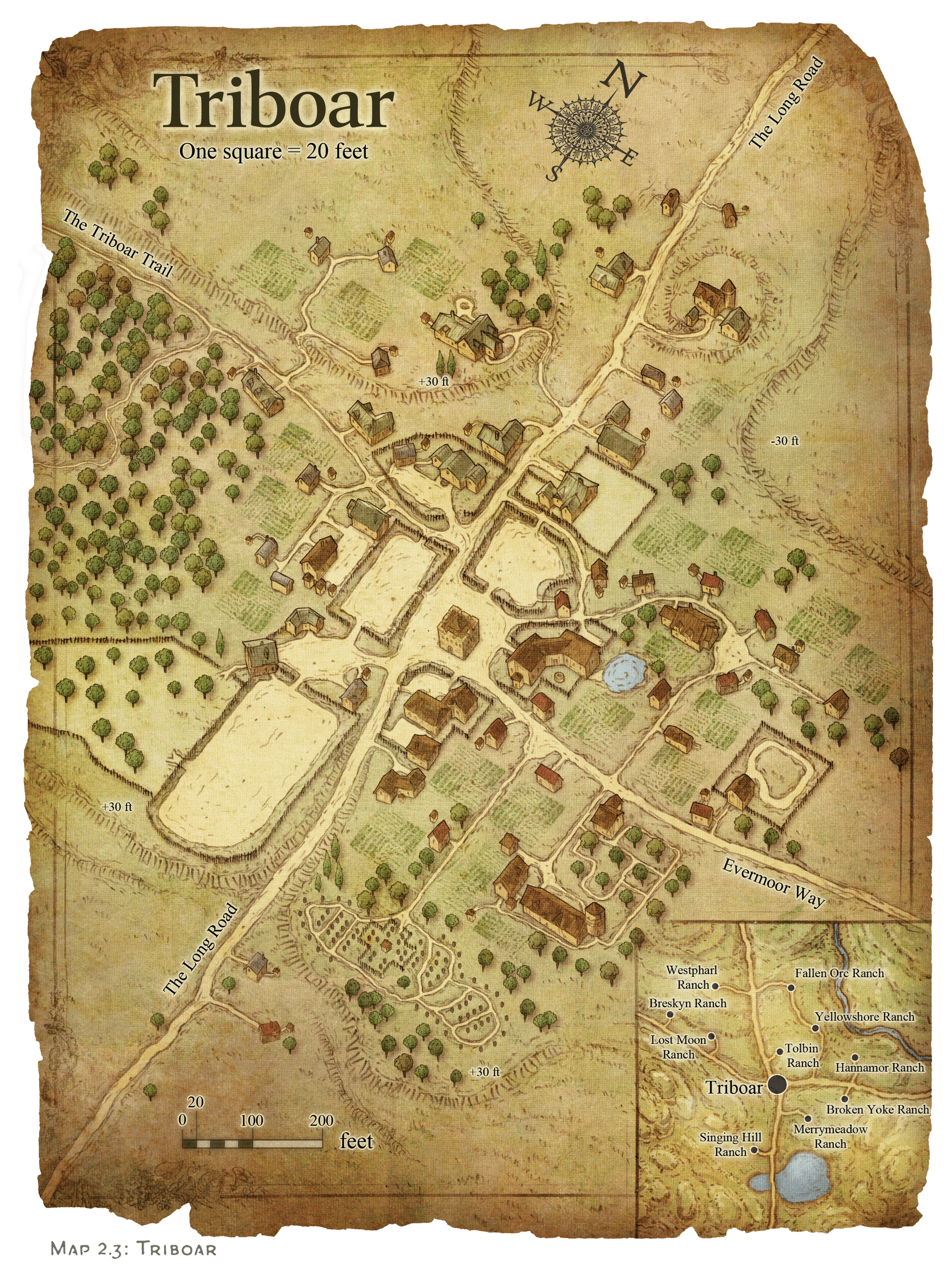
Triboar was a small town rising majestically at the crossroads of the Evermoor Way and Long Road. It was a bustling trade town and full of activity all day and night, giving it its sobriquet 'the Town Where Only Gwaeron Sleeps'. At the heart of the town, where the roads crossed, was a vast marketplace where local farmers, ranchers, and roadside salespeople offered their wares. The majority of stores and services faced the market. Rising over it was the Tower of the Lord Protector, a simple two-story stone keep with a markedly eastward lean.
Surrounding the town were paddocks, the horse market, and stockyards; the fenced yards of the two caravan outfitters; and two camping grounds. In the late 1500s, the caravan campgrounds covered the north and east sides of the town center. It was noted for having two fine blacksmiths and a famous wagonmaker, Skulner Wainwright. Most houses were simple stone cottages and farmhouses with outhouses surrounded by gardens and pastures. The old cemetery lay atop a ridge beside the Long Road to the south; Triboar's first settlers lay here, in graves marked by weathered headstones, with the very oldest in the center, in an area contained by an old and unpainted picket fence. Opposite it was the marshaling field wherein armies had historically assembled and camped before going on campaign. In the late 1400s, it was a large field, often muddy, ringed by an old and partly broken wooden fence.
Guilds and Factions
The secret Kraken Society had a bases in Triboar and Yartar in the mid-to-late 1300s DR, for together these towns were the crossroads of the North. Meanwhile, Zhentarim had inserted agents in key positions here as they had in other places. By 1370 DR, rumors spread of their presence, speculating they planned to secure a trade route or infiltrate local government, and there'd been a discreet year-long effort to find and root them out, with suspects disappearing swiftly and completely. The Zhentarim spies were back in 1491 DR. The Shadow Thieves also had an operation here circa 1368 DR.
In contrast, the Moonstars had their own unidentified agent based in Triboar, monitoring The Sword Coast and Dessarin Vale and potentially affiliated with Lord Tolgar Anuvien of Goldenfields, around 1370 DR. The Harpers had a cell here around 1491 DR, thanks to Lord Protector Darathra being one herself.
History
Millennia before the Era of Upheaval, the giants and dragons of the North fought a great battle on the land upon which Triboar would be built. The giant-crafted relic known as the Vonindod was used during this conflict, and a piece broke off and became buried in the ground.
The combined armies of Phalorm, Uthtower, and others battled and finally destroyed the illithid-led Orc army known as the Everhorde at the Battle of Firetears south of here in the Year of the Jester's Smile, 612 DR at great cost to their own ranks. But it was a pyrrhic victory—another orc horde routed the armies of Phalorm on the future site of Triboar just two years later, driving them into the place that would be named the Mere of Dead Men after them.
The Book of Fangs and Talons, a holy book of the Church of Malar, passed through Triboar in the mid–10th century DR.
The region was ravaged during the Orcfastings War of the Year of the Sky Riders, 936 DR, in which the orcs of Uruth Ukrypt drove many of the Dessarin Valley's inhabitants to flee to Nimoar's Hold for safety. By the Year of the Circling Vulture, 942 DR, there were almost no Human settlements remaining in the area.
Triboar, along with Red Larch, Longsaddle, Secomber, Loudwater, Llorkh and others, was among the first places that were resettled in the Dessarin Valley after the city of Waterdeep grew to prominence around 1000 DR and the establishment of the Lords of Waterdeep there in 1032 DR. These pioneers were sponsored by noble and mercantile Waterdhavian families. The town's name was thought to be based on a mid–11th century DR tale of a traveler who killed three boars here on the same day.
Over the centuries, owing to its strategic location, the town was commonly used as a mustering point when human armies banded together against the orc hordes descending from the mountains in the north along the Surbrin River. It had seen a dozen such armies by 1370 DR, some of them in the last century put together in quite a hurry.
The Scepter of Mystra was sighted in Triboar some time in the 13th century DR.
During the First Dragonspear War of the Year of the Worm, 1356 DR, the devil-led armies of Dragonspear Castle ransacked Triboar. By the month of Mirtul, the inhabitants had fled north, as had many other people of towns in the area. The loss of the wild grain harvest around Triboar contributed to a general food shortage in the North.
In the mid-1360s DR, the traveler Volothamp Geddarm visited Triboar to write about the town for his guidebook, Volo's Guide to the North.
When the annis Tanta Hagara led a force of fiends from Hellgate Keep and allied Blue Bear tribesmen in an attack on The Citadel of the Mists in the Year of the Gauntlet, 1369 DR, Lord Protector Faurael Blackhammer of Triboar led a force to aid in its defense while the Mistmaster used the Gatekeeper's Crystal to obliterate Hellgate Keep. Faurael and his warriors were killed fighting the demons, but took no less than six of the tanari'ri down with them.
Points of interest
Shops
- The Cart and Coin: This business offered horses and other draft animals for sale.
- Foehammer's Forge: The Foehammer forge was run by Ghelryn "Goldhand" Foehammer, Royal Armorer of Citadel Felbarr.
- Happy Horse Ranch: This stables and paddock was run by the Karnveller family.
- The Lion's Share: The Yartaran branch of the Lionshield Coster was not well-received by the citizens of Triboar.
- Merivold Pony Park: The Merivold sisters bred and sold ponies from this small cottage.
- Othovir's Harness Shop: The owner, Othovir, was the most-skilled craftsman of elk skin in the entire Dessarin Valley.
- Ransor's Open Road: While this store once sold draft animals and supplies for caravan travel, it fell to ruin during the 15th century.
- The Triboar Travelers: The town's eponymous caravan company regularly made trips to Everlund and Waterdeep.
- Uldinath's Arms: This Smithy enjoyed a friendly rivalry with Foehammer's.
- Wainwright's Wagons: This wagon shop was a mainstay of Triboar for many decades.
- Triboar playhouse: A shabby theater for various small performances.
Restaurants & Taverns
- The Pleasing Platter: This pretentious restaurant offered quality dishes at exorbitant prices.
- The Talking Troll: Despite its comprehensive list of drinks, this bar was wholly unpleasant.
- The Triboar Arms: This otherwise-unremarkable tavern was twice burnt to the ground and rebuilt.
Inns
- Everwyvern House: The most luxurious, and most expensive, establishment in Triboar catered to Waterdhavian nobility and refused to take in anyone who didn't have similar affluence and influence.
- The Frost-Touched Frog: Since abandoned, the Frog was once a lively establishment run by Alatha Riversword.
- Northshield House: This tidy, unassuming inn was well-suited for those passing through town.
- Six Windows: Patrons who couldn't find rooms in Triboar's other inns were left to stay at this drafty boarding house.
Landmarks
- Tower of the Lord Protector: The stone keep of Triboar's head authority was located in the center of the town square.
- Caravan campgrounds: Fenced fields in the heart of town where caravans could park their wagons and keep their oxen.
Residences
- Boar's Rest: This grand manor was the residence of the arrogant, retired adventurer Hyuth Kolstaag.
- Home of the Boars: A lodge on the edge of town in the late 1400s, and a refuge for Harpers.
Tourism
The god of rangers, Gwaeron Windstrom, was often seen walking the land around Triboar. It was said that he slept within the stand of trees known as Gwaeron's Slumber, lying just west of Triboar, and was sometimes sighted entering or exiting the wood. The grove was free of any shrine, but local laws in Triboar protected it against disturbance so as not to anger him. Woodcutting and hunting here were forbidden and the militia patrolled to prevent orcs, trolls, and others camping here, while monsters were never sighted within the woods.
In Triboar, there was a long-running treasure tale revolving around the so-called Lost Guide, a wagon driver who disappeared between Triboar and Yartar while transporting a load of gold. Naturally, the two towns each accused the other over his murder and the loss of the gold. Outsiders believed it more likely he, his wagon, and his sacks of gold pieces all lay at the bottom of the Dessarin River.
Geography
Triboar was nestled in the Dessarin Valley, strategically placed where the Evermoor Way intersected with the Long Road.
As a crossroads town, it was centrally located amidst a number of prominent settlements. Triboar was located about 225 miles (362.1 kilometers) east of Phandalin, if traveling along the Triboar Trail; 60 miles (95.6 kilometers) west of Yartar, as traveled along the Evermoor Way; 80 miles (128.7 kilometers) north of Westbridge, and 200 miles (321.9 kilometers) north of Red Larch, by way of the Long Road. In 1358 DR, a wagon from Waterdeep to Triboar along the Long Road took around 13 days and one from Triboar to Yartar took 2 days, to Everlund took 15 days, and to Silverymoon took around 20 days.
The landscape in and around the town was fairly flat, with only a few natural rises in some parts. It was also fertile, making it well-suited for farming.
Maps
-
Triboar
Alternative Name(s)
Town Where Only Gwaeron Sleeps,
The Gateway to the North
The Gateway to the North
Type
Large town
Population
~2500
Included Locations
Characters in Location

Comments