

Rider of Providence
(a.k.a. Bonnie & Clyde)
Noble Phantasm:
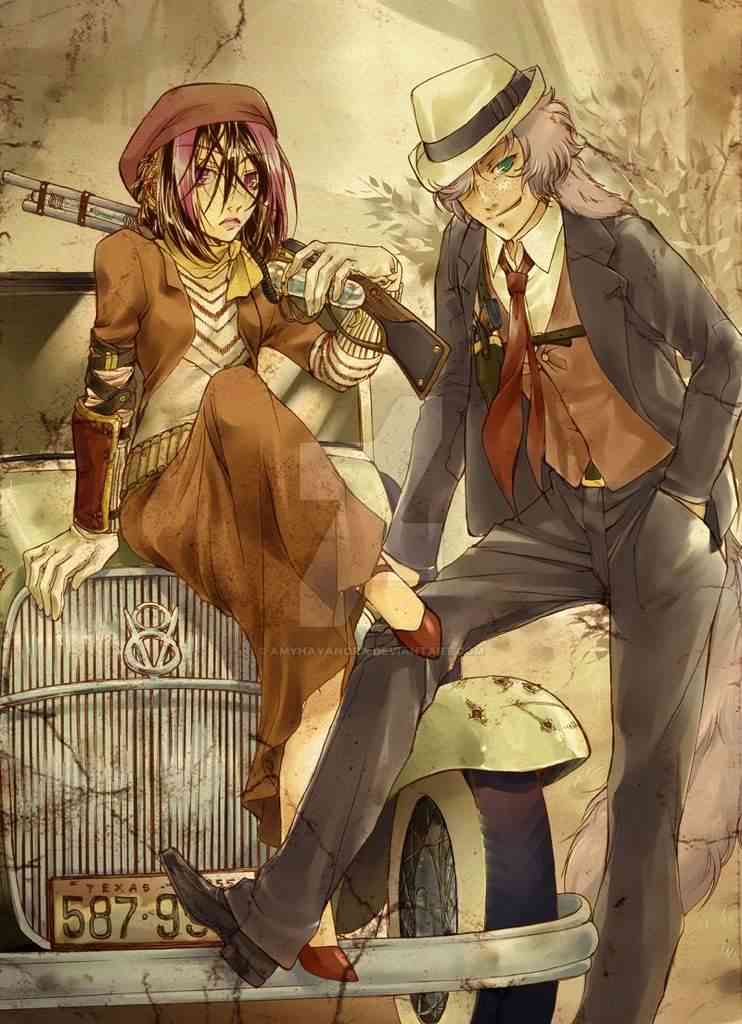
The Story of Bonnie & Clyde; Go Down Together (B): A crystallization of the tale of Bonnie & Clyde, the story of two runaway criminals hopelessly in love. Bonnie jumps into the air allowing Clyde to drive his Ford V8 & crash into their opponents, exploding on impact.
Mount: Ford V8: Bonnie & Clyde’s famous 1934 Ford Deluxe V-8.
Skills: Combination, Riding, Hold Up, Disengage, Stage Presence (Bonnie), Quick Draw (Clyde), Robbery
Holy Grail War: Fate/Providence
Dream: The first time Bonnie & Clyde met.
Death:
The Story of Bonnie & Clyde; Go Down Together (B): A crystallization of the tale of Bonnie & Clyde, the story of two runaway criminals hopelessly in love. Bonnie jumps into the air allowing Clyde to drive his Ford V8 & crash into their opponents, exploding on impact.
Mount: Ford V8: Bonnie & Clyde’s famous 1934 Ford Deluxe V-8.
Skills: Combination, Riding, Hold Up, Disengage, Stage Presence (Bonnie), Quick Draw (Clyde), Robbery
Holy Grail War: Fate/Providence
Dream: The first time Bonnie & Clyde met.
Death:
| Strength | Endurance | Agility |
| C | C+ | B- |
| Mana | Luck | NP |
| D | A | B |
Mental characteristics
Personal history
Bonnie Parker
- Bonnie Elizabeth Parker was born in 1910 in Rowena, Texas, the 2nd of 3 children. Her father, Charles Robert Parker, was a bricklayer who died when Bonnie was 4 years old. Her widowed mother, Emma Parker, moved her family back to her parents' home in Cement City, an industrial suburb in West Dallas where she worked as a seamstress. As an adult, Bonnie wrote poems such as "The Story of Suicide Sal" & "The Trail's End", the latter more commonly known as "The Story of Bonnie & Clyde". Parker was a bright child who thrived on attention. She enjoyed performing on stage & dreamt of becoming an actress. In her 2nd year in high school, Parker met Roy Thornton. The couple dropped out of school & married on September 25, 1926, 6 days before her 16th birthday. Their marriage was marred by his frequent absences & brushes with the law & proved to be short-lived. They never divorced, but their paths never crossed again after January 1929. When she died, Parker was still wearing the wedding ring Thornton had given her. After she left Thornton, Parker moved back in with her mother & worked as a waitress in Dallas. One of her regular customers was postal worker Ted Hinton. In 1932, he joined the Dallas County Sheriff's Department & eventually served as a member of the posse that killed Bonnie & Clyde. Parker briefly kept a diary early in 1929 when she was 18, writing of her loneliness, her impatience with life in Dallas, & her love of photography.
- Clyde Chestnut Barrow was born in 1909 into a poor farming family in the town of Telico in Ellis County, Texas. He was the 5th of 7 children of Henry Basil Barrow & Cumie Talitha Walker. The family moved to Dallas in the early 1920s as part of a wider migration pattern from rural areas to the city, where many settled in the urban slum of West Dallas. The Barrows spent their first months in West Dallas living under their wagon until they got enough money to buy a tent. Barrow was first arrested in late 1926, at age 17, after running when police confronted him over a rental car that he had failed to return on time. His second arrest was with his brother Buck Barrow soon after, for possession of stolen turkeys. Barrow had some legitimate jobs from 1927 through 1929, but he also cracked safes, robbed stores, & stole cars. He met 19-year-old Parker through a mutual friend in January 1930, & they spent much time together during the following weeks. Their romance was interrupted when Barrow was arrested by Dallas County Sheriff's Deputy Bert Whisnand & convicted of auto theft. He escaped from the McLennan County Jail in Waco, TX, on March 11, 1930, using a gun Parker smuggled into the jail. Recaptured on March 18, Barrow was sent to Huntsville State Prison in April 1930 & in September he was assigned to the Eastham Prison Farm at the age of 21. He was sexually assaulted while in prison, & he retaliated by attacking & killing his tormentor with a pipe, crushing his skull. This was his first murder. Another inmate who was already serving a life sentence claimed responsibility. To avoid hard labor in the fields, Barrow purposely had two of his toes amputated in late January 1932, either by another inmate or by himself. Because of this, he walked with a limp for the rest of his life. The amputation slowed him down physically, making it harder to outrun law enforcement & limiting his mobility during his many robberies. However, without his knowledge, his mother had successfully petitioned for his release & he was set free 6 days after his intentional injury. He was paroled from Eastham on February 2, 1932, now a hardened & bitter criminal. His sister Marie said, "Something awful sure must have happened to him in prison because he wasn't the same person when he got out." Fellow inmate Ralph Fults said that he watched Clyde "change from a school boy to a rattlesnake". In his post-Eastham career, Barrow robbed grocery stores & gas stations at a rate far outpacing the 10 or so bank robberies attributed to him & the Barrow Gang. His favorite weapon was the M1918 Browning automatic rifle (BAR). According to John Neal Phillips, Barrow's goal in life was not to gain fame or fortune from robbing banks but to seek revenge against the Texas prison system for the abuses that he had sustained while serving time.
- Parker & Barrow first met on January 5, 1930, at the home of Barrow's friend, Clarence Clay, at 105 Herbert Street in West Dallas. Barrow was 20 years old, & Parker was 19. Parker was out of work & staying with a female friend to assist her during her recovery from a broken arm. Barrow dropped by the girl's house while Parker was in the kitchen making hot chocolate. After Barrow's release from prison in February 1932, he & Ralph Fults began a series of robberies, primarily of stores & gas stations. Their goal was to collect enough money & firepower to launch a raid against Eastham prison. On April 19, Parker & Fults were captured in a failed hardware store burglary in Kaufman in which they had intended to steal firearms. Parker was released from jail after a few months, when the grand jury failed to indict her. Fults was tried, convicted, & served time. He never rejoined the gang. Parker wrote poetry to pass the time in Kaufman County jail & reunited with Barrow within a few weeks of her release. On April 30, Barrow was the getaway driver in a robbery in Hillsboro during which store owner J.N. Bucher was shot & killed. Bucher's wife identified Barrow from police photographs as one of the shooters, although he had stayed inside the car. On August 5, Barrow, Raymond Hamilton, & Ross Dyer were drinking moonshine at a country dance in Stringtown, Oklahoma when Sheriff C.G. Maxwell & Deputy Eugene C. Moore approached them in the parking lot. Barrow & Hamilton opened fire, killing Moore & gravely wounding Maxwell. Moore was the first law officer whom Barrow & his gang killed. They eventually murdered 9. On October 11, they allegedly killed Howard Hall at his store during a robbery in Sherman, Texas. W. D. Jones had been a friend of Barrow's family since childhood. He joined Parker & Barrow on Christmas Eve 1932 at the age of 16, & the three left Dallas that night. The next day, Christmas Day 1932, Jones & Barrow murdered Doyle Johnson while stealing his car in Temple. Barrow killed Tarrant County Deputy Malcolm Davis on January 6, 1933, when he, Parker, & Jones wandered into a police trap set for another criminal. The gang had murdered 5 people since April. On March 22, 1933, Clyde's brother Buck was granted a full pardon & released from prison. He & his wife Blanche set up housekeeping with Bonnie, Clyde & Jones in a temporary hideout at 3347 1/2 Oakridge Drive in Joplin, Missouri. Buck and Blanche were there to visit; they attempted to persuade Clyde to surrender to law enforcement. The group ran loud, alcohol-fueled card games late into the night in the quiet neighborhood, buying a case of beer a day. The men came & went noisily at all hours, & Clyde accidentally fired a BAR in the apartment while cleaning it. No neighbors went to the house, but one reported suspicions to the Joplin Police Department. The police assembled a 5-man force in 2 cars on April 13 to confront what they suspected were bootleggers living at the Oakridge Drive address. The Barrow brothers & Jones opened fire, killing Detective Harry L. McGinnis outright & fatally wounding Constable J. W. Harryman. Parker opened fire with a BAR as the others fled, forcing Highway Patrol Sergeant G.B. Kahler to duck behind a large oak tree. The .30 caliber bullets from the BAR struck the tree & forced wood splinters into the sergeant's face. Parker got into the car with the others, & they pulled in Blanche from the street where she was pursuing her dog. The surviving officers later testified that they had fired only 14 rounds in the conflict; 1 hit Jones on the side, 1 struck Clyde but was deflected by his suit-coat button, & 1 grazed Buck after ricocheting off a wall. The group escaped the police at Joplin but left behind most of their possessions at the apartment, including Buck's parole papers, a large arsenal of weapons, a handwritten poem by Bonnie, & a camera with several rolls of undeveloped film. Police developed the film at The Joplin Globe & found many photos of Barrow, Parker, & Jones posing pointing weapons at one another. The Globe sent the poem & the photos over the newswire, including a photo of Parker clenching a cigar in her teeth & a pistol in her hand. The Barrow Gang subsequently became front-page news throughout the United States. The group ranged from Texas as far north as Minnesota for the next 3 months. In May, they tried to rob the bank in Lucerne, Indiana, & robbed the bank in Okabena, Minnesota. They kidnapped Dillard Darby & Sophia Stone at Ruston, Louisiana in the course of stealing Darby's car; this was one of several events between 1932 & 1934 in which they kidnapped police officers or robbery victims. They usually released their hostages far from home, sometimes with money to help them return. Stories of such encounters made headlines, as did the more violent episodes. The Barrow Gang did not hesitate to shoot anyone who got in their way, whether it was a police officer or an innocent civilian. Other members of the gang who committed murder included Hamilton, Jones, Buck Barrow, & Henry Methvin. Eventually, the cold-bloodedness of their murders opened the public's eyes to the reality of their crimes & led to their ends. The photos entertained the public for a time, but the gang was desperate & discontented, as described by Blanche in her account written while imprisoned in the late 1930s. With their new notoriety, their daily lives became more difficult as they tried to evade discovery. Restaurants & motels became less secure; the gang resorted to campfire cooking & bathing in cold streams. The unrelieved round-the-clock proximity of 5 people in one car gave rise to vicious bickering. Jones was the driver when he & Barrow stole a car belonging to Darby in late April, & he used that car to leave the others. He stayed away until June 8. Barrow failed to see warning signs at a bridge under construction on June 10 while driving with Jones & Parker near Wellington, Texas, & the car flipped into a ravine. Parker sustained 3rd-degree burns to her right leg, so severe that the muscles contracted & caused the leg to "draw up". Parker could hardly walk; she either hopped on her good leg or was carried by Barrow. They got help from a nearby farm family, then kidnapped Collinsworth County Sheriff George Corry & City Marshal Paul Hardy, leaving the two of them handcuffed to a tree outside Erick, Oklahoma. The three rendezvoused with Buck & Blanche & hid in a tourist court near Fort Smith, Arkansas, nursing Parker's burns. Buck & Jones bungled a robbery & murdered Town Marshal Henry D. Humphrey in Alma, Arkansas. The criminals had to flee, despite Parker's grave condition. In July 1933, the gang checked into the Red Crown Tourist Court south of Platte City, Missouri. It consisted of 2 brick cabins joined by garages, & the gang rented both. To the south stood the Red Crown Tavern, a popular restaurant among Missouri Highway Patrolmen. Blanche registered the party as 3 guests, but owner Neal Houser could see 5 people getting out of the car. He noted that the driver backed into the garage "gangster style" for a quick getaway. Blanche paid for their cabins with coins rather than bills, & did the same later when buying 5 dinners & 5 beers. The next day, Houser noticed that his guests had taped newspapers over the windows of their cabin; Blanche again paid for 5 meals with coins. Her outfit of jodhpur riding breeches also attracted attention. Houser told Captain William Baxter of the Highway Patrol, a patron of his restaurant, about the group. Barrow & Jones went into town to purchase bandages, crackers, cheese, & atropine sulfate to treat Parker's leg. The druggist contacted Sheriff Holt Coffey, who put the cabins under surveillance. Coffey had been alerted by Oklahoma, Texas, & Arkansas law enforcement to watch for strangers seeking such supplies. The sheriff contacted Captain Baxter, who called for reinforcements from Kansas City, including an armored car. Sheriff Coffey led a group of officers toward the cabins at 11 p.m. on July 20, 1933, armed with Thompson submachine guns. In the gunfight that ensued, the officers' .45 caliber Thompsons proved no match for Barrow's .30 caliber BAR, stolen on July 7 from the National Guard armory at Enid, Oklahoma. The gang escaped when a bullet short-circuited the horn on the armored car & the police officers mistook it for a cease-fire signal. They did not pursue the retreating Barrow vehicle. The gang had evaded the law once again, but Buck had been wounded by a bullet that blasted a large hole in the bone of his forehead & exposed his injured brain. Blanche was also nearly blinded by glass fragments. The Barrow Gang camped at Dexfield Park, an abandoned amusement park near Dexter, Iowa, on July 24, 1933. Buck was sometimes semiconscious, he even talked & ate, but his massive head wound & loss of blood were so severe that Barrow & Jones dug a grave for him. Residents noticed their bloody bandages, & officers determined that the campers were the Barrow Gang. Local police officers & approximately 100 spectators surrounded the group, & the Barrows soon came under fire. Barrow, Parker, & Jones escaped on foot. Buck was shot in the back, & he & his wife were captured by the officers. Buck died of his head wound & pneumonia after surgery 5 days later at Kings Daughters Hospital in Perry, Iowa. For the next 6 weeks, the remaining perpetrators ranged far afield from their usual area of operations, west to Colorado, north to Minnesota, southeast to Mississippi; yet they continued to commit armed robberies. They restocked their arsenal when Barrow & Jones robbed an armory on August 20 at Plattville, Illinois, acquiring three BARs, handguns, & a large quantity of ammunition. By early September, the gang risked a run to Dallas to see their families for the first time in 4 months. Jones parted company with them, continuing to Houston where his mother had moved. He was arrested there without incident on November 16, & returned to Dallas. Through the autumn, Barrow committed several robberies with small-time local accomplices, while his family & Parker's attended to her considerable medical needs. On November 22, they narrowly evaded arrest while trying to meet with family members near Sowers, Texas. Dallas Sheriff Smoot Schmid, Deputy Bob Alcorn, & Deputy Ted Hinton lay in wait nearby. As Barrow drove up, he sensed a trap & drove past his family's car, at which point Schmid & his deputies stood up & opened fire with machine guns & a BAR. The family members in the crossfire were not hit, but a BAR bullet passed through the car, striking the legs of both Barrow & Parker. They escaped later that night. On November 28, a Dallas grand jury delivered a murder indictment against Parker & Barrow for the killing – in January of that year, nearly 10 months earlier – of Tarrant County Deputy Malcolm Davis; it was Parker's first warrant for murder. On January 16, 1934, Barrow orchestrated the escape of Hamilton, Methvin, & several others in the "Eastham Breakout". The brazen raid generated negative publicity for Texas, & Barrow seemed to have achieved what historian Phillips suggests was his overriding goal: revenge on the Texas Department of Corrections. Barrow Gang member Joe Palmer shot Major Joe Crowson during his escape, & Crowson died a few days later in the hospital. This attack attracted the full power of the Texas & federal government to the manhunt for Barrow & Parker. As Crowson struggled for life, prison chief Lee Simmons promised him that all persons involved in the breakout would be hunted down & killed. All of them eventually were, except for Methvin, who preserved his life by turning on the gang & setting up the ambush of Barrow & Parker. The Texas Department of Corrections contacted former Texas Ranger Captain Frank Hamer & persuaded him to hunt down the Barrow Gang. He was retired, but his commission had not expired. He accepted the assignment & was given the specific task of taking down the Barrow Gang. For 20 years, he had been feared & admired throughout Texas as "the walking embodiment of the 'One Riot, One Ranger' ethos". He "had acquired a formidable reputation as a result of several spectacular captures & the shooting of a number of Texas criminals". Starting on February 10, Hamer became the constant shadow of Barrow & Parker, living out of his car, just a town or two behind them. 3 of Hamer's 4 brothers were also Texas Rangers. Brother Harrison was the best shot of the 4, but Frank was considered the most tenacious. On Easter Sunday, April 1, 1934, at the intersection of Route 114 & Dove Road, near Grapevine Texas, highway patrolmen H.D. Murphy & Edward Bryant Wheeler stopped their motorcycles thinking a motorist needed assistance. Barrow & Parker opened fire, killing both officers. During the spring season, the Grapevine killings were recounted in exaggerated detail, affecting public perception. All 4 Dallas daily papers seized on the story told by the eyewitness, a farmer who claimed to have seen Parker laugh at the way that Murphy's head "bounced like a rubber ball" on the ground as she shot him. The stories claimed that police found a cigar butt "with tiny teeth marks", supposedly those of Parker. Several days later, Murphy's fiancée wore her intended wedding dress to his funeral, attracting photos & newspaper coverage. The eyewitness's ever-changing story was soon discredited, but the massive negative publicity increased the public clamor for the extermination of the Barrow Gang. The outcry galvanized the authorities into action, & Highway Patrol boss L.G. Phares offered a reward of $1,000 for "the dead bodies of the Grapevine slayers". Texas Governor Ma Ferguson added another reward of $500 for each of the two killers, which meant that, for the first time, "there was a specific price on Bonnie's head since she was so widely believed to have shot H.D. Murphy". Public hostility increased 5 days later when Barrow & Methvin murdered 60-year-old Constable William "Cal" Campbell, a widower & father, near Commerce, Oklahoma. They kidnapped Commerce police chief Percy Boyd, crossed the state line into Kansas, then let him go, giving him a clean shirt, a few dollars, & a request from Parker to tell the world that she did not smoke cigars.
- By May 1934, Barrow had 16 warrants outstanding against him for multiple counts of robbery, auto theft, theft, escape, assault, & murder in 4 states. Hamer, who had begun tracking the gang on February 12, led the posse. He had studied the gang's movements & found that they swung in a circle skirting the edges of 5 midwestern states, exploiting the "state line" rule that prevented officers from pursuing a fugitive into another jurisdiction. Barrow was consistent in his movements, so Hamer charted his path & predicted where he would go. The gang's itinerary centered on family visits, & they were due to see Methvin's family in Louisiana. Unbeknownst to Hamer, Barrow had designated Methvin's parents' residence as a rendezvous in case they were separated. Methvin had become separated from the rest of the gang in Shreveport. Hamer's posse was composed of 6 men: Texas officers Hamer, Hinton, Alcorn, & B.M. "Maney" Gault, as well as Louisiana officers Henderson Jordan & Prentiss Morel Oakley. On May 21, the 4 posse members from Texas were in Shreveport when they learned that Barrow & Parker were planning to visit Ivy Methvin in Bienville Parish that evening. The full posse set up an ambush along Louisiana State Highway 154 south of Gibsland toward Sailes. The lawmen were in place by 9 pm, & waited through the whole of the next day (May 22) with no sign of the perpetrators. At approximately 9:15 am on May 23, the posse was still concealed in the bushes & almost ready to give up when they heard a vehicle approaching at high speed. In their official report, they stated they had persuaded Methvin to position his truck on the shoulder of the road that morning. They hoped Barrow would stop to speak with him, putting his vehicle close to the posse's position in the bushes. The vehicle proved to be the Ford V8 with Barrow at the wheel & he slowed down as hoped. The 6 lawmen opened fire while the vehicle was still moving. Oakley fired first, probably before any order to do so. Barrow was shot in the head & died instantly from Oakley's first shot & Hinton reported hearing Parker scream. The officers fired about 130 rounds, emptying each of their weapons into the car. The two had survived several bullet wounds over the years in their confrontations with the law. On this day, any of Bonnie Parker's & Clyde Barrow's wounds would have proven to be fatal.
Social
Contacts & Relations
Barrow Gang: Bonnie & Clyde were both heavily involved in the Barrow Gang named after Clyde.
- Marvin "Buck" Barrow: Clyde's older brother.
- Blanche Barrow: Buck's wife.
- W. D. Jones: One of Clyde's accomplices in carjacking.
- Henry Methvin: An escapee of Eastham prison. When Bonnie & Clyde broke Raymond Hamilton out, they offered several prisoners to join their Barrow Gang. Henry Methvin agreed while the other 3 inmates refused.
- Raymond Hamilton: One of Clyde's childhood friends.
- Ralph Fults: A prisonmate of Clyde in Eastham Prison Farm, who helped him escape.
- Joe Palmer:
Relationships
History
John summoned Bonnie & Clyde using a car horn. This horn short-circuited after catching a stray bullet, allowing Bonnie & Clyde to escape. Their contract ended when.
Nicknames & Petnames
John often refers to Bonnie & Clyde as Prisoner A & Prisoner B. Clyde often refers to John as John Porkman, or pig.
Relationship Reasoning
John is a law abiding citizen & former police officer, while Bonnie & Clyde are both outlaws who've killed multiple officers. John originally hoped to summon someone like Frank Hamer, Holt Coffey, or even J. Edgar Hoover. However due to John's conflicting nature of the law, his catalyst, & the archer already being summoned, he was stuck with the 2 outlaws.
Alignment
Chaotic Neutral
Age
23
Date of Death
May 23, 1934
Year of Death
1934 AD
Circumstances of Death
Shot to death by 6 police officers.
Place of Death
Bienville Parish, Louisiana, U.S.
Spouses
Siblings
Children

Comments