

The Aetherion Covenant: The Imperian Myth of the Rift
When Aetherion split the heavens, the gods awoke, and the summons began. None cross the Rift by chance; all are called to prove their worth.”
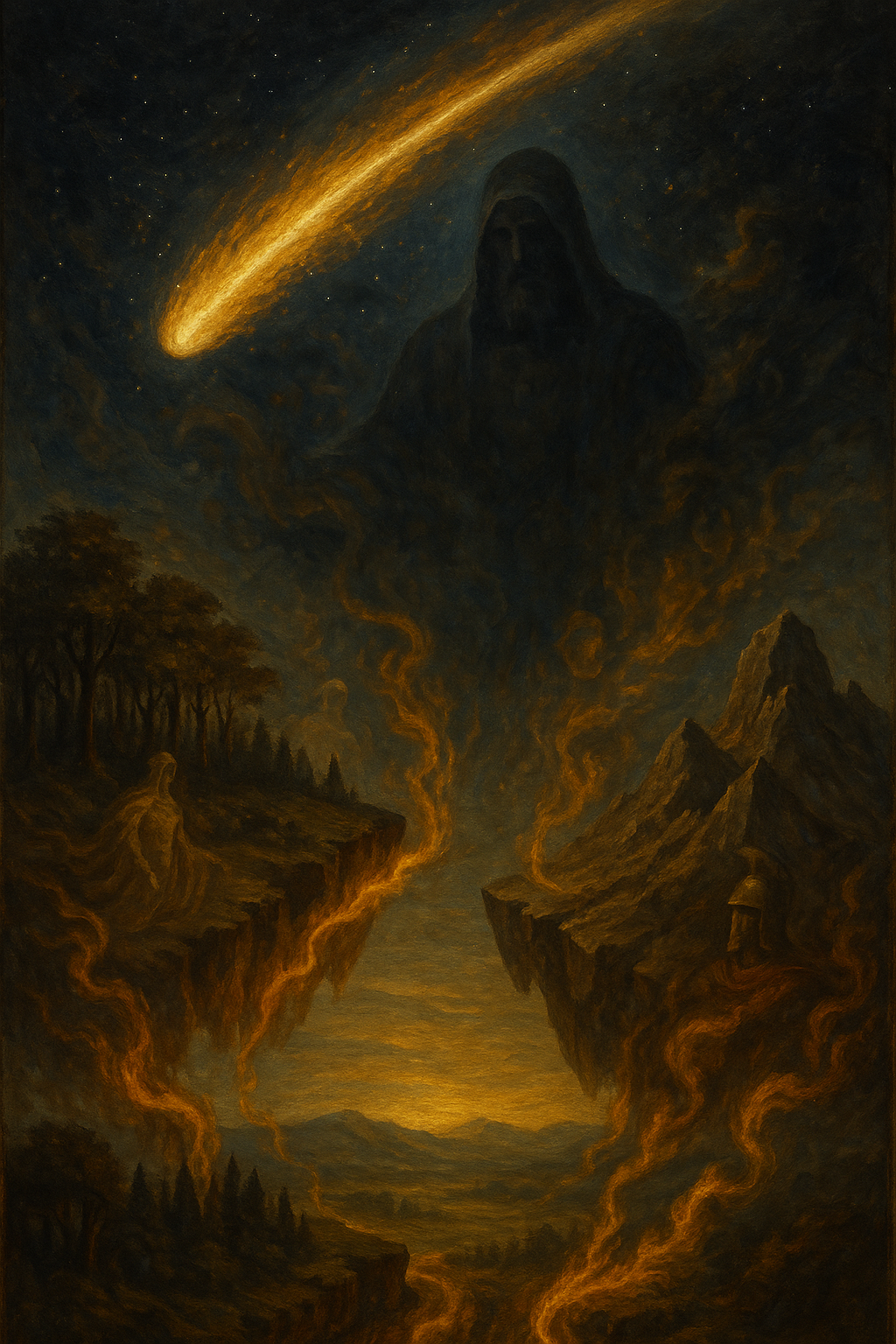
Imperian tradition holds that the world known today as Exilum Novum was not born whole, but assembled over millennia through a divine-celestial pact known as the Aetherion Covenant. According to this myth, the comet Aetherion is no silent wanderer but the herald of a cosmic summons. Each time it scorches its path across the night, the Rift opens — not as a wound of chaos, but as a deliberate invitation from the World-Soul, the vast and ancient consciousness believed to underlie the fabric of all realms.
The myth claims that every civilisation drawn into this world — from the Elven Elder Courts to the Dwarrow Clans, from the Warborn hordes to the Brass Cities — came at Aetherion’s call. These peoples form the stages of a grand, ongoing trial: a test of strength, wisdom, resolve, and destiny. When Rome itself was summoned in Year 0 NE, Imperians believed they were not victims of cosmic upheaval but participants in a design older than the stars.
In this telling, the gods themselves are children of the Rift, awakened whenever worlds converge and shaped by the belief and struggle of the mortals who survive the crossing. Humanity’s arrival, then, is not merely historical — it is theological, marking the moment when mortals first recognised the purpose behind the summons and sought to answer it.
Thus the myth frames the Imperium not as conquerors, but as contenders in a sacred contest. Their expansion, diplomacy, wars, and works of civilisation are expressions of devotion to the Covenant: proof that humanity can rise to meet the challenge set before all worlds.
Summary
The myth tells that in the dawnless age before reckoning, the Animus Mundi—the living spirit of creation—slumbered in vast, formless silence. Nothing stirred until the comet Aetherion carved its blazing path across the void. That incandescent breach awakened the first divine impulses within the Animus Mundi, and from its quickened breath came the First Rift, through which the Elven Elder Courts were drawn to tend a world still soft with possibility.
Each time Aetherion returned, the Animus Mundi opened another summons. The Dwarrow arrived to sculpt mountains and carve runes into the bones of the land. The Warborn followed, embodying the trial of untamed strength. Other peoples came and vanished, leaving only bronze shells or towering relics—warnings, the Imperians say, of civilisations that failed their test. The Centaurs were called to master the boundless plains, teaching the lesson of freedom shaped by wisdom.
With every Rift, new gods awakened—beings sparked from the marriage of celestial fire, the Animus Mundi’s deep will, and the beliefs of those who survived the crossing. But Rome’s arrival in 0 NE marks the myth’s great fulcrum. Alone among the summoned peoples, the Imperians perceived the Aetherion Covenant: the understanding that the Rift is not exile nor misfortune, but a deliberate contest of civilisation and spirit. Humanity, through discipline, reason, and unyielding will, claims its role as the contender destined to interpret the Covenant and strive to fulfil its purpose.
In this telling, the Imperium Novum is not the first civilisation called, nor the strongest, nor the most ancient—but the first to comprehend the trial and answer it willingly. Thus begins the human charge: to rise, to forge, to endure, and to prove worthy before gods who themselves were shaped by the same summons.
Historical Basis
Though clearly mythologised, The Aetherion Covenant draws upon several threads of observable history that lend it an air of credibility within Imperial scholarship. The sequence of the Rifts is real and meticulously recorded by all major cultures, each arrival reshaping the land, altering mana flows, and introducing new peoples whose own traditions consistently reference a moment of translocation or divine upheaval. The Imperians use this consistency to argue that the Rifts follow a purposeful pattern rather than random calamity.
Archaeological strata support the idea of discrete continental graftings, matching the chronology preserved in the Senatorial Archives. The Bronze Ruins of the -800 BR Rift show abrupt discontinuity from surrounding geology, while the Tall-Walker artefacts scattered from the -400 BR Rift speak to a vanished people whose imprint is undeniable. Likewise, the Centaur oral histories describe a sky-born rending and sudden transplantation onto foreign plains, aligning closely with the Imperial interpretation.
The most persuasive element, at least to myth-writers, is the fact that gods demonstrably manifest after Rifts—minor deities first appearing in the years following major arrivals, their domains often linked to the traits or histories of the incoming peoples. Imperial theologians point to this as evidence that the Animus Mundi responds to the presence and will of mortals, lending mythic authority to the idea of a cosmic summons.
Whether these convergences represent deliberate design or merely the human desire to impose order upon upheaval remains debated outside Imperial circles. Yet to Imperians, the alignment of Rift chronology, divine emergence, and cultural memory forms a compelling foundation for the Covenant myth: a narrative in which humanity is not uprooted, but appointed.
Spread
The Aetherion Covenant spread swiftly through the Imperium in the first two centuries of the Nova Era, carried by legionaries, civic priests, and the itinerant scholars of the Collegium Arcanum. Its appeal lay in its clarity of purpose: a vision of the world not as a patchwork accident but as a stage upon which humanity had been deliberately placed. By 70 NE, the myth had become a fixture of temple sermons and military oaths; by 120 NE, it appeared in children’s primers, state pageants, and the informal philosophies shared in bathhouses and taverns.
Yet the myth has never been entirely uniform. Among the frontier legions, the Covenant is retold with harsher emphasis—less a cosmic calling and more a stark reminder that only the vigilant survive the trials each Rift unleashes. In the rural provinces, storytellers linger on the Animus Mundi as a nurturing force, casting Aetherion not as a challenger but as a herald of renewal. Meanwhile, the Civic Priesthood of the Phoenix promotes a more orthodox version, framing the Imperium as the rightful interpreter of the test and custodian of its future.
Apocryphal versions circulate in scholarly and arcane circles. Some Magisters argue that Aetherion does not choose peoples, but worlds; others claim the Covenant is incomplete, a fragment of an older pact dating back to civilisations whose names are long eroded. A fringe belief—unwelcome in the capital but tolerated in distant provinces—suggests that humanity was not summoned for greatness at all, but as a counterbalance to the Warborn, a necessary stabiliser rather than a destined champion.
Despite these divergences, the core remains constant across the Imperium: Aetherion calls, the Animus Mundi judges, and humanity stands as the civilisation most willing to meet the trial head-on. Whether whispered in barracks, proclaimed in temples, or debated in academies, the Covenant endures as one of the empire’s most pervasive and adaptable myths.
Variations & Mutation
As the Imperium expanded its borders and deepened diplomatic ties, especially after the Pact of Iron & Stone in 9 NE, The Aetherion Covenant naturally began to absorb and influence the mythologies of neighbouring peoples. Each culture reshaped the tale to fit its own history, values, and worldview—though none adopted it as fully as the Imperians themselves.
The Dwarrow possess the most prominent and respected variation, born from centuries of close alliance, troop exchange, and shared labour in the forging of roads, fortresses, and under-mountain infrastructure. In their telling, the Covenant becomes less a cosmic summons and more a universal proving of craft. The Animus Mundi is envisioned not as a sweeping spiritual force but as the Great Forge of the Deep, an immense and half-sentient crucible that tempers civilisations as a smith tempers steel. Aetherion is not a herald of destiny but the Hammer of the Heavens, whose passage strikes sparks that open the Rifts.
Where humanity casts itself as the civilisation that recognised the trial’s purpose, the Dwarrow cast each people as a different alloy—valuable only insofar as they endure pressure, fire, and strain. The Elves are the soft metal that shapes beautifully but warps under force; the Warborn are the raw ore that must be smelted or it shatters; the Centaurs are quicksilver alloyed with wind; and humans are the iron that learns, capable of taking an edge without losing its grain. In this version, the Covenant is not a declaration of human destiny but a shared burden: all peoples must withstand the hammer-blows of Aetherion or be found brittle and unworthy.
Among the Elves, the myth is politely dismissed as a human attempt to structure events far older and more mystical than their empire. Nevertheless, a woodland variant circulates in some courts, describing Aetherion as a wayward fire-spirit that cleaves paths between realms so that the Animus Mundi may gather echoes of lost beauty. In this softer telling, humans are not chosen but drawn—a people of sharp edges whose ambition adds contrast to the world’s melody.
The Warborn retain rough tales of a sky-fire that hurled them into a new hunting ground, but they reject the idea of a test or covenant. To them, the Rift was conquest delivered by the heavens, and survival itself is proof of worth.
In every retelling, the core pattern of Rifts persists, but its meaning shifts. Whether seen as destiny, burden, or cosmic metallurgy, the Aetherion Covenant transforms to reflect the hands that hold it—yet always circles back to the Imperian version, the thread from which all others were spun.
Cultural Reception
Within the Imperium Novum, The Aetherion Covenant occupies an unusual space: half-scripture, half-state philosophy, and entirely ingrained in the cultural psyche. To Imperians, the myth offers reassurance that their struggles—against foreign invaders, hostile frontiers, or the frictions of empire—are not meaningless hardships but necessary trials within a cosmic order. It reinforces the belief that discipline, reason, and collective purpose are virtues observed not only by mortals but by the gods awakened in the wake of each Rift. Among citizens of the capital, the Covenant is spoken of with reverence; among soldiers, it is a source of steel-hard resolve; among scholars, it is a framework through which history can be interpreted as purposeful rather than chaotic.
Beyond Imperial borders, the myth’s reception varies dramatically.
The Dwarrow, who have worked side by side with humans for centuries, view the Covenant with a respect tempered by pragmatism. They appreciate its structure and the dignity it gives to labour, endurance, and legacy, yet they quietly reject the human claim of centrality. To Dwarrow, the myth is “a good tale, hammered straight,” but they see themselves not as supporting actors in humanity’s trial, but as fellow metals in the universal Forge. Many Dwarrow artisans keep small plaques inscribed with Aetherion’s stylised hammer-shape, a symbol adopted not from Imperial dogma but from their own variant of the Covenant.
The Elves treat the Covenant with a mixture of mild amusement and scholarly curiosity. They acknowledge that humanity has woven an elegant narrative, but dismiss its prophetic certainty. To Elven philosophers, the myth is simply an earnest attempt by a young people to impose order on forces older than their civilisation. Still, some younger Elves secretly find comfort in the idea that their long exile has a purpose.
The Centaurs incorporate fragments of the Covenant into their sky-omens and seasonal rites, but only insofar as it aligns with their own oral traditions. They believe each Rift to be a turning of the world’s wind-patterns rather than a cosmic summons, and humans are credited not with being chosen, but with being keen enough to read shifting signs.
The Warborn openly mock the Covenant as human vanity. To them, strength alone determines worth, not heavenly decrees. Yet even they speak of the Rift with a strange reverence, acknowledging that the sky-fire marked them for a greater hunt. Their rejection is not disbelief, but pride.
The Halflings quietly adopt portions of the myth for maritime metaphors, describing Aetherion as the “Star-Tide” that pulls worlds together. Their traders appreciate any story that makes the unpredictable seem chartable.
Among the Brass Cities, reaction is guarded. Their scholars recognise the Imperial myth as a political and spiritual instrument—but some within their Sun Temples whisper that the Covenant bears uncomfortable resemblance to their own solar-geometry doctrines. Whether this is convergence or coincidence is hotly debated.
In all corners of the world, the Covenant is known, whether embraced, adapted, contested, or mocked. The universality of reaction only strengthens the Imperian belief that their myth is not merely one story among many—but the central narrative toward which the world inevitably bends.
In Literature
The Aetherion Covenant quickly embedded itself in the written traditions of the Imperium, shaping genres as diverse as epic poetry, military philosophy, theological commentary, and children’s morality tales. The earliest known literary treatment appears in “Annales Novae,” a semi-mythic chronicle composed in the 1st century NE, in which the Covenant forms the spine of a grand narrative linking all known Rifts. Its author, the archivist Livia Marcellina, framed humanity’s arrival as the hinge upon which history turns—an interpretation that dominated Imperial letters for two centuries.
By the 3rd century NE, the myth had migrated into epic verse. The celebrated poem “Aetherion’s Arc” casts the comet as both celestial sign and divine judge, weaving the history of each Rift into a single sweeping tapestry. The work remains a favourite among educated Imperians, recited during festivals and studied in academies for its elegant blend of mythic allegory and historical detail.
Military texts also embraced the Covenant. The treatise “De Certamine” (“On the Trial”), attributed to the legate Marcus Aelius Sabinus, interprets the myth as a guide to Imperial duty. Sabinus argues that each people summoned is a “lesson” to the Imperium—Elves teaching patience with the arcane, Dwarrow the shaping of the land, Warborn the price of untempered strength. His work influenced officer training for generations, subtly merging theology with strategy.
In theological circles, the Covenant inspired countless commentaries. The Civic Priesthood of the Phoenix produced illuminated manuscripts that interpreted the Rift as a sacred rite of purification. Meanwhile, the Collegium Arcanum penned disputations on the nature of divinity birthed from Rift-flame, some accepting the myth nearly wholesale, others dissecting it with academic precision until little remained but metaphor.
More accessible versions appear in children’s primers and folktale collections, where Aetherion becomes a star with a will of its own, calling brave souls across worlds to test their hearts. These softened retellings subtly instil Imperial values—discipline, unity, aspiration—framing the myth as both bedtime story and civic moral.
Outside Imperial borders, the Covenant finds scattered echoes in Brass Cities sun-poetry, Dwarrow rune-ballads influenced by human storytelling, and Centaur wind-odes that borrow the figure of Aetherion as a wandering sky-spirit. Though rarely adopted in full, the myth’s imagery has become part of the literary lexicon of every culture touched by Imperian influence.
In Art
From the earliest decades of the Nova Era, The Aetherion Covenant became one of the most visually resonant themes in Imperial art, shaping everything from grand civic murals to the intimate iconography etched on a legionary’s shield boss. The myth’s central imagery—the blazing comet, the sundering heavens, the mingling of worlds—proved irresistible to artists seeking to express the awe and terror of the Rift.
In the capital’s basilicas and senate halls, vast frescoes depict Aetherion as a radiant spear of fire piercing a darkened sky, with the lands of arriving peoples painted as drifting continents swirling toward one another. These state-sponsored works present humanity as stepping confidently through the cosmic breach, framed by the Animus Mundi’s great, indistinct silhouette—a shape that shifts subtly between mural cycles, reflecting changing theological interpretations.
The Civic Priesthood of the Phoenix favours a more devotional style. Their illuminated codices show Aetherion as a gold-and-crimson arc descending upon stylised landscapes, each Rift represented by concentric rings of colour. In these works, the gods appear as luminous figures emerging from the Rift-flame, neither wholly human nor wholly other, their forms shaped by the belief of those who behold them.
Across the frontier, art takes on a starker tone. Legionary standard-shrines often bear reliefs of Aetherion forged in bronze, its arc framing scenes of battle against Warborn, Jotun, and unnamed Rift-beasts. These images portray the Covenant as trial rather than blessing—a reminder that cosmic summons demand vigilance and sacrifice. Dwarrow artisans, influenced by human myth but adhering to their own sensibilities, craft stone engravings that depict the Covenant as a great forge: Aetherion as the hammer-blow, the Rifts as sparks, and the many peoples as ingots set upon the anvil of the world.
Among the Elves, the myth inspired only brief artistic curiosity. A handful of delicate tapestries, woven during a short-lived cultural exchange in the 3rd century NE, reinterpret Aetherion as a wandering fire-spirit whose wake encourages new growth. The imagery is ethereal, all glimmering threads and flowing contours, a stark contrast to Imperial gravitas.
The Brass Cities adopt the Covenant into sun-wheel mosaics, representing Rifts as geometric disruptions in their sacred patterns. Although not formally aligned with Imperial theology, these artworks hint at a shared fascination with cosmic order and the mathematics of divinity.
Even the Halflings, who rarely embrace foreign myths, decorate ship-figureheads with stylised comet motifs, claiming they bring favourable currents and safe crossings—an interpretation more practical than theological, but nonetheless born of Imperial imagery.
Over time, the Aetherion Covenant became so widely depicted that its symbols—fire-arc, world-disc, converging lands—are now woven into the visual language of the entire continent, transcending myth to become a cultural shorthand for destiny, upheaval, and the strange unity of a world built from many worlds.

Comments