

Lex Riftalis
“Reality fractures not in anger, nor mercy, but in rhythm. The Rift is the heartbeat of a many-world cosmos.”
The Rift is the single most consequential Natural Law ever observed in Exilum Novum — a cyclical, cosmological fusion of worlds whose precision and inevitability eclipse every mortal institution. It is neither anomaly nor disaster, neither curse nor blessing, but an underlying structural rhythm of the cosmos, in which realities converge like gears in an unseen machine.
Imperial doctrine defines the Rift as a cosmo-arcane fracture, a point where celestial motion, astral resonance, and arcane equilibrium intersect so perfectly that one world is translocated into another without friction, violence, or moral intent. This is the Core Principle: the universe recalibrates itself, maintaining an equilibrium no mortal order yet understands. To Imperial scholars, the Rift is not aberration — it is mathematics expressed as miracle.
Despite the Imperium’s rigor, the phenomenon remains interpreted through many cultural lenses.
Elven mystics describe the Rift as the exhalation of the world-soul, a living breath between slumber and waking.
Dwarven rune-priests insist it is a fissure in the great World-Anvil, where the cosmos briefly exposes the hammer-blows of creation.
Halfling navigators map it through astral tides and stellar currents.
The Brass Cities view it as a precise solar-geometry harmonic, a celestial instrument resonating on a two-century cycle.
Each view is incomplete; each holds a shard of the truth. Standing atop centuries of cartography, augury, arcane modelling, and the merciless record-keeping of empire, Imperial consensus reigns the most consistent:
the Rift behaves lawfully, rationally, and predictably — and therefore can be studied, forecast, and governed.
For all its structure, the Rift remains humbling. No world has ever repeated its arrival. The interval of two centuries has never wavered. The boundaries form with unnatural geometric certainty. And the selection of which realm is taken follows no known moral, mythic, or political logic. The universe offers no negotiation, no warning save its own astronomical signs.
Yet it is precisely this blend of utter predictability and vast unknowability that has shaped the Imperium’s destiny. Every Rift brings upheaval, renewal, invasion, innovation, resettlement, and religious reinvention. Kingdoms rise, gods return, empires fracture and re-form under its shadow. The Rift is not merely an event; it is the heartbeat that dictates the tempo of history itself.
To live in Exilum Novum is to stand on a world eternally re-forged. And under the watch of the Imperium, this cosmic law is not feared — it is measured, managed, and woven into the very foundations of statecraft.
Manifestation
A Rift announces itself long before it opens, yet its true manifestation is unlike any other natural or arcane phenomenon. Scholars describe it as the moment reality “forgets its shape,” while common folk simply call it the Shimmering Hour — a time when the world seems to hold its breath.
When a Rift forms, the first visible sign is a luminous distortion, as though light is being bent around an invisible blade. Colours sharpen unnaturally, shadows stretch in directions the sun does not permit, and heat disperses unevenly, creating patches of cold air amidst summer warmth. Animals sense it instinctively: horses refuse harness, birds scatter in spirals, and wolves howl as though challenging a rival beyond the sky.
As the fracture intensifies, gravity loosens its grip. Dust lifts; water hums; pebbles skitter across the ground in circular patterns. Scholars note that these motions always spiral inward, as though drawn toward a point that does not yet exist. Elven augurs describe this stage as “the world leaning toward another world.”
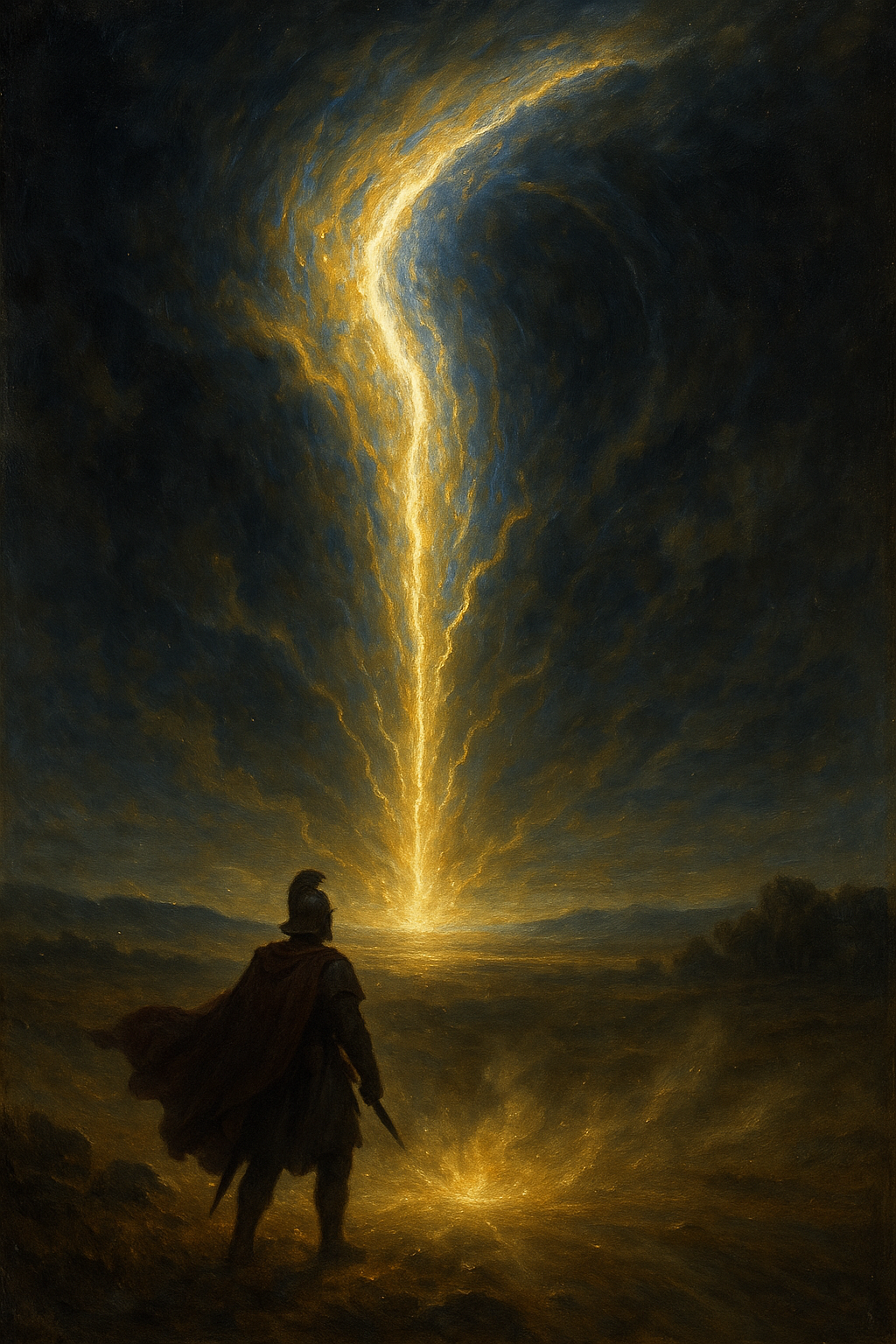
Then comes the opening itself — a wound of light suspended in midair, oval or circular depending on the celestial alignment. It is neither portal nor hole, but a boundary where two realities overlap. The surface ripples like heated metal, throwing off reflections of landscapes not yet present: foreign skies, alien forests, unknown mountains. These glimpses are fleeting, maddeningly incomplete, and impossible to record except through magical scrying.
The air resonates with a subharmonic vibration that can be felt more than heard, rattling bone and tooth. At its peak, the vibration harmonises into a faint choral hum. Dwarves claim this to be the sound of creation’s forge; humans simply call it “the second heartbeat.”
Moments before transition, the light collapses inward, forming a sphere of blinding radiance. Gravity stabilises, the wind falls dead still, and for a heartbeat the world is silent.
Then — instantaneous translocation. No explosion. No displacement.
No destruction.
Only the sudden presence of foreign land, fused seamlessly to the old.
In the hours that follow, faint arcane aftershocks ripple outward: sparks crawling along stone, momentary illusions, drifting glimmers of blue-green light. These fade within days, leaving behind Rift Scars — narrow seams of fused geology where colours, minerals, or soil types change abruptly. Each Scar is unique to its Rift, a geological signature as distinctive as a fingerprint.
For nearly a century afterward, the world brightens subtly. Stars appear sharper; moonlight reflects strangely off water; and arcane practitioners feel a deepening of power, as though someone has lifted a muffling hand from the fabric of magic.
To witness a Rift is to see the universe in the act of editing itself — silent, luminous, and utterly uncompromising.
Localization
Although the Rift is a cosmic law acting upon the whole of existence, its tangible influence is strikingly confined. Every recorded event occurs within a sharply defined translocation radius of roughly thirty-five Roman miles. Inside this zone, reality loosens as though stretching in anticipation; outside it, the world remains utterly unaffected, as if the Rift respects a boundary drawn with geometric exactness.
Within the Rift Zone, subtle disturbances accumulate in the hours or days before the event. Time itself does not warp, yet many describe an uncanny stillness in the air, as if the world is holding its breath. Animals skirt the edges nervously, plants sometimes bud or wither without cause, and the wind seems to falter before entering the centre. These effects halt precisely at the radius, ending so abruptly that surveyors can walk across an invisible threshold where strangeness becomes normality again.
At the moment of transition, the boundaries of the Rift reveal their most extraordinary behaviour. Sometimes the join between worlds manifests as clean geological fusion, where stone and soil of different origins meld together so seamlessly that only close study reveals the impossible marriage. These borders appear almost sculpted, with watercourses adjusting politely to their new paths and mineral veins aligning just long enough to give the illusion of continuity.
Other Rifts produce sheer dimensional cliffs, where incoming terrain sits dramatically higher or lower than the land it replaces. These cliffs can rise or fall hundreds of metres in an instant, composed of mismatched strata that seem to ignore every law of natural formation. Dwarves often insist such cliffs bear the unmistakable signature of divine craftsmanship, “as if the heavens had split the stone with a mason’s hammer.”
The most iconic of all boundary phenomena are Rift Scars, the slender seams of altered geology running the full circumference of the transition. Some shimmer faintly when touched by moonlight; others remain stubbornly barren even in fertile soil; still others hum with low resonance when struck with metal tools. Though harmless, they unsettle even seasoned travellers, for they feel like a seam in the fabric of the world itself — a visible stitch where two realities were joined.
In the days after a Rift, arcane residues often linger along the boundary. Practitioners speak of flickering motes of aether drifting like fireflies, momentary shifts in gravity causing loose stones to wobble before settling, and ghostly impressions of foreign landscapes that fade as quickly as they appear. These remnants rarely last long unless the event was a Riftstorm, in which case instability may haunt the boundary for months.
Different cultures interpret the consistency of the radius in their own ways. Elves see the circular zone as the point where the world-soul exhales against the mortal plane. Dwarves regard the perfect geometry as proof of a divine architect. Halfling star-navigators read the boundary as a marker of astral rotation, while scholars of the Brass Cities insist it corresponds to precise harmonics within solar geometry. The Imperium, adopting a more pragmatic view, treats the radius not as mystic symbolism but as a dependable constant around which to build fortifications, deploy Riftwatch cohorts, and prepare emergency protocols.
Whatever the interpretation, the localization of Rift events reaffirms a core truth: the Rift is not wild disorder, but a disciplined and measured phenomenon. Its boundary is a circle drawn by a hand too vast to comprehend, yet too precise to deny.

Comments