

Vitrum Riftale
"In every shard of Riftglass lies the memory of worlds undone, and the promise of what may yet be forged."
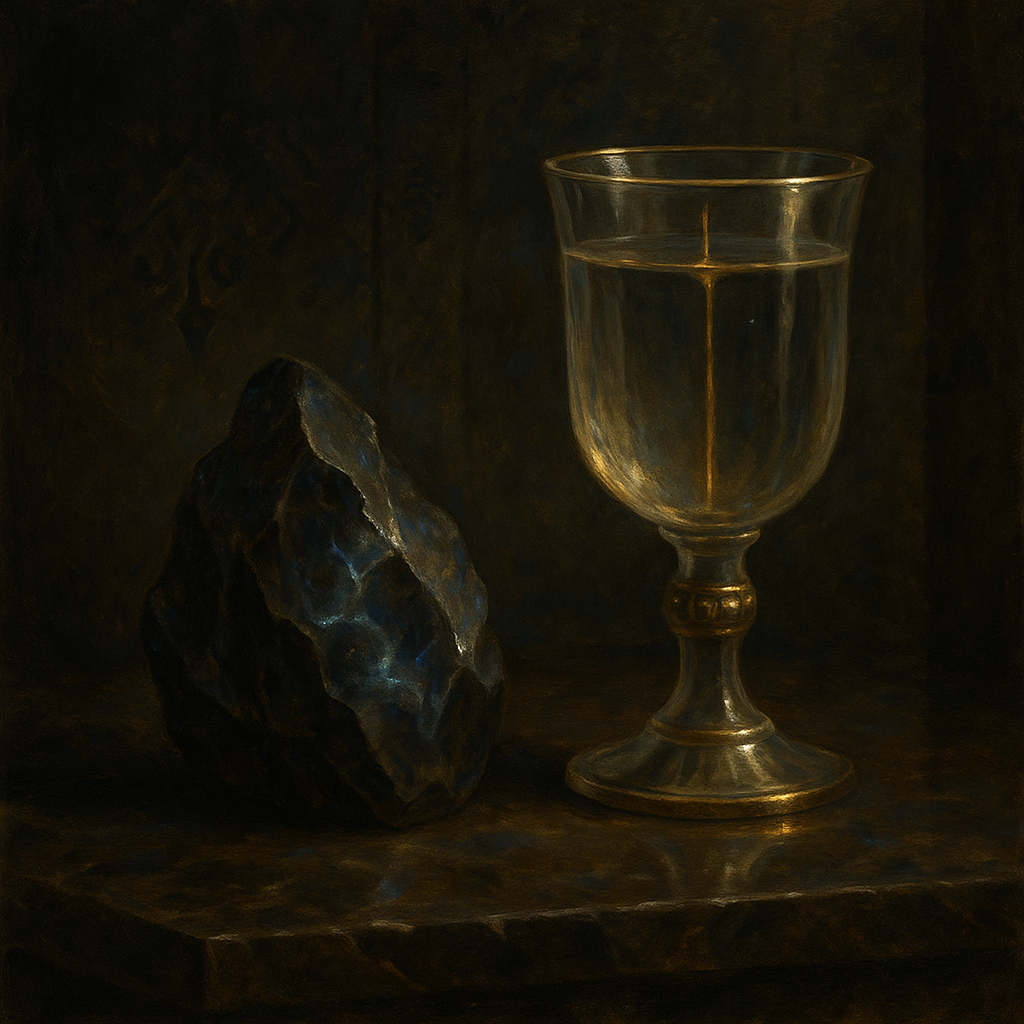
Vitrum Riftale, known commonly as Riftglass, is a rare arcano-geological metamaterial formed at the moment a foreign realm is fused into Exilum Novum by the cosmic violence of the Rift. Neither wholly mineral nor wholly arcane, it exists in a liminal state between substance and resonance: a fragment of extradimensional memory made solid. In its raw form it appears as a dark, smoky vitreous mass shot through with errant flickers of pale aether-light, as though storms from another world still roil within its depths. These shifting patterns have unsettled observers for centuries, and early Imperial natural philosophers described the material as “glass that dreams of being elsewhere.”
Although known in a rudimentary sense since the mid-1st century NE, Vitrum Riftale remained little more than a dangerous curiosity for most of Imperial history. Raw Riftglass is volatile, warm to the touch during mana flux, and prone to magnifying or distorting ambient spellcraft in unpredictable ways. For this reason it was tightly controlled by the early Collegium Arcanum, who deemed it simultaneously sacred, perilous, and indispensable to their study of the Rift’s nature.
Only within the last eighty years has the Imperium unlocked the method of purification, a painstaking refinement that stabilises the material and leaves a single thread of golden aether running through its now-clear heart. This safe-grade Riftglass has become one of the most coveted substances in the Empire. Arcanii craftsmen employ it in resonance lenses and scrying mirrors, while senators and highborn families flaunt it in ceremonial pendants, signet lenses, and even drinking vessels—status symbols proclaiming both wealth and the favour of the arcane.
To the Arcanii, Vitrum Riftale is more than a curious mineral; it is a relic of cosmological truth, a shard of the threshold between worlds. To the common folk it remains an object of quiet awe and whispered superstition. And to the Empire as a whole, it stands as proof that even the wildest forces of the Rift may be studied, mastered, and ultimately woven into the tapestry of Imperial dominion.
Properties
Material Characteristics
Raw Vitrum Riftale presents as a dense, smoky vitreous mass, neither fully opaque nor truly translucent. Its base body resembles darkened glass or cooled obsidian, but with a depth that feels less geological than dimensional. When held to the light, shifting tendrils of pale blue aether flicker within the interior—thin, lightning-like arcs that dance and coil, fading and reappearing without predictable rhythm. These internal patterns react subtly to movement, temperature, and ambient magical activity, creating the impression that the material is alive with trapped storms or restless memories from another world.
To the touch, raw Riftglass is unnervingly smooth, almost oily, and often carries a faint residual warmth during periods of heightened mana flux. The surface refracts light irregularly, producing faint halos and distortions that can cause dizziness or momentary disorientation in those unaccustomed to its presence. When fractured, the material breaks along jagged, razor-sharp planes, each edge gleaming faintly with a cold aetheric sheen.
Purified safe-grade Vitrum Riftale is visually and physically transformed. The smoky opacity vanishes, replaced by flawless transparency reminiscent of the finest crystal. Suspended within this clarity lies a single, hair-thin filament of molten gold aether—an unbroken line that serves as the material’s stabilised “spine.” This filament refracts light with a soft internal glow and remains perfectly straight even when the glass around it is shaped or polished. Safe-grade Riftglass is cool to the touch, pleasantly resonant, and markedly more durable than common glass; when tapped, it produces a pure, bell-like chime that Arcanii claim reflects its harmonised connection to the Rift.
Whether raw or refined, Vitrum Riftale is unmistakable: a material born of violent cosmic upheaval, shaped by aether, and balanced precariously between beauty and danger.
Physical & Chemical Properties
Vitrum Riftale possesses a suite of unusual and often contradictory behaviours shaped by its hybrid nature as both mineral and aetheric construct. In its raw state, the material is mana-reactive, responding to ambient arcane currents with subtle pulses of internal light or sudden shifts in its smoky patterns. These reactions can intensify during celestial events—particularly during Aetherion’s higher phases—causing the internal “lightning” to quicken or fracture into branching filaments. Raw Riftglass is also thermally unstable, warming slightly during arcane fluxes despite ambient temperature, and cooling rapidly when removed from magical influence.
Magically, raw Vitrum Riftale behaves as a resonance amplifier: it strengthens spell energies passing through or near it, but does so unevenly, often resulting in distortion, harmonic feedback, or uncontrolled surges. These distortions make the material hazardous for direct spellcasting, but highly valuable for the study of mana topology. Arcanii note that each shard carries a unique “signature”—a pattern of resonance that reflects the world from which the Rift fragment originated.
Purified safe-grade Riftglass exhibits dramatically different properties. The unstable internal flicker collapses into a single stabilised aetheric filament, and the material becomes mana-conductive rather than erratically amplifying. Spell energies pass through it smoothly, gaining clarity rather than distortion, which makes refined Vitrum Riftale ideal for scrying lenses, resonance mirrors, and arcane measurement devices. Safe-grade Riftglass also demonstrates notable resilience, resisting shattering and bending light with exceptional precision.
Chemically, the material remains largely inert in both raw and refined forms, though prolonged exposure to intense magical force can cause microfractures that glow faintly with blue-gold light. It is neither soluble nor reactive with common acids or bases, and retains its structural integrity even under high heat—though extreme temperature shifts may disrupt the aetheric filament within purified forms.
To non-magical senses, purified Riftglass seems deceptively ordinary, but under the scrutiny of spellcraft it reveals itself as a harmonised conduit of aether, capable of shaping, focusing, or revealing energies that ordinary materials cannot perceive. It is this duality—mundane clarity, supernatural responsiveness—that makes Vitrum Riftale one of the most coveted materials in the Imperium.
Compounds
Vitrum Riftale serves as a foundational component in several arcane and artisanal compounds developed throughout Imperial history, each leveraging its unusual resonance profile.
The most famous of these is Filamentum Aethernatum, a stabilising compound derived from trace particles removed during the purification of raw Riftglass. When suspended in consecrated oil or mixed into alchemical varnish, this compound enhances the clarity and sensitivity of arcane instruments. Scrying mirrors, resonance rods, and divinatory lenses prepared with Filamentum Aethernatum exhibit markedly reduced distortion and can capture finer fluctuations of mana flow—making the substance indispensable to the Collegium Arcanum.
Riftglass dust—known as Pulvis Riftalis—plays a role in forgework, though only in minuscule quantities. When added to molten metals, especially high-grade bronze or dwarven steel, it can produce alloys that carry faint mana responsiveness. These alloys are not magical in themselves but can be inscribed with runes or glyphs that hold enchantments more effectively. The Brass Cities have shown particular interest in Pulvis Riftalis for their solar-geometry devices, using it to sharpen optical precision in heliometric arrays.
A rarer derivative, Liquor Riftalis, forms when raw Riftglass encounters sustained magical heat. This molten form retains the smoky aether flicker and is used by Arcanii in high-level experiments concerning aether behaviour under compression. Once cooled, Liquor Riftalis solidifies unpredictably—sometimes returning to traditional Riftglass structure, other times producing unstable fractal crystals that must be carefully disposed of.
Finally, purified Riftglass itself becomes a compound when inlaid into Aetheric Conduits: intricate latticeworks of gold, silver, and arcane ink used in ritual machinery. In these devices, Vitrum Riftale acts as the central harmonising element, uniting disparate layers of resonance into a coherent whole. Without it, many of the Imperium’s most sophisticated arcane instruments—such as Rift monitors, long-range augury arrays, and certain elements of the Basilica Arcanii’s codex engine—would be impossible.
Though dangerous and difficult to work with, Riftglass compounds have become quietly foundational to the Imperium’s arcane sciences, elevating the study of the Rift from superstition to structured doctrine.
Geology & Geography
Vitrum Riftale occurs only along the shattered boundaries of Rift Scars, those violent seams where a foreign realm is fused into Exilum Novum. Though the world has endured many such arrivals over its long history, the Imperium has been able to examine only a select few, for most ancient scars lie far beyond Imperial reach or within territories too hostile to permit scholarly inquiry. The scars associated with the Dwarves, Humans, Centaurs, Halflings, Brass Cities, and the enigmatic Tall Walkers form the entire corpus of Rift zones that Imperial natural philosophers and Arcanii have been able to study in detail. These scars fall largely within, or just beyond, the current borders of the Empire, providing a rare opportunity to observe the geological violence of the Rift at close range.
Within these accessible scars, Vitrum Riftale is found embedded in beds of vitrified collision stone, where the incomprehensible energies of world-translocation have flash-melted native rock and fused it with matter from the incoming realm. The surrounding geology reflects this upheaval: fractured layers, jarring shifts in mineral composition, foreign stone types with no analogue elsewhere in Exilum, and veins of fused material that seem more sculpted by pressure waves than by any natural tectonic process. Raw Riftglass forms within this chaos as dark, smoky masses, their interiors flickering with pale aether-light that pulses or spirals according to the nature of the Rift that birthed them.
The most ancient Riftglass known to the Imperium lies within the Dwarven Rift Scar, a zone the Dwarrow have studied since long before the Romans’ arrival. Through treaty and cooperation, small quantities of Dwarven Riftglass reach the Arcanii, valued for its primordial instability and wild, rapid flicker patterns. By contrast, the Rift that delivered the Centaurs to Exilum produced long, slender seams of Riftglass beneath the western grasslands, where steady winds and soil pressure appear to have tempered the material; scholars note that these shards exhibit a slow, almost rhythmic internal flicker that makes them less volatile than other varieties.
The Imperium’s own Rift Scar, created during the arrival of the Nova Roman Province eight centuries ago, runs along the Novaium Perimeter Ridge. This scar contains numerous small deposits of Riftglass whose consistency and predictable resonance have rendered them ideal for modern purification techniques. Most safe-grade Vitrum Riftale currently in circulation originates here. Further afield, the Halfling Rift Scar holds only modest deposits scattered across coastal cliffs and island ridges, yet these fragments, though delicate, possess an unusual clarity in both body and flicker.
The most politically charged of the studied scars lies along the frontier with the Brass Cities. The Brass Cities Rift Scar is rich in Riftglass of exceptional quality, and its deposits often yield purified material marked by especially vivid golden filaments. Access to this zone is a matter of delicate diplomacy; Brass City scholars guard it jealously, and Imperial Arcanii pursue samples through formal exchanges rather than risk international friction.
The scar of the Tall Walkers is perhaps the most haunting of all. Situated to the west of the Empire near the city of Aurinorina, along the edge of the Deserta Solis Aeternar, it presents the ruins of a civilisation that seemingly vanished without leaving a single living descendant. Only shattered stone colonnades, half-buried halls, and fragments of strange architecture remain to hint at their nature. Riftglass found here carries a distinctive spiral-patterned flicker, as though the energies of its birth twisted inward upon themselves. This scar, more than any other accessible to Imperial scholars, underscores the enigma of the worlds drawn into Exilum: not all survive the crossing.
Across all these sites, Vitrum Riftale remains a finite and irreplaceable resource. Since no world has ever been drawn into Exilum twice, each scar represents a unique geological and arcane signature that will never recur. Once a seam is exhausted, its particular form of Riftglass is lost forever. This scarcity, combined with the danger of extraction and the political sensitivity of certain scars, ensures that Vitrum Riftale remains one of the most contested and carefully regulated materials within the Imperium.
Origin & Source
Vitrum Riftale is born in the first catastrophic heartbeat of a Rift event, when two incompatible realities are forced into sudden union. As the incoming realm is overlaid upon Exilum Novum, the unimaginable pressures of translocation crush, melt, and fuse the colliding geologies. Stone is not merely shattered but re-written, its structure destabilised by the violent intrusion of foreign matter and the surge of raw aether that accompanies every Rift. Within this crucible of heat, pressure, and arcane upheaval, certain pockets of material undergo a profound transformation: they vitrify into a dark, glass-like substrate while simultaneously absorbing an imprint of the aetheric forces that tore the worlds together. The result is a metamaterial that is neither natural glass nor true mineral, but something caught between substance and event.
This hybrid nature explains the eerie behaviour of raw Riftglass. The smoky opacity of its body reflects the melted and recombined stone from which it forms, while the pale internal flicker—those drifting arcs of trapped blue-white light—are remnants of the unbound aether passing through matter at the instant of impact. Arcanii scholars describe this flicker as a “resonant echo,” a memory of the Rift shock that was frozen into physical form before it could dissipate.
Although the Imperium only arrived in Exilum eight centuries ago, early Roman engineers and philosophers quickly recognised that certain glassy deposits around the Novaium Rift Scar differed fundamentally from common volcanic glass or melted sand. By c. 50 NE, the Collegium Arcanum had formally classified these strange shards as products of the Rift itself, noting their mana-reactive properties and their tendency to distort spellcasting. However, the true origin of Vitrum Riftale remained speculative until the Dwarrow shared their own geological records centuries later. Dwarven stone-scribes had long observed identical structures within their ancient Rift Scar, confirming that the material arose not from natural processes but from the singular violence of world-crossing.
Despite centuries of study, Riftglass remains a singular creation of the Rift moment. No known forge, crucible, or magical artifice can replicate the pressures or arcane saturation necessary to form it. It is, in essence, a relic of cosmological collision, a substance that exists only because two worlds once occupied the same space for a breathless instant. For this reason the Arcanii consider Vitrum Riftale a sacred artefact, a physical testimony to the forces that shape their cosmology, and a reminder that the boundaries between worlds are thinner—and far more fragile—than they appear.
Life & Expiration
Vitrum Riftale does not decay in the conventional sense; its mineral substrate is as durable as obsidian and resistant to weathering, pressure, and chemical corrosion. Where it differs fundamentally from natural materials is in the stability of its aetheric resonance, which shifts over time in response to environmental conditions and the natural waning of post-Rift arcane saturation.
Raw Riftglass is inherently unstable. Its internal flicker—the pale, restless arcs of trapped aether—gradually weakens across centuries, though never entirely vanishes. As the resonance decays, the material becomes more brittle and more unpredictable in its reactions to magic. Ancient shards from the Dwarven Rift Scar, for example, exhibit quick, fragmented bursts of flicker that scholars interpret as a kind of “resonance fatigue,” the aetheric echo splintering into chaotic pulses after millennia of dormancy. Such samples must be handled with great caution, for their weakened resonance can fracture explosively when subjected to spellcasting or sudden temperature change.
Purified Vitrum Riftale behaves very differently. The purification process aligns the material’s internal resonance around a single stabilised filament of golden aether. This filament is remarkably durable, but not eternal. Over the course of decades—sometimes centuries—the filament may fade, thinning until its glow becomes little more than a memory. As the filament weakens, the Riftglass gradually loses the perfect clarity prized by artisans; faint opacities form, and the resonance that once conducted spell energies with precision begins to muddle.
Even so, purified Riftglass retains its structural integrity for generations, and many noble families consider their Riftglass heirlooms valuable precisely because the filament within is slowly dimming—a visible reminder of the impermanence of all things shaped by the Rift. The Arcanii, however, view such deterioration with concern, for a weakened filament can destabilise high-precision instruments, requiring costly re-purification or replacement.
Riftglass does not expire in the manner of organic or volatile materials, yet it undeniably ages, its aetheric signature drifting away from the moment of its creation. In this way each shard behaves like a chronicle of the Rift event that birthed it: immutable in form, but slowly losing the brilliance of its first, impossible moment.
History & Usage
History
The history of Vitrum Riftale within the Imperium is marked by a striking contrast between how the world’s civilisations regarded the material in its raw state and how they clamoured for it once the Empire learned to tame it. Though Riftglass has existed for millennia—born in every Rift event long before humans arrived—it was humanity, and humanity alone, who recognised early that this volatile, flickering substance held unrealised potential. Other peoples dismissed it for centuries: the Dwarrow saw it as an irritant in their mines, dangerous to strike and worthless to smelt; the Centaurs regarded it as cursed glass that unsettled their herds; the Halflings found it too fragile for jewellery and too unpredictable for trade; and the Brass Cities considered it an aesthetically displeasing byproduct of cosmic violence. Even the Tall Walkers, judging from their abandoned structures near Aurinorina and the Deserta Solis Aeternar, appear to have ignored Riftglass entirely.
When the Imperium arrived eight centuries ago, this indifference puzzled the earliest Arcanii. By c. 50 NE, they had already documented the material’s erratic relationship with magic, its tendency to distort spellcraft, and the eerie aether-light that danced within its smoky interior. To the Collegium Arcanum, Vitrum Riftale seemed nothing less than a physical echo of the Rift’s cosmological power—an object worthy of reverence and study. Other civilisations, however, found the Empire’s fascination excessive, even eccentric. Several Dwarrow stone-scribes famously remarked that “only humans would try to hold a Rift in their hands and expect it to behave.”
Yet what other cultures dismissed, Rome pursued. Over centuries, the Imperium traded, bartered, and negotiated for access to Riftglass deposits within Dwarven, Centaur, Halfling, Brass City, and Tall Walker territories. Most saw little loss in parting with shards that held no perceived value; the Empire saw opportunity. Gradually the Arcanii built a corpus of data unmatched elsewhere, demonstrating conclusively—through Dwarven samples—that Riftglass formed exclusively at the moment of world-translocation and therefore carried a unique aetheric signature from each Rift.
Still, for most of Imperial history, the substance remained volatile and nearly impossible to shape. Countless early experiments ended in catastrophe—resonance flares, shattering shards, shrieking harmonics, and laboratory fires that became the cautionary tales of Arcanii apprentices. Raw Riftglass was powerful but unusable. Its potential remained locked behind unpredictability.
Everything changed in the last eighty years.
During the reign of Emperor Severinus III, a landmark collaboration between Imperial metallurgists, Dwarven rune-smiths, and senior Arcanii produced the first functioning purification crucible. This device harmonised the chaotic flicker within raw Riftglass into a single golden filament of stabilised aether, rendering the material safe to shape, polish, and enchant. The moment refined Riftglass entered the world, its value soared—and, for the first time, other civilisations began to recognise what the Imperium had been chasing for centuries.
The Dwarrow admired its structural resilience and perfect refractive qualities, using it in the crafting of precision rune lenses. The Brass Cities coveted it for heliometric instruments and solar-geometry devices, where aether-stabilised clarity outperformed any native glass or crystal. The Halflings prized it as a mark of elite trade houses, commissioning Riftglass amulets and navigational prisms. Even the Centaurs, initially wary, began to incorporate refined Riftglass into relics and ceremonial bridles, believing the golden filament represented cosmic harmony.
Only the Elves remained cautious, seeing in refined Riftglass not beauty, but a reminder that the barrier between worlds was fragile. Yet even they could not deny its usefulness in certain moonlit enchantments.
Thus refined Riftglass became a rare point of convergence in an often-divided world. While raw Riftglass had been dismissed as dangerous folly, purified Vitrum Riftale became a treasure: coveted for its beauty, its precision, its magical stability, and its symbolic power. The Imperium, having mastered the refinement process, became the sole large-scale producer of safe-grade Riftglass—transforming what had once been a uniquely Roman obsession into one of the most sought-after materials in Exilum Novum.
In the present day, Riftglass stands at the crossroads of culture, science, diplomacy, and commerce. Its raw form remains a sacred mystery to the Arcanii; its refined form is a luxury of kings, a tool of scholars, and a bargaining chip of nations. The rest of the world now covets what the Imperium saw long before anyone else: a fragment of cosmic violence, tamed by human ingenuity, and shaped into a thing of wonder.
Discovery
The formal discovery of Vitrum Riftale as a distinct material of arcane significance unfolded gradually, shaped as much by Imperial curiosity as by the indifference of other civilisations. Although shards of Riftglass had been encountered by countless peoples over the centuries—embedded in Dwarven mine walls, scattered across the Centaurian plains, or glinting along the Tall Walker ruins—none had ever investigated them beyond noting their hazards. To most, the substance was an unwelcome reminder of the Rift’s destructive force, a material to be avoided rather than understood. Its potential remained dormant, overlooked for generations.
For the Imperium, the story began in the earliest decades after the Nova Roman Province arrived through the Rift. Engineers reinforcing the newly formed ridges of Novaium noted with some concern the presence of unusual vitrified deposits. These stones cracked with unnatural sharpness, carried an unsettling warmth, and exhibited visual distortion that made the eye wander. They were catalogued as curiosities, but it was not until the Collegium Arcanum assumed responsibility for studying all Rift phenomena that the material came under serious scrutiny.
By c. 50 NE, the Arcanii had isolated several specimens and conducted experiments revealing that these shards reacted dramatically to magical energy. Even the simplest incantations caused the internal flicker to pulse or spiral, and attempts to channel spells through the material resulted in distortions unlike any known magical resonance. These early tests convinced the Collegium that the substance was not merely geological refuse but a physical remnant of the Rift event itself—a memory of the crossing, preserved in glass.
Yet to understand its universal nature, the Imperium needed comparative samples. This opportunity arrived through diplomatic contact with the Dwarrow, whose Rift Scar predated all others in Imperial reach. Dwarven stone-lore held that such glassy formations existed wherever a Rift tore open the world, and their records confirmed that each deposit bore unique resonance traits tied to the nature of its originating realm. With Dwarven cooperation, Imperial scholars gained access to ancient shards from Rift II—material far older than anything in Novaium—and recognised the same internal flicker, though weakened by millennia. This revelation definitively proved that the Imperium’s strange glass was not unique, but a universal artefact of the Rift.
The Centaurs, Halflings, and Brass Cities were slower to acknowledge Imperial findings, for none had regarded Riftglass as anything more than a nuisance or talismanic oddity. Nonetheless, as Arcanii research grew more sophisticated, samples from their territories were quietly acquired through trade or scholarly exchange, each contributing to the growing body of knowledge. By the mid-Imperial period, the Collegium had amassed the first comprehensive archive of Vitrum Riftale varieties—a collection unmatched anywhere in the world.
Still, the true breakthrough—the moment raw Riftglass transformed from subject of study into a workable resource—came much later. After centuries of failed attempts, the first successful purification crucible was developed during the late 7th century NE. This device harmonised the chaotic aetheric flicker into a stabilised golden filament, producing the first piece of safe-grade Riftglass in recorded history. The refinement process was difficult, dangerous, and poorly understood, yet its results were undeniable. The Collegium immediately recognised its potential; the aristocracy immediately recognised its beauty; and for the first time, every major civilisation took note.
Thus Vitrum Riftale, once dismissed as volatile debris, became a coveted material across the known world. Its discovery was not a single moment but a century-spanning revelation—one driven not by accident, but by the Imperium’s relentless conviction that even the mysteries of the Rift could be studied, mastered, and shaped to human will.
Everyday use
Despite its rarity and value, Vitrum Riftale—in both raw and refined forms—has woven itself into the daily fabric of life across many civilisations, though always in ways shaped by its volatile nature and the cultural philosophies surrounding it. Even so, “common use” is a relative term; among ordinary citizens, Riftglass remains a curiosity glimpsed more often in ritual or public display than held in the hand. Yet its presence is unmistakable in both the mundane rhythms and the elevated moments of Imperial life.
Within the Imperium Novum, raw Riftglass rarely enters the public sphere. Instead, it resides in the laboratories of the Collegium Arcanum, where apprentices and scholars employ small shards for training exercises in mana perception, resonance sensitivity, and aether mapping. These controlled settings offer citizens their primary exposure to Riftglass: the flicker of light in an Arcanii workshop window, or the hum of resonance from behind a closed laboratory door. Ritual specialists occasionally display raw shards during imperial festivals marking past Rift cycles, using them as educational tools to connect the populace with the cosmological history of their world.
Refined Riftglass—known colloquially as safe-grade Riftglass—enjoys far more visible roles. Its most widespread everyday use is in ornamental and ceremonial glassware, particularly among wealthier citizens. Though still expensive, smaller crafted pieces such as pendants, amulets, or small drinking vessels have become fashionable in urban centres like Novaium, Aurinorina, and the Brass City border-towns, where cultural exchange fuels luxury markets. The single golden filament within each refined shard serves as both decoration and status symbol, its purity often scrutinised as closely as a jeweller would examine a gemstone.
In many households, especially those of minor officials or prosperous merchants, a single Riftglass item may serve as a family heirloom or token of aspirational prestige. It is not uncommon to see a Riftglass lens mounted above a household shrine, where its faint internal glow symbolises clarity, harmony, or good fortune. Even the poorest citizens may encounter Riftglass in the form of public artefacts displayed within temples or civic ceremonies, where refined pieces are presented as symbols of the Empire’s mastery over cosmic forces.
Outside the Imperium, common use varies greatly. The Dwarrow, initially skeptical of the material, soon recognised the utility of refined Riftglass in precision tools. Smaller lenses are now found in their workshops and rune-forges, used by artisans to examine minute inscriptions or measure subtle shifts in rune alignment. Among the Halflings, Riftglass has become a fashionable trade good: modestly sized charms, amulets, and navigational prisms crafted from refined shards are becoming common among sailors, serving as both ornament and practical tool under starlight.
The Centaurs employ refined Riftglass sparingly but with reverence, setting it into bridles, ritual staffs, or sacred tokens tied to seasonal observances. In these contexts, the golden filament is interpreted as the path of one’s soul or lineage, lending the material personal spiritual weight. The Brass Cities, ever driven by mathematics and solar-geometric principles, have incorporated Riftglass into a handful of mundane yet vital devices—alignment scopes, signalling prisms, and precise glass gauges—though these are too costly to be truly widespread.
In all cases, Riftglass remains a material whose “common use” reflects not its everyday availability, but its pervasive cultural presence. Though few will ever own a shard, many will see its glow in public rituals, touch its polished surface in a temple alcove, or hear stories of those who possess a treasured piece. Riftglass is not common in quantity, but common in imagination: a material whose very existence shapes the daily worldview of those who live beneath the shadow and splendour of the Rift.
Cultural Significance and Usage
Across the known world, Vitrum Riftale occupies a cultural space far larger than its scarcity should allow. It is a material laden with symbolism: a fragment of cosmic upheaval that inspires awe, reverence, ambition, and at times unease. Each civilisation interprets Riftglass through the lens of its own traditions, seeing in its smoky depths and golden filament reflections of their identity, their fears, and their aspirations.
For the Imperium Novum, Riftglass is nothing less than a tangible expression of the Empire’s destiny. Raw shards are treated by the Collegium Arcanum as relics of the universe’s hidden order—a material through which the Rift’s mysteries may be glimpsed, if not fully understood. Arcanii rites often incorporate raw Riftglass as a visual symbol of liminality: the point at which knowledge blurs into the unknowable, and reason confronts cosmic truth. In public life, refined Riftglass has become deeply entwined with imperial authority. A senator’s signet lens, a legate’s ceremonial goblet, the Imperial Household’s regalia—all gleam with the unmistakable golden filament that signals mastery over forces other peoples left untouched. Displaying purified Riftglass is as much a declaration of intellectual dominion as it is one of wealth or status.
Among the Dwarrow, the material’s cultural meaning has evolved in tandem with their growing respect for refined shards. Once regarded as an irritant in their mines, Riftglass now holds a place of honour within rune-smithing circles. Its perfect transparency allows master artisans to observe the flow of enchantment through the runic matrix, making it a tool of philosophical contemplation as well as craftsmanship. Dwarrow do not revere Riftglass in a spiritual sense, but they esteem it as a marker of precision, truth, and the deep order of stone-lore.
The Centaurs approach Riftglass with a more mystical sensibility. The golden filament within refined shards is seen as an echo of the Life-Current, the undivided path that each spirit follows from birth to death. Riftglass tokens are carried into rites of passage, fastened to ceremonial harnesses during sacred processions, or set into staffs used by their lorekeepers. Though the Centaurs still regard raw Riftglass with suspicion—believing its smoky flicker to be a sign of unsettled spirits—the purified form has become an emblem of cosmic alignment and personal destiny.
The Halflings embrace refined Riftglass as a symbol of prosperity and navigational favour. Mariners claim that the golden filament “remembers the horizon,” and many captains commission Riftglass prisms blessed by shipboard clerics. As adornment, Halfling artisans favour small, elegantly cut pieces mounted in silver, worn as amulets thought to attract fortune and ward off treachery in trade.
In the Brass Cities, whose cultural life is shaped by solar geometry and mathematical philosophy, refined Riftglass is prized for its optical purity. Scholars use it in sun-scopes, heliometric aligners, and ritualised star-gazing instruments. Though not revered spiritually, it carries intellectual prestige: a material whose internal harmony mirrors the order they seek in celestial patterns. The Brass Cities’ adoption of Riftglass has a secondary cultural impact as well—its presence in scholarly devices signals an openness to foreign insight, something their neighbours find both intriguing and disquieting.
Even the Elves, wary of the Rift’s scars upon the land, recognise Riftglass as a potent symbol. To them, refined Riftglass is the “Memory of Wounds”—a reminder that every world drawn into Exilum bears scars, and that the Empire’s triumph in taming this substance may come at spiritual cost. Elven artisans sometimes incorporate purified shards into moonlit vigils or healing rites, not as tools, but as objects of contemplation and mourning. They alone regard Riftglass less as a triumph of civilisation and more as an elegy for worlds lost.
In every culture, Riftglass reflects not what it is, but what each people most values—or fears. It is a mirror held up to civilisation itself. For some, it is the embodiment of mastery; for others, a whisper of danger; for still others, a symbol of the grand cosmic patterns shaping existence. Over time, it has become one of the rare materials that commands near-universal fascination, its golden filament threading quietly through the ceremonies, philosophies, and identities of a world bound together by the Rift’s inexorable rhythm.
Industrial Use
The industrial applications of Vitrum Riftale are shaped by its dual nature: volatile and hazardous in its raw state, yet extraordinarily precise and stable once purified. No other material in Exilum Novum presents such a dramatic divide between unusability and indispensability. As a result, nearly all industrial use centres not on raw Riftglass—which is too unpredictable for conventional manufacture—but on safe-grade, purified Vitrum Riftale, whose stabilised aetheric filament grants it properties unmatched by any natural glass, crystal, or mineral.
Within the Imperium Novum, the purification crucible remains the cornerstone of Riftglass industry. This apparatus—jealously guarded by the Collegium Arcanum and licensed only to a handful of Imperial workshops—subjects raw shards to a sequence of harmonising pressures, gradual heating cycles, and rune-based resonance alignments. The process is slow, expensive, and risky; a quarter of crucible runs end in failure, producing little more than fractured shards or unstable matter that must be safely neutralised. Yet the rewards justify the cost. The resulting material, with its flawless clarity and perfectly aligned golden filament, has become the gold standard for precision optics, arcane instrumentation, and luxury craft.
The most significant industrial use lies in arcane instrumentation, where purified Riftglass serves as the primary material for lenses, prisms, and resonance conduits. Arcanii technicians employ Riftglass lenses in scrying mirrors, aether-flow monitors, and the delicate alignment arrays used to map Rift fluctuations. Its unrivalled clarity allows spell energies to pass through without the distortions common to quartz or volcanic glass, enabling devices of subtlety and accuracy impossible before its refinement. The Basilica Arcanii’s great Codex Engine, whose array of harmonic lenses tracks and interprets cosmological shifts, depends entirely on Riftglass for its function; without it, whole branches of augury and arcane science would collapse.
Dwarven workshops have adopted refined Riftglass for precision rune-smithing, using Riftglass windows and observation crystals to monitor the behaviour of glowing runes as they are laid or recharged. Some of their finest mechanised constructs contain Riftglass viewing apertures that allow smiths to inspect internal enchantments without disassembling the device. These uses remain rare but increasingly influential, bridging the gap between Dwarven metallurgical tradition and Arcanii arcane theory.
In the Brass Cities, Riftglass has become central to the era’s newest solar-geometric technologies. Brass City scholars incorporate purified shards into heliometric calibrators, sun-scopes, and the ritualised astrolabes used to chart celestial geometry. The golden filament is prized not only for structural stability but for the way it interacts with concentrated sunlight, creating predictable diffraction patterns that simplify solar calculation.
Even among the Halflings and Centaurs—civilisations with little interest in Riftglass until recently—industrial utility has begun to emerge. Halfling navigators use small Riftglass prisms in star-compasses, allowing clearer readings in fog or twilight. Centaurian craftmasters employ tiny Riftglass beads within tension-measuring harness fixtures, where the filament’s alignment can indicate stress changes that ordinary materials cannot reveal.
Raw Riftglass, by contrast, sees almost no industrial employment. Its unpredictable resonance and tendency to shatter under magical or mechanical stress make it unsuitable for any process requiring stability or precision. However, in controlled laboratory settings, small raw fragments are sometimes used as reactive catalysts, their flicker patterns allowing researchers to test resonance fields or measure mana flux during experimental spellcraft. These uses are strictly regulated and far removed from any conventional manufacturing practice.
Across the known world, refined Vitrum Riftale has become a material that defines modern industry: a substance that sits at the heart of optics, enchantment, research, navigation, and emergent arcane sciences. Though available only in small quantities and at great cost, its influence far exceeds its volume. Where Riftglass is found, industry advances; where it is absent, entire fields remain shackled to older, cruder tools. The material has become an industrial cornerstone—not for its abundance, but for its unparalleled precision and its capacity to reveal the hidden structures of the world.
Refinement
The refinement of Vitrum Riftale is among the most jealously guarded and technically demanding processes in the known world—part alchemical discipline, part metallurgic art, and part arcane ritual. No other material requires such a delicate balancing of heat, pressure, and resonance, for the very qualities that make raw Riftglass valuable also make it extraordinarily unstable. The aim of refinement is to tame the chaotic aetheric flicker within the glass, collapsing its wild internal storms into a single, harmonised filament of golden light. Only when this filament forms does the material become safe-grade Riftglass, suitable for cutting, shaping, and industrial or ceremonial use.
The process begins long before a shard ever reaches a crucible. Raw Riftglass must be graded according to its resonance profile, a task performed exclusively by trained Arcanii. Each shard is examined for flicker rhythm, opacity, internal temperature flux, and the nature of its aetheric echo; shards whose resonance spirals too violently are set aside as unrefinable, lest they destabilise the crucible. Those with stable or tractable flicker are transported under protective wards to licensed purification workshops in Novaium, Aurinorina, or select Dwarven holdfasts.
The purification crucible—first perfected only eighty years ago—is the heart of the process. At its simplest description, the crucible subjects the Riftglass to a slow, controlled heating cycle while a lattice of runic channels imposes a harmonic constraint on the shard’s resonance. But this description belies the complexity. The runes themselves must be inscribed in a particular order, each one activated at precise intervals measured not in seconds, but in mana pulses. Dwarven rune-smithing provides the structural integrity; Arcanii theory governs the resonance alignment; and Imperial metallurgists maintain the crucible’s thermal stability. Should any one of these elements falter, the shard may fracture explosively, melt into useless slag, or—on rare occasions—produce unstable variants that must be entombed and sealed for safety.
As the shard approaches its harmonic point, the chaotic flicker begins to collapse inward. What was once a storm of blue-white arcs gradually draws into a single, shimmering line that stabilises at the shard’s core. This is the aetheric filament, the hallmark of refined Vitrum Riftale. The process is delicate: too little pressure, and the flicker will not cohere; too much, and the filament will snap, rendering the shard worthless. Skilled refiners compare this moment to “coaxing lightning into a wire”—a feat that requires both scientific precision and intuitive mastery.
Once the filament forms, the shard must be allowed to cool slowly within the crucible, following a strictly controlled temperature descent. Disturbing the shard during this phase can cause the filament to distort, split, or fade entirely. Only after full cooling can the Riftglass be safely removed, cut, and polished. Even then, artisans may reshape it only along specific axes determined by the filament’s alignment; working against the filament’s grain risks compromising the material’s clarity or resonance.
Because the refinement process is dangerous, costly, and slow—each crucible run consumes several days and succeeds only three-quarters of the time—refined Riftglass remains one of the most valuable substances in Exilum Novum. The Collegium Arcanum licenses only a handful of workshops to perform purification, and violations of these restrictions are treated as acts of arcane smuggling, punishable with severe penalties.
To most civilisations, the refinement of Vitrum Riftale is nothing short of a miracle: the taming of a cosmic remnant into a workable material. To the Imperium, however, it is the triumphant expression of a deeply human conviction—that nothing in creation, not even the Rift itself, lies beyond understanding, mastery, or craft.
Manufacturing & Products
The manufacture of goods from Vitrum Riftale is a discipline unto itself, blending the finesse of glassworking, the exactitude of gemstone cutting, and the arcane sensitivity of ritual craftsmanship. Unlike ordinary glass or crystal, refined Riftglass cannot be shaped by brute force or rapid thermal shifts; every stage of production must respect the alignment of the internal golden filament. This filament acts as both the material’s heart and its constraint: a guide that dictates the angles at which a shard may be cut, the curvature it may accept, and the stresses it can tolerate. Skilled artisans describe the process as “listening to the filament,” for the material itself often reveals which form it is willing to take.
Once purified Riftglass has cooled and stabilised within the crucible, it is transferred to specialised workshops equipped with arcane dampeners and enchanted cutting tools. Traditional metal blades or unenchanted abrasives shatter Riftglass instantly; instead, craftsmen employ aether-scribed diamond wheels, rune-weighted stabilisation clamps, and precision chisels coated in mana-insulating resin. Each tool is calibrated to avoid introducing disruptive resonance, for even a single misaligned cut can fracture a shard or cause the filament to shear.
The first stage of manufacture involves shaping the raw purified shard into a workable form—either a block, a facet-ready crystal, or a thin plate. The shaping process is slow, often requiring hours of steady grinding to preserve structural integrity. Once the shard reaches its intended shape, artisans begin the meticulous polishing phase, smoothing the surface until it gleams with flawless transparency. It is during this stage that the golden filament is most carefully examined. If the filament wavers, spirals irregularly, or shows signs of internal strain, the shard may need to be re-cut or, in rare cases, discarded entirely.
With the material prepared, Riftglass enters the final stage of manufacture: integration into its intended purpose. The range of products is diverse:
Arcane Instruments
Riftglass is essential for the lenses, prisms, and harmonic plates used in scrying mirrors, augury engines, and resonance detectors. These instruments rely on the filament’s stability to channel spell energies with perfect clarity. A single Riftglass lens may require weeks of fine adjustment to ensure the filament aligns precisely with the instrument’s focus matrix.
Optical and Navigational Devices
Dwarven runesmiths incorporate Riftglass into precision gauges and inspection windows for enchantment monitoring, while Halfling navigators prize Riftglass prisms for their ability to refract starlight with exceptional purity. Brass City heliometric tools often feature thin Riftglass plates engraved with solar-geometry sigils, allowing scholars to track celestial motion with unprecedented accuracy.
Ceremonial and Cultural Items
The Empire’s elite favour Riftglass drinking vessels, signet lenses, reliquary casings, and pendants. These items are not merely decorative; their flawless craftsmanship displays the owner’s wealth and sophistication. In Centaur culture, Riftglass beads and medallions are integrated into ceremonial harnesses, while Halfling traders frequently wear amulets made from small, polished shards as symbols of fortune and prestige.
Architectural Features
Though rare due to cost, a few temples and state buildings in the Imperium feature Riftglass inlays—thin panels set into altars, ritual alcoves, or the domes of observatories. These installations are always placed where ambient light can catch the filament, producing a soft golden gleam believed to symbolise cosmic harmony.
Scholarly Tools and Scientific Apparatus
Within the Collegium Arcanum and allied institutions abroad, Riftglass is incorporated into experimental chambers, containment flasks, and resonance-mapping arrays. These devices often require precise geometric cuts and multilayered glass assemblies that only a handful of craftsmen in the world can achieve.
Products made from refined Vitrum Riftale are never mass-produced; each piece is a labour of mastery, often carrying the mark of its craftsperson and the record of the shard’s origin. Missteps in cutting or polishing can ruin days of work and destroy material worth a small fortune. For this reason, apprenticeship in Riftglass manufacture is one of the most prestigious—and tightly regulated—trades in the Imperium.
Wherever these products appear, they signal not only technical skill but civilisation’s ability to tame and repurpose a fragment of cosmic upheaval. In every object, from a senator’s goblet to a Brass City sun-scope, the golden filament stands as a reminder that Vitrum Riftale is as much a triumph of human craft as it is a relic of the Rift.
Byproducts & Sideproducts
The refinement and manufacture of Vitrum Riftale produce a small but significant family of byproducts, each with its own properties, uses, and risks. Because the material itself straddles the line between mineral and aetheric construct, even its waste products can behave unpredictably. As a result, the Imperium classifies all Riftglass byproducts under arcane regulation, and their handling is restricted to trained personnel.
The most common byproduct is Pulvis Riftalis, the fine, shimmering dust left behind after cutting or polishing purified Riftglass. Though inert compared to raw shards, the dust retains faint traces of aetheric alignment. Artisans sweep it into sealed containers to prevent inhalation or contamination of other materials. In controlled settings, Pulvis Riftalis is combined with enchanted varnishes or inks, producing resonance-enhanced coatings for arcane diagrams, rune-plates, or experimental apparatus. These coatings strengthen the sensitivity of instruments without introducing the instability associated with raw Riftglass.
A far rarer byproduct, produced only during failed or incomplete refinement runs, is Fractum Aetheris—splintered, glass-like fragments whose internal resonance has collapsed asymmetrically. These jagged pieces can exhibit erratic flicker, temperature shifts, or dissonant hums when exposed to magical stimuli. Too unstable for crafting and too dangerous to store casually, Fractum Aetheris is typically entombed within lead-lined rune vaults until it can be neutralised through a controlled dissolution ritual. The Collegium Arcanum occasionally studies these fragments to better understand resonance failure, though such research is performed under strict supervision.
When a raw shard is overheated during refining or subjected to uncontrolled resonance, it may melt into Liquor Riftalis, a viscous, luminous fluid that behaves as though caught between solid and liquid states. Though unstable and short-lived, Liquor Riftalis has proven useful as a temporary diagnostic medium in arcane laboratories. When poured into sealed crucibles, it reveals mana currents by shifting colour or density, allowing researchers to visualise resonance flows. After several hours, the substance cools into an unpredictable shape—sometimes reverting to inert Riftglass, other times crystallising into fractal formations that must be carefully disposed of before their resonance becomes hazardous.
Another subtle but valuable side product is the Aetheric Soot that accumulates inside purification crucibles over many runs. This faint golden residue consists of microscopic particles shed during the harmonisation of the aetheric filament. Though almost imperceptible, when collected and refined it becomes Filamentum Aethernatum, an additive used to enhance the clarity and sensitivity of Riftglass-based instruments. Only a handful of workshops possess the knowledge to harvest it safely, and it is valued by Arcanii scrywrights for use in high-precision augury lenses.
Even the waste heat generated during refinement has consequences. The crucibles vent mana-saturated vapour, a harmless but distinctive mist that glows faintly blue and dissipates quickly in open air. Some artisans believe this vapour carries spiritual significance, interpreting its fleeting shimmer as the last breath of the Rift’s chaotic echo leaving the material.
Together, these byproducts reveal a striking truth about Vitrum Riftale: nothing associated with it is truly worthless. Whether dust, shard, fluid, or faint residue, every fragment retains some whisper of its cosmological origin. Even the waste products of Riftglass bear potential—potential that the Imperium, ever curious and ambitious, continues to study with a mixture of reverence and caution.
Hazards
Vitrum Riftale, both raw and refined, carries inherent dangers that stem from its unstable relationship with aetheric resonance. Though the Imperium has developed sophisticated methods to tame and exploit the material, mishandling even a small shard can produce unpredictable—and occasionally catastrophic—effects. The Empire’s legal codes classify all forms of Riftglass as regulated arcane matter, and with good reason: where other materials break, burn, or poison, Riftglass distorts reality itself.
The greatest hazard lies in raw Riftglass, whose internal flicker behaves like a trapped storm of aether seeking release. Physical impact, abrupt temperature shifts, or exposure to active spellcasting can disrupt this delicate balance. When destabilised, raw Riftglass may fracture explosively, releasing a pulse of dissonant resonance that can cause burns, temporary blindness, nausea, or in severe cases, arcane shock—a condition in which the victim’s mana pathways become painfully overstimulated. More subtle dangers arise from sustained exposure; prolonged contact with raw shards can induce headaches, vertigo, or auditory distortions, as the shard’s shifting resonance interferes with the body’s natural mana currents.
Even refined Riftglass, though stable, is not without risk. Should its golden filament become strained through improper cutting, impact, or extreme heat, the filament may collapse into a resonance spiral, producing a sudden flare of aetheric discharge. Such events are rare but dangerous, capable of damaging delicate arcane instruments, disrupting nearby enchantments, or inducing panic in creatures attuned to magical stimuli. Because refined Riftglass is commonly used in optical devices and ceremonial items, these incidents often occur in environments where magical concentration is high—ritual chambers, scriptoriums, or the Imperial Senate during state ceremonies.
The refinement process itself carries considerable risk. Purification crucibles, while exquisitely engineered, operate at the edge of stability. A flawed rune alignment or misjudged pressure cycle can cause raw shards to vaporise into mana-saturated dust or collapse into unstable liquefaction. Workshops must be equipped with containment wards, and all refiners are required to undergo rigorous training to respond to resonance breaches. Historical records contain grim reminders of the dangers: crucibles that imploded into aetheric voids, workshops flooded with screaming harmonics, or entire chambers sealed behind leaded wards because the resonance contamination proved impossible to dispel.
In the broader world, hazards arise when Riftglass is misused or poorly understood. Smugglers sometimes transport raw shards in unshielded containers, unaware that vibrations from carts or ship holds can trigger resonance spikes. Unlicensed artisans have attempted to cut purified Riftglass with mundane tools, resulting in shattered filaments and dangerous feedback. Even collectors of antiquities have been injured by mishandling ancient fragments whose resonance profiles have decayed unpredictably over centuries.
Finally, Riftglass poses a psychological hazard, subtle but significant. Its internal flicker, especially in raw form, is known to induce feelings of unease or disorientation. Some claim that prolonged observation of the shifting patterns evokes dreams of alien landscapes or fragmented memories not one’s own. While the Collegium dismisses such claims as suggestibility, they advise apprentices never to stare into a raw shard for more than a few breaths—a warning recorded in arcane doctrine as early as 79 NE.
In all its forms, Vitrum Riftale demands respect. It is a material born of violent cosmic convergence; its hazards are not flaws but reminders of its origin. Those who work with it understand that every shard carries a whisper of the Rift—a force that reshaped worlds, and does not easily forget its nature.
Environmental Impact
The presence and extraction of Vitrum Riftale exert subtle yet profound effects on the environments surrounding Rift Scars. Because the material is formed at the very moment of world-translocation, its existence is inseparable from landscapes already warped by cosmic violence. Yet once the initial upheaval has settled, the long-term environmental impact of Riftglass depends largely on how it is handled—and whether it remains raw or has undergone purification.
In areas where raw Riftglass remains embedded in the terrain, the land often displays unusual ecological behaviour. Plants growing near exposed shards may exhibit irregular growth patterns, with leaves curling toward or away from the shard according to shifts in ambient aether. Some species appear invigorated, as though the resonance stimulates their internal lifecycles; others grow stunted or distorted. These effects are rarely dramatic but contribute to the eerie reputation of Rift Scar landscapes. Wildlife demonstrates similar sensitivities. Herd animals tend to avoid exposed Riftglass deposits, becoming agitated when driven too close, while magically attuned creatures may be drawn to the faint flicker, lingering near shard clusters as though listening to a distant rhythm only they can perceive.
Soil quality near Riftglass outcrops can also be affected. Low-level resonance seepage subtly alters mineral composition, making the ground more brittle or more prone to retaining moisture than expected. Dwarven surveys in Rift II noted that certain veins rendered surrounding stone more fragile, creating unpredictable hazards within mines. For this reason, several civilisations—most notably the Centaurs—avoid building permanent structures near Riftglass formations, believing the land to be unstable both physically and spiritually.
Extraction introduces its own challenges. Mining raw Riftglass disrupts the delicate equilibrium within Rift Scar strata, sometimes triggering resonance fractures that propagate through stone layers. These fractures release faint waves of aetheric distortion, harmless to biological life but capable of confusing navigation spells, disturbing enchantments on nearby tools, or frightening local wildlife. The Imperium’s extraction protocols require stabilisation wards to be placed before removing significant deposits, and several early mishaps—collapsing tunnels, shattering vein clusters, or sudden aether pulses—are cited in Arcanii manuals as examples of why unregulated mining poses unacceptable risks.
Purified Riftglass itself has negligible environmental impact. Once stabilised and shaped, the material emits no hazardous resonance and does not leach aetheric energy into its surroundings. The purification process, however, produces byproducts that must be managed carefully. Mana-saturated vapour, released during crucible operations, dissipates harmlessly in open air but can accumulate in enclosed spaces, causing mild disorientation or headaches. Workshops are therefore constructed with tall chimneys, dispersal wards, and ventilation systems designed specifically to prevent vapour stagnation.
Fractum Aetheris, the unstable shards produced by failed refinement attempts, poses the greatest environmental risk if improperly contained. Should such fragments enter waterways or soil, their erratic resonance may disrupt local enchantments or interfere with mana-sensitive flora. To prevent contamination, all waste materials are sealed in lead-lined containers and transported to designated Arcanii disposal sites, where they are neutralised through ritual dissolution.
Even the disposal of Liquor Riftalis—should the molten form escape containment—must be approached with caution. While short-lived, the fluid’s shifting resonance can destabilise nearby enchantments or induce temporary fluctuations in local mana density until it cools fully.
On a broader scale, the presence of Riftglass has shaped cultural approaches to environmental stewardship. Some civilisations treat Rift Scar zones with reverent caution, viewing them as sacred or inherently volatile; others, particularly the Imperium, approach them as resources to be studied and carefully harnessed. Yet all recognise that Vitrum Riftale is a remnant of forces far greater than mortal craft. Its environmental impact is the quiet echo of worlds colliding—an enduring reminder that even long after a Rift has settled, the land itself still bears the memory of that impossible moment.
Reusability & Recycling
Vitrum Riftale, despite its rarity and complexity, possesses a surprising degree of longevity. Yet its potential for reuse depends almost entirely on the condition of its internal aetheric structure. Where ordinary glass might be melted down or reforged without difficulty, Riftglass—raw or refined—responds to such processes with unpredictability, for its defining qualities emerge not from its mineral composition but from its aetheric resonance.
Raw Riftglass cannot be recycled in any conventional sense. Once a shard has fractured or lost structural integrity, its internal flicker becomes unstable, dispersing irregularly through the material. Attempting to remelt or reforge raw Riftglass results not in workable substance but in unstable liquefaction—Liquor Riftalis—which rapidly cools into useless or hazardous forms. For this reason, broken raw shards are not recycled but ritually neutralised, often by dissolving them through controlled resonance dampening. The resulting inert fragments are typically buried under leaded wards or delivered to Arcanii disposal sites.
Refined Riftglass, however, presents more promising—and culturally important—avenues for reuse. Because the golden filament within safe-grade Riftglass represents a stabilised, coherent resonance line, objects crafted from purified material retain their aetheric integrity even when damaged. A cracked goblet, fractured lens, or chipped ornament may be cut down and recut into smaller items, provided the central filament remains intact. This practice is widespread among artisans, who carefully examine each salvageable piece to determine what new shapes or functions it may support. Many high-ranking households possess heirloom Riftglass items crafted from ancestral pieces long broken, preserving the lineage of the original shard through successive generations of refinement.
When a purified shard’s filament is damaged but not destroyed, the material can sometimes undergo secondary purification. This delicate process, performed only by the Collegium or licensed workshops, seeks to realign the weakened filament within a smaller volume of glass. The success rate is low, but when it works, the result is a smaller, flawlessly stable shard with renewed clarity. Secondary purification is typically reserved for items of great sentimental or political value.
Fragments too small to recut still contain trace aetheric ordering and are collected as Pulvis Riftalis, the fine dust produced during polishing or incidental breakage. This dust is not discarded. Instead, it is incorporated into enchanted inks, experimental coatings, and resonance-sensitive varnishes used in arcane laboratories. In this way, even the smallest remnants of Riftglass find new purpose, contributing to the creation of tools and instruments that support broader research.
In recent decades, Dwarven rune-smiths have begun experimenting with embedding infinitesimal Riftglass shards within runic core matrices, where the material’s latent resonance enhances the responsiveness of certain inscriptions. Early results are promising, though the practice remains controversial among traditionalists who fear introducing Rift-born matter into sacred stonework.
Finally, an unexpected form of “recycling” has emerged in Brass City architecture. Micro-shards of Riftglass, deemed too unstable or impure for crafting, are ground into fine crystalline sand and mixed into the glass used for heliometric windows. These windows do not behave like Riftglass artifacts, but they refract sunlight with a barely perceptible golden tint—something the Brass City mathematicians claim increases the precision of solar-geometric readings.
Though full recycling in the mundane sense remains impossible, Vitrum Riftale proves remarkably renewable in purpose. Broken pieces become heirlooms reborn in new forms; dust becomes the backbone of arcane experimentation; flawed shards find lives embedded within greater constructs. In every case, the material echoes its cosmological origin: nothing is ever truly lost, only reshaped—its essence carried forward along new paths, much like the worlds once drawn through the Rift itself.
Distribution
Trade & Market
The trade of Vitrum Riftale is among the most tightly controlled and diplomatically sensitive commodity exchanges in Exilum Novum. While refined Riftglass is coveted across nearly all major civilisations, its distribution is shaped by rarity, political leverage, and the Imperium’s near-monopoly on purification technology. As such, the trade of Riftglass is less an open market and more a complex web of negotiations, patronage, and strategic alliances.
Within the Imperium Novum, raw Riftglass may only be gathered, transported, and refined under licences issued by the Collegium Arcanum and the Imperial Bureau of Natural Materials. This regulation ensures that the Empire maintains absolute control over its internal supply. Citizens may not legally possess raw shards; even nobles must obtain special dispensation to hold unrefined material for ritual or scholarly purposes. Refined Riftglass, by contrast, can be bought and sold—though its price places it firmly in the realm of high luxury. Small polished fragments are common in the markets of Novaium and Aurinorina, purchased as amulets or gifts, while larger pieces suitable for lenses or ceremonial vessels are typically sold through guild-backed auctions or by commission from licensed workshops.
In foreign trade, Riftglass occupies a paradoxical position. Most civilisations now desire refined Riftglass for its beauty, precision, or spiritual significance, yet few have independent means to produce it. The Imperium’s control of the purification process makes it the principal exporter of safe-grade Riftglass, but the Empire carefully restricts such exports to maintain diplomatic leverage. High-quality lenses or multi-shard constructs rarely leave Imperial borders except as gifts in state negotiations, payments in treaty arrangements, or offerings meant to secure alliances. Such items often become treasured heirlooms in foreign courts.
The Dwarrow participate in a unique reciprocal arrangement. In exchange for raw Riftglass samples from their ancient Rift Scar, the Imperium provides refined pieces suitable for rune-forging. Dwarven masters prize these refined shards for their clarity and stability, and many guilds keep detailed genealogies of their Riftglass tools, tracing each shard’s origin as if it were a noble lineage. These trades are conducted with solemn ceremony, reinforcing the deep partnership between the Dwarrow and the Imperium.
Among the Centaurs, Riftglass trade is irregular but symbolically important. Nomadic clans often barter raw shards uncovered on the plains in exchange for grain, steel, or medicinal supplies. Refined pieces are rarer, usually gifted by the Imperium to clan chieftains or loremasters. These pieces circulate slowly through clan networks and are often reworked into ceremonial gear rather than sold outright.
The Halflings, masters of maritime commerce, have created a small but vibrant trade niche focused on Riftglass. They purchase polished fragments from Imperial merchants and resell them at coastal markets across the known world. For Halfling traders, refined Riftglass is both a status symbol and a profitable commodity, its portability and durability making it ideal for long voyages.
The Brass Cities represent the most politically charged aspect of the Riftglass market. They possess their own Rift Scar—rich in volatile but potent shards—yet lack the purification mastery of the Imperium. As such, they engage in a competitive diplomacy, sometimes trading raw material for purified pieces, sometimes attempting to acquire knowledge of the refinement process through scholarly exchange, espionage, or commercial infiltration. Riftglass is thus a critical component of Brass City–Imperial relations: a source of cooperation, tension, and quiet rivalry.
Illicit trade persists despite strict regulation. Smugglers sometimes traffic raw shards taken from Centaurian lands or Tall Walker ruins, selling them to unlicensed artisans or private collectors who seek unrefined material for experimental or spiritual uses. The risks associated with such trade—magical, legal, and political—are substantial. The Imperium enforces harsh penalties on those caught smuggling raw Riftglass, viewing it as both a public hazard and a challenge to imperial authority.
Prices fluctuate sharply according to shard clarity, filament quality, and provenance. A small polished piece of refined Riftglass may be worth a month’s wages for a labourer; a large, perfectly harmonised lens could purchase a townhouse in Novaium. Riftglass tools, instruments, and jewellery often appreciate in value over generations, their golden filaments seen as symbols of continuity and inherited prestige.
In essence, the trade of Vitrum Riftale is not driven solely by supply and demand, but by status, diplomacy, and the profound cultural significance attached to a material born of cosmic collision. A shard of Riftglass is never just a commodity—it is an artefact of worlds intertwined, and its movement across borders reflects the shifting balance of power between nations.
Storage
The storage of Vitrum Riftale depends almost entirely on its state. While raw Riftglass remains volatile and demands strict containment, refined Riftglass requires no special storage beyond the care afforded to any valuable glass or gemstone. This distinction reflects the dramatic transformation that occurs during purification: once its internal resonance collapses into a stable golden filament, the material becomes inert, durable, and entirely safe to handle.
Raw Riftglass, however, remains one of the most tightly controlled substances in the Imperium. Its unstable flicker reacts sharply to physical shock, ambient mana fluctuations, and even the proximity of active spellcasting. For this reason raw shards are stored only within lead-lined containment caskets etched with Arcanii dampening runes. These caskets incorporate shock-absorbing resin bedding and silvered latticework that disperses resonance spikes before they can cascade into dangerous flicker surges. Laboratories and extraction vaults maintain deliberately low-mana environments, ensuring that nearby spellcraft does not inadvertently provoke resonance instability.
Transporting raw Riftglass requires equal caution. Licensed handlers convey it in sealed, warded cases strapped to vibration-dampened litters. Arcanii protocol mandates constant monitoring during transit, with handlers trained to recognise the earliest signs of resonance escalation—subtle shifts in light, temperature, or vibration that precede a potential flicker collapse. Unauthorized transport is a severe offence, both for its inherent danger and for the risk of smuggled shards entering unregulated hands.
By contrast, refined Riftglass is wholly stable. Once the filament forms and the chaotic resonance has been harmonised, the material becomes no more hazardous than fine crystal. It is commonly stored in cabinets, shelves, jewelry boxes, reliquaries, or display cases without the need for arcane warding or climate control. The golden filament remains intact under normal conditions and is unaffected by ambient mana. Artisans and nobles handle refined Riftglass as they would any precious material—mindful of its value, but not fearful of its properties. Even the Collegium Arcanum permits unrestricted storage of refined items, considering them safe for public use.
Foreign civilisations follow similar practices. The Dwarrow house refined shards alongside gemstones and precision instruments. Halfling traders store Riftglass amulets in padded cases aboard their ships, confident that the material will weather rough seas without harm. Centaurs carry refined beads in ceremonial harnesses with no need for specialised containers, and the Brass Cities integrate refined panels into instruments and architecture without protective measures.
Only when Riftglass is raw does the need for strict containment arise; once refined, it becomes as cooperative as any crafted mineral. The Imperium’s laws reflect this distinction: possession of unrefined Riftglass is tightly regulated, while ownership of refined pieces is unrestricted beyond their considerable price. The storage of Vitrum Riftale is therefore not a universal art, but a bifurcated one—demanding vigilance for the chaotic shards of cosmic origin, yet allowing elegant simplicity for the material once tamed.
Law & Regulation
The Imperium Novum enforces some of its most stringent arcane legislation upon Vitrum Riftale, recognising both the volatility of its raw state and the immense diplomatic and economic value of its refined form. Imperial law draws an uncompromising distinction between raw Riftglass, which is treated as a hazardous arcane substance, and refined Riftglass, which is regarded as a stable luxury material with virtually no restrictions on ownership or trade.
Raw Riftglass falls under the jurisdiction of the Bureau of Regulated Materials and the Collegium Arcanum, whose joint decrees classify it as Periculum Resonantiae Ordinis Tertii—a Third-Order Resonant Hazard under Imperial doctrine. This designation places raw Riftglass alongside the Empire’s most tightly controlled arcane substances. Only licensed extractors, certified Arcanii, and authorised Imperial officers may possess, study, or transport it. Unauthorized handling is considered a grave offence, punishable by confiscation, heavy fines, forced dissolution of arcane privileges, or imprisonment. Smuggling raw Riftglass is prosecuted with the same severity as illicit rune-forging or unlicensed summoning, for the material poses not only public safety risks but strategic ones as well.
Extraction sites—particularly those along the Novaium Perimeter Ridge—are protected under Imperial charter. All mined shards are immediately catalogued, resonance-tested, and sealed within containment caskets under Collegium supervision. Any attempt to alter records, conceal shards, or divert raw material into unregulated channels is treated as an act of arcane contraband trafficking.
Refined Riftglass, by contrast, is legally treated as inert. Once the aetheric filament has been stabilised, the material requires no special storage or containment and may be bought, sold, or displayed without restriction. The Imperial mint maintains an official certification mark—typically etched discreetly near the base or rim of a crafted item—to distinguish legitimate products from fraudulent imitations. Counterfeiting Riftglass or forging this certification seal is punishable by fines, guild sanctions, or loss of trade privileges, but is not considered an arcane crime.
Foreign powers maintain their own regulatory traditions. The Dwarrow impose strict controls on raw Riftglass extraction within their mountains, but freely trade refined pieces in reciprocal agreements. Centaurs leave enforcement to clan law, though cultural norms forbid storing raw shards near herd sites. The Halflings maintain loose regulation but rely on merchant-guild standards to avoid importing dangerous material. The Brass Cities treat raw Riftglass as a state mineral whose export requires council approval, partly to prevent the Imperium from monopolising purification.
Diplomatically, refined Riftglass often functions as a prestige commodity and bargaining token. Treaties, emissary gifts, and long-term alliances frequently include the exchange of purified pieces, which now appear in courts, academies, and temples across the known world. Such trade is a subtle language of power: to gift a refined shard is to acknowledge the recipient as worthy of a relic born from the merging of worlds.
Finally, the Collegium Arcanum maintains an absolute legal monopoly on the construction and operation of purification crucibles. Attempting to craft or operate an unlicensed crucible constitutes a capital violation of arcane law, for such devices, if misused, pose catastrophic risk. The Collegium justifies this authority with centuries of hard-won experience—hardly a workshop exists that has not witnessed a resonance failure or crucible collapse.
In all matters, Imperial law reflects a simple truth: raw Vitrum Riftale is a dangerous remnant of cosmic upheaval, while refined Riftglass is a triumph of human mastery. The law shields the former and celebrates the latter, preserving both public safety and the Empire’s supremacy in the arcane sciences.
VrΨₐ

Comments