

Constitutio Novae Imperii
“By will of the gods and decree of those who yet endure, let the Empire rise anew upon foreign soil.”
The Constitutio Novae Imperii stands as the single most consequential document in the history of the Imperium Novum — a charter that crystallised a decade of uncertainty, hardship, and revelation into a unified vision for Rome’s rebirth upon foreign soil. To the citizens who survived the Rift, it was more than a legal mandate: it was a statement of identity, purpose, and destiny. Drafted when the fires of survival still smouldered and the first fragile walls of Nova Roma had only just risen, the charter provided the structure and legitimacy required for a displaced people to transform crisis into empire.
It is at once pragmatic and sacred. The text blends the unyielding logic of Roman jurisprudence with the solemnity of divine mandate, declaring that the Rift was no accident of the cosmos but a summons — a call from the gods to renew Roman greatness in a world of new alliances, strange magics, and looming threats. The charter established a triad of authority — civic, military, and religious — ensuring that no single pillar could overreach while preserving Rome’s tradition of layered governance.
Among scholars, the charter is often described as the moment when the Romans ceased to be refugees and became architects of destiny. Its clauses laid the foundation for every institution that followed: the Senate-in-Exile, the future Collegium Arcanum, the evolution of legionary command, and the Imperial cult that bound the people together. In its ink lies the promise that Rome shall not only endure but rise transformed, its flame unextinguished across worlds.
Purpose
The Constitutio Novae Imperii was authored to transform the uncertainty of exile into the certainty of nationhood. In the decade following the Rift, the people of Nova Provincia endured isolation, unfamiliar skies, hostile neighbours, and the slow realisation that no legions, envoys, nor imperial orders would ever come from Old Rome. The charter arose from a growing consensus among civic leaders, military commanders, and the priesthood: survival alone was no longer enough. Rome required purpose.
The document’s foremost aim was to establish lawful governance in a land divorced from its parent empire. By defining a clear hierarchy of authority — uniting the Legate, Praetor, High Priest, and the lone Senator — the charter prevented power struggles, mutinies, and factional collapse. It proclaimed that Rome’s traditions still held legal weight, even upon alien soil, and created a framework ensuring continuity rather than chaos.
Yet its intentions were far greater than administrative order. The charter sought to sanctify their presence in Exilum Novum, declaring the Rift itself to be a divine summons. This gave the Imperium Novum a spiritual mandate: they were not victims of cosmic chance but chosen participants in Rome’s renewed destiny. This belief solidified morale, justified expansion, and reshaped the cultural identity of the displaced populace.
The charter also addressed the unprecedented emergence of arcane forces whose presence defied Old Roman understanding. By asserting the right of the state to regulate magic, the charter laid the first legal stones of what would become the Collegium Arcanum and the Imperial Arcane Codes. It ensured that riftflame — powerful, unpredictable, and potentially catastrophic — would be guided toward collective benefit rather than personal ambition.
Finally, the charter offered a unified imperial vision. It declared that Rome would not wither as an orphaned province but rise again as the Imperium Novum — a self-determining empire rooted in tradition yet adapted to its new world. Its purpose was nothing less than the rebirth of Rome, armed with ancient dignity and reshaped by divine will.
Document Structure
Clauses
Invocation & Divine Mandate — Proclaims the Rift not as catastrophe but consecration. This clause binds the Imperium Novum to a divine calling: that Rome was chosen to rise again beyond the boundaries of its birthworld. It affirms that all governance derives from this sacred summons and that the gods themselves bear witness to the re-founding of the Empire.
Authority & Legitimacy — Establishes continuity from the Empire Eternal, preserving Roman law, hierarchy, and rite. It recognises the Legate, Praetor, High Priest, and Senator as lawful inheritors of Roman authority, empowered to speak for the absent Emperor until a new sovereign is anointed. This clause prevents fragmentation and declares the Imperium Novum a legitimate successor state, not a provincial remnant.
Governance of the Reborn Empire — Defines a balanced triad of rule: military command, civic administration, and sacred oversight. It outlines their shared duties, mutual checks, and collective obligation to safeguard Rome’s future. The clause anticipates the eventual rise of a new Emperor and sets the legal boundaries of imperial power, ensuring that even a crowned ruler shall govern within constitutional limits.
Rights of Citizens — Enshrines the protections, privileges, and obligations of Roman citizenship. This clause asserts the sanctity of person, property, and due process, while also requiring loyalty, service, and civic participation. It is the first declaration that citizenship in the Imperium Novum carries both honour and burden, forming the backbone of societal unity.
Arcane Order & Magical Regulation — Addresses the unprecedented emergence of riftflame and arcane phenomena. It charges the state with the stewardship of magical forces, forbidding unsanctioned use and establishing early legal precedent for the future Collegium Arcanum. The clause frames magic as a divine gift whose misuse could imperil the Empire, making its regulation a sacred duty.
Defence & Foreign Relations — Commands vigilance at all borders, recognising the uncertain temperaments of neighbouring realms. This clause mandates a strong legionary presence, prudent diplomacy, and readiness for war, codifying Rome’s obligation to protect its people and expand only with wisdom. It defines the Imperium Novum’s posture toward the world: measured, assertive, and unwavering.
Amendments & Future Provisions — Ensures the charter’s endurance by allowing lawful evolution. It acknowledges that the Empire will grow, encounter new peoples, and face unforeseen trials. Through this clause, future emperors, senates, or governing triads may expand, refine, or reinterpret the constitution—so long as its core mandate of Roman unity and divine purpose remains inviolate.
Caveats
The Constitutio Novae Imperii contains several binding constraints designed to prevent tyranny, preserve divine integrity, and ensure the Empire endures without corruption of purpose. These caveats function as the legal and moral guardrails of the young Imperium, each forged in response to the dangers witnessed during the decade of chaos following the Rift.
Divine Mandate Limitations — No magistrate, priest, or commander may claim exclusive or personal ownership of the divine summons. The gods called the Empire, not the individual; to invoke divine authority for private ambition is declared sacrilege and treason entwined.
Prohibition of Unsanctioned Arcana — The harnessing of riftflame and all arcane forces is strictly bound to state oversight. Any citizen or soldier practising magic outside authorised instruction or Collegium-sanctioned channels is subject to immediate arrest and trial. This caveat exists to prevent catastrophic misuse of rift energies and to maintain the Empire’s sacred responsibility to protect its people from unbounded power.
Supremacy of the Charter — No decree, edict, temple pronouncement, or military order may contravene the constitution. Any law in conflict with the charter is null, and any official enforcing such a law is guilty of dereliction of duty against Rome itself.
Checks on Emerging Authority — Should a new Emperor arise, their legitimacy is valid only if they swear the Oath of Reforged Sovereignty, binding themselves to the charter’s limits. Without this oath, no coronation holds legal or divine authority.
Duration and Inviolability — The charter shall endure until formally replaced by a later instrument of equal or greater authority — one requiring the assent of Emperor (if present), Senate, and Temple. No emergency, war, or arcane anomaly may be used as justification to suspend its core protections.
Penalty for Subversion — Any individual or institution seeking to undermine, alter secretly, or unlawfully reinterpret the charter is guilty of constitutional subversion. Punishments range from exile to execution, as deemed appropriate by a triad of civic, military, and religious judges.
Together, these caveats ensure that the Imperium Novum remains guided by balanced power, divine purpose, and lawful order, preventing the rise of despotism or the descent into chaos.
References
The Constitutio Novae Imperii draws upon a wide corpus of inherited Roman jurisprudence as well as early post-Rift legal precedent. Among its most significant references are:
The Twelve Tables — Cited as the ancestral backbone of Roman civic rights, property law, and due process. Several phrasing structures in the charter deliberately echo the Twelve Tables to reinforce continuity.
Lex Provincialis — The overarching legal framework governing Roman provinces. Its principles inform the transitional powers granted to the Praetor Provincial and the provisional Senate-in-Exile.
Imperial Rescripts of the Late Principate — Particularly those concerning delegated authority, military jurisdiction, and the powers of provincial legates. These serve as precedence for the Legate’s expanded role in the absence of a reigning Emperor.
Temple Codices of the Capitoline Triad — Religious texts affirming divine mandate, ritual legitimacy, and the gods’ sanction of lawful order. These sources underpin the clauses regarding the divine summons and the sacred oversight of the High Priesthood.
The First Arcanii Observations — Early notes and treatises penned by priest-scribes and legionary engineers documenting riftflame phenomena. Though fragmentary, these writings form the embryonic legal foundation for regulating arcane practice.
Pre-Rift Diplomatic Edicts — Used to model the initial structure of foreign relations and defensive protocols, adapted to the unprecedented diversity of neighbouring realms in Exilum Novum.
Through these sources, the charter grounds itself in the wisdom of Old Rome while establishing a new legal tradition shaped by divine intervention, arcane emergence, and the realities of an unfamiliar world.
Publication Status
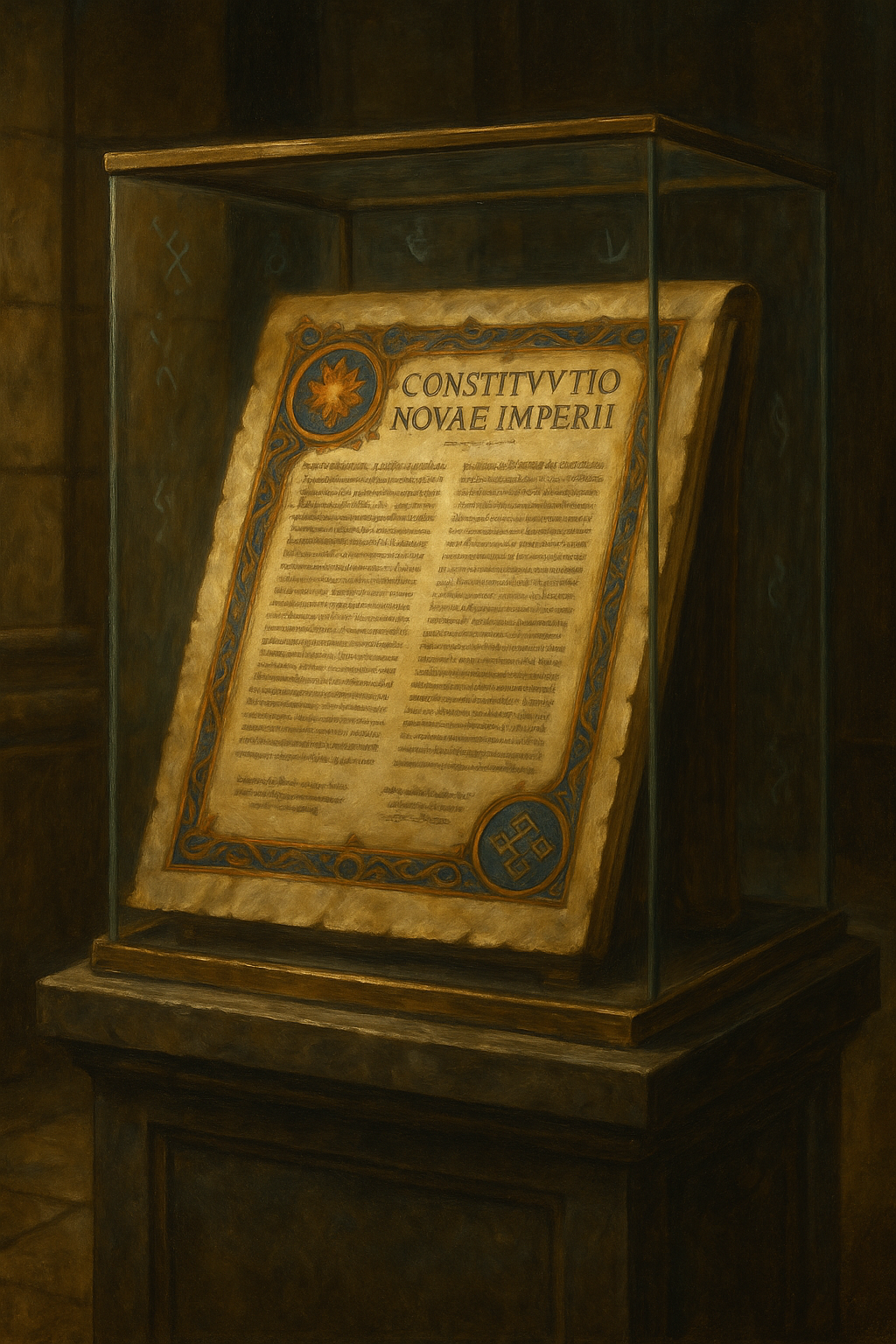
The Constitutio Novae Imperii is one of the most widely disseminated and symbolically visible documents in Imperial history. The original master copy — written in silvered aether-ink upon consecrated vellum — is enshrined within the Basilica of Nova Roma, displayed behind crystal warding panes and guarded day and night by the Custodes Basilicae. Pilgrims, scholars, magistrates, and legionaries visit it as both a civic relic and a sacred testament.
Authorised replicas, produced only under priestly supervision, are kept in every provincial capital, each bearing the tri-seal of the Legion, the Provincial Administration, and the Temple. These copies serve as reference for courts, senates, legions, and arcane academies — ensuring that the foundational law is never distant from the institutions it governs.
A simplified public edition, inscribed onto bronze tablets, stands in all major fora. These versions allow common citizens to read the clauses that define their rights and obligations, fulfilling the charter’s intent of transparency and unity.
Although revered, the document is not secret nor exclusive. By decree of the First Senate, the charter is public law, and any citizen may request an officially stamped reading copy from the provincial scribes. Even the Collegium Arcanum maintains annotated transcriptions for arcane legal scholars.
In this way, the publication of the charter reflects the Empire it founded — solemn, authoritative, widely known, and ever-present in the life of its people.
Legal status
The Constitutio Novae Imperii holds the highest legal authority within the Imperium Novum. All subsequent laws, edicts, decrees, and arcane statutes derive their legitimacy from it, and none may contravene its core mandates. In the eyes of the courts, it is treated as both sacred writ and constitutional bedrock — a dual nature reflecting the Empire’s fusion of divine mandate and Roman jurisprudence.
In legal tradition, three principles govern its interpretation:
Primacy of the Foundational Text — When disputes arise in matters of governance, military command, or civic authority, the original charter supersedes all later documents unless formally amended in accordance with its own provisions.
Triad of Interpretation — Only the Senate, the High Priesthood, and the presiding Legate (or Emperor, if extant) may jointly issue binding interpretations of the charter. This prevents any single institution from shaping constitutional meaning unilaterally.
Arcane Jurisprudence Integration — With the rise of riftflame and arcane disciplines, the charter is recognised as the basis for all magical law. Courts of arcana, founded centuries later, cite it as the first document to define the legal status of magic and the state’s right to regulate it.
Together, these principles ensure that the constitution is not merely a relic of the Empire’s earliest days but a living legal force that shapes every tier of governance. It stands above magistrates, above generals, above priests, and even — in times of controversy — above the Emperor himself.
Historical Details
Background
The decade preceding the creation of the Constitutio Novae Imperii is often described by Imperial historians as the Years of Ash and Omen. Torn violently from Old Earth, the Nova Province awoke beneath unfamiliar constellations, surrounded by strange flora, predatory beasts, and neighbours whose intentions were anything but certain. The first years were defined by relentless adversity: failed harvests, raids by opportunistic tribes, sporadic outbreaks of rift-born maladies, and a populace divided between despair and defiant resilience.
The absence of communication with the wider Roman world forced an agonising reckoning. What began as hope for rescue slowly transformed into the grim understanding that the Nova Province was utterly alone. Legions stationed beyond the Rift would never march to their aid; the Emperor’s envoys would never arrive; no grain fleets would cross the seas. The institutions that once anchored Roman identity—Senate, Emperor, homeland—were now separated by a cosmic gulf.
Yet amid hardship, new patterns emerged. Strange energies seeped through the land, manifesting as riftflame phenomena that bewildered scholars and terrified commoners. Early encounters with Elves, Dwarrow, and Orcish warbands taught the Romans the precarious nature of their new world—a realm where diplomacy, steel, and sorcery carried equal weight. It was in this crucible that a new generation of leaders rose: practical, iron-willed, and unshackled from old-world complacency.
By the end of the first decade, the province had survived its baptism of uncertainty. Fortified walls encircled the earliest districts of Nova Roma, trade had been tentatively established with cautious neighbours, and the Temple proclaimed the Rift a divine sign rather than a curse. It was in this moment of fragile stability—when survival no longer consumed every breath—that the need for a unifying document became undeniable. The people required not merely protection, but purpose. The institutions of Rome needed legitimacy. And the rising figure of Legate Gaius Marcellus Aurelius required a lawful foundation upon which a new empire could be built.
Thus, the charter was born: forged not in triumph, but in endurance; shaped by necessity, faith, and ambition; and destined to become the cornerstone of an empire that would reshape the world.
History
In the centuries that followed its ratification, the Constitutio Novae Imperii evolved from a pragmatic necessity into the sacred cornerstone of Imperial identity. The earliest decades saw its clauses tested repeatedly as the Imperium Novum expanded beyond the defensive walls of Nova Roma. Border skirmishes with Orcish warhosts, diplomatic overtures to the Elven courts, and the uneasy stalemate with the Dwarrow Kingdom all forced the young Empire to interpret and refine the powers granted by the charter.
The rise of Emperor Gaius Marcellus Aurelius — once the Legate and chief architect of the constitution — marked the first great reinterpretation of its authority. His coronation, sanctioned through the Oath of Reforged Sovereignty, affirmed the charter’s supremacy even over the imperial throne. Later emperors would follow this precedent, each swearing fealty not to a person or dynasty, but to the document that legitimised their reign.
Throughout the Middle Rift Era, the charter guided the integration of non-human auxiliaries and the gradual expansion of citizenship privileges. Its adaptability allowed the Empire to forge alliances, incorporate new cultures, and administer territories far beyond the original bounds of Nova Provincia. Dwarven treaty-law, Elven mercantile rights, and even Halfling maritime privileges were grafted onto its framework through carefully debated amendments.
The most transformative period came with the formation of the Collegium Arcanum, whose rise to prominence necessitated unprecedented legal interpretation. As arcane disciplines became central to Imperial infrastructure, warfare, and scholarship, the charter’s early clauses on magical stewardship were expanded into a vast body of arcane jurisprudence. Courts of arcana, established in the Third Century NE, treated the constitution as their prime legal source.
In later centuries, the charter survived political schisms, attempted coups, and even the rare usurpation. Each time, its supremacy clause served as the rallying cry for loyalists, scholars, and magistrates who sought to preserve the Empire’s foundational identity. During the War of the Shattered Standard, the charter was famously carried into battle by the Custodes Basilicae, symbolising the Empire’s unbroken continuity.
Today, the document is as much a political instrument as a cultural relic. Emperors, senators, generals, and magi alike invoke its authority to justify reforms, expansions, and decrees. Its text has been copied, illuminated, debated, weaponised, sanctified, and celebrated across eight centuries — yet its core purpose remains unchanged: to define Rome reborn, and to bind a disparate people to a shared destiny.
Public Reaction
The announcement of the Constitutio Novae Imperii stirred the fledgling Imperial population with an intensity that few events before or since have matched. After ten years of fear, hunger, and the constant dread of annihilation, the ratification of a formal constitution felt less like a legal milestone and more like a collective exhale — the moment Rome stood upright after a decade on its knees.
Among common citizens, the reaction was a powerful blend of relief and pride. Families gathered in the Forum to hear the clauses read aloud, many weeping openly as the heralds proclaimed the end of provisional rule and the dawn of a lawful, divinely sanctioned future. Merchants and craftsmen celebrated the clarity it brought to trade and labour, while veterans of the early border conflicts saw in it the promise of an organised defence and stable command.
The priesthood declared the charter a sacred confirmation of the gods’ will, interpreting its invocation of the divine mandate as proof that the Rift had been a trial of worthiness. Temples rang their bells for days, and offerings were made in thanks for Rome’s survival and rebirth.
Not all reacted with unbridled joy. Some citizens feared the weight of divine purpose, questioning whether the expectations placed upon the Imperium Novum would demand more sacrifices in the years ahead. A small minority worried that the balance of power between military, civic, and sacred institutions might fracture under strain. These concerns would later fuel early debates within the Senate-in-Exile.
Nonetheless, even the sceptical acknowledged the profound significance of the moment. For the first time since the Rift tore them from their world, the people of Provincia Novaium felt the ground steady beneath their feet. The charter became not only a legal document but a symbol of identity — proof that Rome had not died, but endured, adapted, and risen anew beneath alien stars.
Legacy
Over the centuries, the Constitutio Novae Imperii has become far more than a legal instrument — it is the spiritual, political, and symbolic heartbeat of the Imperium Novum. Its legacy is woven into every era of imperial history, shaping the Empire’s sense of identity and destiny with enduring force.
Pillar of Imperial Legitimacy — Every emperor since Gaius Marcellus Aurelius has sworn the Oath of Reforged Sovereignty upon the charter. This ritual, performed before the sealed master copy within the Basilica, has become the defining act of coronation. Even would-be usurpers who sought the throne in times of strife attempted to invoke the charter to validate their claims, demonstrating its unrivalled authority.
Foundation of Arcane Law — As the Collegium Arcanum grew into one of the most influential institutions of the Empire, its jurists repeatedly turned to the original clauses on arcane stewardship. Entire schools of magical legal theory — including the Doctrine of Sacred Flame and the Codex Riftalis — trace their legitimacy to the charter’s early assertion that riftflame is a divine gift requiring regulation. Without the charter, the arcane might have fractured the Empire instead of strengthening it.
Engine of Cultural Unity — Across Provincia Novaium and beyond, the charter serves as a shared point of identity for citizens of diverse ancestry. Humans born long after the Rift, Dwarrow auxiliaries, Elven scholars, and Halfling traders all recognise its authority. For many, especially during frontier expansions, carrying a copy of the charter was akin to carrying Rome itself.
Anchor in Times of Crisis — During the War of the Shattered Standard, the charter became a symbol of unity against rebellion. When the Imperial capital was threatened, the Custodes Basilicae marched into battle bearing the bronze public tablets, rallying loyalist forces with the cry “For the Charter and the Empire!” The moment is immortalised in frescoes throughout the Empire.
Guide of Imperial Evolution — As centuries passed, amendments added new dimensions to the charter — from the recognition of non-human citizenship to the regulation of aetheric weaponry. Yet each amendment required painstaking adherence to the charter’s own procedures, reinforcing its role as the guiding spine of imperial governance.
Enduring Religious Symbol — The priesthood venerates the charter not merely as a legal document but as tangible proof of divine will. Festivals honouring Dies Constitutionis and Dies Imperii Novae reaffirm the belief that the Rift was a sacred call to purpose. Many temples even possess engraved tablets of the opening invocation, displayed beside their altars.
A Living Testament — Scholars often remark that the charter has outlived dynasties, wars, rifts, and magical upheavals, yet remains remarkably intact in spirit. It is the closest thing the Imperium Novum has to an immortal witness: the document that remembers every chapter of its rise.
In all these ways, the Constitutio Novae Imperii continues to define what it means to be Roman in a world remade — a legacy of resilience, sovereignty, and divine destiny.
Term
The charter remains in force from its ratification in 10 NE to the present day, its authority enduring across eight centuries of growth, conflict, reform, and arcane evolution. Though amended many times, its core principles have never been overturned. To the Imperium Novum, the Constitutio Novae Imperii is not merely a historic text but a living mandate — an unbroken thread linking the first decade of exile to the modern age, binding all citizens and rulers to the divine and lawful foundations of the Empire.

Comments