
Virelings
"A relic of forgotten cruelty, the Vireling does not hunt. It waits."
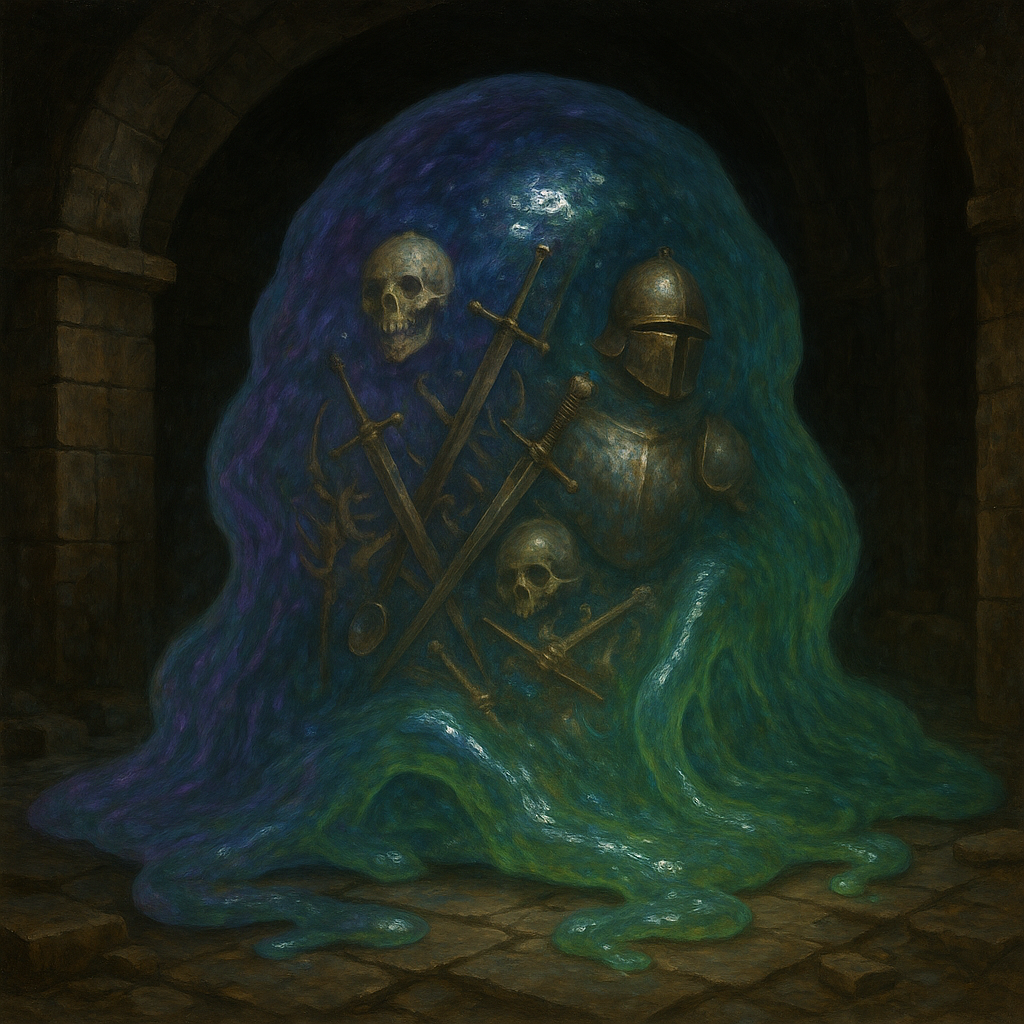
Slumped in silence beneath the earth, the Vireling does not breathe, think, or want, yet it endures, year after year, in places long abandoned by gods or memory. Its gelatinous body, glowing faintly in shades of acidic violet, venom-green, and shimmering cobalt, pulses with unnatural light, like stars drowned in a slick of oil. There is beauty in its form, yes, but the kind found in venomous coral, or a corpse’s rictus grin. Scholars argue over its origin. Was it a mage's gluttonous failure, a thinking stomach spilled across the underworld? Or the living residue of divine punishment, sent to dissolve the pride of men too greedy to leave the depths alone? Perhaps it was never made at all, only found, writhing in the dark, older than thought, feeding patiently through the ages. Whatever truth lies buried beneath the theories, one fact remains certain: the Vireling does not pursue. It lingers, on ceilings, in flooded steps, in the corners of ruin and rot. It waits where light is a memory. And when something warm and alive dares pass, it rises, soundless and deliberate, to drown them in its body of searing hunger. Those who live to speak of it describe not panic, but confusion, a sensation like drowning without water, as armor, flesh, and memory all vanish into the shimmering dark. And somewhere within its mass, glittering just beneath the surface, float the swords, helmets, and clean-picked bones of those who thought themselves clever enough to pass through its den unnoticed. It does not forget. It does not forgive. It does not die. It remembers every scream it has ever consumed.Basic Information
Anatomy
The Vireling resembles a mass of semi-viscous gel, roughly spheroid or cuboid in resting form. Coloration ranges from acidic blue, bioluminescent green, or violet-streaked indigo, always with a faint inner shimmer reminiscent of a night sky drowned underwater, what miners refer to as "graveglitter." The creature’s surface is slick, gelatinous, and entirely acidic, able to dissolve organic tissue in moments. Surprisingly, equipment, bones, coins, or stone are left intact, often suspended within the creature’s transparent mass. These remnants swirl with slow, almost balletic grace as it moves, giving it a grotesque aesthetic akin to a treasure vault full of death. It lacks organs, a brain, or skeletal structure. Its mind, if it can be called that, seems dispersed through its entirety. Some specimens form eyeless pseudopods, or thin, whip-like tendrils when disturbed.
Genetics and Reproduction
The Vireling reproduces asexually through budding, any sufficiently large segment can split from the whole and, if left alone, form a new organism over the course of a few days. Though the creature does not appear to seek reproduction intentionally, overfeeding or trauma can cause spontaneous division. In certain ruins, hundreds of coin-sized Virelings can be found forming microcolonies along ceilings and walls, harmless alone, but deadly en masse. Specimens across the Three Lands appear to share identical magical signatures, suggesting a shared origin. Some scholars believe they may even be fragments of a larger whole, still buried beneath the crust of the world.
Growth Rate & Stages
- Hatchling: Coin- to apple-sized blobs, nearly harmless but capable of dissolving insects or small rodents.
- Juvenile: Basketball-sized, capable of dissolving large birds, small dogs, or unwary kobolds.
- Mature: Man-sized or larger. Capable of dissolving humanoids, armored or not.
- Colossal Specimen: Rare. Up to 20 feet across, housing dozens of suits of armor and skeletal remains, like a mobile, acidic ossuary.
- Size is limited only by feeding opportunities and environmental constraints. There is no maximum, and they do not seem to die of age.
Ecology and Habitats
Virelings favor deep, low-light, high-humidity environments. Commonly found in:
- Abandoned mines.
- Forgotten crypts.
- Fungus-choked burrows.
- Flooded basements.
- Cave systems with slow foot traffic.
Dietary Needs and Habits
The Vireling can digest any organic material with no apparent limitation. Muscle, fat, bone, cartilage, even toxic flesh or diseased tissue, it matters not. It cannot, however, digest metal, stone, or cloth, and these materials remain trapped in its body until excreted or expelled through shedding. Most larger Virelings look like floating junk heaps, their inner cores a churn of suspended swords, buttons, coins, helmets, belt buckles, and snapped weapons. Feeding time is slow, taking minutes to consume a body fully. However, a large enough Vireling can restrain multiple victims at once, burning through flesh while they struggle. Fortunately, most prefer to feed once per several days, needing little sustenance to survive long-term.
Biological Cycle
Virelings are effectively immortal unless destroyed. They do not appear to die naturally, and some have likely existed since the early Lost Ages. Their only regular vulnerability is dehydration, which can cause them to shrivel and lose coherence. In dry environments, they become brittle and inert over time.
Behaviour
- Ambush predators. Not aggressive in open space.
- Do not pursue prey. They prefer to wait.
- Will occasionally leave their lairs if starving.
- React to vibration, heat, and movement.
- When struck with fire or thunder magicks, they will recoil violently but reform shortly after if the splattered pieces are close enough.
- Certain specimens have been recorded “shivering” in the presence of holy magicks or artifacts of divine origin.
Additional Information
Perception and Sensory Capabilities
They have no eyes, ears, or smell, but can:
- Sense movement via vibrations through stone.
- Detect heat within 30-60 feet.
- Respond to the presence of life with increased internal pulsing.
- Glow faintly brighter when prey is near.
Scientific Name
Gelus caecus viridescentia.
Origin/Ancestry
Believed to be a failed magical experiment by an unknown hedge mage of the early Lost Ages. Original purpose unknown, some theorize it was intended to dissolve waste or corpses, and simply escaped containment.
Conservation Status
Extremely common in ancient ruins and deep catacombs. Considered an ecological nuisance in Kathar and southern Kibonoji. Controlled burning and salt barriers are often used in known infestations.

Comments