
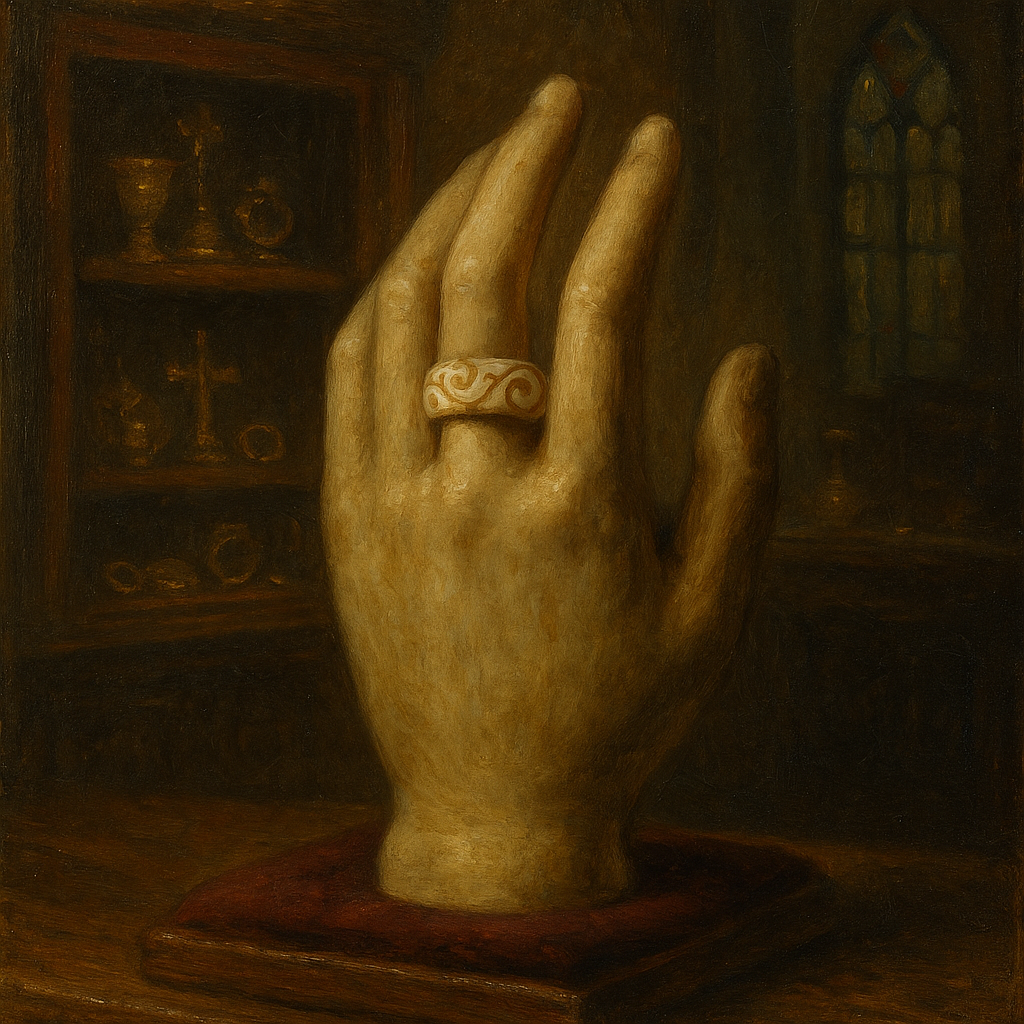
The Windwound Band
"He rose laughing above the masts, the sky his second skin, but when the wind took him, he did not stop. The chains snapped like reeds, and by dawn his body lay broken on the cliffs below."
The Windwound Band is one of the most perilous relics ever bound to the element of air. At first glance, it is a marvel, a slender loop of ivory traced with golden spirals that resemble drifting clouds at dusk. To nobles it gleams like a symbol of refinement, to mages it promises transcendence, and to dreamers it whispers of freedom beyond measure. But its beauty is a mask, a gilded invitation into a covenant no mortal can truly master. To wear the Band is to be reborn in the sky’s embrace. Its gift is immediate, instinctive, requiring neither study nor spoken incantation. One moment the bearer stands on earth, the next they rise, carried aloft on unseen currents as though gravity itself has kneeled before them. They may hover in place, drift as gently as falling snow, or hurl themselves forward with bursts of wind-speed that carry them like arrows loosed from a bow. Precision becomes second nature, the Band allows its wearer to pause mid-air as though balanced on invisible stone, or to weave between battlements and sails with all the poise of a hawk. In these early hours, there is no curse, no whisper of doom. Only mastery, only ecstasy. But the Windwound Band is a liar. Its betrayal comes without warning, and when it comes, it is absolute. One moment, the sky bends to the wearer’s will; the next, the sky turns predator. An unseen force seizes them, wrenching their body ever upward. The pull grows with every heartbeat, hunger deepening the more they fight it. Ropes snap, chains tear loose, stone itself shatters as the Band mocks all efforts at tethering. It is not levitation, but abduction, a theft of the earth’s claim upon its child. There is no escape but removal, and by the time the bearer understands this, it is already too late. They have risen too far, borne into the cold blue vastness where air thins and clouds shred to mist. To strip the Band away is to plummet with terminal swiftness, bones broken, body dashed apart like a bird against cliffs. To keep it on is to vanish into heaven, until hunger, frost, or lack of breath finally claims what the Band refuses to release. The Windwound Band does not warn. It does not bargain. It offers the dream of flight, then demands your life as the toll. Those who wear it may feel, for one brief season, like masters of the sky. But in truth, they are its prey, lifted until the band makes a tomb of the open air.Mechanics & Inner Workings
To wear the Band is to gain:
- Instinctive Flight: With the Band, flight is as natural as a step. A thought replaces a stride, and suddenly the ground is gone.
- Aerial Precision: The wearer may halt mid-air, pivot, or drift with balance so exact it seems they stand upon invisible steps.
- Wind-Speed Bursts: Sudden acceleration, carrying the body like a dart or arrow through open space.
- Sudden Uplift: A violent pull upward, growing stronger the more the wearer resists.
- Tether Breaking: All attempts at grounding fail; chains, columns, and bindings are destroyed by the Band’s escalating force.
- Terminal Fall: The curse ends only when the Band is removed. But removal at altitude ensures a deadly fall.
- The Band offers mastery, but its betrayal is not gradual. It is swift, merciless, and final.
Manufacturing process
Fragments of lore describe its crafting, ivory carved from skybeasts that swim through upper airstreams, etched with storm-lit gold guided not by tools but by captured lightning. Ritualists sang hymns into its hollow during the shaping, binding obsession into its ivory frame. Whether god-blessed or god-cursed, the Band has remained unchanged for centuries, as flawless as the day it was made.
History
The Windwound Band’s trail through history is written in sudden triumphs and abrupt tragedies, its bearers remembered less for their lives than for the manner of their deaths. The most enduring account is that of Haskor the Red, a sellsword-turned-warlord who seized the Band during a siege. For days he rained fire from above, darting across the sky faster than arrows could follow. His enemies broke ranks in panic, certain they fought a man blessed by the gods. Yet the Band never tolerates long possession. Witnesses later recounted that, in the middle of his final charge, against a great fort Haskor’s movements turned frantic. His attempts to tether himself with climbing rope to the battlements only hastened the Ring’s hunger. The rope tore free, the stone crumbled, and Haskor was dragged into the storm above. When the skies cleared, his body was discovered, shattered, miles inland, sprawled among the rocks like a discarded doll, the Windwound Band resting in the dirt nearby as if it had chosen its next stage. Other tales repeat the same pattern in different trappings. A border lord who believed he had finally united his kingdom vanished in a sudden gale, found later broken among the pines, the Band lying unclaimed beside him. A corsair queen who used the relic to plunder ships from above was seen one evening climbing the mast to lash herself down, by dawn, only the band remained, washed up on the shore with no sign of its former master, the Band glittering faintly in the sand. Each rediscovery follows the same cycle: glory, fear, and a fall. No master of the skies has ever walked away with the Band still upon their finger.
Significance
The Band’s allure is undeniable. To those who seek power, it is a relic that grants the most primal freedom, mastery of the skies. Armies dream of messengers beyond arrow’s reach, of scouts who can rise over mountains in an hour, of warlords who can strike from the clouds. Traders imagine limitless routes, smugglers the ability to glide unseen past patrols, and dreamers the ecstasy of soaring unfettered. But in taverns and on pilgrimage roads, the Band is spoken of differently, not as a tool, but as a curse disguised as wonder. To folk who have lost kin to its hunger, the Band is not proof of freedom, but of the sky’s cruelty, that it does not welcome mortals, it only tests how long they can cling before being claimed. Sailors whisper that the Band is the reason the sea keeps its storms, jealous of the sky’s trophy. Farmers in the highlands tell their children that when they feel a sudden wind lifting their hair, it is the Band passing overhead, searching for its next fool. Thus, its significance straddles awe and dread. It is proof that the air itself can be touched, bent, even ruled, but also that some elements remain untamable. The Windwound Band tempts mortals with transcendence, only to remind them with terrible certainty that the heavens were never meant for their kind. To scholars, the Windwound Band is proof that even air can be bound. To sailors, it is proof that the sky is cruel. To the dead, it is neither. It is only silence.
Rarity
Unique. Whispers persist of “siblings” forged in the same storm, but if they exist, they have never been seen.
Weight
So light it seems weightless when held. Yet worn, it grows heavy with dread, as though every heartbeat carries the shadow of its inevitable betrayal.
Dimensions
A narrow ivory band, chased with spiraling golden clouds. Its gleam is refined, noble, and almost too perfect, as though mocking the ruin it conceals.
Base Price
Beyond value. No market dares to price it, though lords and kings have spilled much blood to claim it.
Raw materials & Components
The Windwound Band is fashioned from white ivory, polished until it gleams with the sheen of bone-turned-marble. Along its curve run inlays of fine gold, traced into swirling cloud motifs that spiral upward like gusts caught mid-motion. The patterns are delicate, yet deliberate, as though each curve were intended not merely as ornament but as invocation. The ivory itself was not carved from common beast, but drawn from the tusks of leviathan-born creatures slain during the Lost Ages, beasts whose very marrow was said to echo with the voices of storms. The gold is whispered to have been hammered from tribute ingots once belonging to the vaults of ancient Humans, melted and re-purposed to bind the Band’s enchantment in place. No gemstone crowns the Band; its beauty lies in its restraint. A pale, regal thing, seemingly flawless, yet hiding within it the seed of inevitable ruin. Accounts of its manufacture describe the ivory softened not by flame, but by exposure to thin air on mountain peaks, where the breath of storms worked the material until pliable. The golden spirals were then etched in with blood-mixed resin to fuse the two materials together, sealing the Band with the strength of oath and sacrifice. Though elegant in form, the Band is scarred faintly with hairline fissures, as if lightning itself once passed through it during its creation. The result is a relic whose very body embodies paradox: a crown of splendor masking a covenant with the void of sky.
Tools
The Windwound Band could never have been crafted in any common forge. Its creation required tools as unnatural as the relic itself, and while the Lost Ages were cetainly a time of magickal and technological wonder; What recounts of its creation exist are anecdotal, not widely considered remotely factual as they are told with an air of something out of a fairytale:
- Storm-hammers, bronze mallets left out in thunder squalls until they rang with trapped weightlessness of the sky. These were used to drive the golden filigree into the ivory without cracking its brittle form.
- Needles of bone, carved from raptors and kites, dipped in tinctures of quicksilver and feather-ash. With these, the cloud-patterns were inscribed, each stroke binding a fragment of wind into the Band’s surface.
- High-altitude crucibles, shallow dishes carved into cliff-stone where ivory dust and blood-resin could be tempered in open gales rather than in flame.
- Breath-catcher flutes, hollow reeds said to trap the exhalations of priests mid-prayer, later shattered and mixed into the runes’ binding lacquer, tethering the enchantment to mortal breath itself.

Comments