
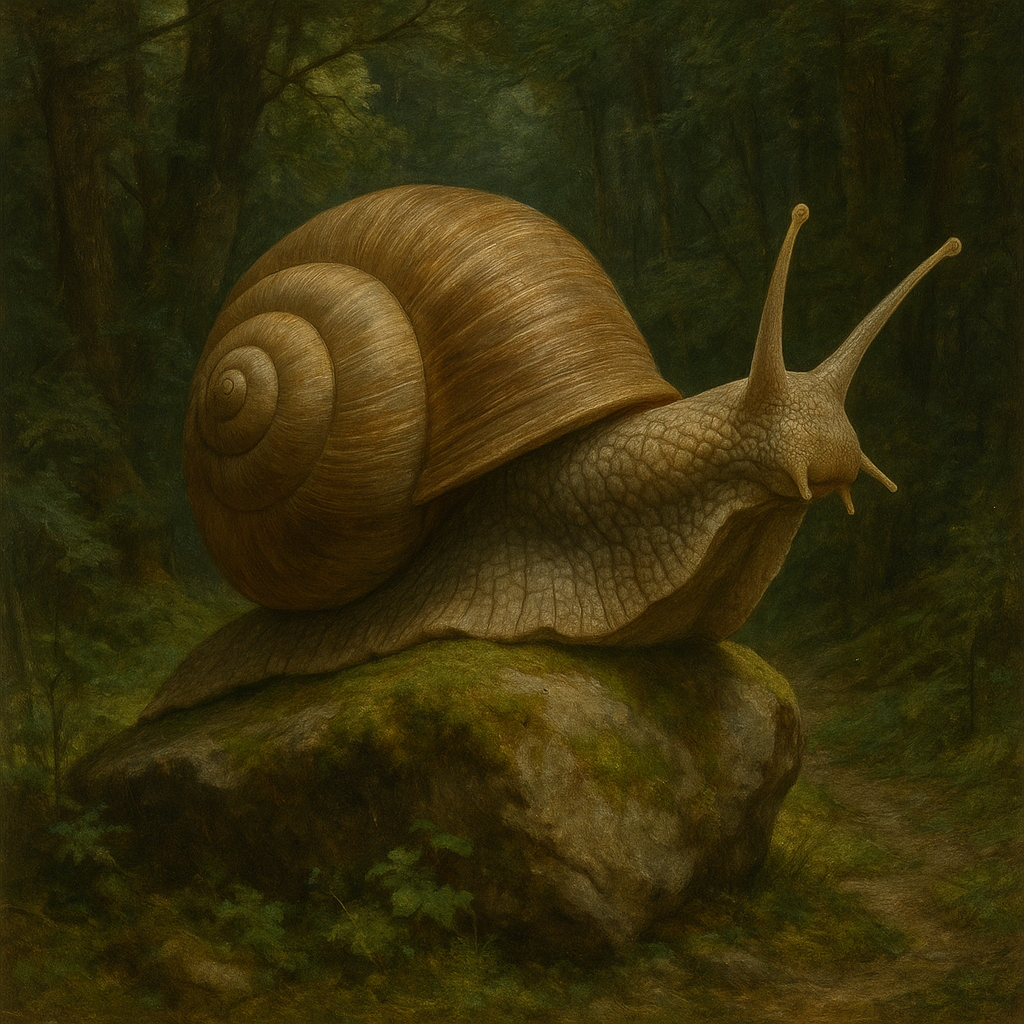
Great Snails
"You stop seein' 'em, start seein' empty shells? Best not pitch camp. Something worse is crawlin' around."
Bloated, slow, and everywhere you don’t want them, the Great Snail isn’t just another pest, it’s a sign the land’s still hanging on. In the mulch-choked fringes of The Grandgleam Forest and the weed-sick beds of Three Land's Run, it thrives among the soft rot of abandoned fields and lichen-swallowed shrines. Their presence marks land that’s merely dying; Their absence marks land that’s already dead. For slum-farmers and tribal Whogi herders also native to these areas, they are livestock, boiled thrice, eaten poorly, and feared for what sickness rides their meat. Their spiral shells are salvaged into wheelbarrows, cradle-cauldrons, and chamber pots; Their slime smeared on rust and children’s tongues alike. In market fables, they’re beasts of last resort, the “Last Feast Bringers,” edible only when all gods have turned their backs. And when they vanish from a path once thick with their trails, the wise pack light and walk fast, because even the dumb things in Everwealth know when to flee.Basic Information
Anatomy
Great Snails reach 4 feet in length and often weigh more than 200 pounds, with some elders growing heavier even than some Orcish. Their flesh, clammy beige and blotched green, is riddled with slime-streaked abrasions and rot-resistant hide. Bunched, filamented eyestalks twitch at every tremor, though rarely lift above the moss. Their most defining trait is the enormous spiral shell, 3 feet across and pocked with weather pits, claw-scars, and half-shed moss. Colored in filthy bronze, slate, and calcified whorls, these shells are sturdy enough to outlast the creature's death by many years. You’ll find them reused everywhere, because everything in Everwealth is repurposed, or buried.
Genetics and Reproduction
Hermaphroditic and opportunistic, Great Snails breed in the wet, desperate weeks of late spring, their eggs hidden in rotted timbers or soft grave-loam. A dozen or more pale, jelly-like sacs hatch in muck-stink holes, emerging into a world that rarely has room for another mouth. In lean years, snails may reabsorb their own eggs, digesting future generations for a few more crawling days.
Growth Rate & Stages
Their life stages mirror Everwealth’s slow erosion, birth through muck, growth through hunger, and death by stillness.
- Hatchling (0-3 months): Gel-flesh and half-formed, they dissolve underfoot if stepped on.
- Juvenile (3 months-1 year): Hardened shells form. They begin carving trails of ruin.
- Adult (1-7 years): Reproductive peak. Voracity blooms.
- Elder (7+ years): Motion slows, but cunning increases. These are the ones that circle harvest sheds and wait.
Ecology and Habitats
Great Snails dwell in humid, decaying wildlands. From the drowned groves of Grandgleam to the maggot-laced banks of Lough Shears, they slide from shade to shadow, devouring everything not yet stone. They favor abandoned croplands, cursed orchards, and moss-fed ruins. Their presence warps the ecology around them, dimming undergrowth, stripping fungus beds, silencing smaller beasts. Locals say when even the Great Snails have fled, you’re not the apex anymore.
Dietary Needs and Habits
Though docile, they eat as if they’ve never known abundance.
- Bark, lichen, rotwood.
- Vegetables, ripe or spoiled.
- Fungus, fruit, leaf, grave-offal.
Biological Cycle
As with all things in Everwealth, the snail’s rhythm is one of hunger, slowing only when frost starts to bite. During the spring thaw and into high summer, Great Snails become fiercely active, mating, gorging, and spreading clutches of eggs like rot in a pantry. In autumn, their slime thickens and movements slow, trailing longer and more pungent wake behind them. By winter’s first frost, most dig shallow pits and withdraw into torpor beneath their shells, buried beneath dead leaves and hollow timbers. In this state, they can sleep months, stirring only when warmth or scent of rot calls them.
Behaviour
Simple, grim, and relentlessly present, Great Snails act without malice, but never mercy. They learn routes. They remember gardens. They return. At night, they align into slow, silent parades, drawn to rot or remembered sugar. Their arrival is not heralded by sound, but by the steady vanishing of anything edible. To many, their plodding silence is a lullaby. To others, an omen. If the shells are empty and the slime trail cold, don’t camp there.
Additional Information
Perception and Sensory Capabilities
Blind beyond blur, but scent-sensitive to decay, fruit sugars, and iron. Their tendrils quiver when blood hits loam, and they can find a fermenting peach from half a mile.
Scientific Name
Helix rexmorbus.
Origin/Ancestry
Believed to have spawned from ancient pre-Schism mollusk species. Present in scattered historical texts dating back sometimes over a thousand years.
Conservation Status
Stable, but considered a pest.
Geographic Distribution

Comments