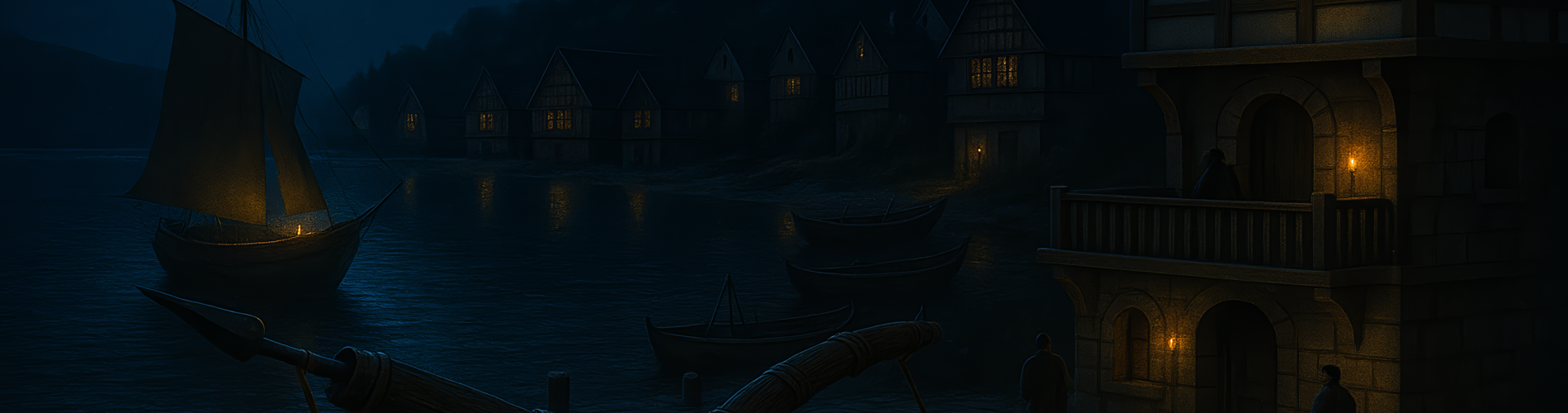
What the River Keeps
The harpoon took on the first cough, the way it always did—oak bow unbending, iron bolt flying, the river answering with a hiss as the line bit and went from slack to bar in a blink. Halm’s platform shivered under the force and then settled into its shape, the shape he trusted: wood braced, men placed, decisions narrowed to the width of a lever.
“Brace,” Halm called out. Spikes hammered into pre-cut holes. The traverse pins went home. The ballista’s tiller groaned against its stops and held a steady bearing on the fleeing ship’s quarter. Out on the water the tri-lantern mast at the Harborhouse showed HIGH+LOW steady: bookends bite. Weapons are live. The duty signalman liked his rules as much as Halm did. Rules cleared a path for a clean kind of courage. The lights from the tri-lantern were clear and unmistakable in this cold, damp night.
The fleeing pirate ship now had a six-foot iron harpoon thrust through its windward side, flung by the huge ballista that Halm commanded. That ship took on a panic like extra rigging. Sails bellied and halyards snapped. Oars smacked water out-of-rhythm and gouged white scars the length of her. Deckhands shouted in three separate tongues and yet the same flustered pitch.
“Winch,” Halm called out. The crew leaned into the bar. The pawl sang in its toothy way. The line thrummed a single note that Halm could feel through his boot heel and the hair in his ear and the old knuckle that healed wrong in a long-ago winter. The River Chionthar loved to argue, and today it argued with the Watch’s rope through every molecule of him. On the Master mast, HIGH+MID blinked slow. Inspection required. Soren, the harbor clerk, was serving as the lamp signalman. He was dutiful even when frightened. Good. Halm did not like improvisations that skipped protocol, although in this instance, it seemed maybe it would be appropriate to jump past "inspection required" and into "get your stern to shore, now". Something moved on the pirate ship’s rail—small, quick, where that scurrying meant youth more than speed. A boy, maybe twelve years old, hauled himself onto the rope, braced his bare feet against the tar, and produced a long knife that glinted in the light of the three-quarter moon.
“Rigger,” Halm said calmly, because calm helped the men do things that scared their joints. “Do we have fouling?” “The line is secure, and the harpoon's dug in tight” the rigger said, peering along the line. He thought he saw the boy look once straight at him before putting that saw-like knife to the thick rope that held the enormous ballista to the ship. He cut not like someone who merely does a job needing done. No, he cut like a prisoner who’s been promised freedom upon completion of his task. Halm’s stomach made a small, precise knot. He had seen that kind of frantic speed twice before. Once downriver near Baldur's Gate where a corsair’s captain paid a diver by the heartbeat to plug a hole in the hull, and once when a smuggler in Iriaebor tied a man to the wrong end of a net to use him as a weight. Both times the river had been the honest party. It took only what it was owed. May the gods grant there be no taking tonight.
“Signal skiff,” Halm called. “Launch.” The skiffmen nosed their boat into the water, waiting for the horn because you don’t outpace the horn in fog or clear. The horn gave two long blasts, imploring the pirate ship to return to the dock. The procedural rituals stacked up like crates. Halm made the hand sign: a closed fist, opened twice, mimicking the horn blasts. The skiff slid off the pontoon and took a circular course to the ship, wary that the harpoon line might break and whip into them.
“Guillotine ready,” Halm said and put his palm on the lever. The blade’s weight pulled back against him, promising a clean cut if he asked for it. The line guillotine was a last resort. It could save the ballista platform, should the drag prove too strong. The line hummed a key higher. The boy was working his knife into the splice where tar made a proud lip. He must have been taught where a rope is weakest. He must have been taught by someone who didn’t tie knots—someone who paid boys to gnaw through them. Halm didn't want to use the guillotine unless he absolutely had to.
“Chief?” the rigger said. “She’s resisting us. We brace more or we get dragged.” Halm set his boots and ran the numbers the way he had when numbers regarded freight and not moral weight. The river drag, the mass of the vessel, the moderate breeze working in the ship's favor, the winch leverage, the platform timbers, the distance to the pier’s edge. It all made a figure that was stupidly close to the resistance of this one rope. He looked again to the ship and saw it: another child on the pirate ship’s quarterdeck, smaller than the cutter, holding the pinrail. A man stood over the small child wearing a hat too fine for this work, one hand on the boy’s shoulder, the other tightening on the rail as if it would reassure him. Halm squinted his eyes at the thought of these children who could have had a better life, had they not been consigned to piracy. He took a slow breath.
“Winch,” Halm said softly. “Steady. Keep it steady. We have no more braces to use, so be steady.” The men grunted. The platform creaked and stood fast on the side of honor. The cutter boy’s shoulders shook, and he redoubled his speed. Each stroke across the thick rope took breath from him and gave a small promise of freedom to the ship in the same measure.
“Chief,” the rigger spat. “He’ll part it in a minute's time!” The horn voiced one long blast and three short barks from the Harborhouse: boarding required. The signal lights on the Harbor Mast fast-blinked now. Halm saw Clerk Soren’s hands shaking as he moved the paddles over the lanterns to make the lanterns blink; Halm could hear it in the rhythm, the way a drummer’s nerves talk through the sticks.
“Skiff!” Halm shouted. “To the quarter! Get the cutter, but take care!” The skiffmen pulled hard. The oars bit. The pirate captain looked from his youngling to the rope to the platform to the mast. Halm saw the calculation enter him and run like dye through cloth. Men like that will cut the harpoon line. They will cut anything that binds them to an accounting of their deeds.
The captain drew his cutlass. He slashed once. Halm braced for the jolt in his hand, but the jolt didn’t come. The captain’s blade had cut into the pinrail, where he left it. He scooped the child up with no effort, stepped onto the bulwark, and jumped to the dark, swirling water below. For a second they disappeared in a silver seam that closed over them. Then the skiff rose, and the skiffmen leaned, and the river gave up two souls that it had chosen, for once, not to keep.
The cutter boy saw none of it. He sawed still. The rope fibers went from song to snarl. The splice blew. The line snapped back with a crack like a rib broken in a tight chest. Halm rocked. The pawl screamed and then spun free, useless and loud. The pirate ship yawed away, suddenly foolish under too much sail. She lapped up water as she see-sawed side to side. The harpoon had struck into a poorly-made lapstrake, and the combination of piercing, pulling, and sudden snapping forces pulled several planks of wood from the side of the ship. After three increasingly exaggerated wobbles she threatened to founder. The oars no longer thrashed and began to fall one-by-many down the sides as fearful hands abandoned them. And then, with one last monstrous roll, the darkened ship dropped quickly beneath the water's surface, releasing a churn of air. How many had been aboard—ten? Fifteen?
Halm scanned the river, but could see no bodies, alive…or otherwise. He looked to the Watch patrolmen and shouted "Dancing Lights! Dancing Lights!! Surely one of you had some damned magic training in all your years!" A young officer of the Watch nodded and ran closer to shore, circling her hands in a practiced way, reminding Halm of the mesmerizing fan dancing he had seen once in Cormyr. Four glowing orbs appeared above the swift, dark water, each perhaps twenty feet from the next, forming a line that followed the flow. The orbs moved in concert, silently and solemnly, but revealed only twigs and leaves moving along the black surface. These twigs and leaves and tiny pointless things will be in Scornubel by tomorrow, Halm thought. The people on that ship, however, will likely be consumed by the silt right here by then.
The skiffmen dragged the pirate captain and the small child aboard. The man lay on his back, coughing river from his lungs, eyes open to the mast where the all three lamps now pulsed: hazard warning. The boy clung to a skiffman’s sleeve with ferocity that made the fabric's seams creak. It was a short and sober trip back to the shore, where the Watch patrol officers seized the two survivors and marched them back to Chief Halm.
Soren arrived at Halm’s shoulder with a dripping quill and his book.
“Charges will be read—” Soren began, in that stern but even tone that tried to plaster civility over the tense circumstances. The pirate interrupted, voice shredded by water. “Do not bother,” he rasped. “Write me as you please.” He reached, not quite touching the boy’s hair, hand hovering in a way that looked like a man memorizing a stove’s heat. “I downed my ship tonight.” Halm met his eyes. The captain's hat had gone. Without it he looked merely like a father. But Halm thought of the other boy—the cutter—whose rope ran off down the current with its new slack, and of where he would come up…or remain.
Soren’s quill scratched away under his previous notations detailing the pirate crew's failed work that evening to kidnap one of the village's wealthier merchants. I witnessed the following. Seizure attempted. Harpoon line severed by hostile action. Child rescued. Adult survivor detained. Soren halted, looked up at Halm with worried eyes, then wrote souls unaccounted for, presumed 10-15. Soren blotted the page and handed the book to Halm. With a long sigh, Halm signed his name next to these notes in the margin.
Halm looked to the pirate and in a low voice barely more than a mutter, "This book doesn’t have a place for the thoughts that will plague me after the lanterns are hooded and my squad have gone to beer. It won't say that a man cravenly abandoned his mates to the grave so to save himself and his ward. It will not call attention the notion that those mates were themselves sons and daughters. It must be that the river itself will keep the final record of their deaths."
Halm raised a hand to the mast and gave the signal he wished had been the world’s default: MID+LOW steady. Docks clear to approach. The lantern chimneys were placed, the horn gave one long report, and the harbor finally breathed. Some minutes later, when the platform was empty, the pirates surely at least halfway to the prison, and the remainder of the rope coiled like a sleeping serpent under the tarp, Halm still sat with the guillotine’s lever under his palm, and he let himself feel the weight he hadn’t released. He looked up to the starry sky and spoke to any gods who would listen:
"'Drown' is a word for the surrender of one's light to the ever-surrounding shadow. May the river, at least, remember them kindly if any others cannot".

Comments