
The Right to Annotate
“Stop.”
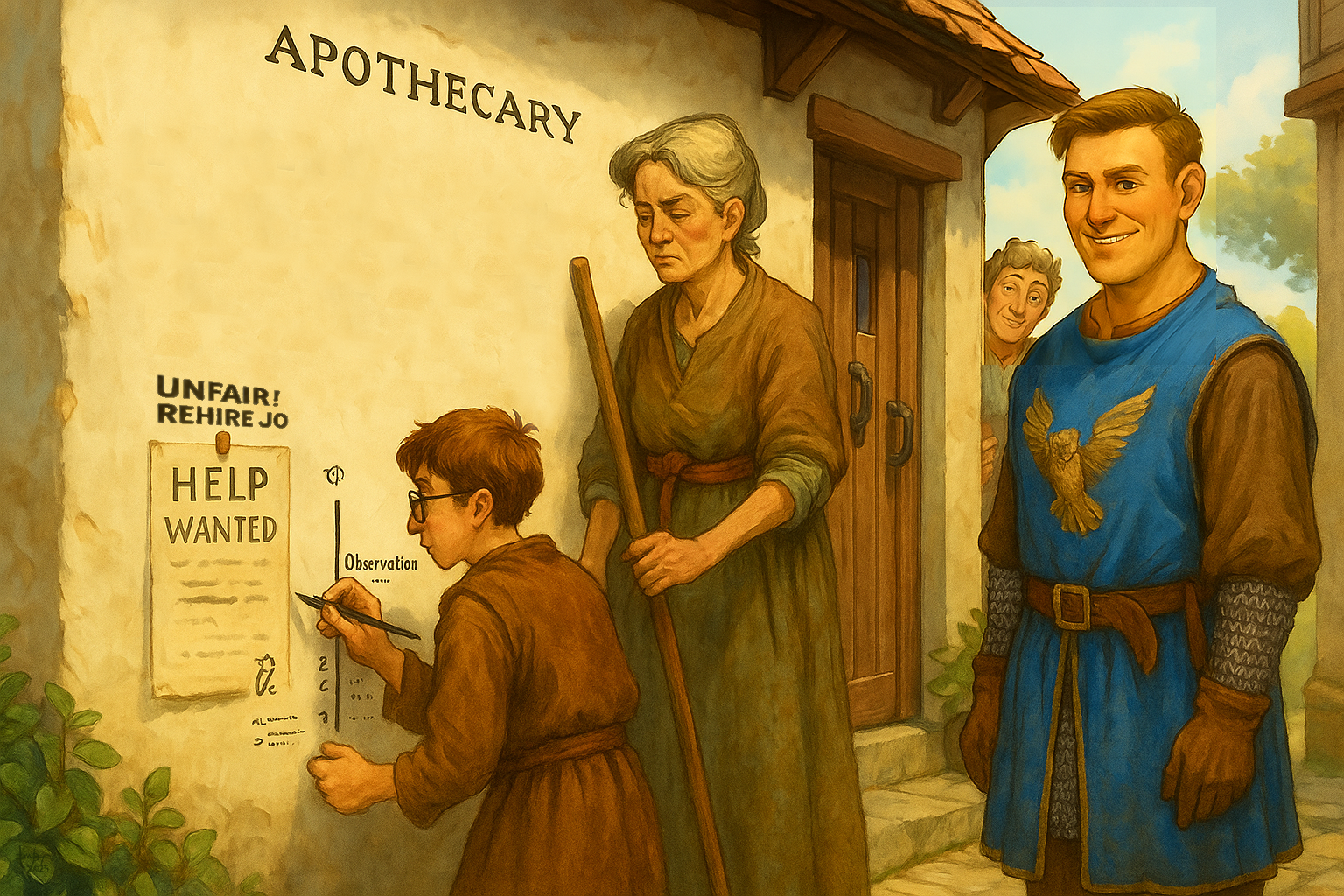
Pip Merrow’s brush halted a hair from closing the bracket. The margin—a clean, ink-dark line—waited beside three bold words on Mistress Pel’s apothecary wall: UNFAIR! REHIRE JO!
Mistress Pel advanced, fiercely wielding a broom. “You’ve defaced my plaster.”
“Almost finished,” Pip said. “It isn’t official until I close the bracket.”
“Official? So what, you've put official paint on my wall!?”
He exhaled, stroked the bracket true, and lettered a header a coin's breadth high: Observation. Beneath it, three footnotes nested in small, tidy script. Two neighbors slowed to gawk. The lane smelled of mint and mortar in the noonday sun. “Is that a margin?” one guffawed. “Like the scribes do?”
“Boy,” Pel said, thrusting the broom at the graffitied wall, “last spring some thugs scrawled rude songs here. The Watch made me scrub it until my arm rattled. This is going to be the same strenuous, pointless, undeserved kind of labor for me. Unless, that is, you remove it!”
Pip pushed his glasses up with the back of his wrist. “It’s adjacent to your Help Wanted placard,” he said, nodding at the wooden notice board nailed to the wall near the shop's entrance. “That makes the wall a public document—such as it is—and the Marginalia Statute allows—”
“The what?”, Mistress Pel squawked.
The familiar creak of over-polished boots cut him off. Constable Brin arrived, folio under one arm, a tea-colored pamphlet poking out like a shy tongue. He considered the vertical bracket Pip had painted down the wall. “Hm. A margin? I never thought to use such a thing as part of an exterior beautification project. This could become a real decorating trend, Mistress Pel.”
Pel threw up her hands. “Tell this child to fetch water and a stiff brush! I won’t spend solstice scrubbing soot-black commentary from my shop.”
Brin tugged the pamphlet free. Its gilt title winked: MARGINALIA STATUTE: A PRACTICAL BOOKLET. He licked a thumb, found a creased page. “Section Two,” he read. “‘Where an exterior posting invites response, citizens may append a margin in neat hand proposing amendment; demanding a factual source or inferential reasoning or an admission of opinion; or to…." Brin winked at Pip as he trailed off, then continued, "…beseech mercy. The Watch shall consider such annotations in good humor, providing no damage is made to the posting or to property.’” He shut it with a soft clap. “There it is. Good humor, I'd say, is binding in the merchant district; elsewhere, it’s advisory.”
Someone snorted. Pel tried not to. “And what, precisely, does this neat hand propose?”
Pip swallowed. “Restitution for the shoplifted lavender oil. A probationary rehiring of Jo for the period of the festival rush. And a public apology—to be written…um…in the margin. Where apologies go.”
A murmuring settled over the little crowd. Evenshade loves clever jousting as everyday theater. The fletcher leaned in, squinting for a closer look. “What’s Footnote Two?”
Pip’s neat letters looked like they could walk off the plaster and sit in a book.
2. Doctrine of First Offense Lenity, Watch of the Scroll Handbook, p. 14: “Restitution and service may suffice where malice is absent.”
Pel’s broom lowered. “Jo is a donk when dared,” she said. “She held the door for that shoplifter, Pip.”
“She did,” Pip said, cheeks hot. “She is also my friend. And I cannot afford the constabulary’s fines. Not with my library overdues.”
Laughter rippled. Pip didn’t smile. His overdues were epic.
The corner of Brin’s moustache twitched. “The margin is neatly delimited.” He pointed at a tiny owl depiction balanced next to the word Observation. “And whimsical.”
“The owl judges all margins,” Pip intoned.
Pel set the broom tip on the ground and thrust a hand to her hip. “This is paint. On my wall.”
“It’s officially filed paint,” Pip pled.
“De-filed,” Pel muttered.
Brin weighed his folio like a judge with a light gavel. “Proposed remedy is reasonable. Festival’s coming; hands are short. By reference, under Section Two, this qualifies as commentary marginalia adjacent to a posted instrument.” He glanced at Pel and spread his hands wide. “And with the notice no longer needed, Pip can scrub away the marginalia.”
The river talked against the piers in the distance. A barge knocked, and in the pause the growing crowd of bystanders glanced between Brin and Pel, Pel and Pip.
Pel sighed. “Three weeks. Apprentice hours. Restitution in coin or second-shift labor. AND the thief brings back the lavender oil. Or what's left of it.” She tapped the bracket’s spine with the broom handle. “And you, Annotator, repaint this plaster within the tenday.”
Pip bowed, hard, to keep the grin from cracking his face. “Yes, Mistress Pel.”
“Not so fast,” Brin said. “Your lettering.”
Pip braced. “My lettering? I can—”
“Would you like to take a Secondday scribe shift?” Brin asked. “Our public notices look like chickens argued with ink. A good margin could keep the arguments on the wall.”
The crowd chuckled. Jo, half-hiding in the alley, mouthed sorry and thank you in quick succession.
By dusk, Pel had set the tea-colored booklet by her till. She actually let the bracket remain, and travelers asked about the handsome graffiti on the outside wall. Someone—no one confessed—even added a clerkish note in a crisp hand: Margins are for mercy. The shoplifter abashedly returned the oil. Jo worked, and worked well. Pip arrived at the Temple-Library the next Secondday with his best nib. Brin genially handed him a stack of crooked notices like a man accepting absolution.
“Constable?” Pip asked, posting one beside the fletcher’s. “I wanted to thank you again for supporting my argument.” Brin shook his head. “In Evenshade,” Brin said, tapping the bracket’s clean edge, “scribes don’t defile; they file. You actually turned an unfortunate situation into a document, of all things!”
Harvest tents went up, white as teeth. Fresh plaster covered the shop's wall, but the margin stayed, painted anew: a slim civic spine with a tiny owl perched on it. Footnote Three was amended in a very fine hand:
3. On Mercy in Trade, 1415 DR revision: “Where possible, let justice be sheltered in the margins.”
Under it, a new, unclaimed note in noble script appeared overnight:
4. The owl approves.
Pel never scrubbed the apothecary shop's bracket. Some stains, it turns out, are instructive.

Comments