

Estaklian
In the warm, sun-drenched islands and rugged coasts of the southern seas lies Estaklyos, cradle of one of the oldest continuous human cultures in Elaris. Here, the Estaklians have flourished for millennia, shaping a society steeped in myth, artistry, and the ceaseless dialogue between mortal and divine. To outsiders, they are as mercurial as the sea they sail: at once passionate and disciplined, fiercely independent yet bound by the invisible cords of ancestry and tradition.
The origins of the Estaklians are shrouded in both history and legend. Oral tales speak of early tribes drawn from many shores—bronze-wielding seafarers, pastoralists from the mainland, and fisherfolk who knew the deep currents long before ships carried sails. Over centuries, these disparate threads wove themselves into a single tapestry, producing a people who learned to balance the demands of survival on rocky islands with the call of beauty and glory. Unlike many cultures, the Estaklians mark their beginning not with a founding king or city, but with the forging of their first sacred covenant: a pact between mortals and the gods of sea and sky, pledging mutual reverence, thus forming one of the first Hero-Gods, Aelyake.
Estaklians are renowned for their intense cultural pride and a spirituality that permeates everyday life. They are a people of ritual and meaning, where even the simplest acts—pouring wine, casting nets, greeting the dawn—are tinged with layers of symbolism. Conversation flows like poetry, often laced with references to myth and proverb, and music seems ever-present, carried on sea winds and echoing from temple courtyards. To live as an Estaklian is to live in dialogue with the past, the divine, and the ever-changing present.
At their core, Estaklians value arete—the pursuit of excellence in all things, be it craft, governance, or personal virtue. This pursuit is not selfish; it is framed as service to polis and pantheon alike. Their city-states may bicker and war, but they share a cultural unity in the belief that greatness is achieved not only for oneself but as an offering to gods and ancestors. Though famed for their philosophers, sculptors, and sailors, Estaklians also carry a reputation as fierce warriors, tempered by generations of defending their islands and trade routes from invaders and pirates. For them, war is not glory for its own sake but an act of preservation and duty.
Estaklians are inwardly anchored to their heritage, measuring the worth of new ideas against the wisdom of their forebears. Yet they are not stagnant. Their islands have birthed great innovations in art, architecture, and naval craft. They are the first known civilization in Elaris to have constructed marble temples aligned to the stars and the first to codify laws balancing mortal justice with divine mandate. The Estaklian polis system itself has become legendary, each city-state a jewel with its own patron gods, heroes, and customs, yet all speaking the same ancient tongue.
Naming Traditions
Feminine names
Female names in Estaklyos are typically melodic and flowing, with an emphasis on open vowels and softer consonants to reflect grace, vitality, and lineage. Suffixes like -a, -eira, and -is are common, with some regions favoring double vowels or liquid consonants like “l” and “r” to create a lyrical quality. Many female names are tied to natural elements—flowers, stars, rivers—or to ancestral matriarchs, as women are often viewed as the carriers of lineage through story and ritual. A daughter’s name is sometimes chosen to mirror a grandmother’s or great-grandmother’s with slight variation, maintaining the ancestral thread without repetition.
Examples: Psomeira, Siaphora, Aelyra, Korythea, Thyllis, Peridona, Ephyraia
Masculine names
Estaklian male names often carry strong consonant clusters at the beginning or middle, giving a sense of weight and presence. Many are drawn from ancient hero-gods or legendary ancestors, reflecting the belief that a name is not just identification but a call to embody inherited virtue. Male names frequently end in -os, -es, or -on, which in Estaklian tradition often signify “of strength,” “of service,” or “of endurance.” Fathers sometimes combine fragments of their own name with an ancestor’s to create a new one, symbolizing both continuity and the forging of a new path.
Examples: Kekaros, Thallion, Asteres, Myrakon, Symaros, Pyrgion, Olythes
Family names
Estaklian surnames emphasize ancestry and civic identity in equal measure. A typical structure is [Given Name] son/daughter of [Parent or Ancestor] of [Polis/Region], though in everyday use the polis name often becomes the inherited family name. For example, “Kelkaros son of Thallos of Aelyosos” would commonly be shortened to Kelkaros Thallion Aelyosian, with Thallion serving as a living marker of his immediate lineage and Aelyosian tying him to his polis. In some regions, especially the eastern valleys, the ancestral name takes precedence over the city, creating long chains of honorifics for families with deep recorded histories. Hero-gods and revered ancestors are sometimes integrated into surnames as a blessing, e.g., “Ephyraides” meaning “child of Ephyraia.”
Examples: Myrakon Pyrgides (Myrakon, son of Pyrgi), Psomeira Aelyosia (Psomeira of Aelyosos), Thyllis Koratheira (Thyllis, descendant of Korathos)
Culture
Major language groups and dialects
The Estaklian tongue is one of the most ancient surviving languages in Elaris, with roots reaching back to the dawn of written law and epic poetry. Though all Estaklians share a common linguistic foundation, the fragmented nature of the archipelago and mainland region has produced numerous distinct dialects. As follows are several of these hundreds of dialects.
Aelyosian
One of the oldest dialects of Estaklian and said to imitate Aelyake's own speech, this tongue is spoken along the warm north-eastern coasts and surrounding island chains. It is known for its flowing, melodic cadence and soft consonants. Words seem to roll together, with lengthened and smoothed vowels. The dialect has a reputation for sounding sung rather than spoken, and is considered the most musical of the Estaklian tongues. It favors open vowels and lilting inflections, making it a common choice to learn for hymns and poetry.Kytherian
Kytherian is a hardy, earthy dialect spoken in the central regions of the northern highlands and more rugged inland poleis. It has a distinct weight to it with shorter and more guttural vowels, hard hitting consonants, and frequent pauses. All of this combined gives speech a grand sense of gravitas. It carries remnants of archaic words from pre-classical Estaklian and is sometimes seen as "ancient-sounding", despite keeping less original words than Aelyosian.Myrinthian
Commonly found along the western coastal regions, Myrinthian is a patchwork of old Estaklian, sailor's slang, and unique local idioms. Its cadence is irregular compared to the polished inner polis dialects, with sudden shifts in tone and rhythm. It is often described as "weather-worn", carrying the charm of rural speech. It is believed to be a somewhat degenerated form of Aelyosian.Pyrgian
The northern reaches of Estaklyos produce a dialect marked by low, rumbling vowels and strong, almost harsh consonants. Pyrgian carries a solemn, weighty tone; it is a language that sounds as though it was carved from stone. Speech is slower, deliberate emphasis on every word, giving a sense of permanence.Koryphaic
Spoken in the high passes and skyward regions of the eastern mountain range, Koryphaic is a high, clear dialect shaped by thin air and the echo of stone corridors. It favors long, sustained vowels and soft consonants, producing a hollow-sounding tone that seems to resonate even after the speaker falls silent. The deliberate pace of speech is due a way to help teach patience due to the harsh terrain, and carries a quiet tone as to avoid accidental rockslides or cave-ins.Drakoneian
Born from the storm-wracked ridges of the Serpent's Spine mountains and deep valleys between them, Drakoneian is hard-edged and forceful. Consonants strike hard and vowels are short and compressed, giving it a clipped rhythm. It is said to mimic the sound of stone cracking in frost and the rumble of distant avalaches. This is a dialect of laborers, miners, and fortress-keepers.Dymaric
Spoken where the rocky southern borders of Estaklyos bleed into the desert scrub to the south, Dymaric carries a long and drawn-out cadence. Its vowels are dry and rasped, with a distinctive "breathiness" between syllables. Sentences are often broken by short pauses.Thyllian
Deep within the dense interior rainforests of Estaklyos, Thyllian has grown as a language of whispers and closeness. Vowels are low and rounded, consonants muted, creating a murmur-like sound that seems to blend with the canopy hum. It is highly tonal, with subtle shifts in pitch altering meaning, a trait believed to come from the need to communicate quietly while hunting or traveling under the listening leaves.Peridyne
Spoken where dense jungle meets open plain and river delta, Peridyne has a bright, rolling quality. It blends the low tones of Thyllian with the more open vowels of coastal trade dialects, creating a sound often descriped as "rippling". Words often flow into one another, and sentences carry a sense of momentum.Culture and cultural heritage
The Estaklian identity is bound to the constant interplay between the divine, the ancestral, and the civic. Every polis embodies its own reflection of this relationship, yet across the islands and valleys of Estaklyos the same current runs: the belief that mortal life is woven into a greater tapestry of myth and duty. The Estaklian does not see themselves as a solitary individual but as the living vessel of a lineage and a citizen of both city and cosmos. This shared cultural foundation binds together diverse city-states and dialects into a single civilization defined by reverence, artistry, and a pursuit of excellence that transcends the self.
At the heart of Estaklian life is a profound reverence for myth and history. Their stories are not relegated to the past but are active and present forces shaping law, custom, and identity. Every polis traces its founding to a hero-god or divine patron, and their deeds are retold not as distant legend but as ongoing truth. An Estaklian child learns their genealogy before they can read, reciting the names of ancestors as though each were a prayer. To forget one’s lineage is more than social shame; it is to sever oneself from the spiritual lifeblood of the culture. Festivals reenact ancient victories and sacred covenants, not merely as spectacle but as reaffirmations that the deeds of gods and mortals are bound together across time.
Art in Estaklyos is never just decoration; it is devotion. Sculpture, song, and painted reliefs are all offerings, each stroke of chisel or brush a gesture to gods and ancestors. Public squares bloom with mosaics of civic unity and divine favor, while even humble clay vessels bear motifs of heroism or mythic animals, transforming daily life into ritual practice. The Estaklian artisan does not craft for beauty alone but to create a bridge between the mortal and the eternal. Temples are adorned not only to glorify the gods but to show gratitude, and households keep small shrines where painted tiles or carved figures stand as daily whispers of faith. In Estaklyos, art is not a luxury of culture; it is the language through which the people speak to the divine.
Civic duty and the pursuit of arete—excellence in all things—form the spine of Estaklian society. The health of the polis is sacred, placed above individual ambition. Whether one is a farmer, sculptor, soldier, or magistrate, to fulfill one’s role with skill and virtue is to honor not only city and kin but the gods themselves. Excellence is never pursued for personal glory alone; it is seen as a sacred obligation and an offering. The greatest shame is not failure but apathy, for to neglect one’s craft or civic role is to neglect the entire chain of divine and ancestral duty. City-states may war and compete, but in each the same ethos resonates: the individual exists not as an island, but as a stone in the foundation of the greater whole.
Even the smallest acts of Estaklian life are wrapped in ritual and meaning. From the first libation poured at dawn to the prayers whispered over evening bread, daily existence becomes a dialogue with gods and ancestors. Hospitality is offered with invocations; trade begins with symbolic gestures of exchange; planting and harvest are marked with blessings that tie mortal labor to divine cycles. This ritualization does not make life rigid but sacred. To an Estaklian, every action carries weight, and the boundary between the mundane and the holy is not a wall but a thread, woven so tightly through their culture that it becomes impossible to pull apart. In living this way, they see themselves not as fleeting mortals but as living participants in the eternal order, a people for whom every word and deed is part of an unbroken offering.
Shared customary codes and values
Piety and reciprocity lie at the heart of Estaklian belief, a constant exchange between mortal and divine. The gods are seen not as distant overseers but as active participants in the life of the polis, and so every gift from them demands an answering gesture. A good harvest, a safe voyage, or even a moment of unexpected fortune is met with libation or offering, for to take without returning is to unbalance the sacred covenant that binds heaven and earth. Neglecting these rituals is more than impiety; it is hubris, a silent declaration that the mortal owes nothing to the divine. To an Estaklian, such neglect is not merely personal failure but a threat to the harmony of the entire city, for the bond between gods and mortals is a communal one.
Speech in Estaklyos is treated as a living oath, every word carrying weight beyond its immediate meaning. Public declarations are binding, whether in the marble halls of civic assembly or on a humble fishing dock, and the people hold eloquence as a mark of virtue. A careless insult can spark generations of blood-feud, while a carefully crafted apology has the power to heal old wounds and restore balance. Words are not weapons or tools alone; they are seen as threads that weave the fabric of fate, each utterance a binding act between speaker, listener, and the gods who hear all. In this culture, mastery of speech is not a luxury but a sacred responsibility, for to speak is to shape the world.
Hospitality is considered one of the most sacred duties in Estaklyos, carrying both civic and divine weight. Guests are believed to arrive under the watchful eyes of the gods, and to offer food, drink, and shelter is not merely kindness but an act of worship. Violating guest-right is among the gravest social crimes, one that stains both household and lineage. The sharing of bread and wine is treated as a binding ritual, a moment where host and guest are joined in a sacred compact. Even enemies who enter under the rites of hospitality are protected, for to harm them is to defy not just custom but the divine order itself. In a culture where the boundary between mortal and god is thin, every shared table becomes a small temple. This is taken advantage of by witches occasionally, and so this particular value has been falling out of practice in certain regions.
Passion is celebrated by the Estaklians, yet they hold that raw emotion alone is not enough; it must be tempered by discipline and purpose. Love, anger, ambition, and joy are not shunned but channeled, harnessed as fuel for service to the polis and the gods. To feel deeply is seen as a blessing, but to allow those feelings to spill into chaos is a betrayal of both self and city. Festivals and rituals give space for passion to surge and flow, while the structure of civic and religious duty ensures it is directed toward creation, not destruction. In this balance, the Estaklians see the reflection of their own world: wild seas bound by sturdy ships, fierce fire held in tempered bronze, and mortal hearts forever striving to mirror divine order.
Common Etiquette rules
Greetings in Estaklyos carry the weight of both respect and devotion, blending social courtesy with a trace of ritual. The most common form is a hand clasped firmly over the heart, followed by a brief invocation to a local god or hero, marking the exchange as not just between mortals but witnessed by the divine. Among close kin and lifelong friends, this formality gives way to warmth, and kisses on both cheeks serve as a sign of affection and trust. Even these intimate gestures retain a sense of reverence, as though acknowledging that the bonds between people are threads spun by the gods themselves.
Hospitality in Estaklyos is never a casual courtesy but a sacred bond between host and guest. Bread and wine are the cornerstone of this exchange, and to offer them is to extend a piece of one’s hearth and soul. Refusing either without grave cause is more than rudeness; it is a symbolic rejection of friendship and can create a rift that demands formal apology or ritual reconciliation. The act of sharing food and drink is treated almost as a covenant, a reminder that every meeting, no matter how small, is bound by the divine laws of welcome and protection.
Debate is not merely tolerated in Estaklian culture; it is celebrated as one of the highest forms of civic engagement. Public discourse is viewed as the lifeblood of a healthy polis, where the clash of ideas sharpens both mind and law. Heated argument is not seen as disrespect but as a sign of passion and commitment to the truth, provided it is tempered by courtesy. To speak over one’s elders or dismiss a counterargument without acknowledgment is considered deeply uncivilized, an insult not only to the opponent but to the communal pursuit of wisdom. In the Estaklian mind, a debate well-fought and well-ended is not a contest of egos but a joint offering to the gods of law and reason.
Common Dress code
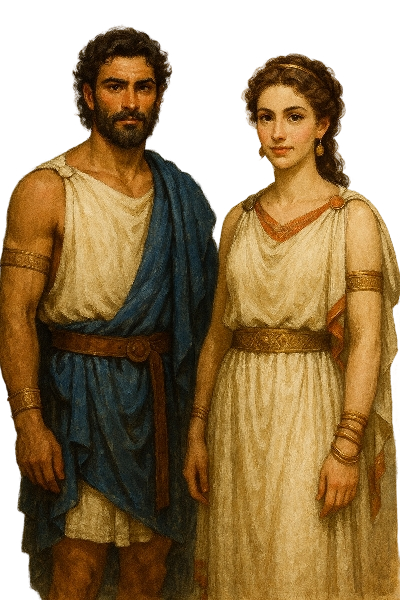
Estaklian attire for men balances practicality with a subtle display of civic pride and ancestry. Everyday garments are typically composed of light, breathable fabrics suited to the warm island climate, most often in muted earth tones or colors drawn from the surrounding sea. Men wear draped tunics or belted chitons, often pinned at the shoulder with bronze or iron clasps for laborers and silver or gold for those of higher standing. The cut of a man’s attire is usually simple and functional, allowing ease of movement for farming, sailing, or soldiering, yet even the plainest garment is rarely without a mark of identity—embroidered hems bearing the symbol of a polis, a woven pattern signifying ancestral lineage, or a strip of color denoting one’s civic or military role. Jewelry tends to be understated but deeply symbolic; rings inscribed with the emblem of a city-state or a family crest are common, while pendants depicting a patron god or hero serve as both ornament and devotion.
Women’s clothing in Estaklyos reflects the same emphasis on lightness and movement, yet it is typically more varied in color and texture, often embracing soft hues reminiscent of dawn, seafoam, or fertile earth. Like men, they wear draped chitons and tunics, but women’s garments often feature additional folds or layered panels, creating a sense of flowing movement even when standing still. Pins and brooches are not only functional but frequently elaborate, crafted to resemble mythic animals or symbols of the gods. Embroidery plays a significant role in women’s clothing, with borders and sashes frequently depicting stylized vines, waves, or celestial motifs. Jewelry carries profound cultural weight; bracelets and anklets are often heirlooms passed down through generations, while necklaces may carry charms representing a woman’s household gods or personal prayers. During festivals, women’s attire becomes a canvas of myth and ancestry, with embroidered scenes of hero-gods and divine patrons celebrating both the wearer’s lineage and civic devotion.
Children’s clothing is intentionally simpler, reflecting both practicality and the belief that youth is a time of potential rather than declaration. Boys and girls alike wear shorter chitons or belted wraps, often undyed or in soft, natural colors, with only minimal embroidery marking their household or polis. Jewelry for children is rare, typically limited to a protective charm blessed by a family priest or crafted in honor of a patron deity. As they grow older and take part in rites of passage, their clothing begins to incorporate more symbols of identity, marking their gradual integration into the civic and ancestral web of Estaklian life. Festivals are a notable exception, where even the youngest children are dressed in bright fabrics and adorned with wreaths of fresh flowers or leaves, symbolizing the vitality of new generations and their link to both ancestors and gods.
In the northern coasts and islands, clothing reflects the maritime climate and the region’s famed artistry. Fabrics are light and often dyed in gradients of sea-inspired hues—blues, greens, and soft whites meant to mimic waves and foam. Fisherfolk and sailors favor short chitons or wrap-around garments secured at the waist for ease of movement on ships. Jewelry here often incorporates shells, polished driftwood, or beads of colored glass, blending artistry with materials from the sea. Festival clothing in Aelyosos frequently includes long flowing cloaks dyed with wave-like patterns, symbolizing both protection and the blessings of the sea gods.
In the fertile eastern valleys and cultural heartlands, attire tends to be more structured and formal. Linen is the favored fabric, dyed in rich earth tones and accented with deep reds or gold to reflect the abundance of the land. Tunics here are cut longer and belted tightly, emphasizing dignity and restraint. Such embroidery is renowned for its precision, often depicting stylized vines, olive branches, and civic emblems in intricate repeating patterns. Jewelry is usually crafted in bronze or silver, with signet rings and brooches serving as marks of both citizenship and lineage. Ceremonial clothing is particularly elaborate, with full-length chitons and cloaks embroidered to display mythic scenes that tie the wearer to their ancestral hero-gods.
In the rugged highlands, clothing is designed with durability in mind. Wool and heavy linen dominate, dyed in muted greens, browns, and stone-grays to blend with the land. Garments are often layered, with shorter chitons or tunics worn beneath heavier cloaks fastened with large bronze pins. Decorative elements are minimal but meaningful: thick woven belts often bear patterns unique to a family or polis, serving as both ornament and identification. Jewelry here is practical and sturdy, typically iron or bronze pieces that can withstand hard labor. During festivals, however, they exchange their muted tones for vibrant sashes and cloaks, a striking display of color symbolizing the endurance of life in harsh lands.
Within the dense inner jungles, the heat and humidity dictate light, breathable fabrics dyed in deep greens and earthen hues to blend into the surrounding canopy. Clothing is often minimal, with loose wraps or short chitons allowing freedom of movement for hunting and gathering. Natural fibers and woven grasses are incorporated into belts, sashes, and even jewelry, which frequently includes wooden or bone charms carved with protective symbols. Mythic animal motifs dominate the adornment, reflecting the close spiritual relationship between the jungle dwellers and the creatures of their homeland. Ceremonial dress often includes wreaths of jungle flowers and painted designs on the skin, turning the body itself into a living canvas of devotion.
Along the arid southern borders where Estaklyos meets the desert, clothing is designed to shield the wearer from sun and sand. Long, light chitons and draped outer cloaks are common, dyed in pale earth tones and ochres that reflect the landscape. Head coverings are frequent, both for practical and cultural reasons, with cloth wraps protecting against the harsh light while also carrying embroidered symbols of family or civic identity. Jewelry often uses polished stones and metals that catch the sunlight, invoking blessings of endurance and prosperity. Festival attire in this region includes vivid, sun-dyed fabrics and golden accents, celebrating the harsh beauty of the desert and the strength required to thrive there.
Art & Architecture
Art in Estaklyos is not merely aesthetic but an extension of faith and civic identity, a language through which the people speak to their gods, ancestors, and each other. The Estaklian worldview holds that beauty is a form of devotion and that proportion and harmony reflect the divine order. Sculpture dominates their artistic tradition, from colossal marble figures of hero-gods guarding temple forecourts to small household votives carved in clay or bronze, each one a humble offering. Public spaces are living galleries; every plaza, fountain, and marketplace is adorned with reliefs and mosaics that tell the stories of divine pacts, heroic deeds, and civic unity. Even utilitarian objects bear artistic weight—amphorae painted with mythic scenes, shields engraved with ancestral emblems, and tools etched with protective symbols—transforming daily labor into ritual practice.
Architecture in Estaklyos embodies the same fusion of beauty, function, and reverence. City planning itself is treated as a sacred art, with streets and civic centers aligned to natural landmarks or celestial events. Temples are the highest expression of this devotion, constructed to mirror divine perfection through symmetry, proportion, and alignment with solstices or equinoxes. Marble colonnades rise in graceful repetition, symbolizing eternity, while amphitheaters are designed for perfect acoustics, allowing spoken word and song to carry as if aided by the gods. Harbors are often built in sweeping curves reminiscent of protective arms embracing the sea, reflecting the Estaklian belief that cities themselves are offerings to the divine. Even modest homes are constructed with symbolic care; a central hearth aligned with a household shrine ensures that every dwelling becomes a miniature temple of family and faith.
Painting and mosaic art hold a central place alongside sculpture and architecture, serving as both decoration and narrative. Walls of temples and civic halls are alive with vibrant frescoes depicting myths, historic events, and allegories of civic virtue. Floors are adorned with intricate mosaics designed to be walked upon, symbolizing the unity of mortal life and divine story beneath every step. Estaklian artists have a particular love for color and texture, using deep blues, rich earth tones, and shining gold leaf to evoke both the natural landscape and the presence of the gods. The blending of artistic mediums—sculpture framed by mosaic, architecture integrated with relief, and painting used as ritual storytelling—creates an immersive cultural aesthetic where art is never separate from life but inseparable from it.
Music, while less dominant than true art, plays an important role as the living breath of Estaklian culture. Hymns and chants are essential in religious rituals, believed to carry prayers upward like smoke to the gods. Civic life also resonates with music: festivals are filled with choruses, flutes, and lyres, while martial rhythms accompany soldiers on parade or to battle. Each polis tends to have its own musical flavor; coastal cities favor lilting, flowing melodies reminiscent of waves, while highland and mountain regions use deep, resonant chants that echo through stone. Music is also a teaching tool; epic poems are often sung or recited in rhythmic patterns, allowing myth and history to pass easily through generations. Though less monumental than sculpture or architecture, music is the heartbeat of Estaklyos, carrying the voice of its people across temple courts, city walls, and the ever-shifting sea.
Foods & Cuisine
Estaklian food is a celebration of the land and sea, blending the agrarian heart of the highlands with the abundance of the surrounding waters and the lush gifts of jungle and forest. Bread remains the foundation of nearly every meal, typically made from barley or wheat cultivated in the terraced fields of the inland valleys, and is always accompanied by rich, golden olive oil regarded as both sacred and nourishing. Fresh fish and shellfish dominate the coastal diet, grilled over open flame or stewed with fragrant herbs like thyme, oregano, and bay leaves. In the jungle and forested regions, wild fruits such as figs, pomegranates, and citrus mingle with earthy staples like legumes, roots, and foraged greens, creating a cuisine that balances sweetness and freshness with the grounding flavors of the earth. Goat and lamb are the most common meats, often roasted with honey and herbs for festivals, while venison and boar from the highland hunts are rare delicacies served in thick stews with pulses and wild mushrooms. Meals are deeply communal, not only feeding the body but binding family, polis, and faith together, with each dish often accompanied by ritual blessing or a small portion set aside for household gods and ancestors.
Drinks in Estaklyos carry equal weight as both sustenance and symbol. Wine is the lifeblood of Estaklian dining, ranging from deep, resinous reds cultivated in the sun-baked highlands to light, floral whites produced in the fertile river valleys. It is more than a beverage—it is a medium of prayer, poured first as libation before being shared in the communal cup that binds host and guest together. Jungle and river regions produce an array of fruit-based drinks, from sweet fermented pomegranate and fig wines to refreshing citrus infusions flavored with herbs like mint and basil. Highlanders favor stronger, earthier brews, including honeyed mead and barley-based ales flavored with local spices and pine resin, while coastal cities are known for diluting wine with cool spring water, a practice believed to mirror the union of sea and land. Even simple water is treated with reverence; fresh springwater and rainwater collected in clay vessels are often used in rituals of purification. Whether for daily meals, solemn offerings, or the joyous clamor of a festival, drink in Estaklyos is always more than refreshment—it is a vessel of community, memory, and devotion.
Common Customs, traditions and rituals
One of the most enduring Estaklian customs is the lighting of the household hearth, a ritual performed each dawn and dusk to honor both the gods and the ancestors. The hearth is considered the heart of the home, a fragment of the First Fire said to have been gifted by the divine when mortals pledged themselves to the covenant of polis and family. Each morning, a small libation of oil or wine is poured into the flame (or onto the stone where the fire will be rekindled) alongside a prayer for guidance and protection. At night, the final embers are stirred with a whispered invocation to the ancestors, symbolizing their continued presence as guardians of the household. Even in modest homes, this practice is never neglected, for an unlit hearth is believed to invite both spiritual and material misfortune.
Another central tradition is the Libation of First Fruits, performed during the first harvest of any season. Before any grain is milled or fruit consumed, the first basket is taken to the city’s central altar or, in rural areas, to the nearest shrine. There, the offering is divided into three portions: one burned for the gods, one buried for the ancestors, and one shared among the gathered community to symbolize unity and gratitude. This ritual reinforces the belief that all bounty flows first through divine and ancestral hands before reaching mortal ones. Even fishermen follow a variation of this custom, casting the first catch of the season back into the sea while uttering prayers to the gods to ensure continued abundance.
The Festival of Masks is a beloved civic and spiritual celebration observed across many polis, though each city interprets it differently. Participants craft elaborate masks representing gods, ancestors, or mythic beasts, and for a single night, identities are set aside as everyone mingles in anonymity. It is said that during this festival, the divine walk among mortals, wearing masks of their own, and that any guest might be a god testing the virtues of hospitality and joy. The following morning, the masks are burned in a communal pyre to release the prayers and blessings carried within them.
Among the most sacred customs is the Naming Libation, performed when a child is formally presented to their ancestors and the gods. Shortly after birth, a priest or family elder pours a mixture of oil and water over the infant’s forehead, speaking both the given name and a litany of ancestral names into the ritual. This act is believed to bind the child’s spirit to their lineage and ensure that the gods recognize and protect them as part of the eternal chain of Estaklian blood. A small token, such as a carved charm or woven band, is given to the child during the ceremony and kept as a lifelong talisman. It is believed that someone who does not have this rite performed as a child will not go to the gods when they die, instead cast to drift eternally without friend or family.
Finally, the Oath of Bread and Salt is a widely observed tradition sealing bonds of trust, alliance, and reconciliation. When two individuals or groups wish to cement a pact, end a feud, or enter into partnership, they meet at a neutral hearth and share a piece of bread dipped in saltwater. The bread represents sustenance and the shared bond of community, while the saltwater symbolizes tears, sacrifice, and the weight of promises made. Speaking the oath over this simple meal elevates it beyond mere words, transforming the agreement into a sacred vow witnessed by both gods and ancestors. To break a bond forged over bread and salt is considered one of the gravest social and spiritual crimes, carrying not only shame but the fear of divine reprisal upon one’s house and polis.
Common Taboos
Hubris against the gods is regarded as the most dangerous and unforgivable act an Estaklian can commit, for it is seen as an attempt to unravel the very order of the world. To claim equality with the divine or to scorn their gifts is not just arrogance but a defiance of the sacred covenant between mortal and god that underpins all Estaklian culture. Myths are filled with tales of cities laid low, families cursed, and heroes struck down for even a single act of hubris, serving as constant reminders that mortal greatness exists only as an offering to the divine. Even subtle forms of this taboo—failing to give proper thanks for blessings, boasting of deeds as though they were achieved without divine favor, or defacing a holy image—are believed to invite misfortune, not just upon the offender but upon their entire polis. In Estaklyos, humility before the gods is not weakness; it is the foundation of survival.
Breaking oaths is considered a spiritual wound that festers through generations, staining not only the individual but their bloodline. An oath in Estaklyos is never seen as a mere agreement between mortals; it is a spoken bond witnessed by the gods and the ancestors alike. To shatter such a vow is to shatter the trust between mortal and divine, and the consequences are believed to ripple outward like cracks in stone. The worst criminals in Estaklian history are not thieves or murderers but oathbreakers whose betrayal is said to have brought famine, war, or divine silence upon their people. Because of this, oaths are made with great solemnity, often over sacred fire or with libations poured to the gods, and even in everyday life, a promise is treated with the same gravity as a sworn treaty. In a culture where words are living things, an oath is seen as a thread woven into fate itself, and to tear it is to invite ruin.
Dishonoring ancestors is viewed not only as a personal failing but as a severing of the soul from its rightful place in the eternal chain of life. Estaklians see themselves as the living vessels of those who came before, carrying their names, deeds, and sacrifices forward. To forget one’s lineage, to neglect ancestral rites, or to speak ill of the dead is considered a crime against both blood and spirit. Such acts are believed to leave a person “hollow,” a body without the living breath of their ancestry, and many myths speak of those who dishonored their forebears wandering as restless shades after death, denied entry to the ancestral halls. This taboo is so strong that even enemies are rarely cursed through their lineage; to insult another’s ancestors is to strike at the foundation of who they are, an act seen as almost sacrilegious. Remembering and honoring the dead is not a choice in Estaklyos; it is the act that makes one truly alive.
Refusing hospitality is a shame so deep it resonates beyond the personal and into the spiritual. In Estaklyos, the guest and host relationship is sanctified by divine law, watched over by the gods who first taught mortals the sacred bond of the shared table. To turn away a guest in genuine need is to reject that divine teaching, while to refuse the hospitality of another polis without dire cause is to insult not only the host but the gods who guard the exchange. Bread and wine are not just food and drink; they are symbols of life and community, and to reject them is to reject the bond between people and the sacred trust that underlies society itself. Myths tell of wandering gods disguised as beggars or weary travelers, blessing those who welcomed them and cursing those who turned them away, a reminder that no guest should ever be treated as merely mortal. Even enemies who accept the rites of hospitality are protected by this law, for to harm them under one’s roof is to commit an act of cosmic betrayal that no offering can easily erase. Witches acting to prey on people in this are believed to be cursed by the gods or hunted down by hero-gods.
Common Myths and Legends
- The Pact of the First Hearth. In the dawn of Estaklyos, when mortals lived as scattered tribes, the gods descended to demand a covenant. A single mortal, Aethon the Firebearer, struck flint on sacred stone and lit the first hearth in offering. The gods accepted and swore to bless any city built around such a flame, making the hearth a divine symbol of both family and polis. To this day, every Estaklian city maintains a central sacred fire said to trace back to that first spark.
- The Stone Bride of Thallos. Thallos, a hero who sought to unite two warring city-states, fell in love with a woman said to be the daughter of a mountain god. When he was slain in battle, she turned herself to stone to guard his grave until his soul returned in the next life. The city-states made peace at the site, and the great statue known as the Stone Bride still stands there, believed to weep dew each dawn as a blessing for the living.
- The Broken Lyre of Ephyraia. Ephyraia, a mortal musician beloved of the gods, played a song so beautiful it drew even the sea itself to stillness. But when she defied fate to save her doomed lover from death, the gods shattered her lyre as punishment. Its pieces fell into the sea and became the scattered islands of the southern archipelago. Sailors claim that when the waves are calm and the wind low, you can still hear her unfinished song drifting across the waters.
- The Trial of Kelksiomides. Kelksiomides, a now-fallen hero-god, was said to have faced a trial set by all the gods at once: to ascend Mount Thegys carrying the weight of every mortal sin upon his shoulders. Each step made him older and heavier, until at the summit he became stone, forming the mountain’s peak. Pilgrims climb Thegys to leave offerings, believing each token lifts a fraction of his burden and grants them divine favor.
- The Weeping Columns of Thonis. When Thonis called upon he gods for strength, they granted his thirty marble columns to hold his hall aloft forever. When the city betrayed its patron deity, the columns cracked and began to drip water like tears. The ruins stand to this day, and the "Weeping Columns" are seen as both a warning and a blessing: those who drink from their water are said to gain wisdom but also sorrow for the sins of the past.
- The Tide-Bound Crown. The sea god Brinyas once gave a mortal king a crown of coral and pearl, granting him master of the tides so long as he ruled justly. When the king became cruel, the sea rose and tore his palace into the waves, dragging the crown to the ocean floor. Estaklian sailors tell of glimpsing its glimmer in shallow reefs during storms, and legends say that whoever recovers it can call the tides back to mortal command—if they prove worthy.
- The Spear of Asteron. Asteron was a mortal warrior said to have defended his city alone when the gods turned their faces away. Armed with nothing but a spear, he fought night after night against monstrous tides until he fell upon the walls, his body unbroken though his spirit left him. The stars themselves wept at his endurance, moved by his valor, and stole away his spear into their bodies, reforming into its shape so mortals would always remember courage in darkness. The constellation of the Spear of Asteron points toward true north, and Estaklian sailors know to follow the spear-tip to guide their voyages, believing the hero protects all who brave the unknown.
- The Dreamspeakers. Estaklian legend tells of the great cyclopes, ancient one-eyed seers who dwell in the unseen caverns beneath the roots of the islands. They are said to be speakers of truths so deep it shapes reality itself. When a mortal's deeds rise to the brink of legend, it is said the cyclopes awaken in ther dream-halls and begin to whisper that hero's name into the fabric of the world. Their prophecies are not mere foresight but living declarations of what is to come. What they speak is believed to be woven into destiny, and through their words, mortals are lifted beyond flesh into the threshold of divinity. The birth of a hero-god is often the echo of the cyclopes declaring, "This one shall endure."
- The Feast of Returning Light. Long ago, an arrogant king challenged the sun itself, vowing to keep his city in darkness to prove mortals did not need divine light. The gods withdrew their blessing, and the land plunged into endless night for a full season. At last, a humble baker lit a single loaf of bread aflame as an offering, and the gods, moved by the act of devotion, returned the dawn. The Feast of Returning Light is celebrated every winter, with bonfires, glowing lanterns, and the breaking of special honey-bread baked in the shape of the rising sun. Sharing the bread is seen as renewing the bond between mortals and gods and ensuring the world's light never fades again.
- The Shaking God. Estaklian legend tells of Krython, the god who sleeps beneath the world, his dreams shaping the shifting of earth and sea. When mortals forget their duty to balance creation with reverence, his sleep turns restless, and the land shudders with his stirring. The oldest myths claim that entire islands were born or broken when Krython rolled in his slumber, and that the tsunamis are his sighs when the weight of mortal sin grows too heavy. In coastal poleis, priests pout libations into the sea during tremors to soothe the Shaking God, whispering prayers for calm and promising renewed devotion.
Ideals
Beauty Ideals
For Estaklian men, beauty is measured less by mere physical symmetry and more by how the body reflects strength, discipline, and service to the polis. A well-shaped physique—broad shoulders, sturdy legs, and the lean muscle of sailors or warriors—is admired, not as vanity but as a sign of a life devoted to labor, protection, and civic duty. Weathered skin and calloused hands are not marks against attractiveness but badges of virtue; they speak of endurance, sacrifice, and connection to the land and sea. Facial structure favors sharp lines and strong jaws, though what draws the most praise are the eyes: steady, focused, and alive with purpose. Grooming is seen as an act of respect to both self and city. Beards are common but well-kept, symbolizing maturity and responsibility, while clean-shaven faces are often associated with youth, athletes, or men dedicated to temple service. A man’s beauty is ultimately judged by how his presence commands respect—not through arrogance, but through the quiet confidence of one who serves something greater than himself.
For Estaklian women, beauty is tied deeply to vitality, grace, and the ability to carry both life and lineage. Soft, flowing movement is as prized as any physical feature, for it reflects balance and harmony, qualities that the Estaklians equate with divine favor. Healthy, sun-kissed skin and hair scented with oil or flowers are signs of both physical well-being and devotion to the gods of growth and prosperity. Full, expressive eyes are seen as the heart of feminine beauty, especially when they convey warmth and intelligence. Hair holds special significance, often worn long or elaborately braided, as it symbolizes both ancestry and the threads that bind generations together. Women’s beauty is also intertwined with their role as keepers of story and ritual; a voice that carries song or recites myth with poise is said to be as captivating as any physical feature. Above all, Estaklian ideals place less emphasis on delicate perfection and more on radiance—the vitality that makes a woman seem not merely alive but life-giving. Woman are to be seen, heard, and felt by presence alone, letting them radiant and light their poleis.
Gender Ideals
For Estaklian men, the ideal is not merely to be strong but to embody arete—excellence in service to family, polis, and the gods. Courage is expected, though not the reckless kind; true bravery lies in bearing responsibility without faltering, whether on the battlefield, at sea, or in civic life. A man’s role is to protect and uphold, to be the pillar upon which others may safely lean, yet also to know when to bow to wisdom and temper strength with restraint. Leadership is admired but only when rooted in service, for an Estaklian man who rules for himself is seen as hollow. Physical vigor is respected, but more so when it reflects discipline and dedication rather than vanity. Above all, the ideal man is one who understands that his life is not his own alone, but a thread in the greater tapestry of ancestry, polis, and divine order. Where women are gentle, men are expected to be strong as stones.
For Estaklian women, the gender ideal is woven from grace, wisdom, and the power to nurture both life and legacy. Women are seen as the keepers of continuity: of family, of story, of ritual, and often of the subtle balances that maintain harmony within the polis. Strength for them is not measured in force but in resilience and the ability to shape and preserve through both calm and crisis. An Estaklian woman is expected to embody balance—passion tempered with care, independence joined with deep connection to family and community. Intelligence and eloquence are as highly prized as beauty. The ideal is not passive; Estaklian women are celebrated in myth as leaders, warriors, and priestesses, but their heroism almost always intertwines with creation and preservation, marking them as the living bridge between mortal and divine continuity. Where men destroy and command, women create and guide.
Courtship Ideals
For Estaklian men, courtship is seen as an act of pursuit not only of the woman but of arete itself—the excellence of proving one’s worth as a partner, protector, and contributor to lineage. Drawing heavily from ancient tradition, a man demonstrates devotion not through grand displays of wealth but through service: offering labor to the woman’s family, composing hymns or poems in her honor, or making small, deliberate sacrifices at the household shrine of her ancestors to show respect for the lineage he hopes to join. Public displays of affection are rare during courtship; instead, subtle gestures—an offered cloak, a shared libation, a hand clasped briefly in ritual greeting—carry profound meaning. Gifts are symbolic rather than lavish: a carved token bearing a hero-god’s emblem, a small amphora of oil, or a woven band meant to bind both hearts and households. The man’s role is as much supplicant as suitor, proving not only his passion but his discipline and his willingness to place her and her ancestry before his own pride.
For Estaklian women, the courtship ideal is rooted in grace, discernment, and the power of acceptance or refusal as a sacred act. A woman’s role in courtship is not passive but deliberate; she must weigh not only her suitor’s affection but his ability to honor her lineage, fulfill civic duty, and uphold divine law. Ancient Estaklian tradition holds that a woman signals her openness subtly, often through symbolic acts such as offering a portion of her meal or pouring a libation in his presence, gestures that mirror the sacred hospitality rites. Her response to gifts carries ritual weight; to reject a token is not a slight but a clear declaration that the bond is unworthy, while to accept even a simple offering is seen as the first weaving of a shared destiny. Women are also expected to test their suitors—not through cruelty but through challenges that prove endurance, patience, and devotion, echoing mythic tales where goddesses set trials before mortal lovers.
Relationship Ideals
For Estaklian men, the ideal relationship is one where strength serves as foundation but never domination. A husband or partner is expected to be both shield and pillar, offering protection not only from physical harm but from uncertainty and instability. Loyalty is treated as the highest virtue; a man’s word within a relationship is seen as a binding oath not just to his partner but to the gods who witness all bonds. Emotional restraint is valued, but not to the point of coldness—an ideal man knows when to temper passion with calm and when to let his heart burn openly, especially in devotion to his family. Partnership is not about possession but about stewardship: of love, of household, and of the future lineage they create together. To fail in these duties is seen not just as personal failure but as a crack in the sacred chain between ancestry and divine favor.
For Estaklian women, relationship ideals are centered on balance and continuity. A partner is not only a beloved but a co-keeper of the household, the ancestral line, and the sacred threads that bind family to polis and to the gods. Women are expected to bring not only affection but wisdom into their unions, guiding and tempering their partner’s strength with grace and foresight. Faithfulness is more than fidelity; it is the act of nurturing the bond as if it were a living thing, tending it with care through both prosperity and hardship. Emotional openness is highly prized, as women are seen as the voices of the heart within the relationship, keeping communication alive and ensuring that love does not grow stagnant. Above all, an Estaklian woman’s relationship ideal is to create a union that serves not only personal happiness but the greater continuity of lineage and community, turning love into a sacred act of preservation and creation.
This is a rare option
This option requires special permission to take. In the case of spells, psionic powers, and similar options, this option must be found in the world and cannot be taken upon level-up.
This is a stub
This article will be expanded upon in the future
This is a
Good Article
Game Mechanics
5th Edition
To Be Made
To Be Made
To Be Made
