
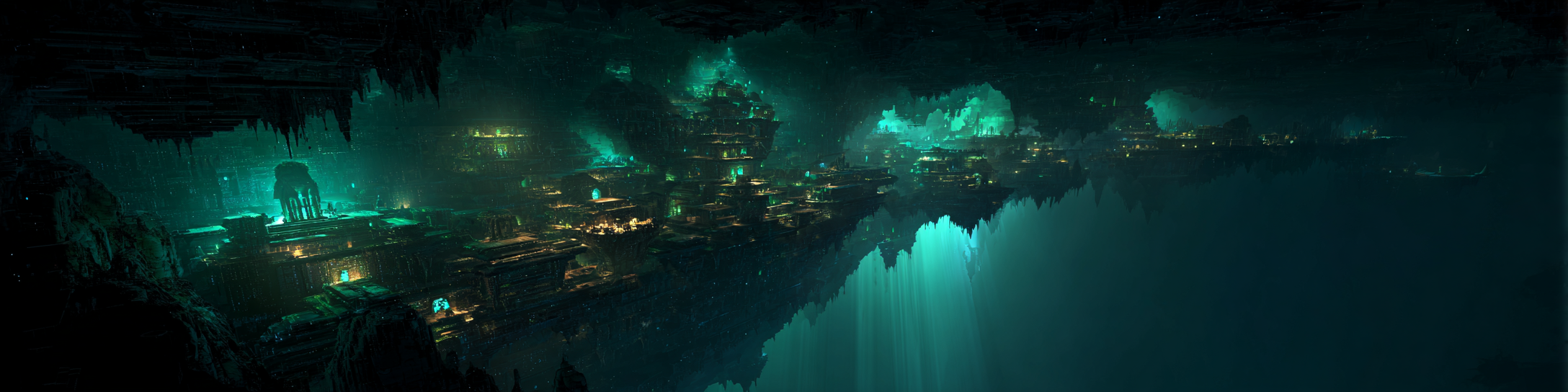
Tritons
The Tritons of the Godslost Sea dwell far below the reach of sun, star, and moon. Their society developed in regions where pressure is immense, light is scarce, and silence rules the water. Life in these depths demands resilience, discipline, and constant awareness, and the Tritons have embraced these traits fully. Their ancestry from the Elemental Plane of Water reinforces this outlook. They see themselves as guardians of an environment that is both vast and perilous, responsible not only for their own survival but for maintaining order in a realm where few others dare to venture.
Because of these conditions, Triton communities are structured, resilient, and deliberately shaped with military precision. Their cities do not arise from natural growth but from purposeful design, engineered to withstand deep-sea forces and deter the predators and threats that roam the abyss. Buildings are reinforced, patrol routes are planned, and public spaces are organized with strategic clarity. Even their lighting reflects this mindset. Luminous stone, enchanted minerals, and cultivated bioluminescent lifeforms cast a cool, steady glow through streets and halls, creating pockets of controlled radiance in an otherwise overwhelming darkness. To the Tritons, civilization is not something that emerges by chance. It is something crafted, defended, and maintained with unwavering vigilance.
Naming Traditions
Feminine names
Common feminine Triton names tend to be fluid and consonant-light, with sounds that carry clearly through water. Examples include Nerisa (meaning “sea-born”), Talrima (“deep current”), Lissara (“quiet watcher”), Marvella (“strong tide”), Veluna (“hidden moonlight in water”), Qarida (“stone of the trench”), Siralla (“song of the shallows”), Orrima (“steady pressure”), Peluna (“dark-blue glow”), Ghajra (“eye of the deep”), Sulnaya (“cold-flow grace”), Rimalta (“sand-keeper”), Kelissa (“guarded reef”), Morqena (“shadowed chasm”), Yalura (“softly rising wave”), Tessira (“shielding tide”), Nalvessa (“vigilant depth”), and Aqelina (“sharp-water mind”). These names are usually given in full in formal settings and shortened only among family or long-standing comrades.
Masculine names
Masculine Triton names often emphasize strength, clarity, and the steady cadence of deep-water currents. Common examples include Ruunar (meaning “deep sentinel”), Tal’vos (“voice of the trench”), Marrik (“stone current”), Velkor (“cold-flow guardian”), Qathen (“chasm-born”), Solmaris (“radiant tide”), Ghallan (“pressure-forged”), Doreth (“bound to the deep”), Kelvarun (“watcher of vents”), Vorallis (“breaker of stillness”), Shalmaruk (“dark-water shield”), Orren (“swift-flow hunter”), Thessarik (“echo of the abyss”), Nalqor (“steady surge”), Veridan (“speaker to currents”), Marqelos (“storm-wrought”), Sulvarin (“guardian of the cold paths”), and Qerrun (“tide-bound mind”). These names tend to be pronounced cleanly and with deliberate cadence, reflecting Triton expectations of discipline, duty, and the weight carried by every word spoken beneath the crushing depths.
Unisex names
Gender-neutral Triton names tend to highlight qualities of vigilance, flow, and adaptability rather than physical traits or roles, making them well suited to a culture that values function and discipline over rigid gender distinctions. Common examples include Neruth (meaning “patient current”), Talvessa (“keeper of the flow”), Selqir (“listening depth”), Varuna (“circle of waters”), Qeliss (“quiet pressure”), Moriva (“shadowed stream”), Lunqar (“pale trench-light”), Rivassa (“river-born strength”), Sorqen (“watcher at the boundary”), Pelorin (“shell of the deep”), Vassira (“ward of the abyss”), Thalun (“calm within the storm”), Ossira (“echoing water”), Kelrun (“steady channel”), Raqessa (“measured surge”), Sulorin (“cold, clear path”), Yelvar (“rising tide-mark”), and Qerila (“mind like still water”). These names are used freely across all genders, chosen more for the virtues they evoke than for any expectation of how the bearer should live or appear.
Family names
Triton naming conventions reflect both lineage and duty, with most individuals bearing a family name followed by a profession name that they earn in adulthood. A child is given a personal name and a family name at birth, such as Nerisa Vassirin, where the family name links them to a recognized household, training line, or ancestral cohort. Later in life, once they have proven themselves in a specific role, they acquire a second surname tied to their profession or function. An Abyssal Guard veteran might be known as Ruunar Qathen, Ghassier-Fond, while a senior Flowkeep engineer could be called Talvessa Moriva, Keeper-of-Fluss. In Aquan, these titles often appear in compact forms such as tal-Ghassa, tal-Fluss, or tal-Kurrenti, and are used in formal introductions, military records, and ceremonial contexts. The profession name does not pass to children; it is earned, not inherited, and serves as a mark of personal achievement rather than a dynastic claim. In everyday speech Tritons often shorten a full name to given name and family name, reserving the profession title for moments when rank, duty, or honor need to be clearly recognized.
Triton family names often trace back to ancestral cohorts, notable deeds, or the deep environments their lines first claimed. Many carry the sound of pressure, stone, or flowing water. Common examples include Vassirin (meaning “of the guarded depth”), Qathemar (“trench-born line”), Morqessan (“shadowed escarpment”), Talravi (“of the ridge currents”), Shulvoss (“cold-vent keepers”), Kelridan (“reefward sentinels”), Nalqirun (“those who listen to the deep”), Rimaltor (“sand-front watchers”), Ghallessar (“pressure-forged blood”), Vorassin (“edge-of-abyss wardens”), Peloranis (“shell-ringed bastion”), Thessavir (“voice of the long chasm”), Varqelin (“circle-of-waters line”), Sorvessa (“boundary-keepers”), Maraqel (“ridge-fire dwellers”), and Vessultar (“watchers above the dark paths”). These names are spoken with pride and precision, tying each Triton not only to their immediate kin but to the history of the bastions, ridges, and trenches their ancestors chose to hold.
Culture
Major language groups and dialects
The primary language of the Tritons is Aquan, a fluid and resonant tongue shaped by their origins in the Elemental Plane of Water. Over centuries spent on the Prime Material Plane, Triton Aquan has diverged from its planar counterpart, becoming denser in vocabulary and more structured in grammar to meet the needs of militaristic command, engineering terminology, and civic governance. Linguists sometimes refer to it as Material Aquan, noting that it carries harder consonants and more deliberate phrasing than the ever-shifting dialects spoken by elementals. Within Triton society several localized accents have formed, usually influenced by depth, current patterns, and proximity to geothermal regions. Speakers from the trench cities tend to use shorter, more clipped forms, while those from vent settlements favor slower, rolling rhythms that mirror the steady rumble of the seabed. Although Tritons also learn additioanl languages for diplomacy and other dealings, Aquan remains the language of law, ritual, and identity. It carries not only their history, but the pulse of the deep where their civilization endures.
Culture and cultural heritage
Triton culture is grounded in a deep sense of duty, shaped by the crushing darkness and ever-present dangers of the deep sea. From childhood they are taught that survival is not an individual pursuit but a shared responsibility, and that every member of their society contributes to the vigilance that keeps their cities secure. Their ancestry from the Elemental Plane of Water forms the foundation of their identity. Traditions emphasize discipline, clarity of purpose, and the belief that order must be maintained in a realm where chaos is an ever-present threat. Storytelling is often conveyed through current-patterns, rhythmic chants, and dances that mimic the movement of tides through stone arches. These expressions reinforce communal memory and honor the Tritons who established the first strongholds in the abyss.
Heritage holds tremendous weight in Triton society, although not in the dynastic sense found among surface nations. Instead, they preserve the achievements of ancestral cohorts—groups who carved out the first defensible spaces or mastered dangerous deep-water skills. These acts become touchstones for the community and serve as instructional pillars for new generations. Ceremonies commemorating historic victories, founding expeditions, and great sacrifices are held regularly, often in luminous halls where elemental lights pulse in time with spoken recitations. Although Tritons can be stern, their cultural pride is not rooted in superiority but in the collective endurance that allowed them to survive where light itself fails. Their songs, rituals, and formal oaths all remind them that each generation holds its position in the deep only because the last refused to yield.
Art and craftsmanship also play a significant role in their cultural heritage, though both tend toward the functional rather than the decorative. Sculpted stone walls depict tactical formations, reef-stabilizing machinery, or stylized versions of great battles fought against abyssal predators. Music is performed through resonant conch instruments, pressure-hollowed stone flutes, and choral arrangements that send waves of sound through entire districts. Even their festivals reflect their environment. The Rite of Rising Pressure, celebrated when young Tritons finish their endurance training, honors the physical and mental fortitude required to thrive below. The Commemoration of the First Bastion, held annually, recounts the founding of Thal’Ruun Vassora and reaffirms the unity of their people. In every tradition, whether grand or humble, the Tritons reaffirm the values that define them: vigilance, discipline, and pride in a civilization carved from the darkness of the deep.
Shared customary codes and values
Triton society places immense importance on discipline and collective purpose. Every individual is taught from a young age that their actions contribute to the strength or weakness of the whole, and that vigilance is the first duty of any citizen living in the deep. Order is not merely a preference but a guiding principle. Decisions are made with deliberate care, strategies are evaluated over long spans of time, and responsibility is taken seriously by all levels of society. Tritons admire precision in thought and action. Rash behavior is viewed with suspicion, while steadiness and strategic patience are celebrated as foundational virtues. Their shared ethos emphasizes clarity, loyalty, and preparedness, with each value reinforcing their belief that survival in the abyss depends on unity.
Another core value is service, which permeates every aspect of Triton life. Service to one’s cohort, to one’s city, and to the deep itself is a point of pride and an expectation. Whether one becomes a warrior, a scholar, or an engineer, the purpose is the same: to strengthen the stability and resilience of their people. Honor is measured not through boasts or personal achievement but through reliability, competence, and the willingness to uphold communal obligations. Breaking an oath or failing in one’s duties is regarded with deep shame, and sincere atonement is necessary to restore one’s place within the community. Tritons believe that every role has significance, whether it is guarding the outer trenches or tending the structural veins of a pressure ward.
At the heart of their code is a reverence for the deep, not as a source of mystical wisdom but as a force that demands respect. The deep sea is viewed as a constant test, shaping them into a disciplined people. Tritons value adaptability, endurance, and the ability to remain calm under pressure, both literal and figurative. Acts of unnecessary destruction or recklessness within their environment are strongly condemned. Even though Tritons often shape or reinforce their surroundings, they do so with a clear understanding of consequence and balance. These shared values create a society where strength is measured in collective resilience, where identity is forged through duty, and where the respect for the deep binds them together more tightly than any written law.
Average technological level
Triton technology is shaped by the immense pressure, darkness, and turbulence of the deep, resulting in a level of engineering that is neither primitive nor overtly arcane, but rather highly specialized. Their mastery lies not in producing delicate instruments but in crafting durable mechanisms and structures able to withstand crushing depths and volatile conditions. Pressure-tempered stonework, reinforced coral composites, and magically stabilized alloys form the backbone of their settlements. Their architectural designs incorporate controlled currents for waste removal, district-to-district transit, and environmental regulation. Energy sources vary by region. Volcanic settlements tap geothermal vents for heat and elemental reactions, while trench cities rely on vibration-harvesting frames that convert movement and hydrostatic pressure into low but reliable power. Within this environment, Triton inventiveness focuses on stability, clarity of function, and rigorous longevity rather than innovation for its own sake.
The most distinctive aspect of Triton technological prowess is sea-forging, a deeply respected craft that requires both technical precision and elemental understanding. Sea-forgers work near volcanic ridges where molten stone and exposed vents create pockets of superheated water. Here, raw metals are tempered directly within pressurized thermal currents, producing alloys impossible to replicate on the surface. These materials, known collectively as vent-born steel, resist corrosion, maintain structural integrity at immense depths, and resonate cleanly with elemental magic. Triton arms and armor forged through this method are not ornamented, but the function speaks for itself. Sea-forging also produces specialized tools used by Flowkeep Orders and the Abyssal Guard, such as vent-hardened anchors, pressure-locking clamps, and short-range vibrational signaling devices.
Triton society incorporates certain deep-sea creatures not as domesticated tools but as environmental partners, forming structured, mutually respectful relationships that reinforce the stability of their cities. The most emblematic of these are the Hushback Rays, whose natural silence fields generate pockets of acoustic stillness in the otherwise turbulent trenches. Triton engineers and Flowkeep Orders map these migratory routes carefully, building listening spires and calibration posts on the edges of known Hushback territories. The rays’ quiet spheres reduce ambient noise, allowing for more precise sonar readings, early detection of structural stress, and the monitoring of distant tremors. While the Tritons never harness Hushbacks directly, they design their acoustic technology with an intimate understanding of how these creatures shape sonic patterns within the deep.
More active defensive integration comes from carefully maintained colonies of Gravetide Anemones, whose powerful stunning tentacles create natural deterrents against leviathans and other deep predators. Triton engineers cultivate these anemone gardens outside critical trenches and access corridors, stabilizing their growth with rune-hardened latticework that prevents uncontrolled spread while preserving their natural defensive responses. These living barriers ease the burden on the Abyssal Guard by intercepting or slowing threats long before they reach populated districts, especially in regions where artificial wards falter under extreme pressure fluctuations. The same ecological philosophy extends to the Tritons’ selective partnerships with mounts such as Stormfin Chargers, swift and disciplined creatures trained through synchronized movement rather than coercion. Chargers serve as rapid-deployment mounts for scouts and messengers, complementing the passive vigilance provided by anemone lines and the ambient quietude of Hushback zones. Together, these relationships reflect a core tenet of Triton technological identity: they do not seek to control the deep, but to work in disciplined concert with its most powerful inhabitants.
Major organizations
Triton society is anchored by several highly structured institutions that maintain order and ensure the safety of their deep-sea realm. The most prominent is the Abyssal Guard, a disciplined military force responsible for patrolling the borders of Triton territory and intercepting threats long before they reach their cities. Complementing them is the Current Council, a governing body composed of veteran tacticians, elemental scholars, and community leaders who oversee strategy, resource allocation, and the administration of law. Tritons who pursue knowledge rather than combat often study within the Deepmind Conclave, an academy devoted to elemental magic, deep-sea navigation, and the engineering of pressure-resistant structures. Beneath all of these groups lies the Flowkeep Orders, specialized teams tasked with maintaining the currents, infrastructure, and protective wards that keep Triton cities stable in the crushing darkness. Together these organizations form the backbone of Triton civilization, each reinforcing a culture shaped by vigilance, precision, and collective purpose.
The Abyssal Guard (Ghassa tal-Fond)
The Abyssal Guard serves as the first and most formidable line of defense within Triton society. Its ranks are composed of highly trained warriors who specialize in deep-sea combat, patrol strategy, and the detection of planar disturbances that may threaten the Godslost Sea. Members of the Guard undergo rigorous training from a young age, learning to maneuver in crushing depths, fight in low-visibility conditions, and interpret subtle shifts in current and pressure that signal approaching danger. Patrols sweep far beyond the borders of Triton territory, often venturing into trenches and geothermal vents where few other creatures dare to roam. Their armor is reinforced with pressure-tempered alloys and etched with sigils that channel elemental water for strength and clarity. Although their presence is most visible during crises, the Guard’s quieter duties are equally vital. They escort civilian expeditions, monitor migration patterns of dangerous predators, and maintain long-standing vigilance over ancient sites that the Tritons consider strategically or spiritually significant. To serve in the Abyssal Guard is to embrace a life of discipline and purpose, and those who wear its crest are regarded with profound respect.
The Current Council (Kunsill tal-Kurrenti)
The Current Council functions as the central governing body of Triton civilization, guiding policy, strategy, and civic order with a blend of military discipline and elemental wisdom. Its members are chosen from among the most seasoned tacticians, deep-sea scholars, and respected community leaders, each bringing a lifetime of service to the table. Council deliberations take place in vast chamber-halls illuminated by shifting bands of enchanted mineral light that mimic the slow pulse of ocean currents. Decisions are rarely made hastily. Instead, the Council studies long-term drift patterns, resource movements, and historical precedent to ensure that every action supports the stability of their deep-water realm. Their responsibilities range from distributing patrol routes to approving engineering projects that alter the seabed, and from shaping diplomatic stances to overseeing the education of promising young Tritons. Although respected for their clarity and foresight, the Current Council is not a distant authority. Council members regularly consult with the Abyssal Guard, the Flowkeep Orders, and the Deepmind Conclave to ensure that the needs of all citizens are met. Through their balanced leadership, the Council maintains the sense of unified purpose that defines Triton society.
The Deepmind Conclave (Konklav tal-Moħħfond)
The Deepmind Conclave stands as the intellectual and arcane heart of Triton society. Scholars, elementalists, engineers, and navigators study within its halls, which are carved into stable regions of the seabed and illuminated by soft arrays of enchanted algae. The Conclave’s teachings draw heavily upon the Tritons’ origins in the Elemental Plane of Water, blending practical science with ancient aquatic magic. Students learn to interpret the movements of deep currents, chart pressure gradients, stabilize structures against shifting seabeds, and channel elemental forces with precision. Research is a central pillar of the Conclave’s mission. Its members monitor geothermal activity, study migratory patterns of abyssal creatures, and develop enchanted materials capable of withstanding the crushing depths. Although many of its teachings are applied directly to civic infrastructure and military strategy, the Conclave also fosters philosophical contemplation about the nature of water, memory, and transformation. Graduates of the Deepmind Conclave often become advisors to the Current Council, designers of public works, or instructors who guide the next generation of Triton scholars.
The Flowkeep Orders (Ordni tal-Fluss)
The Flowkeep Orders are responsible for maintaining the delicate equilibrium that allows Triton cities to exist safely within the deep. Their members are skilled specialists who manage the engineered currents, reinforced structures, and protective wards that shield settlements from the immense pressures and unpredictable forces of the abyss. Flowkeeps monitor the pulse of water through every corridor and channel, adjusting flow patterns to prevent stagnation or dangerous pressure build-up. They also oversee the intricate network of silt filters, current-gates, and elemental conduits that keep out hostile creatures and redirect natural hazards away from residential districts. Apprentices learn to sense minute shifts in temperature, current, and vibration, developing a near-instinctual understanding of how their city breathes and moves through the sea. The Orders are not a single unified body but a collection of specialized groups, each focused on tasks such as structural integrity, current modulation, energy distribution, or ward maintenance. Although their work is often invisible to daily life, Triton society depends heavily on their constant vigilance. Without the Flowkeep Orders, the great cities of the deep would falter quickly, for the sea offers no forgiveness to those who neglect its forces.
Capital of the Tritons
The capital city of the Tritons is Thal’Ruun Vassora, a vast stronghold hidden within a colossal cavern carved deep into the vertical wall of an oceanic trench. The city clings to the stone like a many-tiered bastion, its platforms and terraces suspended over a drop that descends into unbroken midnight. Here the water is so cold and so crushing that no surface-dweller could survive, yet the cavern glows with quiet, eerie luminance. Pressure-tempered structures rise in stacked layers along the rock, illuminated by controlled currents of bioluminescent flowstone that pulse through channels etched into the walls. From the shadows above, stalactitic ridges descend like the jaws of some ancient beast, while the abyss below swallows all sound and light.
At the heart of this submerged metropolis stands the Citadel of Tides: a monumental spire-temple rooted into the cavern’s central buttress where the Abyssal Guard, Current Council, and Deepmind Conclave maintain their shared vigilance. Thal’Ruun Vassora is more than the political center of Triton life. It is a bulwark carved against the endless void, a city built inward rather than outward, designed to endure whatever stirs in the blackness beneath.
Scattered beyond the capital are several fortified satellite strongholds. Maraq’tel is hewn into a volcanic ridge where molten vents feed the forges. Shuunar Kass descends around a geothermal plume and serves as a research enclave for hydromancers and engineers. Vessuun Tal hangs like a watchful lantern over a labyrinthine trench network, its garrison sworn to monitor the deep where ancient threats are rumored to move in the dark.
“The Tritons live where the sea is darkest, and so they have learned to become steady shields against what stirs there. Their discipline may seem hard to others, but in truth it is a quiet kindness…without their vigilance, far fewer of us would sleep in peace.”
~ Seshala, Coral Keeper

Comments