
Suncleft Bloom
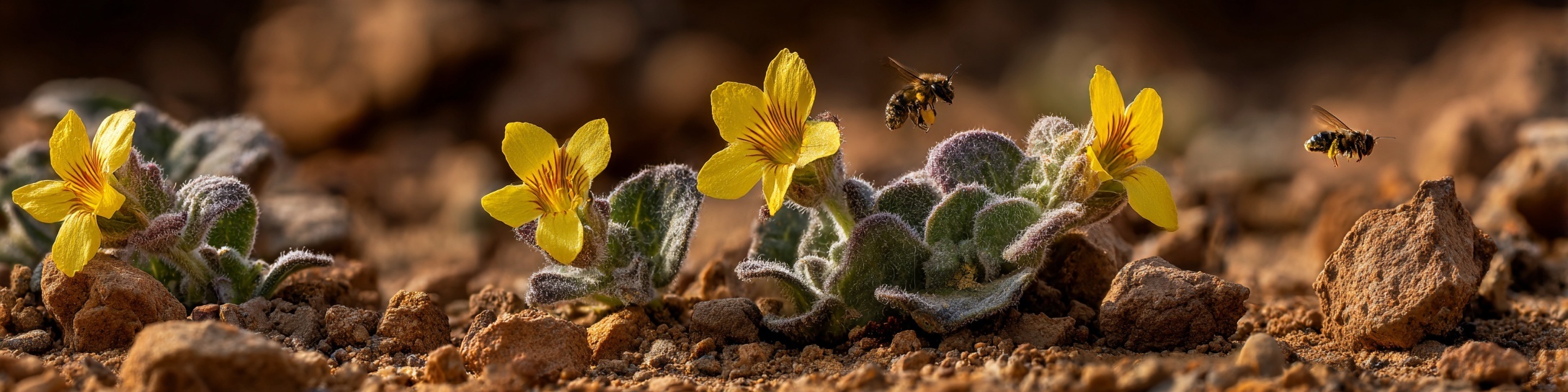
The Suncleft Bloom is a badlands wildflower that appears only when the land is kind enough to remember rain. In the brief weeks after a storm, it pushes from cracks in sunbaked stone and scree, low to the ground and stubborn, its leaves thick and downy with dust-catching fuzz. Its blossoms open like small coins of sunlight against the rock, bright enough to be seen from a distance and fleeting enough to be prized when found. To Ia-gûr, the flower is more than a pretty accident of season, it is a signal: the valley will feed its hives, and Stonegold honey is on its way.
Basic Information
Anatomy
Suncleft Bloom grows as a low, ground-hugging rosette, rarely rising higher than a boot’s width even at its healthiest. This squat form keeps it out of the worst wind and reduces water loss, while also letting it take advantage of the slight shade and cooler air that linger close to stone. Its leaves are thick and slightly cupped, with a dense down of pale, velvety hairs that trap dust and dew alike. To the touch the plant feels almost felted, and on cold mornings those hairs can hold a faint sparkle of moisture before the sun burns it away.
The plant’s stems are short and tough, emerging from the center of the rosette in small clusters rather than a single tall stalk. Each stem bears a bright, open-faced flower with broad petals that catch light like thin parchment, often marked with darker veining toward the throat. These inner markings act as natural guides for insects, drawing bees and other pollinators directly to the nectar. After pollination, the flower closes down into a compact seed head that ripens close to the ground, shedding seeds into the surrounding grit where they can settle into cracks and pockets of soil.
Below the surface, Suncleft Bloom relies on a tight, fibrous root mass that anchors into fissures and rubble rather than deep loam. It favors stone breaks, the base of boulders, and the edges of scree where brief runoff collects and then vanishes. The plant’s entire build is an argument for endurance: low profile, water-storing leaves, fast flowering, and seeds designed to wait out long, punishing seasons until the next small mercy of rain.
Additional Information
Uses, Products & Exploitation
Suncleft Bloom’s greatest value is not in what it yields directly to a hand, but in what it feeds. When the flowers erupt after rare rains, they provide the most reliable local nectar source for Ia-gûr’s hives. Honey taken during this short bloom is distinctly Stonegold in both color and character: bright, mineral-sweet, and faintly resinous, with a clean finish that lingers like warm stone after sun. The same nectar season also produces wax with an unusually low-smoke burn when properly rendered, making it ideal for Ia-gûr’s hooded Oathlights, where a steady flame matters as much as illumination.
Within the valley, the bloom is also used in small, practical ways. Dried petals are sometimes steeped into a mild tisane taken for sore throats and dust-cough, more comforting than curative. Crushed leaves, with their downy texture and slight astringency, are occasionally pressed into poultices for minor abrasions, especially for children, where the goal is to keep grit out rather than perform miracles. None of these uses are widely traded, partly because the plant is too seasonal and partly because Ia-gûr tends to hoard what keeps it well.
Exploitation of Suncleft Bloom is restrained by necessity and custom. The plant cannot be “farmed” in any tidy sense, and overharvesting can collapse a good patch for years. As a result, Ia-gûr treats bloom sites as communal resources: petals may be taken sparingly, but uprooting is frowned upon, and damaging a fissure patch during flowering is treated much like spoiling a cistern. The hives are prioritized. Rangers and valley folk who find a new bloom pocket will often mark it quietly and report it to those who keep bees, not because the flower belongs to anyone, but because the honey does.
Outside Ia-gûr, merchants in Carlisle sometimes attempt to buy pressed petals or dried bundles as curios, but shipments are rare and inconsistent. What does travel is the result: jars of Stonegold honey and blocks of wax, traded only in small quantity during the yearly provisioning run. In this way, Suncleft Bloom remains what it has always been in the badlands, a brief flare of yellow against stone, and a reminder that survival often depends on noticing the short seasons when the land chooses to give.

Comments
Author's Notes
Image created with MidJourney
WorldEmber2025 submission