
Stormsalt
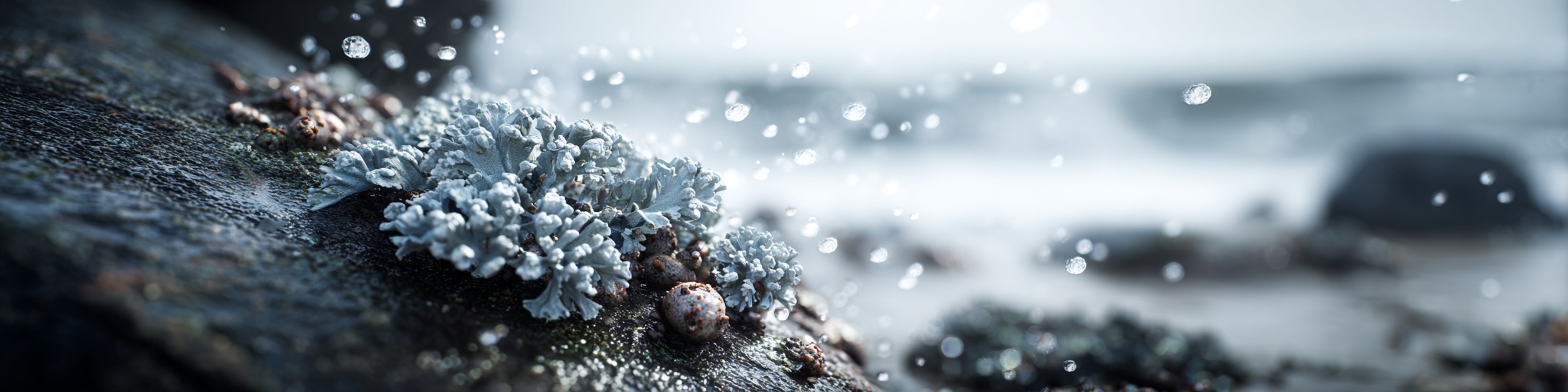
Stormsalt is a thin, pale lichen that clings to the skin of the sea where stone meets relentless surf. It grows in slick, low patches on wave-battered rocks, old harbor pilings, and the exposed ribs of long-dead wrecks, often noticed only when it makes footing treacherous. To most folk it is a nuisance or, at best, a minor ritual or alchemical ingredient. To Locathah, however, stormsalt is a quiet treasure. When scraped from the stone, rinsed, pressed thin in shallow pools, and dried on warm rock, it becomes a potent seasoning with a sharp, briny bite and a faint burning tang at the back of the tongue. Used in tiny pinches on raw fish or mixed with chopped seaweed, stormsalt turns otherwise plain rations into something vivid and waking, a taste of crashing waves and hard coastlines caught in a fragile, grey sheet.
Basic Information
Anatomy
Stormsalt is a thin, crust-like lichen that grows in layered sheets across rock and old wood, each layer holding tiny pockets of brine and mineral grit. Up close, it looks like a pale gray film veined with faint blue-green lines, like dried salt foam that somehow learned to cling. When scraped and pressed flat, these layers form a fragile, flexible sheet with a slightly translucent edge. The outer surface carries salt crystals and trace compounds drawn from constant surf, while the inner flesh holds a bitter, slightly caustic resin. Locathah mouths and gill slits are lined with dense clusters of chemoreceptors that read this resin as bright, energizing heat rather than simple bitterness, so stormsalt hits them as a sharp, waking spice that clears the head and sharpens the senses. To a Locathah palate built for harsh water and raw prey, that sting is not a flaw but the whole point.
Additional Information
Uses, Products & Exploitation
Locathah use stormsalt almost entirely as food and stimulant. Scraped from rock, rinsed, and pressed into thin sheets, it is dried and stored rolled or folded. At mealtime they crumble it in tiny pinches over raw fish, crab, or preserved strips of ray, or mash it with chopped seaweed into a rough paste that can be smeared along a cut of meat. Young hunters often overuse it, chasing the bright sting along their tongues and gill slits that makes their eyes water and their hearts race. Before a hard swim or dangerous raid, some Locathah will chew a corner of a sheet outright, riding the sharp burn as a way to wake up, focus, and push past fatigue. In very small doses, elders sometimes let a sick or exhausted shoal-mate lick stormsalt to coax back appetite and alertness, though everyone knows too much will leave the mouth raw and the head pounding.
Pearl Elves and Tritons almost never eat stormsalt. Their tongues and gills read its resin as a numbing irritant rather than a pleasant heat, so they classify it as a minor ritual and alchemical material instead of a spice. Pearl Elven coral keepers grind dried stormsalt into fine powder to mix with inks used for ward-marks on stone and coral, trusting its sting to sharpen focus during the long, meditative work of tracing sigils. Some Triton alchemists steep it in brine to draw out the resin for use in salves and mixtures that are meant to tingle, wake, or briefly numb the skin, such as poultices for bruises or stimulants for sentries. To them, its value lies in how it bites and tingles when placed on skin or mixed into controlled concoctions. The idea of sprinkling it on food is something they usually leave to Locathah, who seem oddly fond of putting that burn directly in their mouths.
“They all say, ‘just a pinch, only a little,’ like stormsalt is temple-salt, ja? Pah. If my catch no bite my tongue and make my eyes burn-wave, why I chew it at all, taló? Sea is sharp, brakhur, sharp like broken shell-teeth. Food must cut same, or it just sits like dead water in the mouth.”
~ Ressik, young Locathah of the Broken Kelp Shoal

Comments
Author's Notes
Image created with MidJourney
WorldEmber2025 submission