
Sea-Tortles
Sea-Tortles are a people the surface world largely doesn’t realize exist. In the taverns of Colwyn or the markets of Risland, the word “tortle” barely appears outside the mutterings of sailors who’ve spent too long staring at empty horizons: stories of great shells gliding through the deep, of slow voices carried up through the hull in the creak of timbers. Beneath the waves of the Godslost Sea, however, the Pearl Elves, Tritons, and Locathah know better. They speak of the Sea-Tortles as an old, quiet folk who remember the seabed from before it was a seabed at all, when Taralor fell and a mountain range drowned, they learned to treat those sunken cliffs as their first roads.
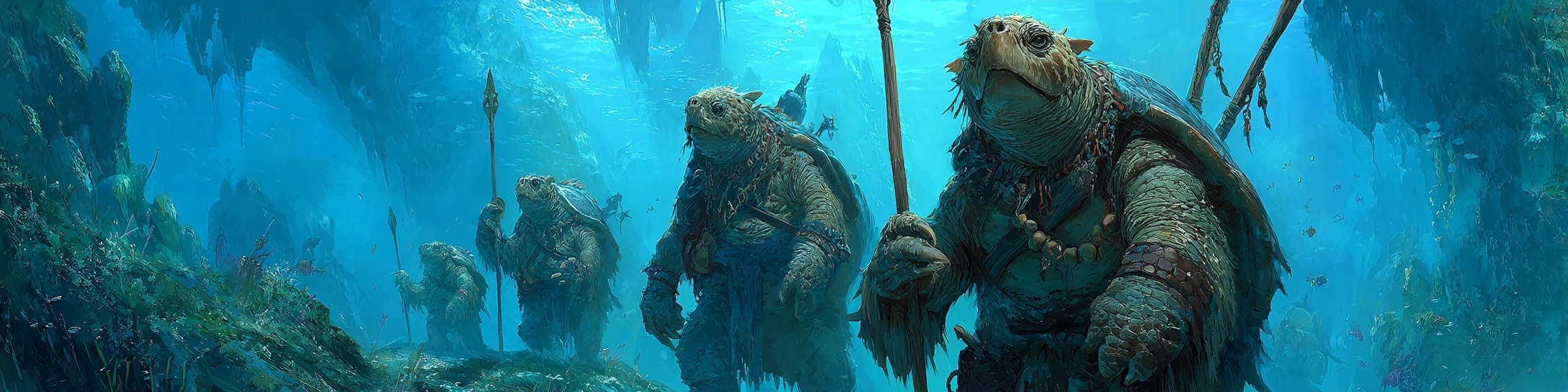
Most Sea-Tortles live in loosely knit pods, ranging along submerged ridges, seamounts, and drowned canyons rather than clinging to fixed “cities.” Their shells grow thick and hydrodynamic, often patterned with ridges and scars that echo the terrain they favor, like walking maps of the deep. They trade little and rarely, preferring to deal with other undersea peoples when necessity or curiosity demands it, and they have almost no interest in land except as something that inconveniently interrupts the water. A few leave their pods to wander more widely, but even these “adventurers” tend to remain creatures of the sea, explorers of trenches, vents, ruins, and genie-haunted currents rather than roads, kingdoms, or sky. To most of Elarion, Sea-Tortles are nothing more than rumors washed up from the Godslost Sea. To the ocean itself, they are among its oldest, steadiest witnesses.
Naming Traditions
Unisex names
Sea-Tortles favor short, fluid names—usually one or two syllables, that can be understood even when spoken underwater. Their names lean on open vowels and soft, humming consonants (m, n, l, r, w), with fewer sharp stops and hissing sounds that get lost in bubbles and current. A name is simply a sound that feels right in the mouth and in the water; if that feeling changes, the name does too.
Like land Tortles, Sea-Tortles see names as personal, not permanent. A Sea-Tortle might change their name a handful of times in a lifetime or every few years as they shift pods, roles, or waters. Some choose a name that echoes the hum of a vent field or the roll of distant surf; others adopt names gifted by Pearl Elves or Tritons and smooth them down into something soft and wave-shaped.
Sea-Tortles do not use surnames. If they need to distinguish individuals with the same name, they’ll add a simple descriptor: Naru-of-the-Shelf, Lima-from-Coldwake, Tona-Who-Left.
Sea-Tortle Names: Ama, Ano, Eru, Ima, Oru, Ula, Lima, Loru, Mara, Meno, Mura, Nalu, Nera, Nimo, Noru, Nua, Raka, Rima, Ronu, Rua, Ruvo, Sela, Suri, Talo, Temu, Tona, Hano, Hura, Kalu, Kimo, Kora
Culture
Major language groups and dialects
Sea-Tortles grow up bilingually, speaking a slow, wave-smoothed form of Common alongside Aquan. Their Common is rounded and vowel-heavy, shaped by the need to be understood underwater as often as in air, and they slip Aquan words into it without thinking—especially for currents, depths, and seafloor features that Common simply doesn’t name well. Pods that range near Pearl Elven enclaves, Triton strongholds, or human coasts often pick up loanwords and curses from those tongues, but rarely with full fluency; a Sea-Tortle might recognize a handful of Pearl Elven ritual phrases, a Triton command shouted in battle, or the coastal slang of Colwyn, then fold those sounds into their own speech until they’re half-unrecognizable. Across the Godslost Sea, Sea-Tortle dialects differ more in rhythm and accent than vocabulary, some speak with long, humming pauses like distant whale-song, others with short, clipped phrases suited to turbulent shallows, but almost all favor open vowels, soft consonants, and an unhurried cadence that makes even heated argument sound like a patient tide coming in.
Culture and cultural heritage
Sea-Tortles see themselves as people of the in-between, born from land, bound to sea, watched over by a goddess who changed shape in their hour of need. Their culture is built around that inheritance. Most live in small pods that follow slow, repeating circuits along drowned ridges, vent fields, or canyon walls. A pod might spend years tending a single seamount, then drift away for a decade before returning as though no time has passed. “Home” is not a fixed place but a pattern of movement: the familiar contour of the seafloor under their claws, the way currents sound when they brush the same stones again and again.
Like land tortles, Sea-Tortles expect to stand on their own, but they’re not nearly as solitary. Hatchlings are raised in undersea nursery-grounds—walled caverns, coral fortresses, or stone circles on a sheltered shelf, where a handful of elders spend their last years guarding the eggs and telling stories of the Stormfall and Moiren’s tears. When the young are strong enough to swim beyond the nursery walls, they’re encouraged to attach themselves to a pod for a few decades, learning the pod’s routes, songs, and seafloor landmarks. In time, they may spin off with a few companions to start a new circuit or return to tend nurseries of their own.
Culturally, Sea-Tortles are obsessed with place and memory rather than possessions. They keep few crafted objects beyond tools and weapons; what matters is knowing where the cold upwellings rise, where the stone is cracked and dangerous, which drowned valley echoes with old, wrong magic. Stories are almost always anchored to locations: “the time Rua met a genie at the broken arch two days’ swim north” or “when Hano followed moonlight down into the fault.” Many pods treat their traditional circuit as a sacred trust—something Moiren (and maybe other powers) gave them so that someone would always remember where the world broke.
Their contact with other peoples varies wildly. Pods that range near Pearl Elven cities, Triton domains, or human coasts often form long-standing trade and guidance relationships: a Sea-Tortle might serve as a guide through vent-choked waters, a neutral witness to undersea treaties, or a slow, stubborn mediator in disputes over hunting grounds. Other pods keep to the deep trenches and rarely see anyone but passing monsters. As a rule they avoid land, finding it cramped, loud, and awkward; the idea of building permanent stone structures on dry ground strikes most of them as vaguely tragic, like trying to freeze a wave in place.
Spiritually, Sea-Tortles sit at a crossroads between reverence and practicality. Most acknowledge Moiren in her moon-aspect as the one who carried their ancestors into the sea, and they mark certain phases—especially nights when the moonlight ripples clearly on the surface above—as auspicious for setting out, changing pods, or making oaths. Taralor is remembered, but not worshiped: more a name for the storm that broke the world than a god to call upon. Some pods keep quiet rites for Veltharos or simply leave nameless offerings on old seamounts, paying respect to the idea that the Godslost Sea is a wound the world is trying very hard to forget. Whatever their particular beliefs, Sea-Tortles tend to express faith the same way they express culture: by walking (and swimming) the same paths carefully, again and again, until the sea itself feels familiar.
Shared customary codes and values
Sea-Tortles live by a quiet, stubborn code built around steadiness, memory, and enoughness. The first value most pods teach is simple: do not panic. Storms pass, currents change, monsters come and go, but if you keep moving, keep breathing, and keep your wits, you usually survive. That calm is an expectation, not a personality trait; a Sea-Tortle who thrashes, shouts, or makes snap decisions is treated as dangerously immature until they learn to slow down. “Quick” is not a compliment in their culture unless you’re talking about a strike or a rescue.
The second core value is keeping the path. Every pod has a traditional circuit of ridges, canyons, or shelves they swim again and again, and they see themselves as responsible for knowing those places intimately. It’s not just navigation, it’s a moral duty. You warn others about unstable cliffs, angry spirits, poisoned vents. You don’t move landmarks thoughtlessly, you don’t strip a hunting ground bare, and you don’t “forget” a hazard because it’s inconvenient to remember. To abandon a long-swum route without good cause is considered almost shameful, like walking away from an elder in their last years.
Sea-Tortles value self-sufficiency inside community. You are expected to carry your own weight: mend your own gear, manage your own food, and not lean on the pod for problems you can reasonably solve. At the same time, refusing help out of pride is frowned on; if someone is in trouble in your water, you help, full stop, whether they’re pod-mates, strangers, or even surface folk who fell in. Debt and obligation are measured less in favors owed and more in paths walked together: swimming with someone through a dangerous stretch binds you to them more deeply than any verbal promise.
Honesty, for Sea-Tortles, is about precision rather than disclosure. You don’t have to say everything you know, but what you do say should be accurate. Exaggeration is seen as childish, outright lying as a serious breach of trust. Oaths are rare and important; when a Sea-Tortle formally promises something, usually under clear moonlight or at a remembered landmark—they will bend their entire life around keeping that word. Breaking such an oath doesn’t just stain the individual; it marks their whole pod as untrustworthy until it’s made right.
Finally, they place strong value on respecting silence and difference. Pods expect long stretches of wordless travel, punctuated by short, carefully chosen exchanges. Questions that pry into another’s past, faith, or inner thoughts without invitation are considered rude. A Sea-Tortle may swim beside the same ally for years and never ask about their deepest scars, trusting that if those stories need telling, they’ll surface in their own time. The shared code is simple: keep calm, keep the path, carry your own shell, help when the water turns bad, and do not waste words or memory on things that don’t matter.
Average technological level
By surface standards, Sea-Tortles have low material technology. Living almost entirely underwater, they make little use of large-scale metallurgy, engines, or complex machinery. Their tools are primarily stone, shell, bone, coral, and salvaged metal traded from Pearl Elves, Tritons, or the rare surface ship they’re willing to barter with. Weapons tend toward sturdy, simple designs that work in water—spears, harpoons, tridents, weighted nets, and reinforced shields, rather than intricate devices.
Where Sea-Tortles excel is in environmental and practical “soft” technology. They are highly skilled at building pressure-safe shelters out of natural stone formations and coral, shaping currents with simple structures, and using bioluminescent algae or shell-lanterns for low-light signaling. Their navigation methods are sophisticated: etched shell-maps, memorized current cycles, and multi-sensory “routes” that combine water temperature, taste, and sound in ways most land-dwellers can’t even perceive. They rarely innovate for innovation’s sake, but when a tool or structure makes it easier to keep a route safe and remembered, it spreads through pods quickly.
In short, Sea-Tortles don’t chase invention, cities, or industry; their technology stops where it stops needing to go any further. They invest their cleverness into survival, navigation, and stewardship of dangerous waters, not into building things that could only ever work on land.
Common Etiquette rules
Sea-Tortle etiquette looks simple on the surface and is wildly alien if you’re used to fast-talking landfolk. The most basic rule is: do not rush. Barging into a conversation, peppering someone with questions, or demanding an immediate answer is considered childish at best and hostile at worst. A polite greeting is usually a slow nod or tilt of the shell, followed by a brief exchange of names and waters—“I am Rima, of the Coldwake shelf,” and then a pause long enough to let the other person decide how much more they want to share.
Silence is not awkward for Sea-Tortles; it’s respectful. Filling every gap with chatter is bad manners. You wait your turn, you don’t interrupt, and if someone falls quiet mid-thought, you let the silence stand rather than prodding them to continue. Direct questions about pod conflicts, faith, or personal losses are generally off-limits unless the other party opens the door first. It’s acceptable to ask, “Do you wish to speak of it?” and equally acceptable for the answer to be a simple, “No.”
Physical etiquette is cautious but not cold. Uninvited touch is frowned upon except in emergencies, but a Sea-Tortle will often offer a forearm, shell edge, or shoulder for support when currents are rough or footing is poor; refusing that help when you clearly need it can be seen as rude pride. Sharing food or safe shelter, on the other hand, is a basic courtesy, if someone travels with your pod or passes through your nursery-ground, you make sure they have something to eat and a place to rest as long as they follow your rules. The unspoken code is: move slowly, speak carefully, don’t pry, accept help when it’s freely given, and never make a problem louder or faster than it already is.
Common Dress code
Sea-Tortles treat clothing as optional. Since they live in the water most of the time, fabric is only used when it serves a clear purpose: a simple harness to secure tools, a belt for pouches, or a wrap to protect softer skin in cold currents or rough terrain. To land-dwellers they can look almost undressed, but to Sea-Tortles the shell already is clothing, armor, and formal wear.
Their real sense of style appears in shell decoration and small ornamentation. Many etch patterns into the outer keratin, such as currents, star paths, or the outlines of drowned mountains, then fill those lines with ink, crushed shell, or faintly glowing paint. Others hang small charms from the rim of the shell or from their harness: polished stones from a favorite seamount, traded Triton tokens, tiny glass beads, or smoothed pieces of wrecked metal. These decorations are personal markers, travel records, or quiet prayers rather than fashion in the surface sense.
For anything resembling formal dress, a Sea-Tortle will usually arrive with a freshly cleaned shell, ornaments placed with care, and perhaps a single extra piece. Examples include a crescent-shell gorget for a Moiren ceremony, a woven kelp band gifted by another pod, or a carved bone clasp that marks them as a nursery-keeper or guide. Anything more elaborate than that is considered pretty but suspect, since it might snag on coral or slow you down when the water suddenly turns dangerous.
Art & Architecture
Sea-Tortles care very little for architecture in the surface sense. They do not raise cities or carve grand halls from the seafloor. What they build is practical and quiet: nursery-grounds walled by natural stone and coral, simple rings of boulders that break current and mark safe resting places, and the occasional shaped ledge or alcove to shelter eggs from predators. Most of their “construction” is a matter of choosing the right place and nudging it gently, rather than imposing new shapes on the sea. If a structure cannot survive a storm or a passing leviathan without constant repair, they consider it unwise to depend on.
Their art lives on their shells. From the moment a young Sea-Tortle completes their first long circuit with a pod, elders begin to etch and paint the story of that journey into the keratin of the shell. Lines curve around the plates in the shapes of ridges and canyons, dots trace the locations of vents and nurseries, small symbols mark encounters with genies, Pearl Elves, or great beasts. Colors are usually made from crushed shell, mineral pigments, and bioluminescent algae that glows softly in the dark. Over time, a shell becomes a layered map of places traveled and dangers faced.
Sea-Tortles are very aware that they will never truly see their own shells. You can feel the grooves under your fingers and catch hints of color on the edge, but the full picture always belongs to someone else. Because of this, shell art is created as much for the pod as for the individual. Elders decorate the backs of younger Tortles so that anyone swimming behind them can read where they have been and what they have become. When a podmate falls behind, you can glance at their shell and know which parts of the sea shaped them, even if they never speak of it.
There is a gentler, more personal layer too. The parts of the shell a Sea-Tortle can see, such as the front edge and the plates near the shoulders, tend to hold smaller, more intimate markings. These might be simple crescents for Moiren, a single inlaid stone from a place they love, or a pattern that reminds them of their nursery walls. When a Tortle changes pods or takes on a new role, it is common for their companions to add one small mark of their own, so the shell carries traces of many relationships along with places. In this way, the Sea-Tortle body itself becomes both canvas and archive, a moving piece of communal art that outlives any one structure of stone or coral.
Sea-Tortles favor art that can travel with them. In addition to shell decoration, many carry small charms and tokens that serve as portable stories. Flat pieces of shell, coral, or polished stone are carved with simple symbols, such as a ridge-line, a crescent moon over waves, or a spiral vent. These are strung on cords and hung from shell rims or harnesses. When two pods meet, it is common for them to trade a single token, so that each group literally carries a fragment of the other’s journey into new waters. Some pods also make “drift tiles,” palm-sized slabs of stone, heavy shell, or traded clay, etched with scenes of nurseries, favorite seamounts, or important omens. A tile might be tucked into a crevice or buried in sand when a pod leaves a place for a long time, a quiet marker that says they were there and remember.
Soft materials appear in the form of woven kelp bands and beadwork. Strips of kelp or sea-grass are braided with glass, shell, or stone beads whose patterns carry specific meanings, such as a pod’s name, a role like nursery-keeper or guide, or a remembered alliance. These bands are worn on limbs or harnesses and passed down or gifted as a sign of trust. Sound is another portable art; small percussion pieces like hollow shells filled with pebbles or bone clappers that click underwater accompany slow, repetitive songs used to mark routes or rituals. A few Sea-Tortles also keep small devotional icons of Moiren or the sea itself, such as thin shell discs carved with a crescent and wave. These fit easily into a pouch or tie to a strap and are brought out when making oaths, saying farewells, or swimming a new stretch of water for the first time.
Foods & Cuisine
Sea-Tortles eat like the real sea-turtles they resemble: mostly seagrasses and algae, with a healthy amount of jellyfish, soft-bodied invertebrates, sponges, crustaceans, and the occasional unlucky fish. Their grazing keeps seagrass beds trimmed and healthy, and many pods treat particular meadows or sponge fields as part of their circuit, taking care not to strip them bare. A young Sea-Tortle learns quickly which greens are safe, which jellyfish sting in the wrong way, and which shelled creatures are worth the effort of cracking open.
They do not have “cuisine” in the elaborate surface sense, but they absolutely care about food. Sea-Tortles prize freshness, texture, and the way a meal feels in the body over complex seasoning. A simple combination of crisp seagrass, soft sponge, and rich crab meat, eaten after a long swim, is considered perfect. They rarely cook in fire, for obvious reasons, but some pods that travel near volcanic vents make use of natural heat. Stones are placed in hot upwellings until they are nearly too warm to touch, then used to sear or gently poach tougher meats in carved shell or stone bowls. The result is a kind of vent-cooked stew or seared crustacean that many undersea neighbors think of when they hear “Sea-Tortle food.”
There are a few specialties that Tritons, Pearl Elves, and Locathah recognize and sometimes seek out. One is a tangy fermented kelp and seagrass mix that Sea-Tortles pack into hollow shells and leave in cool, slow-moving water for weeks. When opened, it has a sharp, clean flavor that pairs well with almost anything. Another is a delicate jellyfish and algae “sheet,” pressed flat between smooth stones and eaten in thin layers. Vent-charred urchins and crabs, cracked open while still warm, are considered a treat at shared feasts. Sea-Tortles also make simple broths by steeping bones, shells, and certain seaweeds in warm vents, then sharing the thick, mineral-rich liquid among the pod as a restorative meal.
To outsiders, Sea-Tortle cuisine looks plain at first glance, mostly greens and simple proteins. Those who travel with a pod long enough learn that there is a quiet artistry in how they match food to the place and time. Certain grasses are eaten only during particular current cycles, some fermented dishes are opened only under clear moonlight, and a pod that welcomes guests will often bring out a carefully saved shell of ferment or a rare vent-cooked dish as a sign of real esteem.
Crescent-Shell Crabs hold a special place in Sea-Tortle life. Their curved, moon-shaped carapaces are closely associated with Moiren’s crescent, so most pods do not treat them as ordinary prey. A pod might take a few during certain phases of the moon, usually for a shared feast or a rite of passage, but hunting them for daily meals is frowned upon. Eating Crescent-Shell Crab is less about hunger and more about marking a moment, such as the end of a long circuit or the naming of a new nursery-keeper.
The meat itself is rich and highly prized, with a sweet, dense flavor that pairs well with fermented kelp or vent-cooked greens. Tritons, Pearl Elves, and Locathah all recognize it as a Sea-Tortle specialty and will sometimes trade generously for a prepared Crescent-Shell feast. The shells are cleaned, polished, and never wasted. Larger plates become crescents for gorgets or devotional tokens, while smaller pieces are shaped into beads and inlays for shell art or woven bands. A few particularly devout pods avoid eating Crescent-Shell Crabs entirely and harvest only shells from natural deaths or old moltings, but even those groups treat the creature as a gift from Moiren rather than something to ignore.
Birth & Baptismal Rites
Sea-Tortle birth rites begin long before a hatchling cracks its shell. When a pod decides it is time to lay a clutch, they return to a familiar nursery-ground: a sheltered cavern, a hollow in a drowned valley wall, or a ring of boulders on a quiet shelf. The ground is cleared of sharp stone, then lined with sand, silt, or warm gravel. Elders near the end of their lives often choose to stay behind as nursery-keepers. They will not make many more long circuits, so they spend their last years guarding eggs and telling stories of the Stormfall and Moiren’s tears to any who will listen.
Egg-laying itself is quiet and practical. Each parent chooses a spot within the nursery and buries a small cluster of eggs together with a few personal tokens, such as a polished stone from a favorite ridge or a bead that once hung from their own shell. Afterward, the nursery-keepers and attending adults swim slow circles around the site, humming an old chant that begins as the origin myth and trails off into wordless sound. The only obvious ritual mark is a simple crescent shape traced in the sand or on the cavern wall, a reminder that these eggs rest in the sea Moiren gave them.
Hatching is less ceremonial and more about survival. When the first shells begin to crack, the nursery-keepers gently clear away sand and help slow hatchlings free, guiding them into the protected center of the nursery where small fish and scavengers cannot easily reach. The pod does not crowd them with attention. A few key adults watch closely, making sure each hatchling can swim, breathe, and right itself if tumbled, but they let the young test their own strength. Within days, each hatchling is given a simple, short name that is easy to speak underwater. Names are often chosen by the nursery-keepers, who claim they can hear which sounds “fit” a young Tortle as it moves.
What passes for baptism happens a little later, when the hatchlings are strong enough to leave the nursery walls for a brief swim. On a calm night with clear water, the pod leads them out along the safest stretch of nearby seafloor to a place where moonlight filters straight down from above. There, the adults form a loose ring and let the young explore within it. Each hatchling is lifted once, just enough for the first clear shaft of Moiren’s light to touch its shell. An elder then presses a wet thumb or claw to the front edge of that shell, tracing a tiny crescent or a single line that points back toward the nursery. After that, the young are considered properly “of the pod” and “of the sea,” ready to begin the long, slow work of learning the routes their parents and ancestors have kept for generations.
Coming of Age Rites
Sea-Tortles do not have a single sharp moment where a hatchling becomes an adult. Instead, they recognize a few quiet thresholds, each marked by a simple rite. The first and most important is the First Circuit. When a young Sea-Tortle has grown strong enough to keep pace with the pod, they are finally allowed to travel the full route. Elders watch carefully during this journey, noting who remembers landmarks, who panics in rough current, and who keeps their head. At the end of the circuit, the pod returns to the nursery-ground or another safe hollow, and the elders gather around the young. Each new swimmer receives their first real markings on the back of the shell, a thin line or small symbol for each major stretch of the route they have completed. From that point on, they are trusted to help keep watch and to guide others along those waters.
A second rite, often a few years later, is called Taking the Turn. A Sea-Tortle is not considered fully grown until they have taken a portion of the pod’s circuit ahead of the others and returned without incident. On a chosen day, an elder assigns a young Tortle a familiar stretch of seafloor and sends them out with one or two peers, no older guardians in sight. Their task is to swim the length of that route, check known hazards, and return with any new information. When they come back, they report what they saw and any changes they noticed. If their account matches reality and they kept their calm, the pod shares a small feast, often including a single Crescent-Shell Crab or another valued food. The young Tortle is then invited to stand in the circle of adults during route discussions and is treated as a full voice in pod decisions.
There is one more turning point that not every Sea-Tortle reaches. Some eventually feel the pull to Leave the Path for a time, whether to travel with another pod, to serve as a guide to other peoples, or to explore a new part of the Godslost Sea. When this happens, the pod holds a simple parting rite. The departing Tortle swims the circuit one last time with an elder at their side, then meets the pod in a place where the moonlight falls clearly from above. There, each podmate adds a small mark or charm to the edge of the leaving Tortle’s shell. No oaths are required and no one speaks of “goodbye.” The understanding is quiet and practical. If the traveler can keep themselves alive and keep their memory of the routes, they will always have a place to return to, and the shell they carry will show that they are still part of something larger than a single life.
Funerary and Memorial customs
Sea-Tortles treat death as another part of the circuit rather than a sharp break. When a pod knows an elder is nearing the end of their strength, they will often settle near a nursery-ground or a favored resting shelf so that the dying shell does not drift into unknown water. The elder usually chooses the place themselves, a ledge overlooking a familiar canyon or a stone hollow where they have stood watch before. There is little drama. Podmates visit in small groups, sharing food, old stories of routes traveled, and quiet silence. When the elder finally dies, there is sorrow, but very little surprise.
The body is returned to the sea with as little disturbance as possible. In most pods, relatives or close companions guide the corpse to a chosen spot where currents are gentle and scavengers can reach it easily. There they wedge the body so it will not tumble, say a few simple words that name the places the elder loved, and then leave it for the smaller creatures of the deep. The belief is that the flesh feeds the waters that fed the Tortle, closing the exchange. What truly matters is the shell. After some time has passed, usually a few days or weeks, the pod returns to retrieve the cleaned shell, which is then given more deliberate attention.
Funerary work focuses on transforming the shell from a personal map into a communal memory. Some markings are left untouched, especially those that record the routes the elder knew best. Others are expanded, clarified, or combined with symbols added by podmates. The finished shell is then set into a nursery wall, a sheltered canyon face, or a ring of stones along the pod’s main circuit. These “standing shells” form a kind of open-air archive. Younger Tortles can run their fingers along the carved lines and learn how many lives have already walked these paths. Passing Pearl Elves or Tritons sometimes recognize a particular shell and know that a trusted guide is gone, which carries its own silent weight.
A few pods keep more unusual customs. Some influenced by Veltharos will gently sand portions of an elder’s shell until certain lines are nearly gone, leaving only a few key routes or symbols. The smoothed dust is scattered into deep water with a short phrase that acknowledges that not every memory needs to be carried forever. Other groups remove a small fragment of shell and carve it into a token to be worn by a close student or child for a time, then eventually added to a drift tile or charm string. Whatever the variation, the pattern remains the same. Flesh goes back to the sea, the shell becomes story, and the routes the dead once walked remain part of the living pod’s path.
Common Taboos
Sea-Tortles are tolerant about most things, but a few acts will get you frozen out of a pod very quickly. The worst offense is breaking the path on purpose. Rearranging stones so others lose a safe route, hiding a known hazard, or selling route lore to people who will exploit or ruin a stretch of seafloor is treated as a deep betrayal. Doing so around nurseries or memorial shells is even worse. Disturbing a nursery-ground, taking eggs, or damaging a wall of standing shells is the closest thing Sea-Tortles have to blasphemy. A Tortle who did any of that would probably be exiled on the spot.
Tampering with another Tortle’s shell is also nearly unthinkable. Painting on someone’s back without consent, scratching out their markings, or breaking off charms is seen as an attack on their identity and history, not just on their body. By the same logic, careless magic that erases memory, confuses landmarks, or churns up currents in long-settled routes is deeply frowned on. You do not play games with the sea’s shape.
There are quieter taboos too. Hunting Crescent-Shell Crabs for casual meals is considered disrespectful to Moiren, and most pods take only a few for special feasts or rites. Loud argument in dangerous water is poor form, since noise can mask predators or oncoming trouble. Oathbreaking sits in its own category. Sea-Tortles do not swear many formal promises, so when they do, failing to keep one stains not just the individual but their whole pod until the wrong is made right.
Common Myths and Legends
Among Sea-Tortles, one of the oldest stories is the tale of When the Sun Fell and the Storm Broke. In this telling, their ancestors lived on storm-beaten shores watched over by Taralor, Lord of Storms, and Moiren, then a blazing Sun Goddess. Taralor’s final rage shattered the mountains, and Moiren, horrified, poured herself out in tears that became the first waters of the Godslost Sea. As her sun light dimmed and drew into the Moon, she saw a small Tortle community walking into the rising flood rather than fleeing. She bound them to her tears, reshaping their bodies so they could breathe water, ride the new currents, and survive in the drowned range. Sea-Tortles repeat this story in many small variations, but the heart is always the same. They trusted Moiren in the moment she broke, and she carried them into the sea.
Pearl Elves, Tritons, and other undersea folk prefer a version called The Wardens of the Drowned Storm. Their lore says that after Taralor’s last storm cracked the land and Moiren’s tears filled the wound, the newborn sea was dangerously unstable. The gods, unwilling to leave such a place unattended, chose a hardy shore people who already lived between land and water. The Tortles were remade with longer lives, shells that echoed the shapes of the drowned mountain range, and instincts tied to the new currents. In this view, Sea-Tortles are not simply survivors. They are appointed custodians, walking memory of where the storm fell and which paths are safe in a sea born from divine mistake.
Among scholars and a few Veltharos touched pods there is a stranger tale, The Shells That Would Not Forget. This myth agrees that Taralor died in his own storm and that Moiren’s tears filled the broken basin, turning her from Sun to Moon. It adds that the Godslost Sea was meant to erase what happened there, so that the world did not live forever in the shadow of that disaster. Most things did sink into oblivion, but some Tortles refused to let go of their mental maps and daily paths. Veltharos, god of forgotten things, noticed them and quietly anchored their memories to the drowned range. According to this story, when Moiren remade their bodies for the deep, Veltharos twisted their fate so that someone would always remember where the land once stood. Most Sea-Tortles do not tell this version openly, yet a few leave nearly featureless offerings at old seamounts, as if acknowledging that part of their existence belongs to a god who will not let certain losses be entirely forgotten.
Ideals
Beauty Ideals
Sea-Tortles are far more interested in whether a shell tells a story than whether it looks pretty. If they have beauty ideals at all, they are quiet and practical.
A smooth, unmarked shell on an older Tortle is almost unsettling. What most pods find pleasing is a shell that has “ripened” with time. Fine etched route lines, small inlaid stones from important places, a few charms that move gently with the current, and maybe a scattering of old scrape marks from reefs or rocks. It reads as “lived” rather than “damaged.” The same is true of skin. Scars that clearly came from real work, such as a long white line from a rockslide or a jagged bite on the forearm, are seen as interesting, not ugly. Needless marks from showing off or careless fights are viewed more as a lack of sense than a flaw in appearance.
Calm movement might be the closest thing they have to physical grace. A Sea-Tortle who swims with smooth, economical strokes, who settles on a ledge without stirring much silt, and who turns their head slowly instead of jerking around, is considered pleasant to watch. Someone who thrashes constantly, flicks their limbs, or sends sand clouding through the water is quietly judged as clumsy or immature. Voice matters a little too. A low, steady tone that carries well underwater is more admired than a sharp or shrill one.
Color is a minor concern. Some pods like rich, dark shell tones with pale etched lines. Others favor lighter shells where pigment shows more vividly. Bioluminescent paint and bright beads are not “fashionable” in the surface sense. They are simply useful for being seen in dim water, and any beauty they have is a side effect. In short, Sea-Tortles do not chase beauty, they chase solidity. A “beautiful” Tortle is one whose shell, scars, and movements all say the same thing. This one has been here a long time, and this one is not going anywhere fast.
Gender Ideals
Sea-Tortles care so little about gender that most of them struggle to understand why anyone else obsesses over it. They recognize biological differences, of course, but those are treated as practical facts, not identities. What matters in a pod is route knowledge, temperament, and current role: nursery-keeper, scout, guide, trader, caretaker for elders, or simply “strong swimmer who does not panic.” A Tortle is judged by how well they keep the path and how they handle bad water, not by who they mate with or whether they lay eggs.
Egg-laying is viewed as a temporary responsibility rather than a defining trait. A Tortle who is actively producing a clutch is excused from long circuits and heavy work, and others pick up the slack without complaint. The focus is on keeping the nursery safe and the parent healthy. After the clutch is laid and the nursery-keepers take over, that Tortle simply returns to their usual duties. Some pods have mild expectations, such as “those who lay eggs should spend at least one season near the nurseries,” but there is no sense that such individuals are meant to stay in that role for life.
From the outside, Tritons or humans sometimes project their own gender frameworks onto Sea-Tortles, trying to decide who is “male” or “female.” Most Tortles find this slightly baffling and a little funny. Their own language rarely has gendered pronouns, and personal names do not signal anything about sex. If pressed, a Sea-Tortle might say that they have shell-kin who lay eggs and shell-kin who do not, and that everyone swims the same water in the end.
Courtship Ideals
Sea-Tortle courtship is so subtle that most outsiders assume it does not exist.
For them, attraction is about temperament and routes, not looks or gender. The core question is simple: “Can I swim the hard parts with you without wanting to bite you?” Courtship usually begins after years of shared circuits. Two Tortles notice that they tend to fall into the same position in the pod, that they prefer the same resting shelves, that they like each other’s silence. They start choosing to scout together, or to linger on the same ledge a little longer when the pod stops. There are no public declarations. It looks like ordinary companionship until you know what to look for.
The most reliable sign of courtship is sharing paths on purpose. A Sea-Tortle who is interested in another will invite them to walk a stretch of seafloor that is personally important. That might be a favorite nursery ledge, a memorial shell wall, or a quiet hollow where they like to watch moonlight ripple overhead. Showing someone those places says, “You belong in the same map as me.” In return, the other Tortle will often add a very small mark to the front edge of their partner’s shell, somewhere they can actually see. It might be a single line that points back toward that shared place, or a tiny symbol only they understand. If that mark is accepted and left in place, the courtship is considered mutual.
Food and patience do the rest. Sea-Tortles in courtship often split the best parts of a meal, pass each other the softest jellyfish or richest crab meat, and make time to swim side by side during easy stretches instead of spreading out. They give each other practical gifts. A new charm carved from a piece of stone both of them swam past during a difficult season. A better strap for a harness. A carefully cleaned Crescent Shell for a future gorget. There is no dramatic “confession.” At some point, the pod simply starts referring to them together, and the pair does not argue.
Mating itself leans on the standard Tortle pattern. Many Sea-Tortles do not produce a clutch until later in life, once they have already spent decades swimming with the same partner or at least the same pod. Choosing to have eggs is a practical decision. The pair returns to a nursery-ground, contributes to a clutch, and then goes back to the circuit or remains as nursery-keepers, depending on age and strength. Some bonds end there, others last until one shell is set into the memorial wall.
From the outside, Tritons or Pearl Elves often miss all of this. They see two Sea-Tortles swimming together, trading food, and sitting in companionable silence, and assume it is just friendship. Which, to be fair, is partly true. For Sea-Tortles, a good partner is simply a friend you have decided to keep swimming with, even when the water turns bad.
Relationship Ideals
Sea-Tortles idealize relationships that feel like a good route. Steady, familiar, and resilient when the water turns rough. Whether the bond is between mates, close friends, or podmates who have swum together for decades, the highest praise you can give it is, “We keep the path.” A good relationship is one where both parties know the same landmarks, trust each other’s memory, and do not panic or turn on one another when currents shift. Passion matters far less than reliability. Someone who is exciting but unpredictable is interesting to visit, not someone you rearrange your circuit for.
They also value spaciousness. Even very close pairs are expected to spend time apart, scouting different stretches of the route or working different roles in the pod. Clinging is considered unhealthy. A strong bond lets each shell carry its own weight while still meeting at the important places. In practice, this means that Sea-Tortle ideals lean toward quiet, long term companionship. You share food, stories, and routes, you respect each other’s silences, and you do not make promises you cannot keep. When a relationship fails those tests, it tends to simply thin out over time rather than explode. The highest ideal is a bond that lasts from First Circuit to final shell, two lives that have walked so much of the same seafloor that their stories cannot really be told apart.
"Storm broke the mountains
Sunlight wept, became the sea
We followed her tears."
~ traditional Sea-Tortle poem
Sea-Tortles as a Playable Species
Homebrew
Sea-Tortle
Your Sea-Tortle character has the following species traits. Ability Score Increase. Your Strength score increases by 2, and your Wisdom score increases by 1. Age. Sea-Tortles grow quickly in their first years and reach physical maturity by about 15. They commonly live around 50 years, with some elders lasting longer if the sea is kind. Alignment. Most Sea-Tortles favor order, routine, and keeping to well known routes. They tend toward lawful alignments and are more often good than not, though any alignment is possible. Size. Adult Sea-Tortles stand around 5 to 6 feet tall and are very heavy for their height, with their shells making up a large part of that weight. Your size is Medium. Speed. Your walking speed is 30 feet, and you have a swim speed of 30 feet. Claws. Your claws are natural weapons. You can use them to make unarmed strikes that deal slashing damage equal to 1d4 plus your Strength modifier, instead of the normal bludgeoning damage for an unarmed strike. Amphibious. You can breathe both air and water. Natural Armor. Your shell and body shape provide significant protection. While you are not wearing armor, your base AC is 16. You do not gain a benefit from wearing armor, but you can use a shield normally. Shell Defense. You can pull into your shell to protect yourself. As an action, you withdraw into your shell. Until you emerge, you gain a +4 bonus to AC and have advantage on Strength and Constitution saving throws. While in your shell, your speed is 0 and cannot increase, you are prone, you have disadvantage on Dexterity saving throws, you cannot take reactions, and the only action you can take is a bonus action to emerge from your shell. Seafloor Instinct. You gain proficiency in the Survival skill. When you make a Wisdom (Survival) check to navigate, track, or avoid becoming lost underwater in the Godslost Sea or another large ocean, you have advantage on the roll. Languages. You can speak, read, and write Common and Aquan.

Comments
Author's Notes
Image created with MidJourney
WorldEmber2025 submission