
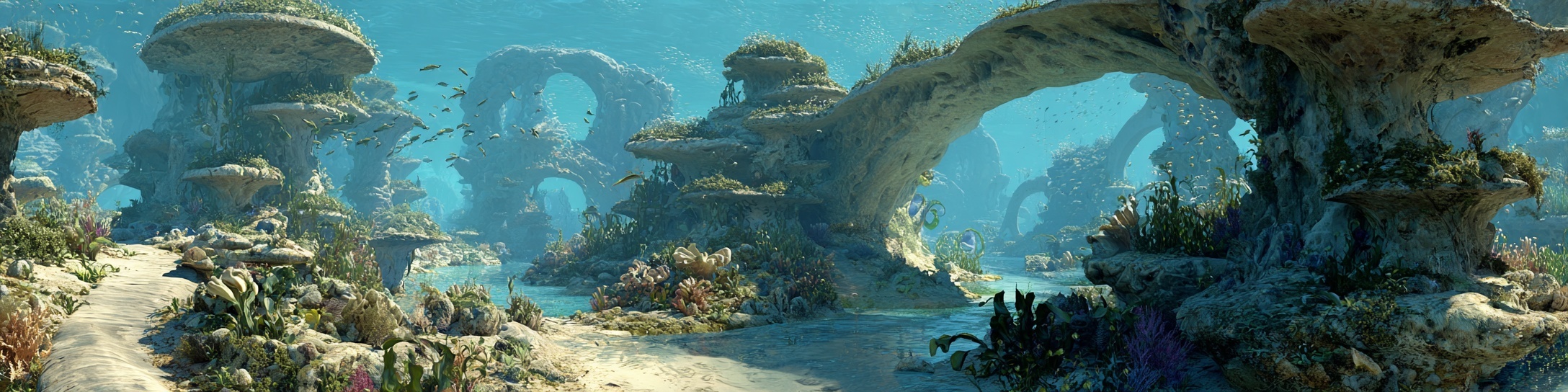
Pearl Elves
The Pearl Elves are a saltwater-dwelling people whose culture is inseparable from the tides, currents, and living coral of the Godslost Sea. With blue-hued skin (as opposed to their green-skinned fresh water cousins, the Reed Elves), gill-lined necks, and hair that mirrors the colors of sea flora, they move through the water with a grace bordering on sacred ritual. Their society is ancient, deeply reverent of memory and continuity, and entirely built around their great coral archives: living reef-libraries where knowledge is stored, traded, and grown. To outsiders these structures appear as dazzling natural formations, but to the Pearl Elves they are histories, genealogies, treatises, and songs, all encoded in coral growth patterns and unlocked through physical communion.
Although not isolationist, they are selective in their relationships with surface folk. Their trust is earned slowly, as humans and land races often fail to grasp the sacredness of memory exchange or the weight of ecological stewardship. Still, where trust exists—such as with the Spell-Kings of Amfa’atu—they can be invaluable allies, offering maritime guidance, biological knowledge, and a cultural patience that spans centuries. The destruction of their coral library during the creation of the Esharan archipelago remains a wound in their collective memory, and the Pearl Elves have not forgotten the cost of elemental meddling.
They are called Pearl Elves by land-dwellers due to their use of pearls in trade and ornamentation, avoiding metal currency and forged materials in general. To themselves, they are Yaerhanórë, “The Tideborn,” with each enclave holding its own lineage, customs, and, if old enough, sacred reefs.
Naming Traditions
Feminine names
Common feminine names among the Pearl Elves include Selaine (“sea-glint”), Mariva (“daughter of the tide”), Lunessa (“moon-washed”), Yaelira (“tide-song”), Orelith (“coral-heart”), Nerala (“of the shoals”), Velissa (“veiled waters”), Talura (“deep current”), Isrien (“foam-crowned”), Naressa (“reef-watcher”), Calune (“quiet wave”), Mirava (“mirror-sea”), Serulith (“silent depth”), Elunara (“moon-tide”), Vorina (“pearl-light”), Lerisse (“shore-echo”), Maelira (“storm’s edge”), Ysalune (“pale-water moon”), Corlassa (“of the coral halls”), and Nerisse (“song of the shallows”).
Masculine names
Common masculine names among the Pearl Elves include Aerion (“sea-wind”), Marival (“tide-borne”), Lureth (“deep-song”), Serun (“still depth”), Vorion (“pearl-glow”), Talemar (“strong current”), Nerun (“of the shoals”), Corveth (“reef-guard”), Isaren (“foam-crest”), Daelor (“far swell”), Yselor (“moonlit wave”), Caleth (“quiet tide”), Orlassan (“of the coral halls”), Maerun (“storm-marked”), Velorin (“veiled waters”), Rhalun (“echoing deep”), Selvar (“sea-watcher”), Orenith (“shell-voice”), Luneth (“child of the moon”), and Thalior (“open sea”).
Unisex names
Common gender-neutral names among the Pearl Elves include Lunir (“moon-marked”), Maelin (“sea-born”), Selunev (“soft tide-moon”), Neralis (“of the shallows”), Caliren (“quiet waters”), Ysarel (“pale wave”), Vorinel (“pearl-shine”), Talune (“guiding current”), Isravel (“foam-trace”), Corlin (“child of the reef”), Seravel (“gentle depth”), Orelis (“coral-soul”), Marinel (“tide-walker”), Velun (“veiled sea”), Rhaelen (“echo of the deep”), Thalune (“open-water moon”), Daelir (“far-water”), Yaelis (“tide-voice”), Miranel (“mirror-wave”), and Savaer (“spray and wind”).
Family names
Rare honor-names among the Pearl Elves include Qorvandarë (“Reefwarden”), bestowed upon guardians of sacred coral halls; Yaerthalir (“Tidebinder”), granted to those who redirect or quell disastrous currents; Ramlissar (“Stormspeaker”), given to negotiators who avert storm-born catastrophe; Perlavélë (“Pearlveil”), held by keepers of great secrets; and Qorlassemar (“Coralheart”), earned by elves who devote their lives to tending a specific coral archive. Other notable honor-names include Talmirion (“Deepwatch”), title of deepwater sentinels; Súravel (“Waveward”), granted to lifesavers and rescuers; Gajselírë (“Shellsinger”), reserved for legendary chroniclers; Lunyarë (“Moonwake”), for those who act decisively under Moiren’s omen; and Rihlendarë (“Currentbearer”), an honor for long-serving diplomats. Additional rare titles include Maristren (“Seastrand”), for stewards of vulnerable coastlines; Qorlineth (“Glowreef”), for those who restore dying coral; Sílentaer (“Silentreach”), granted to scouts who return with vital knowledge; Gloammarë (“Gloamwater”), held by leaders through dark eras; and Sahrandil (“Dawnsurge”), for heroes who stand at the fore of a decisive battle. These names are seldom used, but when they appear, they mark their bearers as individuals remembered by the reefs themselves.
Culture
Major language groups and dialects
Pearl Elves speak Yaerhasir, thier primary language known as Pearl Elvish amongst surface dwellers, a fluid, melodic tongue shaped by the acoustics of underwater communication. Its sounds emphasize elongated vowels, soft consonants, and rhythmic patterns that carry clearly through water, allowing speech to remain intelligible even across shifting currents. Most enclaves share a mutually intelligible dialect, though subtle variations exist around different coral libraries and reef systems. Because of their close relationship with deepwater peoples, many Pearl Elves also speak Aquan, and it is common for those who interact regularly with Tritons to move easily between the two languages. The reverse is often true as well; Triton emissaries and deepwardens who make frequent contact with Pearl Elven enclaves typically learn enough Pearl Elvish to communicate with courtesy and precision.
Knowledge of Common varies significantly between enclaves. Those near major surface ports, especially along the trade routes connected to Amfa’atu or Colwyn, tend to learn Common for practical reasons, although fluency is seldom widespread. Farther from surface settlements, Common may be understood only by diplomats, memory-keepers, and elves trained to interface with surface travelers. A few additional languages appear in smaller concentrations. Some Pearl Elves learn Sirenic for dealing with coastal merfolk choirs, while others study fragments of Giant preserved in older coral libraries, remnants from before Taralor’s fall. These secondary languages are never universal, but they persist where history or necessity demands them. Overall, linguistic knowledge among the Pearl Elves reflects their priorities: clarity underwater, harmony with marine peoples, and selective openness toward the world above.
Although Yaerhasir is shaped by underwater acoustics and carries distinct Aquan influences, it remains a close linguistic relative of surface Elvish. Many surface elves can follow the general meaning of Pearl Elvish speech even if they miss the subtleties, and Pearl Elves often find surface Elvish easy to understand when spoken slowly. The two languages share deep grammatical roots, but centuries of life beneath the waves have given Yaerhasir its own cadence, vocabulary, and resonant sound patterns.
Culture and cultural heritage
Pearl Elven culture is rooted in memory, patience, and a profound sense of stewardship toward the reefs they call home. As the Yaerhanórë, they view themselves as caretakers of a living legacy passed down from the earliest generations and preserved within the coral libraries that anchor their society. Their values emphasize continuity over conquest, cooperation over hierarchy, and harmony over ambition. Architecture is grown rather than built, nurtured through subtle shaping of coral and careful cultivation of kelp and reefstone. Tools, garments, and even artworks arise from the sea itself, crafted from shell, woven seagrass, bioluminescent algae, or the fibers of Moonstring Kelp. This relationship to living materials has shaped a worldview in which creation is inseparable from caretaking, and change is measured not in seasons but in tides, currents, and the slow growth of the reef.
Cultural heritage among the Pearl Elves centers on remembrance. Their histories are preserved through resonant songs designed to travel long distances underwater and through memories woven into the coral itself. Collective gatherings, rare but deeply significant, allow enclaves such as Corlúnë and Qorlassë to share stories, update their libraries, and reaffirm ties across the Godslost Sea. Art forms blend movement, light, and sound: dances performed within strong currents, murals of glowing algae that shift with the tide, and music shaped by the harmonics of Dawnglass Reeds. Families are fluid and communal, and leadership is based not on age or inheritance but on who best understands the needs of the reef at any given time. Even their etiquette reflects life beneath the waves—quiet speech, restrained movement, and a deep respect for personal and communal space.
Though they maintain cautious relationships with surface peoples, the Pearl Elves hold strong ties with the Tritons of the deep, whose mastery of sea-forged metal complements the Yaerhanórë’s biological arts. Their culture is not isolationist so much as deliberate; they open their knowledge sparingly, preferring genuine connection over curiosity. To be welcomed into a Pearl Elven enclave is to be treated with courtesy and watchfulness in equal measure, for they have long memories and a keen understanding of how easily the sea—and those who live above it—can be harmed. Yet beneath their reserve lies a people shaped by resilience, artistry, and an enduring belief that the past must be honored so that the future may endure.
At the heart of every Pearl Elven enclave lies the Coral Reef Archive , a living library grown from memory-bearing coral that preserves the emotional and historical resonance of the Yaerhanórë. These archives serve as both cultural foundation and communal conscience, guiding decisions, rites, and identity through the echoes of generations past. Access is carefully moderated by trained Coral Keepers, and even outsiders may be granted limited, supervised glimpses—provided they offer a truthful memory of their own in return. The archives are considered the soul of Pearl Elven heritage, a place where the past continues to shape the present in fluid, ever-growing currents.
Shared customary codes and values
The Pearl Elves adhere to a set of deeply ingrained customs that reflect their bond with the sea and their reverence for memory. Foremost among these is the principle of Steady Harmony—the belief that every action should preserve balance within the reef, the community, and the flow of knowledge from one generation to the next. Wastefulness, carelessness, and needless disruption are viewed not merely as errors, but as betrayals of the sea itself. Even small everyday acts, such as pruning seagrass or guiding young coral, are performed with mindfulness and a sense of continuity. Speech follows a similar restraint: unnecessary noise is discouraged, and clarity is preferred over embellishment. To speak thoughtfully is not only courteous but a sign of one’s understanding of the underwater world, where every sound has weight.
Another core value is the Duty of Remembrance, a cultural expectation that individuals honor both personal history and communal memory. Pearl Elves are taught from childhood that memories are gifts entrusted to their care, and that forgetting—willfully or through neglect—breaks the lineage that binds them to their ancestors. This duty extends to the coral libraries, whose preservation is a solemn communal responsibility. Likewise, Reciprocal Respect forms the foundation of their social ethos. Every relationship, from family bonds to interactions with visiting outsiders, is understood as a mutual exchange: trust is offered in measured degrees, privacy is honored, and courtesy is the baseline upon which all further rapport is built. Even disagreement must be carried out with restraint, for agitation spreads quickly underwater, and harshness is considered an admission of imbalance within oneself.
Finally, Pearl Elves uphold the value of Measured Action, a cultural code that encourages careful observation before intervention. Whether tending a damaged reef, arbitrating conflict, or responding to danger, they believe that haste clouds judgment. A well-timed pause is seen as a mark of wisdom rather than indecision. Violence, while not forbidden, is treated as a last resort and often entrusted to those trained to bear its consequences without disturbing the community’s equilibrium. Taken together, these codes create a society that prizes stability, clarity, and long-sighted stewardship. To live among the Yaerhanórë is to move with purpose, speak with intention, and act with awareness of the generations who will inherit the choices made today.
Average technological level
Pearl Elven technology is shaped entirely by life beneath the waves. Their innovations are biological rather than mechanical, relying on coral, kelp, shell, bone, and specialized marine plants instead of metal or fire. Architecture is grown from living reefs that have been gently guided over generations, creating chambers, pathways, and arches without a single cut or brick. Tools and everyday implements are crafted from sharpened shells, polished bone, hardened seagrass fibers, and coral structures shaped through natural acids or patient erosion. Their fabrics come from treated kelp-silk, woven seagrass, and resilient lumen-thread harvested from Moonstring Kelp, all of which produce garments and nets that move cleanly through the water. In place of torches or lamps, Pearl Elves cultivate soft bioluminescent algae and reef organisms that provide steady, natural illumination.
Because fire cannot be used underwater, the Pearl Elves have developed a sophisticated understanding of chemistry, biology, and sound. They refine oils, resins, and extracts from marine plants for use in adhesives, medicines, and protective coatings. Dawnglass Reeds provide them with hollow, resonant chambers used for communication tools and intricate musical instruments, while coral structures are shaped to channel or mute sound in communal spaces. Their navigation techniques rely on tide charts, harmonic mapping, and patterns of water temperature and salinity rather than mechanical devices. Although they do not forge metal, the Pearl Elves are far from technologically simple; their mastery lies in nurturing ecosystems, guiding biological growth, and creating tools and structures that blend seamlessly with the sea. Their technology reflects harmony rather than domination, functioning as a natural extension of the environment rather than something imposed upon it.
Pearl Elves practice a form of agriculture that relies on careful stewardship rather than active cultivation. Their food sources come from a combination of wild harvesting, reef management, and long-term ecological guidance. Kelp forests and seagrass meadows are tended much like orchards, with selective pruning that encourages new growth and prevents overgrazing by local fauna. Beds of Moonstring Kelp are maintained in carefully monitored rotations, allowing sections of the reef to rest and regenerate while others are harvested for food, textiles, and lumen-thread fibers. Edible algae, mollusks, and small shellfish are grown within constructed reef hollows, where currents circulate nutrients through naturally engineered channels. These environments are shaped over generations, turning reefs into living larders without disrupting the greater ecology of the sea.
Fishing plays a role in Pearl Elven food production, but it is practiced in a manner that avoids disrupting migratory cycles or decimating local populations. Whisperback Mullets , crescent-shell crabs, hushback rays, and other small species are caught using lightweight nets woven from kelp fibers or Moonstring strands, and most communities follow seasonal quotas passed down through tradition rather than law. Larger creatures are rarely hunted, as many serve essential roles in maintaining reef balance or navigation patterns. In deepwater regions where wild harvests fluctuate, Pearl Elves supplement their diets with curated algae gardens and coral-fruit clusters that grow along certain patterned reefs. Their approach to agriculture is slow, deliberate, and deeply intertwined with their understanding of marine ecosystems. The result is a sustainable food system that prioritizes renewal over extraction and treats the ocean not as a resource to be consumed, but as a partner that must be continually honored and maintained.
Common Etiquette rules
Pearl Elven etiquette emphasizes restraint, clarity, and quiet respect for both space and sound. Conversation is typically soft and succinct, as raised voices carry unnaturally far underwater and are considered intrusive. Approaching another without signaling one’s presence—usually through a gentle shift of light, a soft tap on nearby stone, or a brief gesture—is viewed as discourteous. Interrupting is rare, not because it is taboo, but because listening is regarded as a fundamental courtesy; a speaker deserves the chance to finish their thought without disturbance. Touch is used sparingly and only with clear intent, for physical contact underwater can convey far more than words. Visitors quickly learn that the Pearl Elves value deliberate movement, mindful speech, and a respectful awareness of how one’s presence affects the currents around them. Within their enclaves, etiquette serves not as rigid rule but as a shared understanding: harmony is preserved when each person considers how their actions ripple through the community.
Common Dress code
Pearl Elves craft their clothing from materials grown or gathered directly from the sea. Traditional surface fabrics are rarely used because they become cumbersome underwater and restrict movement. Instead, Pearl Elves weave their garments from treated seagrass fibers, soft kelp-silk, and the flexible lumen-threads harvested from Moonstring Kelp . These materials cling lightly to the body and move with the current, allowing swimmers to remain agile and graceful. Most daily attire consists of wraps, bands, short mantles, and layered sashes that are chosen for identity and aesthetics rather than warmth or modesty.
Their clothing typically reflects the colors of the reef, with sea-greens, teals, muted blues, and pearled whites being most common. Bioluminescent algae is sometimes applied as delicate trim for ceremonial purposes. Hard materials such as shell, bone, and coral are used sparingly and are shaped with great care to avoid creating drag. Everyday garments remain simple and fluid, while formal attire often features flowing, frond-like shapes that shimmer gently beneath changing light. Clothing among the Pearl Elves conveys role and reverence more than practical function. Memory-keepers prefer pale kelp-silk with small coral pins, tide-guides wear darker wraps marked with luminescent patterns, and artisans sometimes weave fine strands of Dawnglass Reed into their garments so that soft musical tones can be heard whenever the currents shift.
Pearl Elven clothing rarely announces status through wealth or ostentation. Instead, distinctions are communicated through subtle choices in material, color, and adornment that reflect one’s relationship to the community and the reef. Memory-keepers, whose work ties them closely to the coral libraries, often wear pale kelp-silk garments accented with small pieces of shaped coral. These markers identify them not as authorities, but as trusted stewards of knowledge. Tide-guides and navigators favor darker wraps marked with luminous patterns that represent specific currents, routes, or seasonal flows, allowing others to recognize their role even from a distance. Artisans tend to work with more textured materials, using woven seagrass or thin bands of Dawnglass Reed whose quiet chime signals their craft.
Leadership among the Pearl Elves is similarly understated. Those who serve as enclave coordinators, diplomats, or reef stewards do not wear crowns or formal regalia. Instead, they incorporate polished pearls or iridescent shell pieces into their clothing, positioned in ways that signify responsibility rather than authority. Spiritual figures often add faint lines of bioluminescent algae to their garments during ceremonies, but never to excess. Every indicator of status is designed to blend harmoniously with the natural world, creating a culture in which hierarchy is recognized through quiet symbolism rather than display. Outsiders often overlook these distinctions entirely, while Pearl Elves read them at a glance.
Pearl Elves adapt their clothing significantly when traveling onto land, where their underwater materials become heavy, restrictive, or brittle. Surface attire is crafted from dried kelp-silk, treated seagrass cloth, and softened lumen-thread blends, all designed to retain the fluid aesthetic of their underwater garments while remaining light and breathable in open air. These fabrics drape close to the body and move cleanly with the wearer, avoiding the drag or billowing that would hinder their accustomed freedom of movement. Most Pearl Elves favor loose tunics, split skirts, and layered sashes, garments that allow full mobility while protecting their skin from sun, wind, and dehydration.
Because Pearl Elves are adapted to the thermal balance of the sea, the surface feels warm and drying to them, and so their clothing tends to cover more skin than their underwater attire. Light cloaks or shawls are common, along with thin oils derived from kelp or algae used to keep their skin hydrated. Footwear remains minimal, often limited to soft sandals or wrapped soles when necessary for travel over rough ground. Despite these adaptations, Pearl Elves preserve markers of cultural identity through the details of their clothing. Shells, pearls, and polished coral pieces are used as clasps or accents, and fabric patterns often echo the tides, coral branches, or currents of their home reefs. The resulting attire feels both practical and gently otherworldly, carrying the ocean’s grace into a world shaped by air rather than water.
Hair among the Pearl Elves is worn long by most adults, regardless of gender, and is considered an extension of personal identity rather than a marker of sex or social role. Its length echoes the movement of kelp and seagrass in the currents, and many elves regard long, flowing hair as a natural expression of harmony with the sea. Daily life, however, requires practicality, so hair is typically styled in controlled arrangements that limit drag and prevent tangling. Simple braids, bound sections, and wrapped cords are common, and most styles are crafted to remain secure even during swift swimming or work around reefs.
Hairstyles often signal profession or role within the community. Memory-keepers favor long hair divided into many thin, precise braids decorated with small shells or slips of coral, each marker chosen to represent knowledge tended or memories preserved. Tide-guides and navigators prefer straightforward, functional braids that can withstand long journeys and shifting currents. Artisans are known for more decorative arrangements, layering their braids or loops in ways that reflect their craft. Wardens and deepwater sentinels typically keep their hair tightly bound, often in a single thick braid or compact knot that leaves nothing loose enough to snag on coral or equipment.
Hair also marks life stages and rites of passage. Younger elves wear shorter or less elaborate styles until they complete certain communal milestones, after which they begin adopting the more intentional braiding patterns of adulthood. When traveling on land, Pearl Elves adjust their hairstyles to accommodate gravity and dryness, often choosing tighter braids or wrapped styles that remain neat outside the water. Despite these adaptations, their hair continues to reflect both personal history and a deep connection to the sea, creating a form of expression that blends practicality with quiet elegance.
Art & Architecture
Pearl Elven architecture is inseparable from the living reef that surrounds their enclaves. Rather than imposing structures upon the sea, the Yaerhanórë coax coral, kelp, and reefstone into the shapes they require, guiding natural growth through careful pruning, patient shaping, and subtle alchemical encouragement. Homes, communal chambers, and gathering spaces are not built so much as grown, forming smooth alcoves, branching corridors, and curved open-water rooms that respect both the flow of currents and the living creatures that inhabit the reef. No two dwellings are alike, and none are static; as the reef grows, spaces shift and evolve, mirroring the Pearl Elves’ belief that stability is found in harmony with change, not resistance to it. Their artistic tradition reflects the same philosophy—murals made of bioluminescent algae, sculptures grown from patterned coral blooms, and music crafted from reed instruments attuned to the resonance of the water.
Practical functions within their communities follow this organic approach. Sleeping areas are gently enclosed hollows lined with soft kelp-weave, shaped to cradle the body without restricting movement. Pearl Elves rarely sleep lying flat; instead, they rest in buoyant “reef-nests” designed to keep them comfortably suspended within slow-moving currents. Cooking, in the surface sense, is uncommon underwater, so food-preparation chambers are dedicated to fermenting, curing, slicing, and mineral brining. These areas are shaped to optimize water flow, preventing scents from drifting too far and minimizing waste. Speaking of waste, refuse management is a highly refined practice. Organic waste is sorted and placed in specific reef cradles where detritivores—small crustaceans, filter-feeders, and specially cultivated algae—break it down safely, ensuring nothing disrupts the delicate ecology of the enclave. Non-organic refuse is rare and carefully removed from the habitat to avoid contamination.
Residences themselves reflect community over isolation. Individual chambers branch off from larger communal spaces, where families weave and mend kelp fabrics, prepare meals together, or simply drift in shared silence. Light is provided by bioluminescent algae cultivated in recessed pockets along walls, dimmable by altering water flow through the chamber. Every structural feature is mindful of the sea’s needs: open ceilings allow fish and currents to pass freely, surfaces are textured for healthy coral growth, and no hard corners or dead zones interrupt circulation. To surface folk, Pearl Elven architecture seems dreamlike—half sculpture, half sanctuary—but to the Yaerhanórë it is simply a continuation of the reef itself. Their homes are not monuments to craftsmanship; they are living extensions of their identity, shaped with patience, tended with respect, and allowed to grow along the steady rhythm of the sea.
Foods & Cuisine
Pearl Elven cuisine reflects the calm abundance of the reef and the careful stewardship that sustains it. Meals center around fresh seagrass, tender kelp fronds, edible algae, shellfish, and small reef fish, prepared in ways that preserve natural textures and subtle flavors. Food is rarely cooked in the surface sense; instead, Pearl Elves use curing, fermenting, mineral brining, and cold-sea steeping techniques that draw out sweetness or deepen umami without overwhelming the ingredients. Moonstring Kelp is a staple, valued not only for its crisp, luminous fronds but for the soft, glowing broth produced when its fibers are gently steeped. Whisperback Mullet appears often in daily fare, usually sliced thin and cured with reef salts or wrapped in kelp leaves with herbs cultivated from shallow coral gardens.
Communal meals are quiet, deliberate affairs, meant to encourage presence rather than chatter. Dishes are served in shell bowls or on polished coral plates, often garnished with bioluminescent algae that provide gentle ambient light. Celebratory feasts introduce rarer ingredients such as deepwater clams, radiant algae clusters, or the delicately flavored “coral fruit” grown in specially shaped reef hollows. Sweetness is uncommon but cherished, normally achieved through the nectar of Dawnglass Reeds or the naturally sugary sap of certain warm-water kelps. Above all, Pearl Elven cuisine honors the sea itself; no part of a harvest is wasted, and every meal carries the quiet reminder that abundance is a privilege born of careful tending and respect.
Alcohol holds a quiet but respected place in Pearl Elven culture, crafted through fermentation techniques adapted to life beneath the waves. Rather than relying on grains or fruit, the Yaerhanórë produce their spirits from sweet algae strains, Moonstring Kelp fibers, and the nectar of Dawnglass Reeds. These mixtures ferment within sealed coral chambers or flexible membrane flasks, where oxygen-poor environments encourage clean, subtle flavors. Because open liquids disperse instantly underwater, alcohol is consumed using watertight membrane vessels or through gelled preparations that dissolve on the tongue. Rare ceremonial chambers containing stable air pockets allow alcohol to be shared in surface fashion, though such traditions are reserved for sacred rites or honored guests. Pearl Elven spirits are noted for their delicate sweetness, mineral brightness, and quietly warming character, reflecting
Among the most beloved Pearl Elven brews is Lizra’s Light, a faintly glowing, mild ale fermented from luminous algae and served during communal celebrations of renewal or reef restoration. Stronger is Reedfire, a clear spirit made from Dawnglass Reed nectar that carries a bright, saline-citrus bite; it is traditionally shared in small sips before entering a coral library, as a symbolic “clearing of the currents.” The rarest of all is Deep Ember, a smoky, dark-brewed alcohol aged in volcanic stone near Triton territory. Deep Ember is never traded lightly—it is used to seal alliances, honor momentous achievements, or mark the passing of a revered Coral Tender. A few enclaves also enjoy Tidegel, a sweetened alcoholic gel favored by scouts and travelers for its convenience and long shelf life. Each drink carries its own traditions, but all are tied to memory, community, and the steady rhythm of the sea that shapes Pearl Elven life.
Birth & Baptismal Rites
Pearl Elven birth rites emphasize belonging, continuity, and the child’s place within the living reef. Shortly after birth, the infant undergoes the First Drift, a gentle ritual in which they are carried through a sheltered coral garden while elders hum low resonance-tones meant to acquaint the newborn with the rhythms of the sea. The purpose is not to test the child, but to welcome them into the currents that will shape the rest of their life. The coral garden is always one that predates the parents, reminding the family that every new life enters a tradition older than any single generation.
In the days that follow, the family participates in the Naming Tide, a rite in which the infant’s first name is spoken aloud within a quiet alcove of the coral library. A Coral Tender listens for the resonance of the name as it travels through the chamber; if the sound carries cleanly, it is believed the reef accepts the child into its lineage. If the resonance is muddled, the name may be adjusted—never drastically, but enough to align it with the sea’s natural cadence. Gifts for the newborn typically include living tokens such as small bioluminescent algae clusters, braided kelp threads that will be woven into future adornments, or coral buds that will grow alongside the child in the family’s dwelling.
When the infant reaches a few weeks of age, the enclave gathers for the Circle of Breath, a communal affirmation of support. Each adult places a hand over their heart and releases a slow exhale into the water, symbolizing the sharing of strength and the promise of collective responsibility. In return, the family offers a small act of stewardship—clearing a debris patch, tending young coral, or aiding in reef restoration—to honor the life that has just begun. Through these rites, Pearl Elven children are welcomed not only into their families, but into the reef itself, ensuring that from their first days they are woven into the memory, rhythm, and continuity of the Yaerhanórë.
Coming of Age Rites
Pearl Elven coming-of-age traditions reflect their deep connection to the sea, the reef, and the inheritance of memory. The first milestone is the First Descent, in which a young Pearl Elf explores an unfamiliar stretch of reef without guidance. Elders remain nearby but do not intervene unless necessary; the rite is meant to test awareness, not courage. Success lies in navigating shifting currents, noting hazards, and returning by a different route. Another foundational rite is the Gift of First Memory, when an adolescent offers a chosen memory—joyful, painful, or quietly significant—to the coral library. A Coral Tender guides them through the trance that imprints this recollection into living coral. The act marks the initiate’s first contribution to the shared history of the Yaerhanórë and teaches that their life is now part of something larger and enduring.
The transition to recognized adulthood is marked by the Tidesworn Swim, a journey undertaken alone along a prescribed current path or between distinct reef markers. The swimmer carries no weapons and uses no magic to ease their passage; they rely instead on instinct, training, and respect for the sea’s natural rhythm. Upon returning, they are welcomed with quiet celebration and presented with their first significant adornment—often a shell or coral piece symbolizing their new standing. This leads naturally into the Braiding of Standing, in which a mentor or elder helps the young adult adopt their first mature hairstyle. The pattern and accompanying beads or shell slips reflect the individual’s growing identity and the role they are beginning to claim within their enclave.
Many initiates also undertake the Vigil of Still Water, a voluntary but respected rite of reflection. Alone through the night in a sheltered lagoon or reef hollow, the young elf observes tide changes, listens to the slow pulse of bioluminescence, and attends to their own inner currents. At dawn, they speak with a Coral Tender about what they perceived—not to pass a test, but to deepen their understanding of themselves. There are also role-specific rites for those pursuing specialized paths: Coral Tenders undergo the “Third Listening,” Tide-Guides chart and prove a complex “Circle of Currents,” and Wardens complete the “Deep Silence,” a solitary watch on the outskirts of the enclave. Together, these rites shape Pearl Elven adulthood into a process of attunement—requiring awareness, patience, and a willingness to enter the sea with both humility and purpose.
Funerary and Memorial customs
Pearl Elven funerary traditions are understated, solemn, and intimately woven into their understanding of memory and continuity. When a Pearl Elf dies, the body is not buried or burned; instead, it undergoes the Return to the Reef, a rite in which the deceased is laid within a specially prepared coral cradle. Over days or weeks, the reef gently incorporates the body, allowing bone, essence, and trace life to nourish new coral growth. This practice is not viewed as consumption, but as transformation: the sea reclaims what it lent, and the reef becomes stronger through the life it sheltered. Only a few personal items are placed with the body—simple adornments made of shell or kelp—never metal, never anything that would disrupt the reef’s balance.
Before the Return, the community gathers for the Last Tide, a quiet vigil in which family and friends swim past the shrouded form, offering a touch to the water or a whispered phrase that disperses softly through the currents. There is no wailing or dramatic lament; emotion is expressed through stillness, presence, and the resonance-tones hummed by Coral Tenders to guide the spirit’s release. These tones are neither songs nor prayers, but something between: a patterned vibration meant to ease the individual’s memory into the larger communal current. Only those closest to the deceased remain for the final moment when the body is lowered into the coral cradle, ensuring the transition remains intimate rather than ceremonial.
Memorial customs are minimal because, for the Pearl Elves, the coral library itself is the memorial. Shortly after the Return, a Coral Tender performs the Echo Reading, a ritual in which any final memories, impressions, or emotional residues left by the deceased are guided into receptive coral nodes. The act is gentle and brief; the goal is not to preserve a life in perfect detail, but to honor the threads of memory that shaped the community. Once the Echo Reading is complete, that individual’s presence becomes part of the living library—accessible to future generations in echoes, impressions, and resonant wisdom. No separate shrines exist, no statues, no tablets. The reef remembers.
The only outward acknowledgment of loss is the Quiet Current, a custom in which the enclave observes a day of reduced activity, allowing the water around the settlement to remain undisturbed. This silence is not enforced by rule; rather, each Pearl Elf independently chooses restraint, creating a communal hush that honors both the person and the sea that now holds them. In this way, Pearl Elven funerary customs express their deepest beliefs: life flows, memory endures, and the reef—steady, patient, living—keeps the stories of all who return to it.
Common Taboos
Pearl Elven taboos arise from their role as reef-stewards and memory-keepers rather than from notions of sin or purity. Careless damage to living coral, polluting the water near an enclave, or overharvesting fish and plants are all treated as serious breaches of conduct, not simply poor judgment. The sea is their home, their history, and their future, and anything that weakens it is seen as a direct threat to the Yaerhanórë themselves. Loud, disruptive noise in communal spaces is likewise frowned upon; sound travels far underwater, and those who constantly stir the currents with needless clamor are viewed as immature at best and dangerously inconsiderate at worst. Touch without clear consent is also taboo, especially in sacred spaces, as physical contact carries both practical consequences and emotional weight beneath the waves.
Two taboos, in particular, tend to confound surface dwellers. The first is the strong prohibition against bringing significant amounts of metal into the heart of a reef, especially into coral libraries. Sea-forged blades and tools may be tolerated on the outskirts or during diplomatic visits, but metal is regarded as an intrusive, dead substance that does not belong at the living center of Pearl Elven life. The second is the taboo against sharing reef-secrets—hidden passages, nursery locations, memory-coral patterns, or other sensitive knowledge—with those who have not earned the community’s trust. To offer such information lightly is seen as a betrayal not just of one’s enclave, but of the sea itself. Outsiders often mistake these taboos for suspicion or hostility, yet the Yaerhanórë view them as simple necessity: some things, once known, cannot be taken back, and the reef cannot defend itself from those who never learned to think beyond their own desires.
Even well-intentioned surface dwellers often blunder into Pearl Elven customs like a panicked gull diving into a fishing net. The most common offense is noise: speaking too loudly, clattering equipment, or splashing about with unnecessary drama. Underwater, sound travels farther and sharper, so what feels “normal” to a human sounds to a Pearl Elf like someone banging pots in a monastery. Visitors also tend to gesture too broadly or swim too forcefully, disturbing water flow in ways that feel chaotic and invasive. Many Pearl Elves quietly assume that surface folk simply have no concept of spatial awareness.
Another frequent misstep involves touching the reef, whether to anchor themselves, push off for momentum, or simply “see what it feels like.” To a Pearl Elf, this is roughly equivalent to a stranger wandering into your home and rubbing their hands on your grandmother’s face. Outsiders also habitually bring metal far too close to sacred areas, oblivious to the sense of unease it provokes. Some pull out blades or tools without warning, unaware that even accidental scrapes can injure young coral. And perhaps the most bewildering offense from the Pearl Elven perspective is when visitors casually ask for directions to restricted areas—nurseries, coral library alcoves, or private hollow-gardens—assuming information is free for the asking. Nothing marks an outsider as untrustworthy faster than treating the reef as a curiosity rather than a living, vulnerable inheritance.
Ideals
Beauty Ideals
Pearl Elven beauty is judged less by static features and more by how a person moves within the water. Graceful, economical motion is considered the highest form of attractiveness, and those who turn with the currents rather than fighting them are quietly admired. Smooth blue skin, a healthy sheen, and well tended hair that flows cleanly or holds intricate braids through strong currents are all seen as desirable traits. Subtle adornments of shell or coral and finely applied bioluminescent markings add to a sense of refinement, while heavy decoration is regarded as clumsy. A calm voice, clear eyes, and a composed expression complete the ideal. To the Yaerhanórë, true beauty lies in harmony with the reef and the sea around it, and anyone who treats those carelessly is handsome only to the uninformed.
Pearl Elven beauty ideals are almost entirely ungendered. The Yaerhanórë do not divide elegance, strength, or refinement along male, female, or nonbinary lines; instead, they judge beauty through harmony of movement, attentiveness, and the quiet confidence of someone at ease within the sea. Long hair, intricate braids, and subtle adornments are worn by all genders, as are luminous markings during rites or celebrations. Graceful poise, careful touch, and controlled voice carry far more weight than physique or secondary traits, making beauty a matter of presence rather than form. The only faint gender distinction is social rather than aesthetic: women, men, and those of other identities may favor different braiding patterns or adornments tied to lineage or personal rites, but these choices denote experience and role—not desirability. To a Pearl Elf, beauty is the art of belonging to the water, and the sea does not sort its elegance into categories.
Surface dwellers routinely get Pearl Elven beauty wrong in ways that would be charming if they weren’t so consistent. Humans often assume physical traits—broad shoulders, curves, muscular builds, pronounced features—are the primary markers of attractiveness. Pearl Elves, meanwhile, see these as mildly interesting at best and occasionally cumbersome. What matters to them is movement: whether a person glides rather than churns, whether they navigate currents without flailing, whether their presence disturbs the water gently or like a drunken shark in a kelp bed. Many a sailor has tried to impress a Pearl Elf with bold gestures or loud declarations, only to discover they are signaling “dangerously clumsy juvenile” rather than “potential partner.” Even well-meaning surface folk misread hair adornments as romantic cues, when they often indicate maturity, profession, or recent rites of passage. To the Yaerhanórë, beauty lies in subtlety and stewardship; to surface visitors, that subtlety is usually missed entirely—much to the quiet amusement of the reefs.
Gender Ideals
Among the Pearl Elves, gender ideals are nearly nonexistent by surface standards. The Yaerhanórë recognize gender as a personal identifier, not a social role, and they do not attach expectations, virtues, or aesthetic values to any particular gender. Male and female Pearl Elves are raised with the same responsibilities: to understand the reef, to honor memory, and to move through the sea with intention. No task, rite, or profession is gendered, and no social hierarchy privileges one identity over another. To them, gender is akin to voice timbre or the pattern of one’s bioluminescent markings—part of an individual’s expression, not a limiting framework.
That said, personal style often varies in ways that surface observers mistakenly interpret as gendered. Some individuals choose adornments or braid patterns traditionally favored by one lineage or another, or adopt presentation styles associated with particular roles within the enclave. These choices are cultural or practical, not prescriptive. A memory-keeper might wear finer, more delicate braids because of the precision of their craft; a warden might favor sturdier styles that withstand deep currents. Outsiders sometimes assume these differences map onto gender expectations, but Pearl Elves treat them simply as reflections of personality and purpose. In their view, identity flows like the tide: shaped by context, strengthened by choice, and never bound by arbitrary division.
Courtship Ideals
Pearl Elven courtship is subtle, graceful, and almost entirely incomprehensible to surface dwellers. Attraction begins not with appearance but with movement—the quiet precision of someone who reads the currents well, who swims without waste, whose presence in the water feels steady rather than disruptive. A Pearl Elf’s first sign of romantic interest is often the simplest: choosing to share space. They may swim a little closer, drift alongside another’s path, or match their rhythm to the other’s pace. This attunement is the core of Pearl Elven affection; if two individuals cannot find a shared current, they assume they are not meant for one another.
Gift-giving plays a role, but gifts are always alive or meant to be woven into life. A budding admirer might offer a glowing algae cluster cultivated over weeks, a coral bud shaped gently by their own hands, or a braid-bead carved from a sustainably gathered shell. None of these tokens are exchanged lightly, and all are offered with the expectation that the receiver will tend them as a reflection of the relationship itself. Words of affection are rarely direct; instead, courtship is expressed through shared tasks—tending a coral garden together, mapping a shifting tide channel, or accompanying one another through a night of bioluminescent blooms.
The most intimate gesture in Pearl Elven courtship is the Memory Drift, in which one partner shares a small, carefully chosen memory with the other through guided touch against a receptive coral node. This is not the deep, formal work of the coral libraries, but a fleeting resonance meant to offer emotional truth without overwhelming depth. To accept a Memory Drift from someone is to acknowledge real, mutual interest; declining is never considered rude, only honest. A pair becomes formally bonded only when they choose to swim the Long Current together—a traditional journey across a significant span of reef or open water during which they must read the sea as one. Those who complete the journey return not just as partners, but as two individuals who have proven they can share rhythm, purpose, and future.
Relationship Ideals
Pearl Elven long-term partnerships are founded on harmony rather than permanence. The traditional form of union, known as the Long Current Bond, is not a single ceremony but a shared journey. Two partners swim a significant route together—sometimes between enclaves, sometimes along a complex tide channel—requiring them to read the sea, anticipate one another’s movements, and adjust to changing conditions as a single, fluid unit. Completion of this journey signals that the pair has achieved true attunement; upon their return, they exchange coral beads or shell slips to weave into their braids, symbols not of ownership but of mutual resonance. These bonds are respected but not rigid. Pearl Elves do not view partnership as a lifetime contract but as a living rhythm sustained through continued effort, shared purpose, and compassionate awareness of each other’s inner tides.
When a bond falters, the dissolution is as quiet as the union. Ending a relationship is marked by the Receding Tide, a brief and private meeting in which both partners acknowledge the shift in their currents. They remove the braid-beads that symbolized their connection and return them to a coral cradle, allowing the reef to reclaim them without bitterness. There is no stigma in parting; Pearl Elves regard change as natural, and a bond maintained past its harmony is considered more painful than its peaceful conclusion. Former partners often remain within the same social circles, and some even collaborate closely in shared responsibilities, trusting that the relationship’s memory—like all memories—has found a place within the broader continuity of the community.
Cross-cultural relationships are rarer and far more complex. Pearl Elves find surface courtship styles loud, abrupt, and overly expressive, while surface dwellers frequently misinterpret Pearl Elven subtlety as emotional distance. Yet such bonds do occur, usually between individuals who share similar temperaments or a fascination with each other’s worlds. These relationships require patience: the Pearl Elf must adapt to a partner who lives by sound and air, and the surface dweller must learn to perceive affection in quiet gestures, shared currents, and careful movement rather than dramatic declarations. The greatest challenges arise from mismatched lifespans, expectations, and environments, but when these unions succeed, they are celebrated as rare bridges between worlds. The Yaerhanórë do not discourage such relationships, though they gently caution that joining lives across sea and land means learning to hear—and honor—two very different tides.
Major organizations
The Pearl Elves, known among themselves as the Yaerhanórë, maintain two primary enclaves within the Godslost Sea, each shaped by its surrounding waters and the history of its reef. The smaller northern enclave, Corlúnë, rests in a quiet reef-shelf south of Colwyn, where muted corals and gentle currents create a sheltered environment ideal for contemplation and subtle stewardship. Its people tend a modest but ancient coral library and interact with surface folk only sparingly, preferring to keep their knowledge and traditions close. Far to the south, the great enclave of Qorlassë surrounds the islands of Amfa’atu and serves as the cultural and political heart of the Yaerhanórë. Here, the coral library spans vast reef systems and is tended by generations of Coral Tenders who work in close partnership with the Spell-Kings. Though Qorlassë is larger, more influential, and far more accustomed to contact with other peoples, both enclaves hold equally important places within Pearl Elven identity. Each safeguards its own memories, each shapes its reef in its own way, and both are regarded as essential strands of a shared heritage.
“What are the Pearl Elves like? Imagine the sea had standards. High ones. Now imagine you trying to meet them.”
~Zoella, Half Pearl Elven Wizard who frequents the docks of Colwyn

Comments
Author's Notes
Image created with MidJourney
WorldEmber2025 submission