
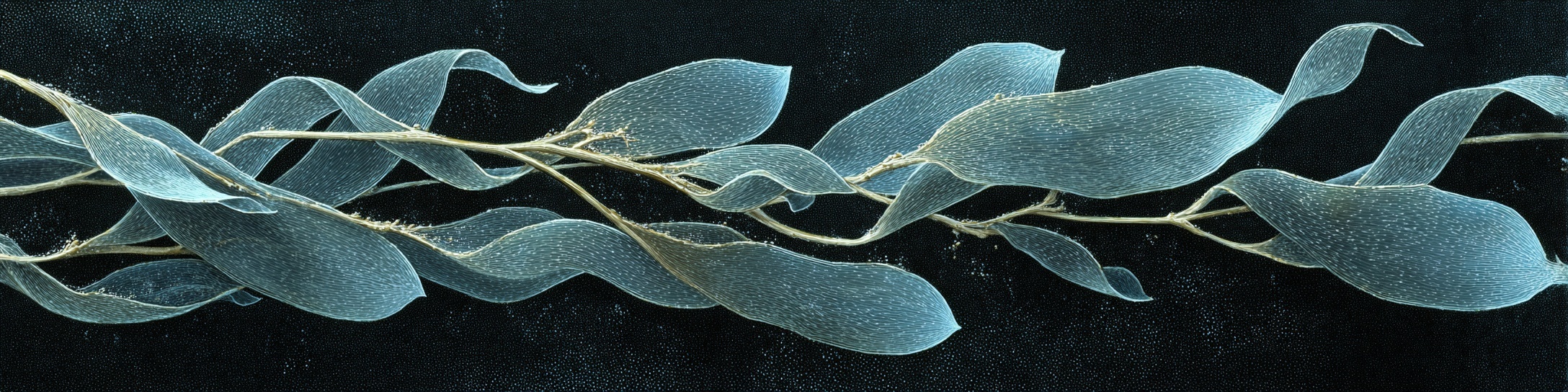
Moonstring Kelp
Found in the temperate northern and southern reaches of the Godslost Sea, Moonstring Kelp appears as long, pale ribbons that sway like silvered threads beneath the waves. Under strong moonlight, each strand catches and reflects light in thin, shimmering lines, creating the illusion of glowing strings drifting just below the surface. Locals dry the kelp into fine, flexible fibers used for fishing lures, ritual bindings, and delicate cordage. Alchemists value it as a subtle reagent in divination and illusion tonics, claiming it helps “tune the mind” to hidden patterns, much as taut strings carry a note.
Basic Information
Anatomy
Moonstring Kelp grows in long, ribbon-like fronds that can reach lengths of 10–20 feet, each frond only an inch or two wide but remarkably strong and flexible. The kelp’s pale coloration comes from its unusually thin epidermal layer, which allows moonlight and starlight to penetrate and reflect off the silvery fibers running along its interior, giving the plant its characteristic sheen. These internal fibers, known as lumen-strands, help the kelp maintain buoyancy and act much like tendons, allowing the fronds to undulate smoothly even in faint currents. The plant anchors itself with a dense, claw-like holdfast that grips rocky seafloors in temperate waters, and from this base it sends up multiple fronds that grow parallel rather than branching. Despite its delicate appearance, Moonstring Kelp is surprisingly hardy; its flexible structure allows it to withstand storms and tidal surges that would tear apart broader, heavier seaweeds.
Additional Information
Uses, Products & Exploitation
Moonstring Kelp is harvested both for its strong, flexible lumen-strands and its culinary value. When dried correctly, the inner fibers can be woven into fine cordage, fishing tackle, ritual bindings, and high-quality lure filaments, prized for their resilience and slight pearlescent shimmer. Alchemists use powdered kelp in divination draughts or clarity tonics, claiming it subtly enhances perception of patterns and illusions. Fresh kelp is edible, though rubbery, and is most often boiled into broths or used as packing material for fish transport. Because Moonstring Kelp beds take years to mature and can be stripped quickly by careless harvesters, some coastal regions now enforce rotational gathering or limit how much root-holdfast can be removed, an effort to prevent the creation of barren seafloors where the kelp cannot regrow.
“Moonstring Kelp? Hah. Every sailor thinks it’s romantic, ‘silver threads of the moon,’ and all that nonsense. What it really is, my friend, is a stubborn plant with a spine like tempered wire. Dry it wrong and it snaps. Boil it wrong and it turns to paste. Handle it properly, though… and you’ve got a filament that holds enchantments better than half the reagents nobles pay triple for. But don’t tell them that. Let them keep buying pearls and powdered feathers while I make miracles with seaweed.”
~ Ingram of the Cryptic and Gold Vase, Colwyn

Comments
Author's Notes
Image created with MidJourney
WorldEmber2025 submission