
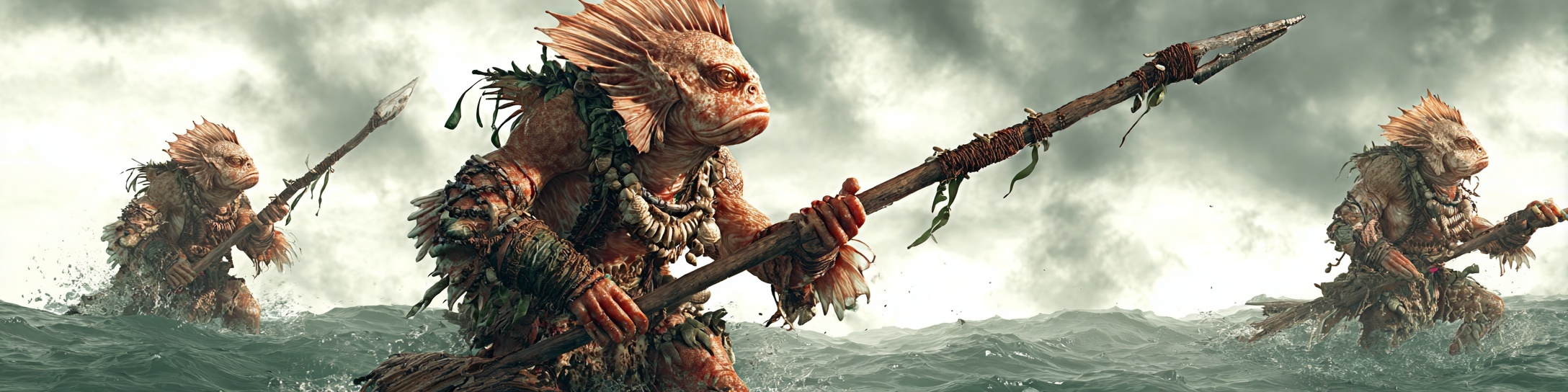
Locathah (LOH-cuh-t)
The Locathah of the Godslost Sea are the sea’s perpetual underdogs, tribal, migratory fish-folk who live in the dangerous shallows where sahuagin, demon-rays, pirates, and coastal powers all collide. They hunt the surf and kelp forests, scavenge wrecks, and raid when they must, but they rarely hold territory for long. Generations of war, slavery, and exploitation have left them wary and hard to break: a shoal may be scattered, but survivors always reform somewhere further down the coast. Sahuagin and ixitxachitl see them as expendable chattel; Pearl Elves and Tritons see them as tragic but useful allies. Locathah themselves see only this: no one else will keep them free, so they will do it themselves—one desperate, stubborn season at a time.
Naming Traditions
Unisex names
Locathah hatch-names are short, sharp, and unisex, given to fry as soon as they are old enough to swim with the shoal. These names are meant to cut through churning water and crashing surf, so they favor hard consonants and hissed sounds such as k, t, ss, rr, and zz, and often double letters or repeat syllables. A hatchling might be called Takk, Rila, Voss, Kess, Jerru, or Hessa, with no distinction between male and female beyond how the individual grows into it. The name usually stays for life; changing one is rare and carries weight, often signaling a break with a painful past or a rebirth after surviving something that should have killed them.
Other names
Earned Names
In place of family names, most adult Locathah carry an earned name given by their shoal. This second name is tied to a deed, a scar, or a defining trait and is usually half insult, half respect. It might commemorate a battle survived, captives freed, a narrowly avoided disaster, or even a memorable mistake that turned out well. A Locathah known as Takk Three Scars, Hessa Shark Ear, or Nuro Chain Snapper carries their story on their tongue every time they introduce themselves. Earned names can change over a lifetime if a new deed leaves a stronger mark on how the shoal sees that person, but only the current one is used in formal speech.
Shoal Marks
Beyond hatch-names and earned names, some Locathah add a shoal mark when dealing with outsiders. This title identifies the shoal or route they belong to, such as “of the Broken Kelp Shoal” or “of the Eastern Shelf.” Among their own people, this is often shortened to a gesture or left unspoken, since everyone nearby already knows who swims with whom. With surface folk, Pearl Elves, or Tritons, the full mark serves as a reminder that no Locathah stands entirely alone, even if their shoal is small or scattered by misfortune.
Culture
Major language groups and dialects
Locathah speech is not a single polished language so much as a drifting patchwork of creoles. Most shoals grow up speaking a rough blend of Aquan, local trade Common, and whatever tongues belong to the powers that rule their waters. A Locathah that lives near Colwyn will mix in harbor slang and human curses, while one that swims along the Pearl Elven reefs uses more Elvish words for magic, coral, and rank. To outsiders it often sounds like broken Common or sloppy Aquan, yet it is perfectly suited to quick, clipped communication in rough water.
Because shoals are small and mobile, there is no stable written tradition in these creoles. Almost all Locathah are illiterate, and those few who learn letters usually do so in the script of whoever taught them, not in any Locathah system. As a result, dialects split and recombine constantly. A phrase that means "safe route" in one region might be heard as "old hunting ground" in another, but tone, gesture, and context do most of the heavy lifting to keep meaning clear. Despite the differences, Locathah from distant shoals can usually make themselves understood after a little careful listening.
The exception to this loose, ever-shifting speech is found among the Scale Keepers. These traveling lore keepers deliberately preserve an older, more formal form of Aquan, although it has drifted from the version spoken in ancient temples and Triton courts. Scale Keepers use this conservative Aquan for songs of lineage, warnings about known slavers, and treaties recited from memory. A handful of them can even read and write Aquan script, scratched on stone or carved driftwood, and in this way they keep a fragile thread of continuity running through a people whose everyday language is forever being rewritten by the tides.
Culture and cultural heritage
Locathah culture is built on the expectation that nothing lasts. Camps are washed away, routes become dangerous, hunters are taken by larger predators, and even allies can turn into masters if the balance of power shifts. They do not raise monuments or carve long inscriptions into stone. Their heritage lives in the shoal itself, in the paths they swim each season, and in the earned names and scars of those who survive. A Locathah elder might point at a jagged reef and say, “Our people used to live there,” but the real weight falls on the next sentence, “and we are still here.” One of their common sayings is, “The sea will take this. Prepare your heart and your gear accordingly.” Their lasting achievement is not a city or a temple but the simple fact that they have not disappeared.
Socially, Locathah organize around the shoal, not bloodline, nation, or caste. Elders hold memory and speak for the shoal when dealing with outsiders, while war leaders handle immediate threats and hunts. Children are everyone’s responsibility, since adults are lost often and no family can rely only on itself. Gender plays little role in their customs, since anyone who can fight, scout, or forage is expected to do so. Values grow out of their history: survival without servitude, loyalty to the shoal above abstract causes, and a hard edged compassion for other prey. Their humor is quick and biting, full of jokes about near misses and bad masters, because laughing at the teeth that almost killed you is one of the few victories they can claim every season.
Their art and ritual life reflect a world that does not reward permanence. Decoration lives on the body and on tools that can be grabbed in an instant. Spears carry etched lines that tell of hunts and losses, shells are carved with simple patterns, and bits of colored glass or metal are bound into armor that might be seen only for a single encounter before being lost in the surf. Camps are often marked with braided kelp, raked sand patterns, and carefully stacked stones that everyone understands will be gone in a few tides. Small rites of letting go accompany most departures and losses, but they are brief: a handful of words, a shared touch, and then the shoal moves on. Children are taught from an early age how to release objects and places without breaking, while holding tightly to the people and stories that remain.
Against this constant flux stand the Scale Keepers, who act as the living spine of Locathah cultural memory. These traveling lore keepers deliberately maintain an older form of Aquan and carry long chains of names, routes, betrayals, and rare acts of mercy. Through them, Locathah heritage reaches beyond the limits of any single shoal. Many Scale Keepers are regular and welcome visitors to the Coral Archives, where they trade carefully chosen memories and knowledge. In return they gain access to preserved records and older forms of Aquan that would otherwise have slipped away entirely. This quiet relationship allows a people who own almost nothing that lasts to anchor parts of their story in coral and song, so that even as camps and routes shift, the Locathah as a whole do not lose themselves.
Shared customary codes and values
Locathah across the Godslost Sea share a rough but consistent code that grows from the same hard history. Freedom sits at the top of their values; they refuse to keep slaves of their own, and selling another Locathah into bondage is one of the few acts that can see someone cast out of the shoal. The shoal itself comes before any one individual. Food, fresh water, and salvage are meant to be shared, and returning hunters turn their catch over to elders for division so that everyone eats something. Heroics that leave half the shoal dead are treated as foolishness rather than glory. Children and elders are a sacred responsibility, belonging to the whole community rather than any one family, and to abandon them when help is possible is a serious breach of trust.
Locathah are expected to speak plainly about danger. If someone spots sahuagin signs, cursed water, or a bad current, they are obliged to warn the shoal. Lying about threats or hiding them to avoid panic is deeply frowned upon. Their ethics draw a sharp line between betraying upward and betraying downward. Sabotaging a tyrant, a slaver, or a cruel master is fair game, but preying on the helpless is not. Debts are taken seriously, especially those owed to someone who breaks chains or saves a life, and are repaid with long term loyalty and aid. At the same time, Locathah are taught from childhood to travel light and let go. Camps, tools, even cherished objects may have to be abandoned to keep people alive. Clinging to possessions at the risk of the shoal is seen as weakness. Through all of this runs a quiet respect for the Scale Keepers, who are to be sheltered, heard, and not lied to about the past, since they carry what little of Locathah history can survive the tides.
Average technological level
Locathah across the Godslost Sea live with a generally low level of technology. Without contact with other peoples, most shoals work with bone, tooth, stone, shell, coral, driftwood, sinew, and seaweed rope. Their native tools are simple but effective: barbed spears and harpoons, javelins, knives, weighted nets, hooks and lines, and traps for fish and crustaceans. Armor is usually made from layered hide, plates of shell or hardened scales, and padded kelp wraps that protect vital spots without slowing a swimmer. They do not build forges, foundries, or large workshops, and they rarely attempt any heavy engineering such as ships or fortifications of their own. Their camps and tools are made to be light, portable, and easy to abandon when the sea or stronger foes make staying impossible.
Where Locathah truly excel is in reclamation and repair. Generations of living in the wake of other peoples have made them expert scavengers. They strip shipwrecks and battlefields of anything useful, fitting iron and steel spearheads to their own hafts, binding bits of chainmail or broken plate into makeshift armor, and turning shattered beams and ropes into frames, racks, and simple boats or rafts. A Locathah spear might carry a Triton head, a human ship’s rope, and a haft carved from driftwood, maintained with patient care so it can last one more season. Nets are patched until they are more repair than original weave, and even half rusted weapons are cleaned, oiled, and wrapped so they will hold together for a few more strikes. They do not build great engines or permanent structures, but they are remarkably skilled at squeezing every last use from whatever the sea and its wrecks will give them.
Common Etiquette rules
Locathah etiquette grows out of life in tight shoals where survival depends on trust. A polite approach to a camp or group is slow and open, with weapons visible but not raised and no sudden dives from above or lunges from below, since those are moves of predators rather than kin. Greetings among shoal mates are brief touches of shoulder, tail, or forearm, while strangers are given a little space until they prove themselves safe. Elders and Scale Keepers are granted the floor in any formal talk, and speaking plainly is considered more respectful than hiding bad news behind soft words. Food and salvage brought in from the hunt are laid where elders or designated sharers can divide them, with children and elders served first as a matter of course. Keeping the best for oneself in secret, picking fights inside the shoal without announcing the grievance, or ignoring a call to stop given by an elder are all seen as serious breaches of manners. Debts and promises are treated carefully. Words that acknowledge a life saved or chains broken are not casual, and breaking even a small promise without good cause harms a Locathah’s standing in the shoal.
With outsiders, Locathah manners focus on fairness to the harmless and cunning toward the cruel. It is proper to warn innocent travelers about known dangers when possible and equally proper to mislead slavers, brutal captains, or sahuagin allies into bad water. Guests who are not obvious enemies are usually given a portion of food if the shoal can spare it, especially if they are children, elders, or other underdogs. Salvage etiquette draws a clear line between small and large finds. A minor item belongs to the first finder unless they gift it to the shoal, while large wrecks and battlefields are treated as communal resources. Stripping useful gear from the dead is accepted as practical, but mocking the bodies or defacing them is considered ugly behavior. Outsiders who grab at fins, gills, or scars without permission, who call Locathah “fish” to their faces, or who ignore the visible authority of elders and Scale Keepers quickly discover that even polite shoals have sharp limits to their patience.
Common Dress code
Locathah have little concept of clothing as surface folk understand it. Their scaled bodies need no covering for warmth or modesty, and what they “wear” is mostly harness and gear. Everyday dress consists of simple belts, chest or shoulder straps, and netted slings made from woven seaweed, kelp strips, tough hide, and rope. These hold knives, hooks, small tools, and whatever they manage to catch. Almost everything is scavenged, traded, or repurposed from wrecks, kills, or coastal rubbish, including flotsam and jetsam washed down from human ports. A Locathah without at least a belt and a few straps is not considered naked so much as dangerously unprepared.
When trouble is expected, they layer armor over this basic harness. Plates of shell, bone, and hardened hide are lashed over chest, shoulders, and thighs, with bits of chainmail or broken metal from shipwrecks strapped in as reinforcement. Dark kelp wraps are sometimes used to break up their outline in kelp forests or among sunken debris. Decoration is usually temporary and practical. Teeth and spines from dangerous kills, glass beads from shattered cargo, and smoothed metal rings sit beside simple ink or dye markings on face and arms that wash away in a tide or two. Covering gills or sensitive fins with wraps can signal injury or caution rather than modesty.
On the rare occasions when Locathah walk among surface folk, some will add short tunics, cloaks, or loincloths taken from discarded clothing or salvaged from wrecks. These garments are often mismatched or roughly cut, chosen more to stop staring or chill winds than to please local fashion. Harness, belts, and pouches remain in place regardless of what cloth is added. To a human eye, a Locathah’s dress looks like a collage of sea life, shipwreck, and necessity, a collection of things the sea has given and might reclaim at any moment.
Art & Architecture
Locathah art is personal, portable, and rarely meant to last. Most of it lives on their bodies and tools rather than on walls or freestanding objects. They paint scales, faces, and fins with simple dyes that wash away in a tide or two, braid kelp and cord into harnesses and fin-frills, and hang trophies such as teeth, spines, shells, and bits of colored glass from belts and armor. Spears, knives, and shell plates are carved or etched with currents, waves, stylized jaws, and repeating lines that mark hunts, escapes, and losses. A single spear haft can serve as both weapon and private record, each notch or swirl recalling a story told only when the owner chooses. Decoration often begins as something to do while keeping watch or waiting for a hunt, a way to pour restless energy into small grooves and patterns.
Their world does not reward permanent structures, so Locathah architecture is minimal and deliberately disposable. Typical camps consist of light domes or lean-tos built from bent driftwood, bone, and woven seaweed, with netted barriers to slow predators and simple racks or anchor points to hold gear. Layout matters more than material. Sleeping circles near elders and children, clear escape paths, and familiar positions for shared stores allow a Locathah to feel at home in any new camp that follows the same pattern. When a site becomes unsafe, the shoal strips what they can, cuts the rest free, and moves on without regret. Occasionally they create more deliberate but temporary constructions, such as stacked stones to mark an important death or raked sand spirals around a place where the shoal nearly perished. These are not monuments intended to endure forever but brief physical prayers, left for the sea to erase in its own time.
Foods & Cuisine
Locathah cuisine is simple, spare, and driven by survival rather than taste. Most meals are eaten raw, taken straight from the sea or prepared with only a few quick cuts. Shoals live on fish of all sizes, crustaceans, shellfish, sea urchins, and strips of edible seaweed gathered from familiar routes. A successful hunt might mean fresh slices of larger fish passed around in the water, while lean days are filled with small fry, crabs, and whatever can be pried out of rocks. Locathah are opportunistic but not careless scavengers. They have a good nose for rot and cursed water and will leave any carcass that smells wrong for the crabs. Children and elders are fed first when food is scarce, and no one is praised for hoarding a private stash when others go hungry.
Cooking in the surface sense is rare and usually reserved for special occasions near shore. Some shoals will use hot vents, sun-warmed tidal pools, or borrowed fires on quiet stretches of coast to sear or dry part of a catch, but such treats are not a daily habit. More common are simple preservation tricks that suit their mobile life. Thin strips of fish or ray are salted in brine and hung in moving water to toughen, becoming travel rations that can be chewed while on the move. Shellfish may be packed into cool crevices to mellow for a few days, creating strong-tasting but long-lasting food. Seasoning is minimal. A few herbs from the shallows or a sour bite from fermented seaweed are enough variety for a people who expect to lose camps and stores without warning. For Locathah, a good meal is one that fills the shoal and leaves enough strength to swim another day, not a work of culinary art.
Locathah do use a small amount of seasoning, though most outsiders never recognize it as food. A thin, pale lichen they call Stormsalt grows on wave battered rocks, old pilings, and the exposed ribs of wrecks in the surf. To surface folk it is just slippery nuisance, and to most Pearl Elves and Tritons it is a minor alchemical or ritual component rather than anything to eat. Locathah scrape it from the stone, rinse away grit, press it into thin sheets in shallow pools, and then dry it on warm rock or in hanging nets. Properly prepared, stormsalt has a sharp, briny bite with a faint burning tang at the back of the tongue. Crumbled in tiny pinches over raw fish or mixed with chopped seaweed for a rough paste, it gives otherwise plain food a vivid edge. Some hunters even chew a small piece before a difficult swim or raid, claiming it wakes the blood and clears the head.
Common Customs, traditions and rituals
Locathah customs grow out of a life where camps, tools, and even whole routes can be lost with little warning. One of the most common shared traditions is the leaving rite when a camp must be abandoned. Before anyone pulls up anchors or cuts loose the nets, the shoal gathers while an elder or Scale Keeper speaks the camp’s name and briefly lists what was gained and lost there: good seasons, hard storms, hunts that went well, kin who never returned. The shoal answers with the same closing phrase each time, a reminder that they still swim, and only then do they strip what can be carried and move on. Smaller daily habits reinforce the same mindset. It is customary to report any sign of predators, slavers, or bad water aloud as soon as it is seen, even if it seems minor, and to pass shared tools hand to hand in a small circle before a hunt, letting several sets of eyes check for fraying lines or weakened hafts.
Mourning is quiet but persistent. When someone is taken by sahuagin, swept away by a storm, or carried off in chains, the shoal keeps a visible reminder of their absence in the camp, often an empty hook, loop, or cord left on a communal rack or line. If the lost person returns, there is a simple welcome: the empty place is filled again with a new token such as a shell, tooth, or bead, and the story of how they survived is told that night so it can be remembered. If they never return, the empty space may travel with the shoal for years, repeated in each new camp as a quiet sign that someone is still missing. Sites where many died or where a shoal was almost wiped out may be marked only briefly when the shoal moves on, often with a few stones or shells at the edge of safe water that everyone knows the sea will eventually erase.
The arrival of a Scale Keeper is one of the few events that can interrupt ordinary routine. When word comes that such a traveler is near, the shoal customarily sets aside a portion of food for them without debate and makes time for a formal gathering that night if the waters are safe. During this gathering, the Scale Keeper recites remembered names, routes, and past encounters with powerful outsiders, while elders add corrections or local details. Children are encouraged to listen and repeat key names and places, learning which banners once meant chains and which currents once brought help. It is considered rude to lie openly during these sessions or to mock what is being recorded for future shoals. Through customs like these, centered on leaving well, remembering losses, and feeding the keepers of memory, the Locathah maintain a sense of shared tradition even as the sea erases most physical traces of their passing.
Birth & Baptismal Rites
Locathah are egg-layers, and their birth customs focus on keeping the clutch alive rather than pleasing any god. When a shoal is ready to spawn, the adults seek out a sheltered “cradle” along their route, such as a tight kelp thicket, a crevice in reef or wreck, or a hollow in warm rock near a gentle current. Several adults may lay in the same cradle over a short span of days, treating all the eggs as one shared clutch. Once the eggs are laid, hunters take special care to feed the watchers, and at least one adult is always on guard. Predators, scavengers, and curious outsiders are driven off quickly. Some shoals mark a cradle with small stacks of shell or stone, not as a shrine but as a simple warning to others that this place is guarded. Scale Keepers who are present often note the cradle in their memory and sometimes speak a brief promise to carry word of this clutch if the shoal does not survive.
Hatching is a communal event rather than a private family moment. As the eggs begin to tremble, the shoal tightens around the cradle in a living ring, ready to fend off any threat and to catch weak hatchlings before the current carries them away. Locathah fry are expected to swim almost at once, but adults guide them gently into the water, nudging and supporting them until they can move on their own. There is no baptism in the surface sense and no formal blessing by priests. The water itself is considered sufficient. Instead, elders and parents may pass soft sounds and clicks through the water while the young swim in their first small circle, a simple welcome rather than a ritual of spiritual cleansing. Within the first few days, once it is clear which fry are strong enough to keep up, hatch-names are chosen, short and sharp so they can be shouted through surf, and the clutch is fully folded into the life of the shoal as “our children,” not simply the offspring of one pair.
Coming of Age Rites
Locathah do not count adulthood by years so much as by what a young swimmer can do for the shoal. The first and most important rite of passage is known simply as the First Catch. A youth who believes they are ready hunts, scouts, or scavenges on their own or with a small group of peers and brings back something that truly matters to the shoal. It might be a good haul of fish after a lean week, a salvaged spearhead that can arm another hunter, or a warning about a new predator or slaver route that allows the shoal to avoid disaster. When they return, the youth lays their prize before the elders in full view of everyone. If the elders agree it was gained with real skill and courage rather than luck or recklessness, they accept it on behalf of the shoal and declare the First Catch complete. In that moment the youth is invited to sit with the adults at councils and to join full hunts rather than staying in the safer waters near camp.
The rite leaves a physical mark as well. An elder or trusted hunter takes the young Locathah’s main spear, knife, or harness and adds a new line, swirl, or small carved symbol that will always belong to that moment. This mark may eventually grow into the basis for an earned name, such as Sharp Eye or Good Net, or it may be overshadowed later by greater deeds, but it is never erased. Some shoals also require a Second Trial before considering someone fully adult, usually tied to weather or danger. This might be surviving and assisting others during the first shared storm in open water, or standing watch during the first real threat of sahuagin or slavers and giving a timely warning. If a Scale Keeper is present for either rite, they make a point of remembering the youth’s name and deed so it can travel with them when they leave. Through these coming of age customs, Locathah remind their children that adulthood is not a matter of size or age, but of being able to keep the shoal alive.
Funerary and Memorial customs
Locathah funerary customs reflect a life where bodies are often lost and death comes quickly. When someone dies and the body can be recovered, the first priority is practical. Weapons, harness, and useful gear are removed and given to kin or to those who need them most, since wasting good tools is considered an insult to the dead. After that, the body is taken a little way from the camp into water that is safe but not heavily used and released to the currents. An elder or close friend speaks the hatch-name and earned name aloud, along with one brief memory of something the dead person did for the shoal, then the body is allowed to sink or drift. Locathah do not linger long. They know that leaving a corpse near camp attracts predators, and they trust the sea to finish what it has started. To them, respect means equipping the living to keep swimming and speaking the dead person’s name so it is not lost, rather than preserving the body.
When a Locathah is taken in chains, swallowed by a storm, or killed far from the shoal, mourning leans heavily on symbols and memory. An empty hook, cord, or loop is added to a communal rack or line in the camp to mark the place that person once held. If they return, a new token such as a shell, tooth, or bead is hung there, and their survival story is told in full that night. If they do not, the empty place may travel with the shoal for years, repeated in each new camp as a quiet reminder that someone is still missing. Sites where many died or where a shoal was almost wiped out may be briefly marked with small stacks of stones or shells at the edge of safe water, simple markers that everyone knows the sea will eventually erase. Scale Keepers play a key role in memorial customs. During their visits, they recite the names and fates of those lost to sahuagin, storms, and slavery, and they listen carefully as elders add new losses to the chain. In this way, even when there is no grave and no lasting monument, Locathah keep their dead alive in the only durable place they trust: the stories carried in living minds.
Common Taboos
Locathah taboos grow directly from what keeps a shoal alive. The strongest of these is anything that smells of slavery. Owning slaves, selling another Locathah into bondage, or knowingly helping slavers hunt new victims is treated as one of the worst possible crimes. A close second is betrayal from within. Hoarding food or salvage when others go hungry, stealing from the shoal itself, or hiding news of predators, slavers, or bad water to protect one’s own comfort all break the basic trust that lets a shoal function. Turning weapons on a shoal-mate without formally naming a grievance, or continuing a fight after elders call an end, is also deeply frowned upon. Children, elders, and Scale Keepers sit inside a shared circle of protection. Harming them without absolute necessity, or refusing them aid when it can be given, marks someone as untrustworthy at best and monstrous at worst. Blocking a Scale Keeper’s travel or lying to them about history is seen as an attempt to wound the memory of the people themselves.
Locathah also hold quiet but firm taboos around death and the sea. Stripping useful gear from the dead is practical and accepted, but mutilating a body, mocking the fallen, or defacing a memorial hook or stone marker is considered ugly and shameful. Deliberately poisoning safe water, drawing dangerous predators toward another underdog community in exchange for payment, or wasting good food without cause are all treated as serious offenses. There is also a softer taboo against valuing objects over lives. Returning to a doomed camp against orders just to retrieve a prized tool, or insisting the shoal risk itself for personal possessions, is seen as a sickness of the spirit. For a people who expect to lose camps, tools, and routes to the tides, clinging too tightly to things at the expense of the living cuts against everything they believe about how to endure.
Common Myths and Legends
Locathah myths and legends are usually short and sharp, more warning than wonder, and the darkest of them speak of shoals that vanished without trace. Scale Keepers tell of routes that were once busy with cousins and trade, only to fall silent over a single season. Marks that once showed camp sites and safe currents are gone, cradles stand empty, and no bodies or broken tools remain. These stories are grouped under many names, but most shoals know some version of the Down Deep Taken: a reminder that there are hungers in the wider sea that do not leave bones or chains behind. Parents use these tales to warn their young against swimming beyond the shelf or chasing strange lights, and even hardened hunters grow quiet when a Scale Keeper pauses over a gap in the chain of remembered shoals and simply says, “They did not come back.”
Individual legends vary from region to region, but the pattern is the same. One common story tells of the Shoal That Followed the Falling Light. In it, a bright glow like a slow star sinks beyond the edge of safe water. A restless war leader orders the shoal to pursue, promising new hunting grounds and rich salvage, and the story ends with a Scale Keeper arriving seasons later to find only empty rock and a strange hush in the currents. Another speaks of a season when headaches and half-heard whispers troubled several shoals at once, followed by sudden quiet along an entire stretch of coast. No one saw raiders or storm, yet the names that belonged to that stretch of water are now recited without answer. These tales never offer explanations, only patterns and dread. For the Locathah, the horror lies not in a known monster that can be fought, but in the simple, unexplained erasure of whole communities. The Scale Keepers carry these incomplete stories carefully, knowing that even a half-remembered warning may one day keep another shoal from swimming into the same blank space.
Ideals
Beauty Ideals
Locathah place little importance on beauty in the surface sense. Strength, endurance, and useful scars matter far more than coloration or ornament, and most “adornment” is simply trophies and practical markings.
Major organizations
Locathah don’t build cities or kingdoms, so their “major organizations” are really the shoals and loose alliances that other peoples are forced to take seriously. None of these rival a Pearl Elven enclave or a Triton fortress, but in the surf-zones of the Godslost Sea, their names still matter.
The Shoal-Road Pacts
Along several rich stretches of continental shelf, neighboring shoals maintain old agreements called Shoal-Road Pacts: promises to warn one another of sahuagin raids, share safe campsites, and avenge mass enslavements when they can. These pacts aren’t formal councils—just elders and war-leaders who recognize the same routes and agree not to turn spears on each other while worse predators are near. From the outside, these networks are the closest thing Locathah have to “regions” or “territories.”
The Broken Nets
The Broken Nets are a scattered brotherhood of ex-slaves who’ve sworn to sabotage slavers wherever they can reach them. They don’t have banners or fixed leaders; they pass word by carved driftwood tokens and scratched symbols on wrecks and rocks. Some Broken Nets serve as “guides” for surface ships—steering them straight into pirate or sahuagin ambushes if those ships carry chains. Others quietly free captives from sahuagin pens or Ixitxachitl temples and vanish before anyone can pin blame on a shoal.
Tide-Sworn Companies
A small number of Locathah warbands have taken long-term service with other powers: Pearl Elven enclaves, Triton fortresses, or even the Spell-Kings of Amfa’atu. These bands, called Tide-Sworn, trade a measure of autonomy for food, weapons, and protection from worse threats. Most Locathah view them with mixed feelings—useful kin with better gear, but always one bad order away from becoming someone else’s expendable troops again.
The Scale Keepers
The closest thing Locathah have to priests or scholars, the Scale Keepers are wanderers who travel from shoal to shoal, carrying songs, warnings, and lineages. They are not a unified order, but they share certain marks and rituals, and most shoals will feed and shelter them. Stories of which sahuagin tribes took slaves where, which routes are “cursed” by Ixitxachitl, and which outsiders kept or broke their bargains all live in their memories. Other peoples dismiss them as ragged storytellers; the Locathah know they’re the only reason mistakes from three generations ago aren’t still being repeated.
“Most folk look at the Locathah and see bait that learned to walk upright. Sahuagin see spare troops, surface captains see cheap guides, and everyone else just… looks past them.
I’ve watched a shoal lose half their people to shark-worshippers and still come back the next season, same route, spears mended, kids already learning which shadows bite. That’s not foolish. That’s courage nobody sings about.
I’m just one little sea-druid; I can’t fix the world for them. Best I can do is nudge a current now and then, point a decent crew their way, and hope the right people notice they’re still fighting to breathe.”
~ Cooper, a very average druid, absolutely nothing unusual about him at all

Comments
Author's Notes
Image created with MidJourney
WorldEmber2025 submission