
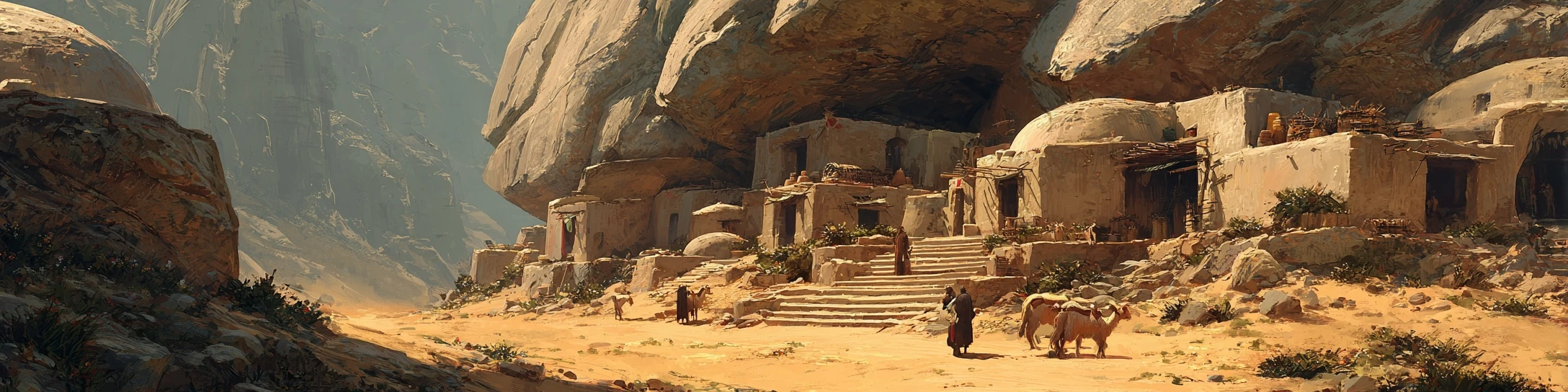
Ia-gûr (EE-ah-GOOR)
Ia-gûr is a young settlement tucked into a hidden badlands valley between Colwyn and Risland, founded by half-orcs who grew tired of being stared at like a problem to be solved. Reached only on foot through a single narrow approach, it has become a self-sufficient community of half-orcs and a smaller number of orcs who chose something rarer than conquest: a home built on consent, communal care, and the steady discipline needed to survive harsh land. Its people farm tough crops, keep goats and bees, and send Rangers beyond the valley for meat and warning, while beneath their rammed-earth compounds runs a web of tunnels called the Quiet Roads. Ia-gûr keeps little commerce with the outside world, making only a yearly provisioning run to Carlisle, and it is largely ignored by its distant neighbors, which suits it just fine.
Demographics
Ia-gûr is primarily a half-orc settlement, though a sizeable minority of full-blooded orcs live within the valley as well. Many residents arrived as outsiders over the years, drawn by the promise of a place where mixed blood is not treated as suspicion made flesh. Alongside these newer arrivals is a growing number of Valleyborn half-orcs whose families have been raised in Ia-gûr for multiple generations. Their presence is quietly important to the community’s identity, proof that Ia-gûr has become more than a refuge and is steadily becoming a people.
Because Ia-gûr’s founders chose distance and self-reliance, the settlement remains small, with most residents known by face if not by name. Households and relationships are fluid and often communal, and children are raised with broad familiarity rather than strict nuclear family structure. The community keeps careful parentage records through the Hearth Ledger, a practical safeguard in a tight population, and maintains multiple Stonehearths for child care as needed. Visitors are uncommon but not unheard of, most often encountered at "the Lodge" near the entrance, and the rare newcomers who arrive with “sharper” mixed features are typically met with deliberate welcome, on the assumption that the outside world has already made their life hard enough.
Government
Ia-gûr is governed through a practical system known as the Council of Hands, a small body chosen by community approval rather than inheritance or wealth. Leadership is expected to be capable in a fight, but strength alone is not enough. Control, sound judgment, and the proven ability to keep the valley fed and safe carry equal weight, and a leader who cannot govern themselves will not be trusted to govern others.
Above the council sits the Speaker-Leader, a role currently held by Stone, a half-orc monk trained at the Monastery of the Forgotten Way outside Ord. Stone is not merely a chair among peers; he calls the council, sets priorities in crisis, and serves as the final voice when the Hands cannot agree. Beneath him, the Hands oversee the daily needs of Ia-gûr: the Hearthward maintains stores, cultivation, water discipline, and the integration of newcomers; the Gateward manages the entrance approach, watch rotations, and visitor protocols; and the Trailward directs the Rangers and scouts who hunt, patrol, and range outward to map threats and return with warning. In practice, Ia-gûr’s government feels less like a court and more like a set of responsibilities, where authority is measured by what a person keeps running, not how loudly they claim it.
Defences
Ia-gûr’s first line of defence is the valley itself. The settlement sits behind steep badland foothills with only a single approach passable on foot, a natural choke point that forces any visitor, trader, or attacker to arrive slowly and in small numbers. The Gateward maintains watch over this approach, and the Lodge near the entrance gives outsiders a place to stop without granting them easy access to the living compounds deeper within the valley.
Within Ia-gûr, defence is communal rather than professionalized. Most adults can fight, and the expectation is not that a few guards will die for everyone else, but that everyone will stand when the valley is threatened. A small number of Rangers range beyond the confines of Ia-gûr to hunt and to scout, tracking dangers in the badlands and returning with warnings before those dangers reach the entrance. Beneath the settlement, the Quiet Roads provide sheltered movement between compounds and safe chambers in times of crisis, allowing families to relocate without exposing themselves above ground.
Ia-gûr also relies on quiet signals rather than shouted alarms. Oathlights, kept burning as hooded vigil lamps in key places, serve as a constant indicator of safety and presence. Two lights mean a site is occupied, one means it stands empty, and no lights means trouble, either a call for aid or the sign that the community has gone to ground. Ia-gûr is not a fortress-city, but it is difficult to surprise, hard to enter in force, and even harder to break once its people decide to hold the line.
To outsiders approaching at night, the Oathlights carry an additional message. Two flames set in shadowed niches read as a pair of eyes in the dark, an unspoken warning that the valley is awake, aware, and not to be tested. Locals sometimes refer to this simply as “the Watch,” a phrase that can mean the people themselves, the Stonewatch on duty, or the valley’s steady habit of paying attention.
Industry & Trade
Ia-gûr has little interest in commerce and even less ability to sustain it. The settlement was founded to be apart from the judging eyes of larger nations, and its distance from Colwyn and hostility from Risland make regular trade impractical. Instead, Ia-gûr is built on self-sufficiency: cultivation within the valley, goats and chickens for milk, eggs, meat, and hides, rabbits for efficient protein, and bees for honey and wax. Rangers range beyond the foothills to hunt and to scout, bringing back meat as well as warning of badlands threats. A handful of low-level druids further strengthen this independence through small magics that matter greatly in harsh land, especially the ability to conjure water and to coax crops through difficult seasons.
What Ia-gûr does produce in abundance is skilled, practical craft. Rammed-earth compounds and cliff-set courtyards require constant maintenance, shaping a local tradition of stonework, claywork, leatherworking, and durable utilitarian design. The most sought-after goods, however, come from the valley’s hives. In the brief weeks after rare rains, the badlands Suncleft Bloom erupts from cracks and scree along the valley walls, and bees feeding on its mineral-sweet nectar produce Stonegold Honey. The wax from those same hives is rendered into Oathlights: hooded vigil lamps prized for their steady, low-smoke burn. In Ia-gûr these lights serve a defensive purpose as much as a domestic one, their paired flames often appearing like watchful eyes in the dark.
External trade is limited to provisioning rather than profit. Once per year, a small party travels to Carlisle to purchase what the valley cannot easily make, such as worked steel, needles, salts, certain medicines, and specialty tools, passing through Pitt on the approach. Carlisle has come to expect these gruff but reliable buyers and bears them no ill-will. More rarely, Ia-gûr may barter with the centaurs of Xinturu Yara for mineral salts, hides, sinew, and route intelligence, exchanging honey, wax, preserved goods, and select metal items acquired on the Carlisle run.
Infrastructure
Ia-gûr’s infrastructure is shaped by two facts: the valley is harsh, and the community intends to stay. Above ground, most structures are thick-walled rammed-earth compounds set around shaded courtyards, often backed into the valley slopes or anchored on stone footings to resist wind and flash rain. Paths between clusters are narrow and intentional, designed for foot traffic, goats, and handcarts rather than wagons. Heat management is built into daily life: shaded lanes, recessed doorways, and semi-sunken courts keep homes livable through the hottest seasons, while small orchards and garden plots concentrate around reliable water.
Beneath the settlement runs the Quiet Roads, a growing network of tunnels that connects most residences and several civic spaces. These passages were not dug all at once; they have accumulated over time as families expanded, storage needs grew, and the valley taught the same lesson repeatedly: what is protected underground lasts. The Quiet Roads link cellars, cool rooms for medicines and honey, work hollows for leather and clay, cistern chambers, and sheltered safe rooms used in storms or emergencies. Digging follows the valley walls both horizontally and vertically, creating stacked chambers, shafts, and split-level spaces that make the underground feel less like a single tunnel and more like a second settlement in shadow.
Visitors are accommodated without being invited into Ia-gûr’s private life. Near the entrance sits the Lodge, a simple structure that resembles an inn only in layout: a common room with benches and tables and sleeping rooms set off to the sides. There is no innkeep, no bartender, and no expectation of service. A sign by the door states the rules plainly in Common and Orcish, with additional languages added over time as newcomers arrive: carry your own, do not wander, and leave it cleaner. Ia-gûr offers shelter, not dependency, and its infrastructure reflects that same principle everywhere.
Districts
Ia-gûr has no formal districts in the manner of larger cities. Instead, locals speak of the valley in practical terms, marking places by purpose rather than status. Near the entrance is the Lodge, the settlement’s simple visitor shelter, positioned so outsiders can be hosted without being folded into daily life. Deeper within the valley, clusters of rammed-earth compounds gather around shared courtyards, with most families living close to the gardens, goat pens, and work spaces that sustain them. Beneath it all, the Quiet Roads serve as a second layer of the settlement, linking cellars, cisterns, workshops, and safe rooms in a network understood by residents long before it is ever shown to a guest.
Assets
Ia-gûr’s greatest asset is not wealth, but resilience. The valley’s single foot-access approach and steep badland walls make the settlement difficult to reach in force, while the Quiet Roads beneath it allow people, supplies, and even entire households to move in shelter when the surface is unsafe. Most adults can fight, and the community’s defence is communal rather than outsourced, reinforced by a small cadre of Rangers who hunt, scout, and return with warning.
Equally valuable are Ia-gûr’s social structures. The community is unusually skilled at integrating newcomers, especially those who arrive sharp-featured and wary from mistreatment elsewhere, and it maintains careful descent records through the Hearth Ledger to prevent kin entanglements in a small population. Multiple Stonehearths and the ever-present Stonewatch ensure children are cared for without requiring rigid households, and the culture’s emphasis on consent and self-control keeps a high-drive people stable rather than volatile.
Finally, Ia-gûr possesses quiet material assets that travel well. Stonegold Honey and the wax that becomes Oathlights are sought after in Carlisle, and even within the valley those lights serve as a low-magic signaling system that communicates safety, presence, and danger at a glance. Alongside durable leatherwork, practical stone and clay craft, and the occasional aid of low-level druids who can conjure water or coax crops through difficult seasons, these strengths make Ia-gûr far more secure than its small size suggests.
Guilds and Factions
Ia-gûr has no true guilds in the urban sense, and it lacks the kind of competing factions that thrive in larger cities. What it does have are roles, responsibilities, and the quiet coalitions that form around work. In a settlement where survival is communal, “influence” is most often measured by who keeps people fed, safe, and steady.
At the heart of governance is the Council of Hands, with Stone serving as Speaker-Leader above the other positions. The Hearthward oversees cultivation, stores, water discipline, and the integration of newcomers, and holds stewardship over much of the Quiet Roads’ practical infrastructure. The Gateward maintains the entrance approach, manages watch rotations and visitor protocol at the Lodge, and controls the security-critical routes beneath the valley. The Trailward directs the Rangers and scouts who range beyond Ia-gûr for hunting and early warning, returning with meat, maps, and news of threats in the badlands.
Beyond these civic roles, Ia-gûr’s most consistent “faction” is the Stonewatch, not a fixed order but whoever is on duty in the moment at a Stonehearth. Any adult may step in as Stonewatch when needed, and the expectation of restraint and responsibility in those spaces is a cultural cornerstone. Smaller circles form around specialized work as well: beekeepers and chandlers who produce Stonegold Honey and Oathlights, tunnel-diggers and masons who expand and maintain the Quiet Roads, and the handful of low-level druids whose small magics of water and cultivation make an outsized difference. These are not rival powers so much as interlocking hands, each essential, each answerable to the community that raised them.
History
Ia-gûr is a young settlement by the standards of kings and old cities, founded within living memory by half-orcs who were weary of moving through human streets under suspicion and contempt. They chose the badlands not because it was gentle, but because it was empty enough to be theirs. A hidden valley, difficult to reach and easier to defend, offered the kind of isolation that could become safety, provided its people were willing to build a life with their own hands.
In its earliest years Ia-gûr was little more than shelters, small cultivation plots, and watchfires, with survival hinging on cooperation and a shared refusal to be ruled by anyone else’s judgment. Newcomers arrived in dribs and drabs, bringing skills and hard-won knowledge from outside communities, and Ia-gûr absorbed those lessons while reshaping them to fit the valley’s needs. Over time, rammed-earth compounds replaced temporary camps, courtyards became the bones of neighborhoods, and the first cellars dug into the slopes quietly began what would eventually become the Quiet Roads.
As the settlement stabilized, it formalized what had already been true in practice: leadership would be chosen by community approval, and authority would be earned through control, competence, and the ability to keep people alive. The Council of Hands emerged from this principle, and Stone, trained in discipline at the Monastery of the Forgotten Way, became Speaker-Leader. With growing families came new customs, including communal childrearing supported by Stonehearths and the Stonewatch, and the Hearth Ledger’s careful keeping of parentage to prevent kin entanglements in a small population.
Today, Ia-gûr remains intentionally small and largely uninterested in the affairs of surrounding nations. It makes a yearly provisioning run to Carlisle for what the valley cannot easily produce, and it is known by name to those with maps and magic, yet ignored by those with larger threats to mind. Ia-gûr’s truest history is still being written: not in conquests, but in the slow work of becoming a culture rather than merely a refuge.
Points of interest
The Lodge. Built near the entrance path, the Lodge resembles an inn only in shape: a common room with tables and benches and a handful of simple sleeping rooms. There is no innkeep and no service. A leaning sign by the door states the rules plainly in Common and Orcish, with additional languages added over time: carry your own, do not wander, and leave it cleaner.
The House of Hands. Ia-gûr’s council hall is modest by design, a place of work rather than pageantry. Here the Council of Hands meets under the Speaker-Leader, and here Stone’s authority is most visible, not in ornament, but in the way arguments end and decisions become action.
The Footgate Approach. The valley’s only walkable entrance is more than a path; it is a controlled approach watched by the Gateward. Its bends and narrow points slow arrivals naturally, ensuring that visitors enter on Ia-gûr’s terms and that attackers cannot arrive in force.
The Stonehearths. Scattered among the compounds, Stonehearths are child-centered spaces that may be active or quiet depending on need. They are open to all adults, but never unobserved for long, as Stonewatch is a role that any responsible adult may assume when children require steady attention.
The Quiet Roads. Beneath Ia-gûr runs a web of tunnels linking cellars, cisterns, work hollows, cool rooms for medicines and honey, and sheltered safe chambers. Visitors may hear the term spoken above ground as a warning to lower voices, but few outsiders are shown more than a single stair and a single door.
Oathlight Niches. In key places, hooded vigil lamps burn with a steady, low-smoke flame, often set in paired niches that read like watchful eyes in the dark. The pattern is a language of its own: two lights for presence, one for emptiness, and none for trouble or hiding.
Architecture
Ia-gûr’s buildings are born from restraint, heat, and a deliberate refusal to look like anyone else’s city. The settlement is composed primarily of thick-walled rammed-earth compounds gathered around shaded courtyards, often anchored on stone footings or backed into the valley slopes. These compounds favor small exterior openings, recessed doorways, and cool interior rooms, making them naturally defensible and far more livable in badlands extremes than thin timber or open-plan halls. Paths between clusters are narrow and intentional, shaped for foot travel, goats, and handcarts rather than wagons, with the valley itself doing much of the work that walls would do elsewhere.
Where Ia-gûr differs from a simple survival village is in how intentionally it uses the land’s contours. Many structures are built as terraces or half-dug spaces, stepping into the hillsides to gain shade and stable temperatures. Storage and work rooms are commonly cut into the earth, and most households have access to cellars that connect into a broader underground network. Over time, these excavations have become the Quiet Roads, a second layer of Ia-gûr that links residences to cistern chambers, cool rooms for medicines and honey, work hollows for leather and clay, and sheltered safe rooms used during storms or danger. The Quiet Roads are part infrastructure, part habit, and only occasionally a thing a visitor is allowed to glimpse.
Aesthetic in Ia-gûr leans toward the functional made deliberate. Joints and seams are not always hidden; stone meets earth in visible transitions, and repairs are treated as part of a building’s story rather than a shame to plaster over. Oathlight niches appear throughout key structures, often in paired recesses that read like watchful eyes at night, reinforcing the sense that the settlement is always aware of who is present and when something has gone wrong. Even the Lodge, built to feel familiar to outsiders, is unmistakably Ia-gûr in make: rammed-earth walls, courtyard logic, and a design that offers shelter without offering servitude.
Natural Resources
Ia-gûr’s primary resources are mundane but dependable: workable badlands stone and clay-rich earth for building, sparse scrub and hardy forage for goats and hares, and seasonal wild growth that supports hunting and beekeeping. The valley also provides shelter in its slopes, enabling extensive cellars and the Quiet Roads to be cut into stable ground for storage, cistern chambers, and safe rooms. Water is the settlement’s limiting resource, gathered carefully from seasonal runoff and stored underground, with occasional aid from low-level druids who can conjure or preserve small but meaningful supplies. Ia-gûr lacks rich timber and easy metal, relying on scavenging, salvage, and a yearly provisioning run to Carlisle for worked steel, salts, and other materials the valley cannot reasonably provide.
“I came looking for a road and found only steps, stone, and two little flames watching me like eyes. At the Lodge there was no innkeep, no questions, just a sign with rules in Common and Orcish, and then in other tongues someone had added later. I slept well enough. Still, when the wind shifted, I could hear voices deeper in the valley, and I kept wondering what lay beyond the Lodge, where strangers aren’t meant to wander.”
~ Rusk, the last hand of a broken caravan

Comments
Author's Notes
Image created with MidJourney
WorldEmber2025 submission