
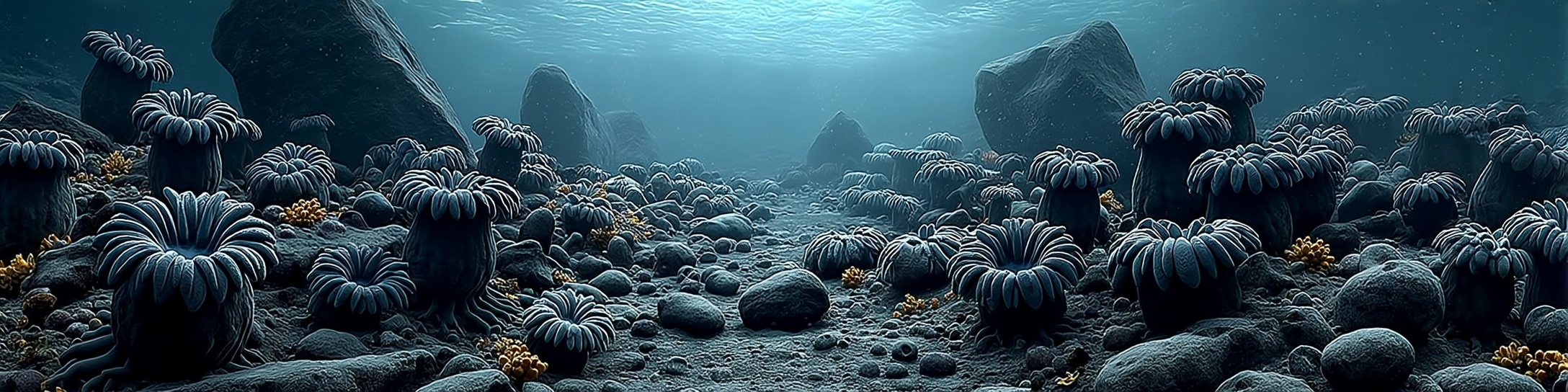
Gravetide Anemone
The Graveltide Anemone is a dull grey, soft bodied sea anomone that favors submerged ruins, shipwrecks, and the scattered bones of ancient giants on the floor of the Godslost Sea. Its short, think tentacles form a low, ragged crown around a central mouth, giving it the look of the withered flower clinging stubbornly to stone. When undisturbed, these anemones sit motionless, blending almost perfectly with the surrounding rock and debris; only a faint, ashy, mottling along their tentcles sets them apart from bare stone. When touched or startled, however, they contract sharply and release a slow swirl of inky-black parituclate from pores along their surface. These particles drift downward rather than up, creating the unsettling illusion of shadows sinking inthe seabead. Though entirely non-magical, this behavior has earned them a funereal reputation and coastal folk often associate their presence with forgotton graves and drowned histories.
Basic Information
Anatomy
The Gravetide Anemone is a squat, radial organism whose body is comprised of a tough, leathery outer column that adheres firmly to stone, bone, or coral using a broad, muscular pedal disc. Its tentacles, tupically 20-30 in number, are short, thick, and slightly flattened, giving them a heavy, drooping appreance unlike the delicate filaments of many anemones. Each tentacle contains dense bundles of meatocysts use for capturing small prey, though these stinging cells are miled anough that larger creatures barely register them. The anemone's signature trait comes from specialized pigment sacs embedded along the tentacles and upper coumn; when thretened, these sacs rupture to release a fine, downward-sinking particulate that resembles falling ash or drifting shadow. Internally the Gravetide Anemone maintains a simple gastric cavity, but its tissues are unusually fibrous, allowing it to withstand the abrasive current and gritty environment of ruins and grave-sites where it most often thrives.
Additional Information
Uses, Products & Exploitation
Despite their unsettling appearance, Gravetide Anemones have a few practical uses. Dried and powdered tentacles produce a mild sedative incense, commonly burned in funerary rites or by priests seeking dream-visions. Their downward-sinking particulate, the “gravetide dust,” is harmless but visually striking, and apothecaries occasionally refine it into theatrical illusion powder for performances or low-grade ritual effects. Fisherfolk also value the dense clusters of anemones as indicators of old wreck sites or bonefields, pointing toward potential salvage opportunities. However, harvesting them is difficult, as removing the anemone kills it and often damages whatever substrate it clings to. Thankfully, their unpleasant texture, low commercial value, and association with “unlucky places” have kept large-scale exploitation minimal. Most are left undisturbed, acting as eerie sentinels of the drowned past.
“The Gravetide anemones cling to what the sea has forgotten. Bones, stones, wrecks…all the things no one claims anymore. That’s why I like them. They keep their vigil without asking to be seen.”
~ Mek, Priestess of Veltharos, at the docks of Colwyn

Comments
Author's Notes
Image created with MidJourney
WorldEmber2025 submission