
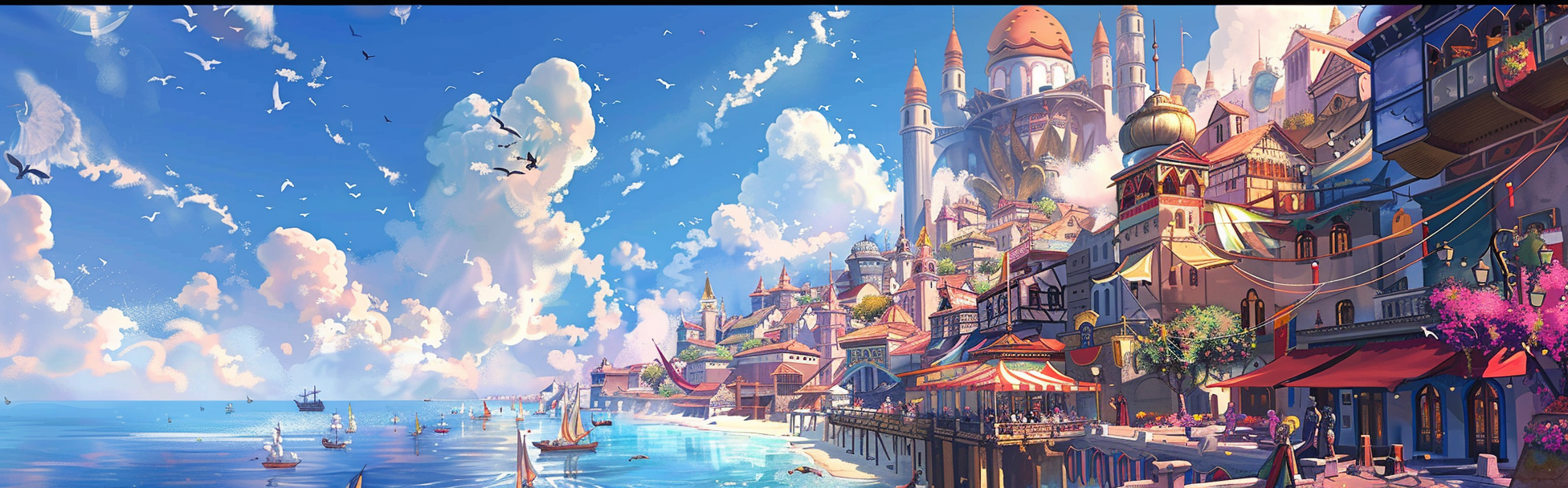
Godslost Sea
The Godslost Sea is a vast and storied expanse of water born from divine catastrophe, its basin carved when the god Taralor fell from the heavens and filled by the moonlit tears of the transformed goddess Moiren. Spanning multiple climates, from termperate coasts to the warm, tropical heart, the sea is a region of rich biodiversity, unpredictable currents, and lingering hints of ancient magic. Its shores cradle thriving cultures built atop the ruins of those drowned in the cataclysm, while sailors still speak in hushed tones of strange winds, hidden depths, and the secrest the sea refuses to surrender. To cross the Godslost is the travel through myth as much as water, where every tide carries whispers of the gods who shaped it.
Ecosystem
The Godslost Sea is an immense and complex marine ecosystem shaped by its divine originas and climatic range. Its waters support layered habitats, from cool northern kelp forests to warm tropical reefs, each hosting its own networks of predators, grazers, and scavengers that create a vibrant, interdependent web of life. The temperate rims of the sea are dominated by nutrient-rich upswellings that feed dense blooms of plankton, drawing migratory fish, seabirds, and great filter-feeding whales. In contrast, the tropical heart of the sea is defined by coral gardens, seagrass meadows, mangrove-fringed shallows, and deep pelagic zones teeming with fast moving predatos and brilliantly colored reef life.
Across the Entire basin, the sea's unusual geology, born of a god's fall, creates dramtic depths, steep drop-offs, submerged ruins, and isolated pockets of biodiversitynot found anywhere else in Elarion. Though divine residue no longer overtly shapes the water, subtle patterns of behavior, migration, and growth still carry the echo of Moiren's tears and Taralor's fury, giving the ecosystem a quiet strangeness that even seasoned sailors struggle to describe. It is a sea defined by abundance, unpredictability, and the subtle interplay between natural forces and divine influence.
Ecosystem Cycles
The ecological cycles of teh sea are driven by seasonal winds, shiftin currents, and the influence of the Equisostitial Gods, whose domains subtly shape the rhythm of the natural world. In Spring, Danaara 's season, nutrient rich waters rise from the depths, feeding explosive plankton blooms that anchor the food chain. Fish populations surge, migratory species reutnr, and many coastal creatures breed in sheltered inlets and mangrove channels.
During Summer, under Ara's blazing domain, warm waters stabalize and the tropical reefs reach their peak activity. Predators roam farther afield, schools of fishgather in vast shimmering clouds, and storms (fierce but predictable) redistribute along the sea's edges.
Autumn, guided by Daan, marks a shift toward decline and transformation. Great migrations sweep across the basin; whales and seabird follow ancestral routes, while many reef species spawn as water temperatures begin to fall. Decaying seasonal plant matter enriches coastal ecosystems, reinforcing the annual cycle of renewal and loss.
Finally, Winter, under Nar's cold and introspective gaze, brings quieter seas. The noirthern and southern waters cool significantly, pushing many species into deeper and more stable zones. Storms lessen, but wind patterns sharpen, allowing long-distnace nutrient mixing that sets the stage for the next year's surge of life. Through this cycle, predator and prey populations rise and fall in delicate balance, creating an ecosystem that is both resilient and ever-shifting, much like the sea's divine origins.
Localized Phenomena
The Veilwind is a rare and unsettling atmospheric phenomenon whispered about by sailors and scholars alike. Appearing only under a clear night sky with a bright, unobscured moon, it manifests as a pale, luminescent gale that moves in utter silence across the surface of the sea. Unlike any natural wind, the Veilwind travel against all prevailing patterns, gliding from west to east as though pulled by an unseen tide. Ships caught in tis path report an eeried stillness just before impact, a moment when sound seems to dim and the horizon blurs into a silver haze, followed by a sudden, ghostlike acceleration as the wind pushes them off theri intended course. Once it passes, the world snaps back to normal, leaving crews disorientated and compelled to check their bearings...and their memories.
Many priests and bards claim the Veilwind is a manifestation of Moiren, herself; a longering echo of the goddess's tranformation from Liora to her current domain of Moon, Night, Secrest, and Arcane Magic. Some believe it is a warning, others a guide, and a few superstitious captains insist the Veilwind reveals hidden truths to those who dare to stand at the bow and face it unblinking. Whatever its origin, all agree on one thing: the Veilwind does not appear by chance. Its passing marks nights when forgotten things stir, ancient magic resurfaces, and the boundary between the mortal sea and Moiren's shadowed influence grows thin.
Climate
The Godslost Sea spans a wide band of climates, its vast waters shaping weather patterns accros the surrounding regions. Along its northern shores, the climate is broadly temperate, with cool winds sweeping down from the north and moringin mist, rain, and gentler seasonal shifts. Farther south, the sea warms dramtically; the central expanse is unmistakably tropical, defined by humid winds, powerful storms, and abundant marine life shaped by the lingering divine energies that birthed the basin.
As the waters stretch toward the sea's southern boundary, the clim ate transitions once more into a temperate zone, though one touched by warmer currents flowing northward. These southern coasts experience mile winters, vibrant summers, and more consistent rainfall than their northern counterparts. Together, thise varied climates create a striking ecological diversity across the Godslost Sea, one of the many legacies of the cataclysm that formed it.
The currents of the sea are shaped as much by divine upheaval as by natural forces. Warm waters flow steadily northward through the sea's heart, creating strong souther-to-north surface currents that accelerate during summer months. Beneath them, older and colder undertows slide southward, remnants of the primordial basin's original chill. Along both costs, gentler littoral currents wrap the shorlines, carryling silt, seeds, and occassionally the ruins of of long-drowned cultures. Sailors swear these coastal currents "remember the fall of the gos" and are prone to sudden shifts, espcially under a full moon when Moiren's lingering influence is strongest.
The winds above the sea are equally distinctive. Broad tropical trade winds dominate its central expanse, blowing reliably from east to west and powering merchant vessels across its middle reaches. Closer to the temperate nothern adn southern shores, seasonal wind patterns become more variable: crisp northerlies arrive late autumn, while warmer southerly breezes sweep upward in spring. On rare nights, when the sky clears and the moon is bright, navigators report the appearance of the Veilwind, a plae silent gale that moves opposite of all expected patterns, believed to be a manifestion of Moiren herself guiding (or warning) those who dare cross her sea.
Fauna & Flora
The sea supports a wide range of plant life shaped by its varied climates. In the termperate northern and southern reaches, vast kelp forests thrive in the cooler waters, forming dense underwater camopies that shelter fish, crustaceans, and migratory predators. Along rocky coastlines, hardy sea mosses and stranf-grasses cling to tidal shelves, taking advantage of nutrient-rich currents stirred by the sea's unusual geography.
Within the body of the sea, its tropical heart burtst with different life. Warm shallows host sprawling beds of seagrass that feed grazing fish and sea turtles, while deeper waters are home to towering fan corals and sponges, ordinary in behvior though often mistaken for magical due to their vivid colration. Near the scatteres isalnds across the cetral sea, magrove thickets form natural breakwaters, their tangled roots providing nurseries for countless marine species.
Unique to the sea are Moonstring Kelp and Dawnglass Reeds . All of these plants would be considered non-magical, but have grown within Moiren's water long enough that, over time they have become sought after by researchers and alchemists.
The sea's fauna is both diverse and abundant. In the temperate belts, schools of silverback herring and longfin mackerel migrate seasonally, pursued by seals, porpoises, and the massive boreal wahle, a gentle filter feeder known for its hauting calls that echo across the waters at dusk. Crabs, mussels, and cold water octopi thrive along the rocky seafloor, creating reliable fisheries for coastal communities.
The tropical center of the sea teems with life: reef sharks, spotted rays, sea turtles, and colorful reef fish form intricate ecological networks around coral formations and submerged ruins alilke. Out in the open water, the powerful swordback tuna dominates as one of the fastest creatures in the sea, hunted by pods of warm-water dolphins. Also, the elusive deepwater duskwhale, a baleen whale rarely seen except when it breaches under moonlight, calls the sea home. Despite the sea's divine origins, these creatures are entirely natural, though sailors often attribute their behavior to Moiren's influence when they appear in uncanny moments.
The sea has given rise to unique fauna, as well. Whisperback Mullet , Crescent-Shell Crabs , Sablewing Skimmers , Gravetide Anemone , and Hushback Rays all live within the sea and are creatures that non-natives find incredibly intriguing.
Natural Resources
Surface communities along the shores of the sea rely heavily on its abundant marine resources, harvesting everything from fisheries to raw materials that fuel local economies. The most widespread resource is, naturally, fish, with species varying by region: silverback herring in the termperate north, swordback tuna in the tropical center, and longfin mackerel along the southern coastlines. These fisheries sustain coastal diets, support thriving salt-curing and smokehouse industries, and drive a lively trade in dried or pickled fish that reaches far inland. Shellfish, particularly mussels, scallops, and crescent-shell crabs, form another key staple, gathered from tidal flats and rocky outcrops where the regenerate quickly and reliably.
Beyond food, the sea provides communities with materials essential for daily life. Kelp and seagrass harvested from shallow water are dried and woven into rope, nets, and mats, while heartier kelp strains are boiled into nutrient-rich broths or used as agricultural fertilizer. Coastal mangrove stands offer durable, water-resistant wood prized for ship repair and dock construction. Even the sea's sand and limestone, reshaped by centuries of shifting currents, are quarried for morter and masonry. In all these ways, the Godslost Sea serves as both pantry and workshop, its natural resources sustaining the cultures that grew along its shores long after the cataclysm that birthed it.
History
1. The Divine Battle and the Fallen God:
Long ago, during an age when gods still walked the world, a colossal battle took place in the heavens. Two mighty deities clashed: Taralor, the God of War and Storms, and Liora, the Goddess of the Sun, Light, and Joy. Their conflict shook the very foundations of the cosmos, culminating in a cataclysmic event. In a final, devastating strike, Taralor fell from the heavens, his immense form crashing into the heart of a vibrant land. His impact created a massive crater, later known as the Godslost Basin.
2. The Transformation of Liora into Moiren:
Stricken with grief over the loss of Taralor—both her rival and her beloved—Liora’s sorrow transformed her. Her radiant light dimmed, and she became Moiren, the Goddess of the Moon, Night, Secrets, and Arcane Magic. Moiren descended to the mortal realm, and her sorrow was so profound that she wept for countless days and nights. Her divine tears, imbued with the essence of the moon and magic, filled the enormous crater, creating a vast sea of salt water. This new body of water was named the Godslost Sea in memory of the fallen god and the love that caused its creation.
3. The Chaos of Weather:
The death of Taralor, the God of War and Storms, and the transformation of Liora into Moiren threw the weather systems into disarray. Storms raged uncontrollably, droughts scorched the lands, and relentless floods devastated regions. The world, already reeling from the formation of the Godslost Sea, faced further destruction from these chaotic weather patterns.
4. The Birth of Danaara:
Witnessing the land being ravaged by her transformation and the death of Taralor, Moiren took a desperate and hopeful action. From the heart of the raging weather, she formed a daughter, Danaara, who would become the Goddess of Life. Danaara's creation brought a glimmer of balance to the tumultuous world.
5. The Creation of the Equisostitial Gods:
Immediately understanding that she could not control the cataclysmic forces alone, Danaara made a monumental decision. She divided her power among four new deities, now known as the Equisostitial Gods:
- Danaara , Goddess of Spring: Embodying life, growth, joy, fertility, and the earth.
- Ara, Goddess of Summer: Representing light, truth, health, and the sun.
- Daan, God of Autumn: Symbolizing death, harvest, loss, darkness, and the spirit.
- Nar, God of Winter: Governing insight, hope, divination, and the water.
Together, these gods began to tame the wild weather systems, bringing a semblance of order and rhythm to the natural world.
6. The Destruction of Cultures:
The sudden formation of the Godslost Sea and the chaotic weather were catastrophic. The deluge obliterated the burgeoning civilization of giants that had thrived in the region. Their magnificent cities, built with stone and magic, were submerged and lost to time. The giants, a proud and ancient race, were scattered. Many perished, and those who survived were forced to seek refuge in distant lands.
In addition to the giants, several other cultures that inhabited the area were destroyed. Smaller tribes and nascent kingdoms found their lands swallowed by the rising waters. The once fertile plains and rich forests were drowned, transforming the region into an underwater graveyard of lost civilizations.
7. The Legacy of the Godslost Sea:
Over the centuries, the Godslost Sea became a place of mystery and legend. Sailors and adventurers spoke of submerged ruins filled with treasures and ancient magic. Scholars and historians sought to uncover the secrets of the giants and the other lost cultures, diving into the depths of the sea in search of knowledge and artifacts.
The sea also became a sacred site for followers of Moiren, who believed that her tears imbued the waters with divine properties. Pilgrims traveled far and wide to immerse themselves in the holy waters, seeking healing, solace from loss, and blessings of magical insight.
8. Modern Times:
In the present day, the Godslost Sea remains a focal point of intrigue and danger. Its depths are still largely unexplored, guarded by powerful sea creatures, and enchanted by residual divine magic. The surrounding regions have adapted to the sea's presence, with new cultures and communities arising along its shores.
Legends persist of hidden treasures and ancient relics lying beneath the waves, waiting to be discovered by those brave enough to venture into the depths. The fallen god's memory and the grieving goddess's tears continue to echo through the ages, shaping the destiny of all who come into contact with the Godslost Sea.
Many worship the Equisostitial Gods, who ensure the balance of the seasons. They remind the world of the cycle of life, death, and rebirth and the hope that endures through it all.
"The Godslost Sea isn't merely sailed: it's survived. Her waters remember the fall of a god and her winds remember every secret Moiren ever wept. Treat her with reverence or she'll remind you why even the gods fear the deep."
~Captain Tzareven "Evan" Stonewake, Captain of the Stone's Throw

Comments
Author's Notes
Image created with MidJourney