
Glassfruit
Glassfruit is a small, hardy tree-fruit native to the volcanic islands of Eshara, found clinging to thin soil along basalt ridges and the mouths of old lava tubes. At a distance the trees look plain, with twisted dark trunks and sparse glossy leaves, but their fruit gives them away. Glassfruit hangs in tight clusters of plum-sized orbs with skins that are smooth, dark, and reflective, like smoked glass catching the light. It is a familiar sight to Esharans who live near rocky slopes and caldera edges, and is one of the most visually distinctive foods to grow from the islands’ rich but unforgiving ground.
Basic Information
Anatomy
Glassfruit grows on small, drought-tolerant trees that rarely reach more than three or four meters in height. The trunks are dark and slightly twisted, with bark that feels almost stone-smooth to the touch. Roots run shallow but wide through the thin volcanic soil, gripping cracks in basalt and old lava flows rather than pushing deep. The leaves are narrow, glossy, and a deep green, arranged in sparse clusters that let plenty of light reach the fruit. Trees often look half-starved until fruiting season, when their branches suddenly seem too heavy for their size.
The fruit itself is roughly the size and shape of a small plum, hanging in tight clusters along the outer branches. Its rind is thin and firm, dark enough to appear nearly black at a distance and polished to a natural shine. When cut open, the interior is divided into fine radial segments that run from rind to core, each segment a translucent wedge of flesh. Colors range from rich reds and ambers to greens and purples, often mingled within the same fruit. Small, dark seeds sit near the center in a loose ring, providing a natural pattern that shows clearly when the flesh is sliced thin.
Additional Information
Uses, Products & Exploitation
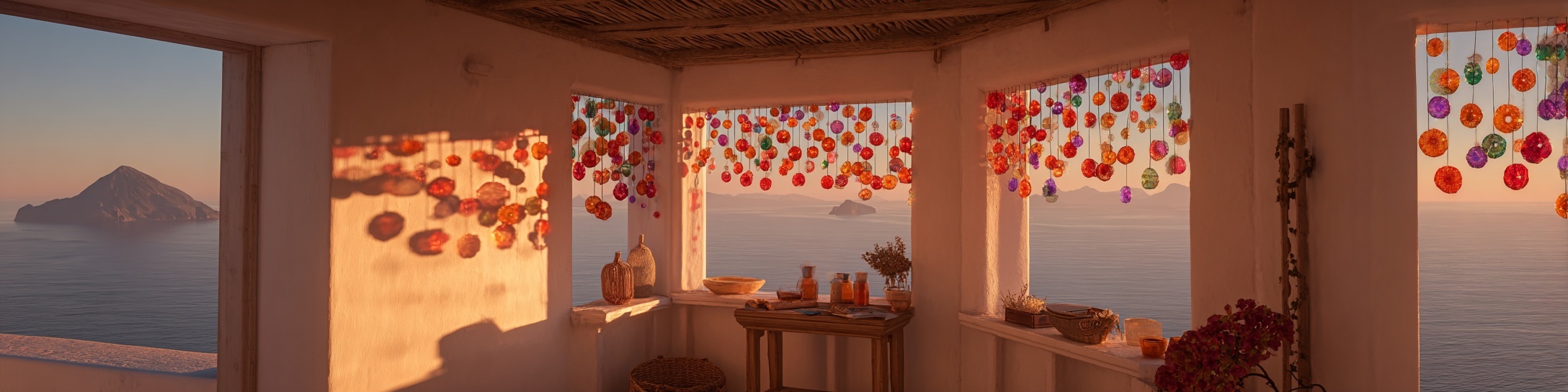
Glassfruit is eaten fresh during its brief harvest season, when its crisp, sweet tart flesh is at its best. Islanders press the fruit into vivid juice, cook it down into syrups and glazes for festival sweets, and fold it into simple home cooking wherever a splash of color and brightness is welcome. Most of the year, however, people encounter glassfruit in its preserved form. Thin slices are cut across the fruit and laid out to dry in the sun, sometimes with the outer rind brushed in syrup so that a thin ring of sugar crystallizes around the edge. The result is a translucent disk of color with a sparkling rim and tiny dark seeds near the center that resemble stars. When several of these slices are strung together and hung in a window or doorway, they catch and transform the light, and many visitors compare them to small, edible pieces of stained glass.
These dried slices serve both as festival decorations and as sweets. Children and travelers eat them straight from garlands once celebrations end, biting off the sugared rim first before finishing the center. More patient or craft-minded Esharans sometimes prepare slices for longer use. Very thin cuts are dried slowly in shade until nearly all moisture is gone, then sealed with a light oil or resin to harden them. These preserved disks are no longer food, but can be set into lanterns, small window panels, or worn as simple charms. Skilled crafters sometimes embed glassfruit slices in clear resin or lacquer to create jewelry, inlay on boxes, or small devotional panels that keep their color for many years.
By-products see quieter use. Peels and pulp left from pressing are boiled into rough syrups or fed to animals, while seeds may be dried and used as decorative inlay or counting tokens. Overharvesting is rare, since glassfruit prefers steep, rocky places that are difficult to reach, and many communities keep informal taboos against cutting trees near shrines or caldera edges. Outside Eshara, truly permanent glassfruit decorations are extremely rare. Most islanders believe that such work should remain with Esharans, and few are willing to sell the finest pieces. Yet Eshara is not a prison, and those who leave sometimes carry strands, pendants, or boxed panels with them. As a result, distant collectors and travelers occasionally encounter a single glassfruit charm or lantern in a far-off port, treated as a treasured keepsake from the Primordial Isles rather than a common trade good.
“People here in Colwyn keep asking how much the ‘jewels’ in my window are worth. I tell them they are only dried fruit, and they never believe me. Glassfruit is like that. You do not really understand it until the sun shines through.”
~ Jhauhara abn Alarid, Earth Genasi enchanter of Colwyn

Comments
Author's Notes
Image created with MidJourney
WorldEmber2025 submission