
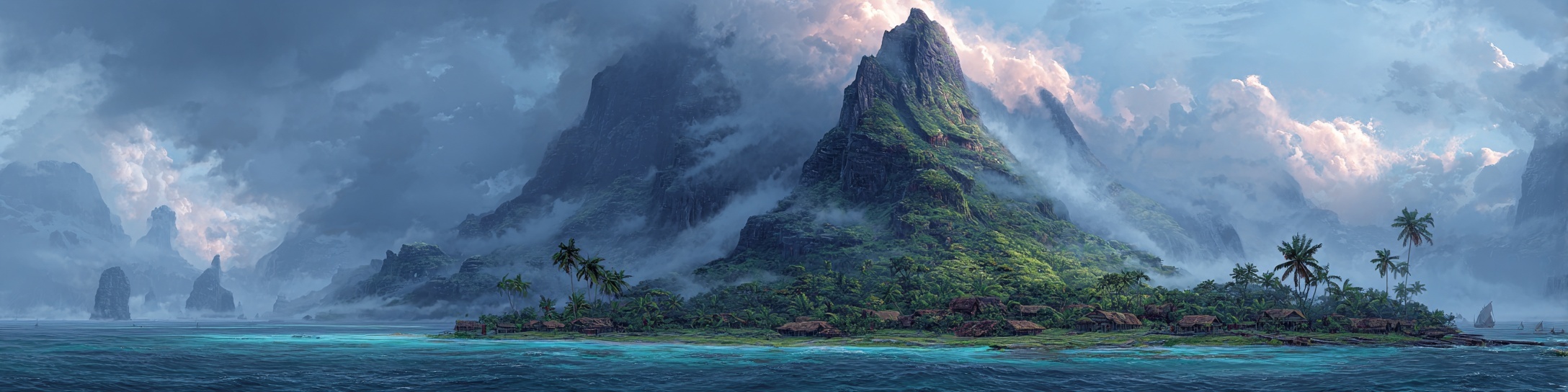
Eshara (eh-SHA-ra)
The Primordial Isles
Eshara is a scattered realm of volcanic islands rising from the heart of the Godslost Sea, a place where the world was once broken and then remade in fire. Its calderas, hot springs, and black cliffs bear the marks of both divine catastrophe and elemental will, shaped first by the fall of a god and later by the rivalries of genie lords who raised land from the depths. Today the islands appear small and self-contained, with quiet villages, misted terraces of rice and taro, and drifting trade ships that seem almost ordinary at a glance. Yet beneath that surface, old pacts, unstable planar rifts, and the lingering presence of Genasi bloodlines give Eshara a sense of watchful tension, as if the land itself remembers what it took to exist and has not entirely forgiven the sea.
Structure
The governance of Eshara is centered on a council known as the Fourfold Stewardship. This body is composed of four voting Stewards, each aligned with one of the classical elements, and a fifth nonpartisan moderator drawn from the monks of Tawāzun monastery. The Steward of Earth speaks for the land itself and is usually selected from the agricultural heart of Gavorah. This office oversees terraces, fields, settlement boundaries, quarrying, and building, and is expected to weigh every decision against its effect on soil, stone, and village life. The Steward of Water represents the coasts, harbors, fishing grounds, and seafaring families. This seat is usually filled from among those who own or manage ships, and has particular influence over docking rights, registration of vessels, and the trade that ties the islands to the wider Godslost Sea.
The Steward of Fire is most often chosen from Eshvel, where forges, hot springs, and volcanically warmed fields are part of daily life. This Steward is responsible for managing the risks and benefits of the islands’ heat, including geothermal works, the use of hot springs, and policies meant to keep volcanic activity from becoming catastrophe. By tradition, the Steward of Air is always an Air Genasi from Murāqabat al-Samā’, also known as Skywatch. This is the only seat reserved for a Genasi and it carries authority over matters of storm, high winds, aerial omens, and any reported elemental rifts in the upper air. The Air Steward rarely attends routine sessions in person and often sends written judgments in advance, but is expected to appear when the balance of the islands is in real danger.
Presiding over the Fourfold Stewardship is the Balance Seat, a monk chosen by the elders of Tawāzun monastery on Shavah. The Balance Seat does not own land or ships and holds no shares in trade, and is sworn to speak only for the stability of the isles as a whole. This monk chairs the council, sets its order of business, and guides discussion. The Balance Seat does not normally vote, but casts a deciding ballot when the four Stewards are deadlocked or when a Steward refuses to rule and the others cannot agree. Each Steward is selected by local councils and elemental communities associated with that seat and usually serves a long term, renewed by custom rather than strict law, while the Balance Seat serves until death or voluntary retirement and always names a successor within the monastery.
In practice, the Fourfold Stewardship concerns itself with matters that affect more than one island. It negotiates treaties and trade agreements with foreign powers, approves or forbids large projects such as new harbors or deep mines, and sets island-wide taboos regarding overfishing, logging, or the use of volatile magic. Village elders and local councils still handle most daily disputes, but they are expected to respect the rulings of the Fourfold Council on anything that might disturb the wider balance of land, sea, fire, and sky. The result is a system that feels informal to outsiders yet is tightly woven into Eshara’s elemental identity, with spiritual authority, practical concerns, and old oaths all meeting in the same hall.
Beneath the Fourfold Stewardship, each island is also served by a local leader who functions much like a mayor. These mayors are chosen by island councils or village elders and are expected to handle the steady stream of lesser concerns that should not trouble a Steward. They oversee things such as maintenance of roads and irrigation channels, minor disputes over grazing or fishing spots, petty crime, dock fees on small boats, and the organization of local festivals or island watches. On most matters they act with broad autonomy, but they are expected to align their decisions with the wider rulings of the Fourfold Stewardship and to consult the appropriate Steward if a local problem might grow into something larger. In practice, visitors and traders deal with mayors far more often than with Stewards, while islanders see them as the first stop for complaints, petitions, and everyday governance.
Culture
Life in Eshara is shaped by the sense that the islands exist in a place that should have been lost. Most Esharans grow up with the idea that the proper goal of any choice is balance rather than victory. People speak about problems in terms of how they lean toward earth, water, fire, or air, and whether a decision will leave the islands more stable or more fragile. Ambitious traders, reckless mages, and loud reformers all meet the same quiet suspicion if they seem to push one element too far. Around family tables and in harborside taverns, a slow, practical consensus is valued more highly than bold plans.
Reverence is usually directed toward place rather than person. Shrines tend to form around particular stones, hot springs, pools, or trees, and offerings are simple. Food, rope, polished rock, or small handmade items are given to thank the island or the bay rather than a distant god. Priests and druids are respected, but everyday speech is more likely to mention “the mountain” or “the sea” than to invoke a formal divine name. To “offend the island” is a phrase that carries real weight, and people are more careful about that than they are about insulting any single priest.
Communities are small and tightly woven. Hospitality is expected, but not automatic. Strangers are fed and sheltered only after someone has looked them over and decided they are not likely to burn fields, foul water, or bring dangerous attention to a harbor. Esharans are polite but direct with outsiders. They do not hesitate to say no when a request feels unsafe and they rarely bother to soften the word. Gossip is common and practical. Knowing who cuts wood without asking, who overfishes, or who toys with volatile magic is treated as shared maintenance of the community rather than as idle talk.
The islands show a quiet love of color and light that does not tip into extravagance. Houses and boats are usually simple in form, but trims, beams, and eaves often carry painted motifs, bright tassels, or strings of objects that catch the sun. Dried slices of glassfruit, shells, polished fragments of stone, and small mirrors are common decorations, especially during festivals. At those times, whole streets may be hung with translucent garlands and lanterns that scatter color across whitewashed walls, after which most of the decorations are eaten, reused, or taken down for storage.
Elemental heritage is present without dominating daily life. Genasi are uncommon, but well enough known that most people have heard of someone whose blood runs a little hotter, whose skin bears unusual colors, or whose moods seem to stir wind or water. They are not automatically placed in charge, but their voices are given weight when storms, tremors, fires, or strange tides are at issue. Families tell stories about long ago encounters with geniekind that left such marks in their lines. This produces a mix of pride and caution. People are glad to be reminded of that power, but prefer that it remain quiet.
That caution shows in a web of small customs. The phrase “I wish” is quietly avoided in everyday language. People say “It would be good if,” “I would like,” or “If the island is kind” instead. If someone slips and says “I wish” aloud, it is common to tap wood or stone three times or to add a quick “Let no ear hear it,” half in jest and half in habit. Many Esharans prefer not to name the genie lords directly and use circumlocutions such as “those above the clouds” or “those below the stone.” Open flames in unattended rooms are usually covered, and it is common to pinch out a lamp with damp fingers while murmuring a short phrase that leaves the house to itself. Generous favors are rarely accepted without some token of payment. Even a single coin, a dried slice of glassfruit, or a length of cord may be offered in return, with the saying that nothing taken entirely for free ends well. These practices are not formal law, but together they show a people who remember how violently their home was made and who prefer to live in ways that do not invite that kind of attention again.
History
Eshara sits in the middle of the Godslost Sea, a basin that was once a mountain range until a god fell and died there. When the god’s divine mother wept, her tears filled the wound in the world, drowning the high peaks and wiping out the giants and mountain folk who lived there. The newborn sea drew the attention of the elemental powers, especially the Dao and the Marid, who fought for influence over this raw, remade place. The Dao, later joined by the Efreet, clawed land back from the depths by raising volcanic islands, while the Djinn mostly watched from the margins. In the process, their upheavals shattered an ancient sea-elven coral library beneath the waves, an act the sea-elves remember as a cultural cataclysm and the main reason they have avoided the region ever since.
Over time, the genie lords’ focus wandered elsewhere, but they did not leave Eshara empty. They abandoned (or “placed”) their Genasi descendants here as quiet custodians and anchors to the elemental planes. The volcanic islands cooled, calderas filled with lakes and villages, and places like Gavorah, Shavah, and Eshvel slowly became home to mortals rather than pawns in a planar turf war. The Air Genasi bastion of Murāqabat al-Samā’ (Skywatch) and the Tawāzun monastery’s Fourfold Breath tradition preserve clear traces of that genie legacy, while unstable rifts and occasional planar bleed-through keep the past from staying properly buried. In the present day, Eshara is a small but self-sufficient realm and a minor trade stop in the Godslost Sea, important not because of wealth or empire, but because it quietly sits atop very old, very unfinished business between the elemental powers and the memory of a dead god.
Demography and Population
While there is a higher percentage of elemental Genasi in Eshara than in most realms, they are by no means common. Most islanders are otherwise typical humanoids, but Genasi bloodlines have left their mark. Descendants often have striking features such as flame-red hair, jewel-bright eyes, or unusually vivid skin tones. These traits hint at elemental heritage without straying beyond what most would still consider natural for mortal folk.
Territories
Eshara consists of five islands of varying size, all shaped in some way by elemental influence and volcanic history. The largest is Gavorah, home to a vast caldera, twin lakes, and the heart of the realm’s agriculture. Shavah is a quieter, more contemplative island, known for its monastery and orchards. Eshvel is warmer and more geothermally active, with hot springs and rich, spice-bearing soil. Ubharnā is the youngest island, still geologically fresh, with tough pioneering grasses and experimental fields. The fifth and smallest isle, Khamisah, is only lightly settled and is often treated as a frontier, a place for those willing to push into uncertain, half-tamed land under the distant regard of Skywatch.
Religion
Religion exists in Eshara, but formal worship is often overshadowed by a deep reverence for the islands themselves and the waters surrounding them. Many islanders see the land, sea, and sky as living forces that must be honored if life is to remain balanced. As a result, druidic practice is more common than traditional temple-based religion. Priests certainly exist, but druids, elemental adepts, and local spirit-keepers tend to wield more day-to-day influence than any organized priesthood.
Foreign Relations
Eshara maintains generally good relations with Colwyn, Risland, and even the Barrens, as long as trade remains profitable and raiding is kept at bay. Their relationship with Amfa’atu is more complicated. The volcanic upheavals that formed Eshara destroyed one of the Pearl Elves’ ancient coral libraries, leaving behind stretches of bleached, lifeless reef. The Spell-Kings of Amfa’atu know this history only as distant lore, but their Pearl Elven allies remember it keenly. As a result, the Spell-Kings keep Eshara at arm’s length. They are willing to trade through carefully controlled channels, but reluctant to extend deeper trust.
Agriculture & Industry
Gavorah, the largest island, is the center of staple agriculture. Rice and taro root are grown in and around the caldera, while two elementally touched crops, Cloud Millet and Ashbeans, are also cultivated here. Cloud Millet thrives in the mist-laden heights of the island’s mountains, while Ashbeans grow best in soil recently marked by ashfall, helping reclaim fields after eruptions.
Shavah is home to quiet orchards of citrus and breadfruit. The island’s monastery also cultivates Stormleaf Tea, an elementally infused tea leaf that grows only on Shavah’s slopes and is prized for its sharp, invigorating brew.
Eshvel is known for its spicy peppers, ginger, and turmeric. Its geothermally warmed soils also nourish Emberroot and Lava Mango , both infused plants with subtle fire-aspected properties that make them local specialties.
Ubharnā, the second youngest island, has no unique export yet, but Ashbeans are being established there and the island’s hardy grasses are tough and sturdy, often harvested and woven into strong rope and matting.
Across all the islands, Glassfruit can be found growing near lava tubes and basalt ridges. Its skin is thin and glossy like dark glass and its flesh is bright and jewel-toned. When sliced thin and sun-dried, the pieces look like colorful panes of stained glass, and are especially popular during festivals and religious observances.
Trade & Transport
Eshara’s reach into the wider world is modest but steady. There is one major trade ship, the Stone’s Throw , which runs goods between Eshara, Colwyn, and the Barrens under the command of Captain Tzareven Stonewake, an Earth Genasi whose stubborn refusal to sink has become part of dockside rumor.
A second notable vessel, the Coral Oath , sails only between Eshara and Amfa’atu and never to the Barrens. Captained by Merel Tideglass, a half Pearl Elf, the Coral Oath operates under a sacred agreement with the Sea-Elves and is one of the few surface ships they trust to pass through their waters without harassment. Between these two keels and a scattering of smaller coastal craft, Eshara maintains its trade links while remaining very much its own, slightly secretive corner of the Godslost Sea.
Mythology & Lore
Esharans tell their stories in layers. Some speak of great powers that once fought over the newborn sea. Others remember smaller tales in which careless words, uncovered lights, or gifts taken too easily draw unseen attention. Together these stories teach that the world is listening and that something old still watches from beneath the waves and behind the wind.
One of the oldest cycles speaks of the Four Courts that gathered over the drowned range after the god fell. In these stories, four great courts of stone, sea, flame, and cloud descended upon the basin and fought to claim it. They raised islands, deepened trenches, and hurled storms at one another until the air itself grew tired of their noise. Some tellings say the gods forced them to stop. Others claim the courts withdrew in disgust once there was nothing left to win. Esharans like to say that the Fourfold Stewardship is a quieter reflection of those courts, a way for mortals to sit where the great ones once raged and to keep what remains from being broken again.
There are also stories of the coral that remembers. In these tales, long before anyone now living, there were reefs in the Godslost Sea that could hear prayers, bargains, and songs and keep them all. No one can point to such coral today. Whatever truly grew there was shattered or buried when the islands rose and the sea settled. What remains are certain patches of water that feel wrong. Fish avoid them, waves lie strangely flat even in rough weather, and sound seems to fall away instead of carrying. Sailors say that if you linger too long in those quiet places, you may feel your own thoughts slipping, or sense that something just beneath the surface is listening for one more secret to keep.
Many smaller myths warn against speaking desire too plainly or inviting strange company into one’s home. One oft told tale remembers a household that loved its ever burning lamp. They left the flame uncovered in an inner room and took pride in never letting it die. One night, something unseen sat in the light and began to listen. In the stories, small wishes and bitter mutterings in that room started coming true in ways that soured each joy. Over time the family turned on itself until a wandering monk, or in some versions a druid, snuffed the lamp with wet fingers and carried it out into the sea. From that story comes the habit of covering unattended flames and the little phrases people murmur when they pinch a light out before leaving a house empty.
Another common warning tells of the gift without payment. A stranger once came to an island and offered great works for nothing. Fields grew thick, harbors deepened, storms parted around the headlands, and every plea was met with a simple “There is no price.” Years later, the stranger returned to collect. Some say he claimed the island’s children, others that he demanded the right to speak law or to choose who might leave and who must stay. The island nearly tore itself apart trying to escape that bargain. The details change with each telling, but they always end with the same saying, now woven into everyday life. Nothing taken for free ends well.
Not all stories are frightening. Some speak more gently of the Genasi and of those touched by elemental blood. One tale claims that when the great courts withdrew from the basin, a few lesser spirits lingered. They had grown fond of the new islands and of the mortals struggling to live there. Rather than return to their lords, they wove themselves into human lines, trading eternity for children and for the chance to see how the story of the isles would unfold. Children born with ember bright eyes, cloud pale hair, or skin that seems to answer the sea are said to carry a memory of those courts, not their chains. In this telling, the Genasi are not warnings but reminders. They show that the powers which once fought over Eshara can also choose to remain and watch more quietly, and that mortals are never completely alone in the place where gods once fell.
Political Influence & Intrigue
Political life in Eshara appears calm at first glance, but much of it is a quiet contest over how to keep the islands livable without inviting new disaster. The Fourfold Stewardship sits at the center of this, with the Stewards of Earth, Water, Fire, and Air arguing in careful, formal language over harbors, terraces, hot spring works, and storm warnings. Earth tends to favor slow, conservative decisions that protect fields and villages. Water pushes for deeper docks, more ships, and broader trade. Fire encourages projects that tap vents and heat for profit, and Air sends written judgments from Skywatch that can halt a plan with a single sentence. Island mayors and local councils carry this tension down into everyday life. They decide who receives building permission, choice plots, or docking space, and are much easier to sway than the Stewards. Families, merchants, and petty smugglers all try to turn those small decisions to their advantage, knowing that if something grows too large it will eventually reach the Fourfold hall.
Outside powers add another layer of subtle pressure. Colwyn’s merchants court the Steward of Water and friendly mayors, offering expertise and investment that gradually pull certain harbors into Colwyn’s orbit. The Barrens send rougher visitors who want safe anchorage and repairs so long as no one asks too many questions about their last port of call. Esharans argue among themselves over whether it is wiser to refuse such ships or to let them in under strict conditions, hoping that trouble will stay outside their own waters. Trade with Amfa’atu remains narrow and formal, filtered through the Coral Oath and long memories on the Pearl Elven side. Many islanders can sense that something old and unspoken lies behind that tension, even if they no longer know its details, and it makes them cautious about any proposal that would tie Eshara too closely to the Spell Kings.
Beneath all of this, powers that no one elected still pay attention to the isles. The Dao who first raised land from the drowned range is whispered of in a few half remembered tales, but in truth he has never entirely let go of Eshara. As a member of the Obsidian Order, he sees the islands as a convenient anchor and resource. Through mortal agents, bound elementals, and the occasional dream, he can nudge a mayor here, a Steward there, or arrange for certain mines, tunnels, and elemental crops to be developed while others are quietly discouraged. Other genie kind also glance in from time to time, encouraging or frustrating plans that strain their favored element. To Esharans, these influences appear as unlikely strokes of luck, sudden failures of once solid schemes, or a sense that balance is slipping for reasons no one can quite name. The monks of Tawāzun and the Genasi of Skywatch are often the first to feel that unseen hand, even if they cannot yet say whose it is or what game is being played.


Comments
Author's Notes
Image created with MidJourney