
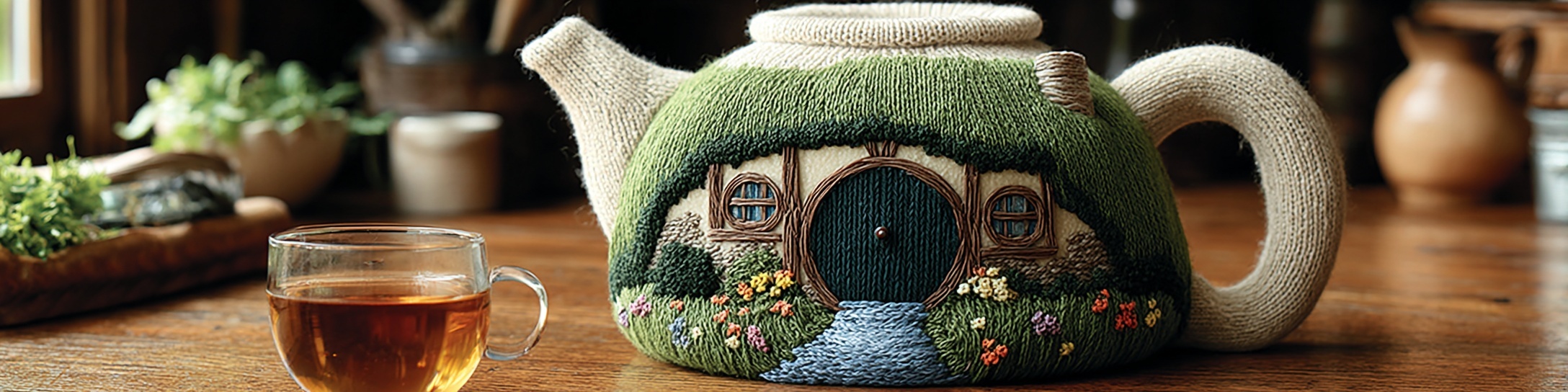
Cyrollalee's Household Tea Cozy
In halfling households, the tea cozy is remembered not as a relic or a treasure, but as a kindness. Once common in the shires west of Colwyn, these softly stitched coverings were placed over steaming pots to keep tea warm and tempers warmer still. Mothers recall them from half-remembered childhoods, priestesses mention them in old hymns without explanation, and grandmothers insist that tea tasted better when brewed beneath proper cloth. Few now recall who first made them, fewer still why their stitching grew more intricate over time, and almost none remember that the cozies were ever more than comfort woven into wool. Yet those that survive carry with them a hush that settles over a room, as though the house itself remembers being cared for.
Mechanics & Inner Workings
Despite their reputation as simple household items, Cyrollalee’s tea cozies follow a precise and stubbornly traditional method of use. Water must first be brought to a proper boil, after which dried leaves or other steeping ingredients are placed within the pot. The cozy is then drawn over the vessel, conforming itself without strain to any reasonably sized teapot. Only once the heated water is poured does the magic take hold, gently infusing the steeping tea with subtle enchantment tied to the nature of the chosen ingredient.
These effects are neither forced nor dramatic. They emerge during the steeping itself, carried in warmth, scent, and shared quiet, and are passed along to any who drink from the pot. The cozy can only perform this infusion once each day, its magic settling and renewing with the next sunrise. Attempts to steep multiple ingredients at once do not strengthen or blend the effects; instead, the magic withdraws entirely, rendering the cozy inert until it has had time to rest. In this, as in all things attributed to Cyrollalee, comfort is offered freely, but never hurried or made to compete.
Among halfling families who still remember the tea cozies, their use is governed less by instruction and more by “what everyone knows.” It is said that a cozy must never be rushed, as hurried hands “confuse the cloth.” Many insist that the water should be poured only after a quiet moment has passed, lest the tea come out thin or oddly bitter. Combining herbs is widely discouraged, not because of any understood consequence, but because “the cozy won’t know which kindness you’re asking for,” a notion often accompanied by a knowing nod and no further explanation.
It is also believed that a cozy should only be used once in a day so it does not “tire,” and that leaving it in sunlight helps it “remember what it’s for.” Some households claim that lending a cozy without first sharing a cup dulls its warmth for weeks, while others maintain that a cozy works best when the brewer is calm, well-fed, and thinking fondly of the people who will drink the tea. None of these rules are taught formally, and many contradict one another, but they are followed with remarkable consistency, passed along as habits rather than truths, and defended with the unwavering confidence of generations who know that the tea always tastes better when made properly, even if no one can quite say why.
So deeply ingrained are these habits that many halflings learn them long before they ever learn to brew tea themselves. In many households, the “rules” of the cozy survive not as instruction, but as a simple children’s rhyme, sung without thought to its meaning and remembered long after its purpose has been forgotten.
Boil it bright and pour it slow,
One good leaf is all you know.
Let it rest and let it be,
Kind tea comes to you and me.
Mix it not and rush it never,
Sun will wake the cloth again.
Share the cup and share the cheer,
Warm hearts stay the whole day clear.
“Oh! Look at the embroidery on that cozy—she’s been busy. Bet her whole house smells like stories and lemon balm by now...”
~ overheard on a busy street from below eye level...

Comments