
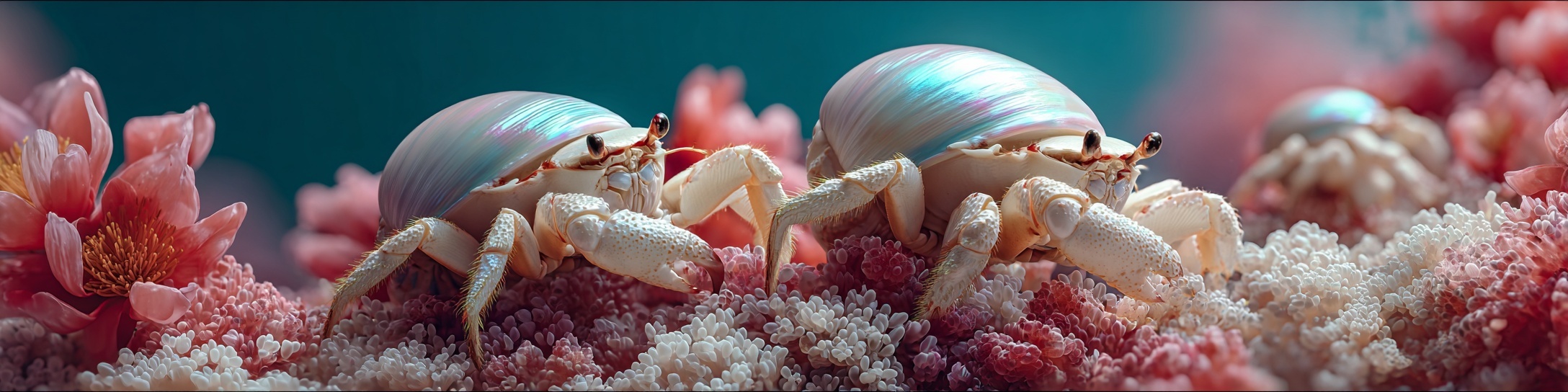
Crescent-Shell Crabs
Crescent-Shell Crabs are small, agile crustaceans found throughout the shallow reefs of the Godslost Sea and sometimes on the rocks of its shores, easily recognized by their distinctive half-moon carapaces that shimmer like polished bone under shifting light. They move in quick, sweeping arcs that mimic the curve of their shells, giving the impression of tiny crescents gliding across coral and sand. Though often overlooked by casual travelers, these crabs play an important role in the reef ecosystem by clearing algae, aerating sediment, and tending the surfaces of coral structures with surprising delicacy. Their presence is considered a sign of a healthy reef and a stable current, and many Pearl Elves regard them with quiet affection as the sea’s gentle caretakers.
Basic Information
Anatomy
Crescent-Shell Crabs take their name from their distinctive carapace, which forms a smooth, arcing half-moon shape that tapers to fine points at either end. The shell is thin but surprisingly resilient, made of layered mineral deposits that create a natural iridescence resembling mother-of-pearl when caught by shifting light. Their bodies are compact and lightly segmented, allowing them to slip easily into narrow crevices within the reef. Each crab has six slender legs tipped with soft gripping pads rather than sharp points, an adaptation that lets them move across delicate coral without causing damage. Their paired fore-claws are small and precise, shaped less for defense and more for scraping algae, grooming coral surfaces, and manipulating bits of detritus. Crescent-Shell Crabs also possess two luminous sensory spots near the base of their shell that respond to changes in current and vibration. These faint glows pulse softly when the crabs are active, giving them a ghostlike shimmer as they move through the reefs at dawn and dusk.
Additional Information
Uses, Products & Exploitation
Crescent-Shell Crabs are not heavily exploited, yet they provide several subtle but valued resources to those who understand their life cycle. When the crabs molt, their discarded crescent-shaped shells wash into quiet pockets of the reef where Pearl Elves collect them for use in delicate inlay work or as components in low-impact alchemical mixtures. These shed shells retain a faint iridescence and a natural resonance with water currents, making them ideal for crafting tuning beads used in current-reading tools and ceremonial instruments. Some reefwardens also use powdered shell as a mild abrasive for maintaining coral gardens, since it cleans without harming living structures. Harvesting live crabs is rare and frowned upon because the species plays an essential role in reef upkeep. Communities that take more than naturally shed by-products often find their coral health declining, a consequence that has made overexploitation both culturally taboo and ecologically unthinkable.
“The little moon crabs? I like 'em. They don’t pinch hard and they clean the rocks where I sit. Sometimes they line up in a curve just like a smile. I hear they’re important, but I just think the sea would look lonelier without 'em.”
— Jory, dockside errand-runner in Colwyn

Comments
Author's Notes
Image created with MidJourney
WorldEmber2025 submission