
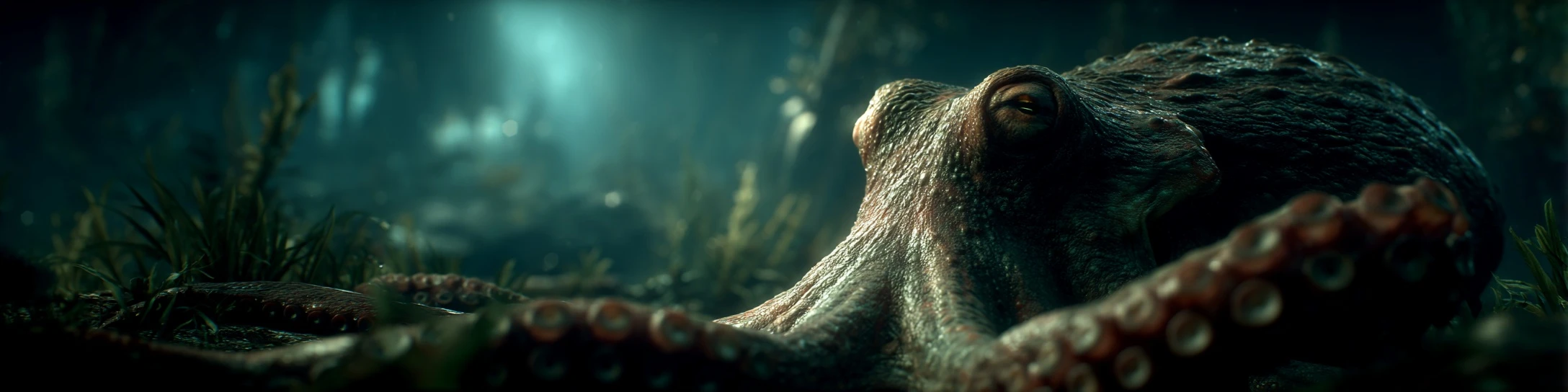
Cephari (seh-FAH-ree)
The Cephari are a little-known species of the deep Godslost Sea: sentient octopi whose minds move in patterns and pulses rather than lines and words. To most sailors and scholars they are nothing more than clever beasts, glimpsed as shadows slipping from reef to trench, but those few who have truly met their gaze speak of an unsettling, deliberate intelligence watching from behind unblinking eyes. The Cephari do not build cities, raise banners, or trade in coin; they weave memory into ink and stone, speak in ripples of color across their skin, and concern themselves less with individual lives than with the great, slow patterns of current, storm, and magic that shape the sea.
Cephari resemble large octopi, with soft, boneless bodies, a rounded mantle, and eight highly flexible arms lined with powerful suckers. Most adults range in size from a small dog up to a rowboat, though exceptionally old individuals can grow larger. Their skin can shift rapidly in color and texture, from smooth and pale to dark, mottled, and spined, and they use this both for camouflage and for communication. Their eyes are large and unblinking, set to either side of the mantle, and give them an unsettling, sideways stare to most humanoids. Cephari are most often found in complex terrain such as coral reefs, wreck-strewn seafloors, and trench walls, where there are many hollows, overhangs, and currents to shape. Individually they live only a few decades at most, like ordinary octopi, but their influence persists much longer in the memory-knots and coral patterns they leave behind.
Naming Traditions
Unisex names
To the Cephari, the idea of a fixed, spoken name is as strange and clumsy as trying to tie a knot in water. They do not speak in mouths and syllables, and they do not seem to think of themselves as discrete, label-worthy units the way most humanoids do. Instead of personal names, they rely on shifting patterns of color, texture, posture, and movement that identify context more than individuality.
When two Cephari recognize one another, they do not “say” each other’s names. They replay a brief signature pattern: a burst of color along one arm, a pulse of texture across the mantle, a distinctive swirl of ink. This sequence is less a word than a remembered impression associated with that other mind: how it moves, what kind of problems it tends to solve, which “constellations” of memory-knots it frequents. Over time, these signatures evolve as circumstances change. A Cephari that once used a pattern meaning “quick-strike hunter in the shallows” may shift to something closer to “slow watcher of the trench wall” after age or injury.
These signatures are not universal names. Different observers may use slightly different patterns for the same individual, depending on what they consider most salient: the Cephari’s hunting style, a distinctive scar, the particular way they shape ink when tending memory-knots. Even the individual in question may respond to multiple signatures without preference. To ask a Cephari “what is your name?” in a humanoid sense is to pose a malformed question; at best, the Cephari might answer with whatever pattern currently feels most true to its role in the surrounding currents.
Gender plays little part in this system. Like their lesser kin, Cephari have biological sexes and complex mating behaviors, but these matter intensely only during brief windows of courtship, spawning, and egg-tending. During such periods, Cephari may temporarily emphasize patterns that signal readiness, fertility, or parental role, but these are states, not identities. Once the eggs are dispersed and the work is done, those patterns fade, replaced by others more relevant to hunting, watching, or shaping memory. There are no stable, gendered “names” as humanoids would understand them, and no sign that Cephari attach enduring social roles or expectations to sex.
Most spoken “names” for individual Cephari therefore come from outsiders. Pearl Elves and Spell Kings who have dealt with them more than once resort to descriptive labels in their own tongues: Old Spiral, Tide-Ink, Many-Scars, Watcher-Below. These words are conveniences for archivists and storytellers, not translations of anything the Cephari actually use among themselves. To the Cephari, identity is not a sound but a pattern: something you enact in color and motion for as long as it fits, then abandon whenever the sea changes shape around you.
Culture
Major language groups and dialects
Despite their profound intelligence, the Cephari are not known to speak in any audible tongue of their own. They have no words in Trade-Tongue, no ancient script recorded on stone, and no translators who can render their thoughts into neat, linear sentences. Instead, they move through a dense web of communication so alien that most scholars can only point at it and say, there is something happening here, before admitting their ignorance.
Individually, Cephari demonstrate a startling talent for understanding the spoken languages around them. Those that dwell near Pearl Elf enclaves, triton patrol routes, or the caverns of genasi and dragons often show clear comprehension of Common, Aquan, and other regional tongues. They respond appropriately to complex requests, recognize names and place-words, and even appear to pick up on tone and idiom. Yet they almost never attempt to reproduce these sounds. Their bodies are capable of faint clicks and water-jet whistles, but they seem to disdain such crude, linear signaling in favor of the subtler channels their physiology affords.
Among their own kind, Cephari communicate through a dizzying combination of color, texture, posture, ink, and water-flow. Bands of pigment surge and fade across their skin in intricate patterns; the mantle ripples from smooth to rough to spined; arms coil and uncoil in precise, repeating configurations. Jets of water flick silt into distinct swirls, while carefully controlled bursts of ink form clouds whose shape and dissolution appear meaningful to watching Cephari. These displays layer atop one another in rapid succession, with different arms sometimes “saying” different things at once. To an outsider, this is like witnessing half a dozen conversations, diagrams, and emotional tones all overlaid in a single moment.
No living sapient race is known to have truly cracked this code. Pearl Elf Coral Keepers and a handful of long-lived druids and mages all agree that Cephari signaling is structured rather than random: patterns repeat in similar contexts, change predictably with mood, and synchronize eerily during the rare gatherings outsiders call Choirs. But attempts to map these signals to anything resembling words, grammar, or dialects have all failed. At best, non-Cephari can guess at the broadest strokes: agitation, curiosity, warning, invitation. Everything more subtle vanishes into the storm of color and motion.
Among the vanishingly small number of people who even accept the Cephari as sapient, there is no real consensus on how to describe their communication at all. A few cautious writers refer to a single Cephari “language” for lack of a better term, but all admit this is little more than a convenient fiction used in their notes. Any finer distinctions – multiple tongues, regional styles, or true dialects – are pure speculation. If such divisions exist, they are layered so deeply into pattern and perception that no outsider has yet recognized them, and the Cephari themselves show no interest in slowing their thoughts down long enough to explain.
Culture and cultural heritage
For the Cephari, what others might call “culture” is less a matter of laws and monuments and more a matter of patterns that refuse to die. It exists in the way they arrange stone and shell around their dens, in the ink-clouds they shape and disperse, in the quiet maintenance of memory-knots along reef walls and trench floors. Individually, Cephari live brief, intense lives by humanoid standards, but they are born into seascapes already marked by the decisions of others. A young Cephari learns not from elders lecturing in words, but from inherited arrangements: spirals of shell, carefully tended scars in the rock, recurring mosaics of bone and coral that encode experiences it can replay through touch and imitation. Where humans inherit stories and laws, Cephari inherit configurations.
This pattern-based heritage is their closest analogue to history. When a Cephari settles in a region, it does not merely claim a den; it adopts a portion of the ongoing pattern. It will revisit old memory-knots, edit them, add new branches of ink and stone, or sometimes deliberately erase parts that no longer match the present currents. Thus a single reef-face can hold layered “chapters” of Cephari experience, each generation reinterpreting what came before without ever reducing it to a linear chronicle. To the rare outsider who manages to recognize these sites for what they are, they resemble living palimpsests: archives written in geometry and texture instead of script.
Nowhere is this more evident than near the great Coral Archives of the Pearl Elves. The elves believe these living reefs to be their own sacred libraries, grown and tended over ages by careful ritual. The Cephari see something subtler: a vast, finely structured surface begging to be used. Those Cephari who dwell within reach of an Archive quietly thread their own patterns into its growth, guiding polyps with touch and ink so that new coral branches form in very specific angles, densities, and spirals. To Pearl Elf readers, these additions appear as nothing more than natural irregularities or the faint imprint of older offerings. To the Cephari, they are an entire second text: a submerged stratum of generational knowledge riding beneath the more obvious elven record. Over centuries, this has created a hidden Cephari heritage layered into reefs the elves think they understand perfectly.
The everyday habits of Cephari reveal a culture that prizes cunning, flexibility, and novelty over any notion of rank. Like their lesser kin, they are superb problem-solvers and tool-users, known to stack stones as shields, repurpose shells, and rearrange debris to control access to their lairs or reshape hunting grounds1. They engage in what looks to outsiders very much like play: repeatedly batting objects through jets of water, passing items from arm to arm, or inventing new ways to skirt the edges of danger without quite touching it.2 Among the Cephari, such behavior is not idle amusement but a respected way of probing what the sea will allow. A Cephari that consistently devises unexpected solutions to difficult conditions will draw the quiet attention of others, its signature patterns copied or echoed in small ways, the closest thing they seem to have to admiration.
Socially, their culture is situational rather than stable. Most of the time, Cephari behave as solitary thinkers sharing a landscape: aware of each other, sometimes cooperating at a hunting ground or memory-knot, but just as ready to slip back into solitude. What outsiders call Constellations, Observatories, and Choirs amount to cultural events, not permanent institutions: recurring patterns of gathering, observation, and synchronized display that arise where currents, prey, and magic make them meaningful, then vanish without lament when the pattern no longer fits. There are no festivals marked on a calendar, no sacred dates, only moments when the sea’s behavior demands many minds attend at once. Heritage, for the Cephari, lives in those recurring shapes: not a line of names recited through generations, but a seascape slowly accumulating thought.
Shared customary codes and values
A handful of careful observers argue that the Cephari do share something like customary codes and values, though nothing is written, spoken, or consciously taught in the way humanoids understand such things. What little can be inferred comes from watching the choices they repeat across generations: which patterns they preserve, which they abandon, and what they are willing to risk or spare.
The first and most obvious value is curiosity expressed as experimentation. Cephari are relentless problem-solvers and tinkerers, forever testing objects, flows, and boundaries: blocking a den entrance with stones, then rearranging them; redirecting currents with piled debris; carrying tools and shells long distances for possible future use.3 They repeatedly engage in what looks like play, batting objects through jets of water or cycling them from arm to arm simply to see what happens.4 To a Cephari, a mind that stops testing the world has effectively stopped thinking. Individuals that continually find novel solutions to difficult conditions tend to have their patterns imitated in small ways by others, suggesting a quiet, unspoken esteem for ingenuity and adaptive flair.
Second, there is a strong, near-universal taboo against careless disruption of patterns that are recognizably “worked”. Cephari will casually tear apart abandoned dens or scatter natural rockfalls, but they are markedly cautious around memory-knots: arrangements of shell, bone, and carved stone that bear the clear signs of deliberate labor. Even when they alter these sites, they do so incrementally, folding new configurations into old ones rather than obliterating them. Near Pearl Elven Coral Archives this restraint intensifies. Cephari that embed their own subtle patterns into the living coral rarely disturb existing elven contributions more than necessary, as if some deep instinct warns that erasing another’s record damages the larger experiment of the sea. To break a shaped pattern without cause is one of the few acts that reliably provokes hostile responses from nearby Cephari, even those that usually ignore each other.
A third shared value might be called non-possession of what moves, coupled with intense attachment to what endures. Cephari show little concept of ownership over prey, tools, or even dens; they will abandon a carefully built shelter without hesitation if conditions change, and do not seem offended when others repurpose their former constructions. By contrast, they treat stable landscape features and long-lived archives with almost ritual caution. The configuration of a favored trench wall, the precise branching of a coral ridge, the layout of a long-used memory-knot: these are things they will defend, adjust, and revisit over many lifetimes. From this, some scholars propose that the Cephari do not value things at all, only relationships between things: currents, angles, intervals, and sequences that can be read and rewritten.
Finally, interactions with other sapient species hint at a loose code of measured reciprocity. Cephari do not show anything like humanoid notions of obligation or gratitude, but they do appear to keep track of how often another mind disturbs or maintains a pattern they care about. A ship that merely passes overhead becomes part of the background; a vessel that regularly dumps waste or anchors in a way that collapses memory-knots will find itself plagued by “accidents” as tools go missing, ropes fray, or guiding lights mysteriously fail. Conversely, individuals who consistently avoid damaging certain reefs or who assist in restoring a disrupted configuration sometimes receive inexplicable aid: a Cephari redirecting a predator at a crucial moment, or leaving a useful object where it is most likely to be found. There are no promises, no oaths, only the quiet balancing of a ledger written in currents and consequences.
Whether the Cephari themselves would recognize any of this as “custom,” or simply as the obvious way to behave in a thinking sea, is impossible to say. To them, these values are not rules but habits the water has worn into their minds: the natural result of many arms, over many years, testing what can and cannot be done without tearing the pattern apart.
Average technological level
From a humanoid perspective, the Cephari have no technology at all. They do not smelt metals, knap stone tools, weave nets, or build enduring devices of any kind. They leave behind no worked artifacts that a surface scholar would recognize as “inventions” – only rearranged stones, curated shell piles, and the occasional unsettling pattern of bone. Judged by the usual scales used for coastal peoples, they would be placed at the very bottom: a tool-using fauna at best, clever animals who never made the leap to true technology.
This assessment misses the point. Cephari show no interest in developing tool chains or specialized crafts, but they display a remarkable ability to understand and exploit the technology of others. Given time around a wreck or an anchored vessel, they will test every moving part they can reach: pulleys, hinges, clasps, nets, locks, valves. They learn quickly which motions release tension, which lines carry weight, which objects respond to pressure or turning. Once a Cephari has grasped the basic function of a device, it will use that knowledge with unnerving precision – slipping a pin, jamming a mechanism with a stone, or resetting a catch so that it fails at the worst possible moment.
Because they do not build devices of their own, Cephari have no tradition of crafting or repairing complex tools, but they are natural saboteurs and improvisers. A broken harpoon launcher might be beyond their interest, yet they will happily repurpose its parts: a spring to trigger a rockfall, a length of chain woven into a choke point, glass lenses stolen and hidden where they distort light in ways only they understand. Magical items fare little better. Cephari cannot read runes or cast spells, yet they are exquisitely sensitive to repeated cause and effect. If activating a wand or focus produces a visible or tangible result three times in a row, a nearby Cephari will remember the motion that preceded it and, weeks later, may repeat that gesture just to see what happens when the pattern is nudged from a different angle.
In short, the Cephari possess no indigenous technology, but operate in a state of perpetual reverse-engineering. They treat foreign devices as puzzles embedded in the seascape, to be solved, subverted, and folded into their ongoing experiments with current and pattern. Where other peoples climb through “ages” of stone, bronze, and steel, the Cephari remain outside that ladder altogether, content to let the rest of the world build things and then test, one careful arm at a time, exactly how those things can be made to fail.
Common Etiquette rules
To the Cephari, “etiquette” is not a set of spoken rules but a collection of habits shaped by what keeps patterns stable and avoids pointless conflict. Most of these customs are invisible to outsiders, expressed through distance, posture, and how one chooses to disturb the water.
Among Cephari, the most basic courtesy is respecting another’s pattern-space. A Cephari’s immediate surroundings, its chosen den, the precise layout of stones and shells near it, the tunnels and blind spots it has engineered, are approached with care. Entering this space without warning is considered intrusive. A polite approach is slow and oblique: arms kept loose and visible, chromatophores dimmed to neutral tones, ink held in reserve. The visitor pauses just outside the worked area and offers a brief burst of color-texture that references one of the host’s known memory-knots, a way of “knocking” that says, I recognize the pattern you have made here and do not intend to unmake it.
Touch is another powerful signal. Cephari rarely grab one another unless there is danger or urgency. A light brush of an arm-tip against another’s mantle or a shared object is considered a cautious greeting, almost always preceded by visible patterning so it is not mistaken for an attack. Gripping another Cephari’s arms, or reaching directly for their body without warning, is deeply rude at best and a declaration of hostile intent at worst. By contrast, joint manipulation of an object, where two or more Cephari simultaneously adjust the same stone, tool, or memory-knot, is one of their closest equivalents to cooperation or even affection.
Their reverence for worked configurations also expresses itself as etiquette. It is polite to move around a memory-knot or archive rather than through it, even when doing so would be less efficient. If a Cephari must alter an existing pattern, good manners dictate doing so incrementally and with visible care, allowing any observers time to register the change. Sudden, sweeping rearrangements are only acceptable in crisis: flight from a predator, imminent collapse of a structure, or some larger environmental threat. Afterwards, it is common for nearby Cephari to return and “apologize” through patient reconstruction, restoring as much of the original pattern as possible before adding new elements.
Cephari interactions with other sapients are governed by a quieter, but no less real, etiquette. Their preferred courtesy toward strangers is non-interference. If a passing vessel or swimmer does not damage key patterns, the polite response is to remain unseen, letting color and posture slide into camouflage and allowing the intruder’s wake to pass unremarked. To reveal oneself is already a breach of this reserve and implies either necessity or strong curiosity. When a Cephari does choose to be visible, it will often hold a steady posture at a respectful distance, arms extended but relaxed, body kept low relative to the other creature. This is as close as they come to announcing, I am here, I am watching, and I have not yet decided to act.
For those very few non-Cephari who interact with them repeatedly, there are patterns that function as mutual politeness. Not staring directly at a Cephari’s eye for too long, avoiding sudden thrashing movements, and refraining from touching carefully arranged stones or coral are all “good manners” that tend to keep encounters calm. Some Pearl Elf Coral Keepers have learned that, when they must alter a section of reef, pausing first and moving slowly, breaking only what is absolutely necessary and then restoring structure afterwards, greatly reduces the chance of inexplicable sabotage later. The Cephari never explain these preferences, but they respond to them with fewer “tests,” fewer accidents, and a lingering impression that, for now, the pattern may be allowed to continue.
Art & Architecture
The Cephari do not build cities or permanent structures. They have no temples, plazas, or monuments that a surface visitor would recognize. Their “architecture” is closer to curated terrain: dens and territories selected for their existing complexity, then refined through careful addition, subtraction, and rearrangement. A Cephari seeks out overhangs, crevices, wrecks, coral tangles, and trench walls that already contain many lines and hollows. It then adjusts these, stone by stone and shell by shell, until currents, hiding places, and lines of sight conform to its preferred pattern. The result is not a constructed building but a tuned environment, a place where water, light, and motion behave in ways the Cephari can predict and exploit.
Defensive “architecture” is an extension of this tuning. Cephari are notorious scavengers of hard objects: stones, broken coral, pottery shards, bits of metal, even discarded tools and weapon fragments. These are rarely used as tools in the humanoid sense. Instead they become components in layered barriers and traps. Heavy objects are stacked to create choke points and blind corners. Jagged pieces are half-buried where a careless intruder will brush against them. Flexible debris is wedged into crevices so that a single tug from a watching arm can release a sudden rockfall or cloud of silt. To a passing fish, the den-mouth looks like any other cluttered patch of seafloor. To the Cephari that built it, every piece has a tested purpose in a three-dimensional puzzle of approach and retreat.
The closest thing the Cephari have to architecture in the traditional sense are their memory-knots. These are constructed arrangements of stone, shell, bone, and sometimes shaped coral that encode experience in physical form. Angles, spacing, repetition, and layering all matter. A memory-knot might occupy a single boulder face or stretch along a reef for many body-lengths, each new arm that tends it adding or shaving away fragments. Some are purely Cephari work, cut into bare rock or built from scavenged material. Others are cleverly woven into existing structures, especially the living Coral Archives of the Pearl Elves. In these cases, the Cephari guide growth so that branches fork at particular intervals or surfaces curve in certain ratios, hiding a second, invisible “blueprint” inside the more obvious elven record.
If Cephari possess art for its own sake, it is inseparable from this impulse to shape and test patterns. They show a clear preference for symmetry that is slightly broken, spirals that deviate in unexpected places, and repeated motifs that are never quite identical. They will sometimes spend long periods rearranging a single cluster of shells or bones without any apparent practical benefit, only to abandon the entire construction once it “feels” right and never touch it again. To an outsider this resembles sculpture. To a Cephari, it is an investigation: a way of seeing how far a configuration can be pushed before it collapses back into noise. During rare gatherings that others call Choirs, many Cephari will engage in such work at once, each adding to and erasing from a shared layout, their bodies flashing synchronized patterns as if the artwork were a conversation too dense for any one mind.
In the end, Cephari art and architecture are not about making static things. They are about shaping the behavior of space. A well-tuned den, a carefully trapped corridor, a layered memory-knot or coral pattern, all serve the same goal. They give the Cephari a place where currents, light, and movement carry meaning, where a slight change in flow or an object shifted by an intruder speaks louder than any spoken alarm.
Foods & Cuisine
Cephari are carnivores that eat much the same prey as their lesser kin. Crabs, shrimp, shellfish, small fish, and the occasional unlucky eel or cephalopod make up the bulk of their diet. A Cephari hunts with the same blend of stealth, speed, and shocking violence seen in ordinary octopi. It flows over a rock like part of the reef, then erupts in a sudden lunge, arms locking down on prey while the beak finds a gap in shell or scale. Venom and raw strength do the rest. They will scavenge when it is easy to do so, but they prefer to take prey alive.
What sets them apart is less the menu and more the method and attitude. Cephari treat each hunting ground as a recurring puzzle. They reshape holes, add and remove stones, and test how different arrangements change the way prey moves through the space. A rubble pile that lured crabs last season may be rebuilt to favor small fish the next, simply to see how the pattern of life shifts. They keep mental maps of where certain tastes and textures are most common. A Cephari that favors hard-shelled prey will return to beds of particular coral and rocky shelves, while one that prefers soft, quick-moving fish will haunt open current lanes and wrecks.
They also show a curious restraint where other sapients are concerned. Cephari are perfectly capable of killing and eating humanoids, merfolk, and other intelligent beings, and there are grim stories of wreck survivors dragged under and never seen again. Yet such incidents are rare, and usually associated with desperate hunger or severe disruption of a cherished pattern. In most cases, Cephari seem to view other thinking creatures as sources of information rather than protein. They will shadow a diver or patrol, testing how it reacts to changed terrain or subtle interference, but refrain from striking even when they could do so safely. Meat from anything that behaves in a consistently surprising way appears to be less interesting to them than the ongoing opportunity to watch it.
Cephari do not cook, season, or combine foods, yet they sometimes engage in behaviors that look like preparation. Hard-shelled prey may be cracked against the same stone over and over, wearing a distinctive groove into the rock. Some Cephari maintain small “larders” of trapped shellfish or penned fish in cleverly arranged pockets of stone and coral. These are not true farms, since the Cephari make no attempt to breed or tame the animals. They are more akin to living pantries and experiments at once. The Cephari periodically adjust the micro-habitats and watch how their captives adapt, then eat a few and rebuild the enclosure for the next round.
Waste is rarely left where it falls. Empty shells, bones, and discarded armor plates are gathered up and folded into nearby memory-knots or defensive structures. Over time, the refuse of many meals becomes part of the local architecture, both record and rampart. In this way, Cephari cuisine remains brutally simple. They kill and eat what the sea provides, raw and unadorned. The complexity lies not in the food itself but in the patterns of hunting, hoarding, and reuse that grow around each meal, so that even the remains of a crab or fish can end up carrying a sliver of history in the shape of a wall.
Birth & Baptismal Rites
Cephari do not practice birth rites in any sense that other peoples would recognize. There are no gatherings to welcome hatchlings, no named parents presenting their young to a community, and no blessings spoken over eggs. Like their lesser kin, Cephari reproduce through clutches of many eggs, anchored to stone, coral, or wreckage in a sheltered place. One parent, usually the mother, devotes herself almost entirely to tending the clutch. She cleans the eggs with careful jets of water, fans them to keep them oxygenated, and drives away scavengers with sudden bursts of ferocity. During this period her hunting and pattern-work diminish, and much of her energy is spent on maintenance rather than experiment.
What comes closest to a Cephari birth rite is the way the chosen nesting site is prepared. Before and during egg-laying, the attending parent reshapes the surrounding terrain with unusual intensity. Stones and shells are arranged into dense, protective layers. Small memory-knots are built into the walls and floor around the clutch. These are simple compared to the great archives that line older reefs, yet they carry very specific impressions: the feel of safe currents, the timing of patrols, the taste of nearby predators in the water. In this way the parent wraps the future hatchlings in a very literal pattern of knowledge. When the young Cephari eventually begin to explore the nest and its boundaries, they do so through a landscape that already encodes lessons about danger, refuge, and flow.
There is no communal visitation, but nearby adults often alter their paths to pass close without approaching the eggs directly. They sometimes add a small stone or shell to the outer arrangements, or adjust a piece that has drifted out of place. No single Cephari appears to claim responsibility for this, and there is no sign of formal agreement. It is simply understood that a guarded clutch marks a point where the pattern is fragile. Those who notice it contribute a little stability before moving on.
When the eggs finally hatch, there is no baptismal moment. The young scatter into the surrounding terrain, drawn by instinct and curiosity. The attending parent, exhausted and often near the end of her life, rarely survives long after. Her work remains in the shaped den and the small knots of memory around it. For the Cephari, this is enough. The sea has been given a new collection of arms and eyes, and they have been placed in a pattern that will teach them, if they are clever enough to read it.
Funerary and Memorial customs
Death among the Cephari is not marked by ceremony, lament, or the gathering of kin. There are no funerals in the humanoid sense. Yet their behavior around a dying individual is consistent enough that most observers would call it a funerary custom, even if the Cephari themselves would not. When a Cephari senses its life waning, it usually retreats toward a familiar memory-knot or archive it has tended over many seasons. Nearby individuals, often those that have interacted with the same pattern-space, begin to converge. They do not circle the body or offer visible comfort. Instead they focus on the surrounding configuration, as if the real subject of concern is not the failing flesh but the pattern that will remain after it stops moving.
In these final hours or days, the group engages in one last act of careful Patterning. Stones and shells are adjusted with unusual deliberation. Old marks are deepened, new elements are added, and existing motifs are refined until the entire memory-knot feels complete. The dying Cephari participates as long as it is able, placing or nudging pieces with trembling arms. Its movements are slow but precise, each choice a final edit to the record of currents, dangers, and insights it has accumulated. When it can no longer act, the others finish the work in silence. There is no spoken farewell, only a shared understanding that the pattern now contains as much of that mind as the sea will keep.
The body itself is rarely preserved. Once death comes, the Cephari withdraw a short distance and allow scavengers to move in. In some cases they even tear the carcass apart and distribute the pieces deliberately, tucking them into crevices or leaving them where the reef will benefit most. To an outsider, this can look brutally indifferent. In truth it reflects a consistent ethic: matter belongs to the food-web and must return to it, thought belongs to the pattern and must be secured there. Death, for a Cephari, is not an event but a redistribution. The mind's traces are embedded in stone, coral, and configuration, while the flesh feeds the ecosystem that will raise future hunters and watchers.
When a Cephari dies within reach of a Pearl Elf Coral Archive, this process becomes even more intricate. The final Patterning focuses less on loose stones and more on guiding the growth of living coral. Failing arms trace paths along branches, leaving behind faint residues that influence how new polyps bud. Other Cephari reinforce these paths with touch and ink, encouraging the coral to fork, curve, or thicken in very specific ratios. To a Coral Keeper reading the outer layer, these changes seem like ordinary growth that happens to record some elven offering. Beneath that, in the hidden geometry only Cephari can fully read, lies the memorial of a life: a private cephalopod epitaph written in living stone.
In this way, Cephari funerary practice is entirely consistent with the rest of their culture. There are no names to recite and no graves to visit. Heritage is not a line of ancestors but a landscape slowly accumulating thought. Each death adds a little more structure to the seafloor and to the Coral Archives, so that every new Cephari begins life inside a world that has already been shaped by uncounted arms. The closest thing they have to mourning is the impulse to keep tending those inherited patterns, to read what came before, and to add new spirals of their own until the sea asks them, in turn, to stop moving and finish the knot.
Major organizations
Although surface scholars insist on cataloguing “major organizations” among every sapient people they encounter, the Cephari frustrate this habit at every turn. They do not form kingdoms, councils, or permanent hierarchies, and they appear to have little interest in anything resembling written law or formal leadership. Individual Cephari are highly independent, and most spend their lives hunting, watching, and thinking alone around a favored reef, wreck, or trench wall. This matches what little is understood of lesser octopi: clever, solitary, endlessly curious, but reluctant to share space for long with their own kind.
Yet to say the Cephari have no large-scale structure is misleading. Instead of fixed institutions, they weave loose, shifting networks of association that rare and extraordinarily observant outsiders might mistake for organizations. A handful of Cephari will return to the same hunting grounds or current-crossroads for years, developing habitual roles there: one who scouts, one who watches the sky through the water, one who shapes and tends the “memory-knots” of ink and stone they leave behind. When conditions change or prey grows scarce, these gatherings dissolve without ceremony, their members drifting away to new patterns. There are no titles to surrender, no ranks to resign; the “organization” ends the moment nobody keeps enacting it.
Pearl Elf Coral Keepers and a few deep-dwelling scholars sometimes speak of three recurring patterns that come closest to recognizable institutions. Constellations are loose clusters of Cephari who share a web of memory-knots over a region, returning again and again to consult, edit, or add to those encoded experiences. Observatories form around places where currents, magic, or migratory paths intersect; here, Cephari gather seasonally to watch the way events repeat or diverge, treating storms, wars, and planar rifts as data in a vast, living experiment. Rarest of all are Choirs: brief, intense gatherings where many Cephari synchronize their color-patterns and movements in stormlike displays, apparently merging their perceptions for a time before scattering again.
These names, however, belong entirely to outsiders. Coral Keepers coined them for their records after recognizing that certain ink-patterns and shell-arrangements appeared in the Coral Archives again and again, evidence that the Cephari had been willingly contributing memories for centuries. The Cephari themselves do not seem to name these formations at all, treating them not as institutions but as transient behaviors the sea happens to think through for a while before it settles into some new shape.
“Most folk see an octopus and think it’s all arms and appetite. The Cephari aren’t like that. You can feel them thinking — not at you, just… around you, the way water thinks around a stone. When one pauses to look you in the eye, don’t call that curiosity. That’s a mind measuring whether your little life fits into the pattern it’s already weaving.”
~ Kelzhar, Cavern-Warden

Comments
Author's Notes
Information about real-world octopuses found within the following articles:
Image created with MidJourney
WorldEmber2025 submission