
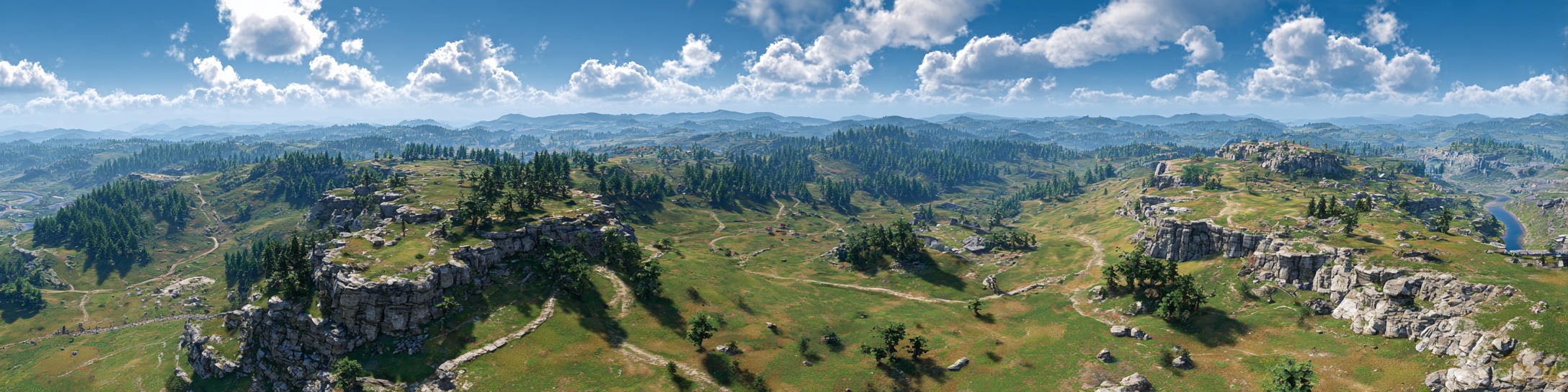
Aerlith
The Aarokocra of Elarion, like those of many other planes, show fluency in speaking, reading and writing Auran. However, over the centuries they have also cultivated another language of their own: the ground script of Aerlith.
Writing System
The Aarakocra ground-script is a geometric writing system laid out across the earth but meant to be read only from the air. Instead of lines of ink or carved runes, its “letters” are patterns of stones, scorch marks, cropped grass, raked soil, posts, and paths, spread over clearings, valley floors, rooftops, or cliff shelves. From ground level these arrangements look like odd landscaping, ruined foundations, or random cairns, with no obvious order. Seen from above along a specific flight path, however, they resolve into crisp shapes: spirals, wings, talons, branching lines and rings that function as glyphs. The angle of approach, the direction of flight, and the reader’s altitude are all part of the script; the same arrangement conveys different nuances depending on whether it’s approached from the north or south, read at scouting height or low gliding height, or viewed while banking toward or away from the pattern.
Meaning in this system arises from relative position and layered perspective rather than from fixed symbols on a page. A central figure marks the topic, danger, water, nesting grounds, sacred sites, while glyphs placed ahead or behind along the expected flight line act like verbs and tense markers. Those offset left or right indicate who the message is for, how severe the warning is, or what season it applies to. Large, widely spaced markers broadcast navigation routes and territorial claims; tighter, more intricate clusters encode tactical notes or private memorials that only resolve for those who know the intended flight pattern. A skilled Aarakocra can “read” a valley by circling it, letting the shifting alignment of stones and scars on the ground unfold as meaning, while most ground-bound peoples never realize they are walking through deliberate design at all.
Morphology
Morphologically, the Aarakocra ground-script is built from a small set of core glyph-forms that gain meaning through scale, orientation, and spatial relationship rather than internal strokes or lines. The basic “roots” of the script are simple aerial shapes, rings, spirals, wings, talons, forks, and straight tracks, that each carry a broad semantic field (place, change, people, threat, choice, path). These roots rarely appear alone; instead, they are inflected by how they’re realized on the ground. A ring of evenly spaced cairns at modest size indicates a neutral area of note, but enlarging it to encompass an entire hill elevates it to a territorial marker, and breaking the ring on one side turns it into an “open” signifier: an invitation, a route, or a weakness, depending on what sits beyond the gap. Spirals tighten or loosen to indicate escalating or fading danger; forked lines bifurcate more or less sharply to distinguish “choice” from “division” or “conflict.” Even material choice plays a morphologic role: light stones vs. dark, burn-scars vs. standing posts, living brush vs. cleared soil—all subtly shift the root glyph’s connotation from natural to unnatural, spiritual to mundane, temporary to enduring.
Complex meanings arise when these root shapes are clustered and layered across terrain. A central glyph serves as the “stem,” while smaller shapes placed along an expected flight line behave like affixes, modifying the core idea. Short, repeated marks leading into a spiral can act as an iterative prefix (“often,” “again and again”), while a talon-form placed just outside a ring is a predatory suffix, turning “gathering place” into “hunted gathering place.” Vertical placement adds another layer of inflection: glyphs arranged on a ridge lean toward sky, wind, and exposure, whereas those sunk into gullies or ravines carry connotations of secrecy, shelter, or ambush. Over time, experienced Aarakocra come to recognize not only individual forms but morphological habits, clans that favor broken rings over forked lines, those that use large spirals as omens rather than warnings, or those that reserve certain materials only for sacred or funerary markers, so that what looks like a handful of stones to ground-walkers becomes, to them, a sentence with subject, tone, and context all encoded in its shape.
Syntax
Syntactically, the Aarakocra ground-script treats flight itself as the sentence line, so word order is defined by the route a reader’s body takes through the air. A message is anchored by a primary glyph-cluster, the topical “noun” of the sentence, usually positioned where an approaching flyer will first see it resolve clearly. From there, additional glyphs are placed ahead of the flight path to act as verbs and tense/aspect markers (“becomes dangerous,” “was once safe,” “will shelter”), while clusters behind or beneath the approach line function like objects, results, or consequences. Markers offset to the left of the flight line tend to bind to the subject or speaker (“for our clan,” “we claim”), while those offset to the right bind to the object or add conditions (“for strangers only,” “in storm-season”). The order in which these clusters come into proper alignment as the reader circles or glides defines the syntactic sequence; if you shift your path, you shift the sequence, which is how the same layout can legitimately yield slightly different readings for “leaving” vs. “arriving” fliers.
Complex statements are built by stacking clauses along multiple passes. A simple warning might be readable on a single straight glide: topic-glyph, then verb-glyph, then a severity marker. More elaborate messages require a loop or spiral flight pattern, where each circuit reveals another aligned cluster functioning as a subordinate clause (“…because storms breed here,” “…except under clear skies,” “…as agreed in the old oath”). Conditional or interrogative structures rely on deliberate incompleteness or branching in the path: a fork in the glyph sequence that does not resolve unless the reader chooses one of two flight lines communicates “if/then” or “either/or,” while open-ended or broken patterns signal questions, doubts, or unfulfilled warnings. Parallel “lines” of stones or scars laid at different scales can encode simultaneous clauses, a wide, easily read path for basic navigation, interlaced with tighter, lower-altitude markers carrying political or religious nuance for those who know to dive. In practice, syntax is whatever path the reader’s wings trace through these options: change the line of flight, and you change which clauses you read, and in what order.
Vocabulary
Vocabulary in the Aarakocra ground-script is built around things that matter from the air: wind, height, motion, prey, refuge, and memory. Their lexicon is surprisingly compact in raw “word count,” but each root glyph encodes a broad semantic field that gets narrowed by context and morphology. A spiral root can mean storm, chaos, or change; a ring can be roost, territory, or focus; a fork can be choice, division, or danger ahead. There are rich distinctions where their lives demand it, half a dozen “words” for updrafts and thermals, several for different kinds of cliff faces (good for nesting, good for ambush, good for soaring), and very fine vocabulary for types of predators and their hunting styles. By contrast, concepts that groundfolk obsess over, individual property lines, coinage, fine social rank, barely exist or ride piggyback on more physical ideas like “nest-claim” or “under-wing protection.” A lot of their “abstract” vocabulary is metaphorical: law is a stable wind, betrayal is a sudden downdraft, a broken oath is a ring with its stones scattered down-slope.
Because the script is laid across real terrain, proper nouns and specialized terms often fuse with landmarks. A sacred storm that returns every few years is not given an arbitrary name; the valley it favors effectively is its name, with extra talon or wing markers indicating which clan names it, claims it, or sings about it. Clan identities themselves live in habitual glyph choices, one clan always uses tall posts for “self,” another prefers tight, interlocking rings,so that their presence reads more like an accent than a separate word. Borrowed concepts from land cultures tend to be naturalized rather than transliterated: a city might be rendered as a dense cluster of tiny ring-glyphs (many roosts pressed together), a marketplace as crossed paths and overlapping rings, a written contract as a doubled ring bound with a straight line, “two nests tied on a single path.” Over time, certain complex clusters become semi-fixed idioms, an arrangement any Aarakocra scout recognizes as “ambush valley” or “good hunting after rain,” but the system always leans on what wings feel in flight and what eyes see from above.
Tenses
Tense in the Aarakocra ground-script is tied to where in the flight you encounter a glyph, how it’s positioned relative to the land, and how permanent it looks. The unmarked “present” is whatever is encoded in the main topical cluster you first read cleanly as you approach: a ring for a roost, a spiral for a storm region, a talon for a predator. Past and future then get layered around that in ways a ground-walker would never notice. Glyphs that sit slightly behind the main cluster along your natural flight line, especially if they’re placed on lower ground or made from more weathered, half-collapsed material, read as “was/were”: a broken spiral behind a clean ring means “storms were here.” Conversely, glyphs laid ahead of the main cluster, often slightly up-slope or using fresher, less-settled materials (raked soil, cut brush, newer stones), read as “will be”: a faint spiral ahead of a calm ring says “storms will be here.” The script is literally built so that what you’ve just flown over is “past,” what you’re seeing now is “present,” and what you’re gliding toward is “future.”
Aspect, the difference between a one-off event and something ongoing or habitual, rides on repetition, spiral direction, and vertical layering. A single small future-marking spiral means “a storm will come,” while a chain of three spirals, each slightly staggered along the forward flight path, means “storms will come again and again.” Clockwise spirals tend to mark building or recurring action, where counter-clockwise forms mark ebbing, fading, or completed action; the same is true of ring-glyphs that close (complete) or open (incomplete) as you circle. Long-term truths and enduring states are carved into stable features, stone set on bedrock, posts drilled into cliffs, so “this pass is dangerous in winter” might be shown by a permanent talon-glyph backed by a secondary, more eroded cluster that says “it has always been so.” Short-lived or tentative futures are scratched into topsoil, brush, or snow, allowing a cautious scout to rake out a quick set of forward-placed marks to say “predators will be hunting here tonight” without pretending that will be true for years.
Sentence Structure
Structurally, most Aerlith inscriptions follow a loose pattern that assumes a particular path of approach. A flyer crosses an opening marker, reaches a topic cluster (the main noun), passes through one or more modifier bands, encounters an action/result sequence, and then exits through a closing marker. In practical terms, the first clear, central glyph along the expected flight line is the “subject” of the sentence: a roost, valley, pass, storm-region, or sacred site. Just ahead of or immediately around it, attached modifiers act like adjectives and short descriptive phrases, encoding danger level, size, ownership, or elevation (“high, exposed,” “deep, hidden,” “ours,” “shared,” and so on). Farther along the glide path come the verb-like clusters, spirals, forks, broken or doubled rings, that say what happens here: storms gather, hunters descend, thermals rise, strangers are forbidden, oaths are remembered.
Longer or more complex sentences are built by stacking these units into lanes rather than switching to a totally different structure. A common pattern is: topic → quality → action → consequence → context. For example, a valley might be written so that your first pass reads “valley (topic) / steep, narrow (quality) / predators descend in storm-season (action + temporal context),” and a lower or tighter second pass reveals “claimed by X-clan (ownership) / sacred to fallen fledglings (cultural context).” Subordinate clauses and asides are literally placed off to the side or on different terraces—drop altitude or shift your bank and you “step into” a side comment: why it’s sacred, when the storms come, what exception applies. Conditionals and choices are handled with branch-points: the glyph sequence literally forks, and each branch you could fly is its own clause (“if you follow this path, danger; if you take the higher line, safety”). So sentence structure isn’t about linear word order; it’s about how a flyer enters the marked space, what they see first, what they pass over next, and which branch they choose to follow. The bones are familiar, subject, description, action, result, but they’re arranged as routes through three-dimensional space instead of lines on a page.
Adjective Order
In Aerlith, adjectives are mostly handled as attached modifiers to the main glyph-clusters rather than as separate “words” lined up in a row. A core noun-form, such as a ring for “roost” or a spiral for “storm-region,” carries the basic reference, and qualities like size, danger, sacredness, and age are encoded by how that form is realized and what small shapes orbit it. A “large” or “vast” roost is simply scaled up to dominate more of the terrain, its stones spread wider and often echoed by a second, fainter ring outside it like a halo. A “small” or “hidden” roost might be pushed into a side gully or tucked under a cliff overhang, the ring compressed and partially obscured. Texture serves as an adjective too: rough cairns of mixed stone say one thing, while carefully chosen pale stones or carved posts signal refinement, importance, or sacred quality, so “sacred roost” is the same ring-root, but made from distinctive materials and backed by subtle radial spokes or a secondary glyph on higher ground.
Position relative to the flight line also does adjectival work. Elements pulled inward toward the center of a glyph, or stacked close to it on the approach path, act like attributive adjectives (“narrow pass,” “steep cliff,” “stormy region”), while features laid just ahead of the main glyph, but still clearly bound to it, shade into something more like “is dangerous,” “is crumbling,” “is safe,” the line between adjective and predicate is thin when your sentence is a flight path. Repetition and doubling add intensity: a single talon-mark attached to a valley glyph might indicate “hunted valley,” but three talons descending down-slope from it intensify that to “heavily hunted,” “perilous,” or “deadly.” Emotional or cultural adjectives, “honored,” “accursed,” “ours,” “theirs,” tend to live in the style of the marks rather than new symbols: an honored site is ringed with balanced, symmetrical spokes and neat stones; a feared or cursed place uses jagged, irregular placements, broken lines, or deliberately toppled cairns. To an Aarakocra reader, all of that registers as “this roost (noun) sacred, old, ours, high, and dangerous (adjectival cluster)” long before they consciously pick it apart; the eye and wings feel the qualities in how the terrain has been written.
Structural Markers
In the Aarakocra ground-script, structural markers are built out of framing shapes, deliberate gaps, and material changes that tell a flyer where a message begins, ends, and how its parts relate. Most longer inscriptions are “bracketed” by a pair of distinct anchor-glyphs—often two matching forms (rings, wing-shapes, or tall posts) placed at the far edges of the readable area along the main flight line. Crossing the first anchor signals that the pattern has begun; passing the second is the full stop. Within that frame, clause breaks are marked by clean bands of emptiness, strips of untouched ground, unburned grass, or unmarked rock, so that a circling reader experiences short stretches of meaning separated by intentional silence. Changes in altitude band also serve as structure: a line of markers on a ridge might carry the primary narrative, while subsidiary details are tucked onto a lower shelf or gully below it, cueing the reader that they have dropped into an aside or gloss.
Emphasis and “formatting” are handled through radial motifs and repetition. A topic the writer wants to stress, “do not land here,” “sacred roost,” “our dead” is often encircled by short spokes of stone or burn-marks radiating outward, a kind of asterisk visible from high above. Parallel lines of glyphs at different scales create multiple registers: a broad, sparse line readable from high altitude gives the public, functional message (navigation, weather, basic warnings), while a tighter, more intricate line closer in and lower down carries political claims, clan names, or religious commentary. Corrections or cancellations are rare but obvious: crossed or toppled cairns, over-burned patterns, or a new ring that neatly overwrites an older form. To a ground-walker it looks like erosion or vandalism; to an Aarakocra it is a clear editorial mark that the meaning of this path has changed.
“Once you’ve seen it, you can’t unsee it. Hills become verbs, ravines turn into questions, and every valley is half a sentence waiting to be flown. I spent half my career riding a gryphon over those lands before I realized we’d been making camp in the middle of someone else’s mourning song.”
— Sir Aeravel, Commander of the Rislani Gryphon Riders

Comments
Author's Notes
Image created with MidJourney
WorldEmber2025 submission