
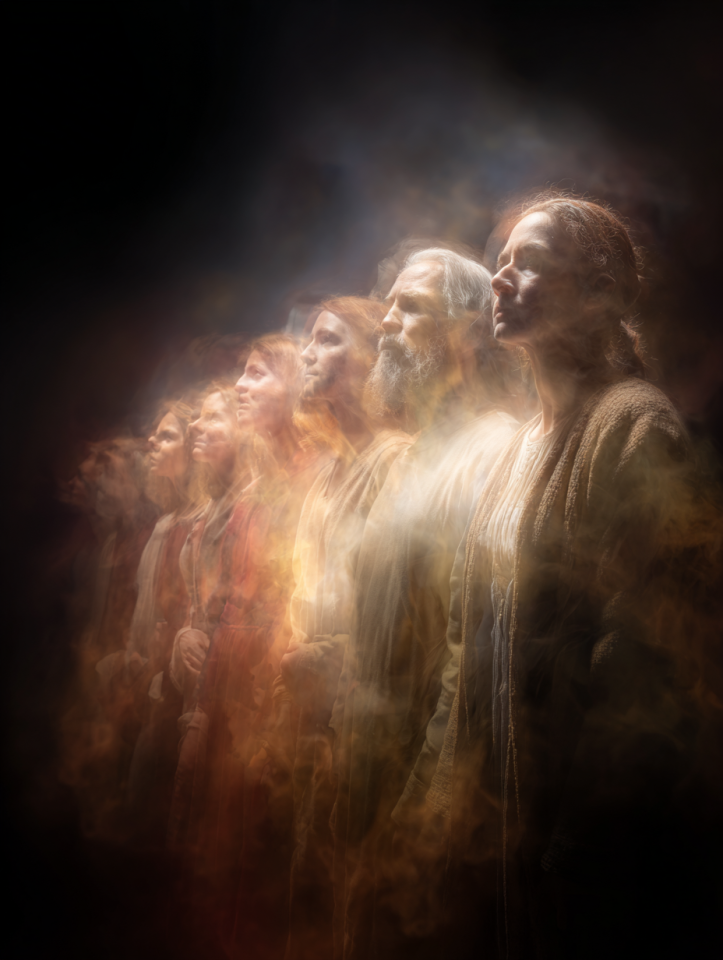




Yeshu ben Yosef (YEH-shoo ben YO-sef)
A Resident
Yeshu ben Yosef (a.k.a. John, Jaan’ak, En-Jahn, Jonas Wainwright, Arturo, Johan De Bruyn, Jonathan March, John Everet)
Yeshu ben Yosef, known by many names across countless centuries, is an immortal wanderer whose life defies the natural order. Born in the ancient deserts of the Levant, his earliest memories are of simple communities, primal survival, and the profound connections between the human spirit and the land. His agelessness became apparent as those around him withered and died, while he endured, a silent observer of the passage of time. Forced to adapt to changing societies, he moved from place to place, adopting new names, languages, and identities to conceal his secret.
During the late Roman Empire, Yeshu lived as an itinerant teacher, embracing a life of simplicity and contemplation. His time in the Middle East left an indelible mark, as his teachings of compassion and spiritual liberation took root among those who listened. Misinterpretations and myths about his words would eventually grow into legends, forever linking him to a figure of divine significance. Disillusioned by the unintended consequences of his words, he fled westward, leaving behind a legacy he never intended to create.
By the 5th century, the echoes of battle between Arthur and Mordred reached his ears. Drawn by the mythic allure of Camelot, he traveled to Avalon, hoping to witness and perhaps guide a moment of transformation in the chaotic age. It was also his desire that maybe the mystics of Avalon could help provide some answers. While there, he found solace in the timeless mists and enigmatic energy of the isle. It was here that he saw Avalon consumed by the mists, only to reemerge in the mystical realm of Tír na nÓg. Captivated by its unearthly beauty and timelessness, he chose to remain, seeing in this land a reflection of his own endless journey.
In Tír na nÓg, Yeshu discovered a world shaped by the very ideals he had long sought to cultivate—harmony, understanding, and balance. The inhabitants of this realm lived by principles that mirrored his teachings, leaving him unremarkable in their eyes. This allowed him to finally lead a peaceful and unassuming life, tending to gardens, crafting tools, and engaging in the small joys of daily existence.
For the first time in his existence, Yeshu felt free from the weight of his past identities and the fear of discovery. In Tír na nÓg, he was neither a prophet nor a wanderer, but simply a man among equals. Here, he could exist without the burden of shaping history or inspiring movements—a relief that brought him profound inner peace.
Today, Yeshu resides peacefully in the small, serene community of Ahuvia, nestled within the timeless lands of Tír na nÓg. By the grace of El-Yaweh, he lives among his adoptive father, Yosef, and his siblings Leah, Mattenai, Miryam, Shlomit, Ya’akov, Yehudah, and Yosef the Younger. Together, they form a family bound not by blood but by shared history and unyielding faith. Their days are marked by quiet joys—shared meals, the laughter of children, and the gentle hum of community life.
Yeshu finds solace in this tranquil existence, tending to the fields and joining in the simple yet profound rhythms of daily life. Ahuvia’s inhabitants embrace the harmony of their surroundings, embodying the ideals of unity and peace that Yeshu had sought throughout his endless journey. For him, this life is a fulfillment of a long-held yearning: to live without the weight of his immortality, surrounded by love, and to finally be part of something eternal in its simplicity.

Relationships
Photo Album
Jaan’ak (Zagros Mountains) 12,005 BCE-111,985 BCEHunter and toolmaker Lived among early nomadic tribes, crafting stone tools and learning the rhythms of nature.


En-Jahn (Uruk, Sumer) 3015 BCE-3000 BCE
Served as a recorder of trade and temple activities in the bustling city-state, symbolizing knowledge and learning in early civilization.

Yeshu Ben Yosef (Nazareth, Middle East) 14 CE-33 CE
Adopted by Yosef, lived with his family, and inspired teachings of compassion and peace..


Jonas Wainwright (Lugdunum (Lyon), Gaul) 255 CE-271 CE
Supported his travels by crafting and trading wagons during the decline of Roman influence in the region.

Arturo (Hispalis (Seville), Iberia) 276 CE-290 CE
Forged tools and weapons, adapting to the Roman and local Iberian cultural mix.

Johan De Bruyn (Tongeren, Flanders) 358 CE-374 CE
Created proto-illuminated manuscripts and decorative arts, serving Romanized Belgian elites and religious communities.


Jonathan March Camulodunum (Colchester), Roman Britain) 380 CE-396 CE
Tended the land while witnessing the tensions between Britons and invading Saxons during Rome's withdrawal.


John Everet (Lindisfarne, England) 515 CE-530 CE
Preserved oral traditions and offered healing wisdom, living among early Anglo-Saxon settlers in northern England.

Yeshu Ben Yosef (Tir na nOg)
Living the dream


Current Location
Species
Ethnicity
Realm
Family
Spouses
Siblings
Children
Sex
Male
Sexuality
Demisexual
Other Affiliations



