



Muisca (Moo-ees-kah)
Andean highland civilization of Colombia
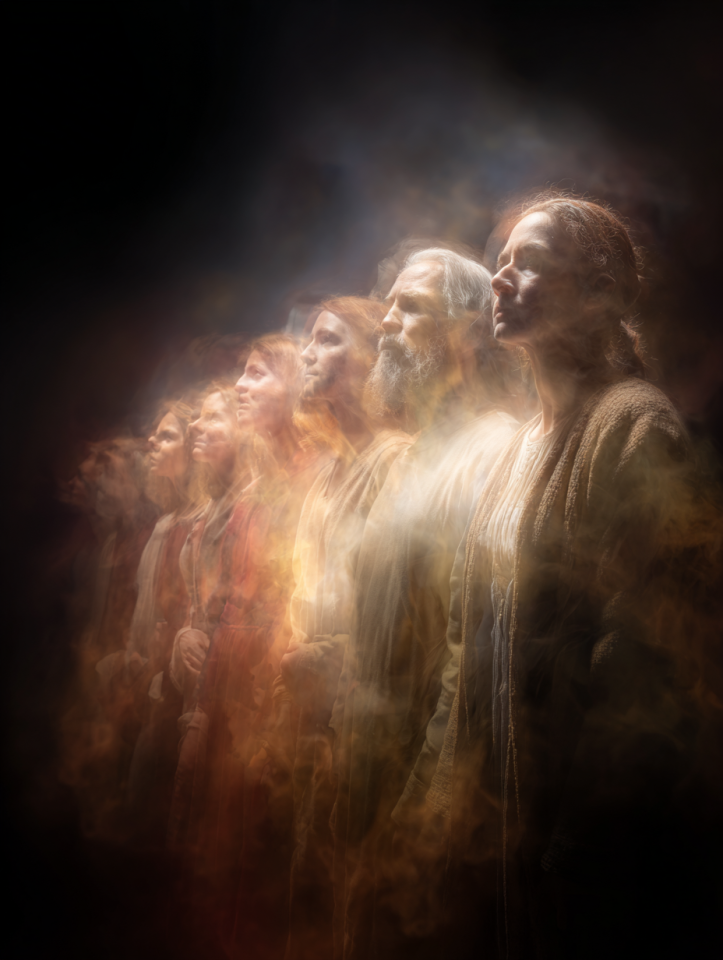
Where the sun nestles close to the earth and the clouds drift like feathers between green mountains, the Muisca walk still—wrapped in gold, woven in silence. Their steps do not press into soil so much as hum through it. In Tír na nÓg, they arrive with their offerings already in hand: salt for memory, emeralds for vision, and stories etched into the folds of tunics dyed by the sky.
They do not arrive as empire or myth. They arrive as elevation—the consciousness of a people who lived not to dominate the land but to understand its rhythm. Their world was not built upon conquest, but upon calibration: to mountain, to wind, to the gods who walk cloaked as storms and hummingbirds. Here, they are remembered not for their monuments, but for the quiet equilibrium they shaped between matter and meaning.
In the Realm, the Muisca remain untouched by colonial distortion. They are whole, resonant, and golden—not because they hoarded treasure, but because they knew how to speak to the light.
Geography & Historical Context
The Muisca emerged on the Altiplano Cundiboyacense, a high Andean plateau in present-day central Colombia, thriving between roughly 600 CE and 1600 CE, though their cultural roots stretch back millennia. As part of the broader Chibchan linguistic family, they were kin in spirit and practice to nearby cultures such as the Guane, Lache, Panche, and U’wa—each adapted to its corner of the mountains, valleys, and cloud forests of the northern Andes. Though never imperial in the sense of the Inca or Mexica, the Muisca developed a confederated network of chiefdoms, ruled primarily from two centers: Bacatá (near modern Bogotá) and Hunza (now Tunja). These dual authorities—the Zipa of the south and the Zaque of the north—oversaw regional trade, ceremonial calendars, and sacred duties rather than absolute rule. Their society balanced central coordination with local autonomy. Their peak came just before the Spanish conquest, when the Muisca were among the most densely populated and culturally rich societies in the Andes. Unlike their southern neighbors, they worked in gold, salt, textiles, and emeralds, not stone, and their temples were woven with smoke, not hewn from rock. Their culture was disrupted by conquest, but in Tír na nÓg, it did not fracture—it harmonized.Culture & Identity
Muisca society was organized around reciprocity, ritual order, and ecological adaptation. Authority flowed through hereditary lines, with male and female leaders alike serving both political and ceremonial roles. The Zipa and Zaque ruled not as tyrants but as cosmological anchors—ensuring that tribute, labor, and ritual stayed aligned with solar rhythms and ancestral obligation. They lived in round, thatched-roof houses arranged in circular villages, with central plazas for council, trade, and festivals. Kinship was matrilineal, with inheritance often traced through the mother’s line, and gender roles were complementary rather than oppositional. Women were merchants, midwives, farmers, and spiritual mediators. Spiritual life centered on Chiminigagua, the supreme force of light and creation, and on a host of deities tied to the sun, moon, wind, and rain. Bachué, the mother of humanity, rose from the lake; Sué, the sun, burned in a golden chariot; Chía, the moon, governed cycles of femininity and reflection. Their rituals were not born of fear—they were acts of cosmic recalibration, designed to keep balance between seen and unseen.Communication & Expression
The Muisca language, Muysccubun, is part of the broader Chibchan family—lyrical, nasal, and shaped by vowel harmony. Though not preserved through written script, it carried a vast poetic lexicon of names, ritual expressions, place-spells, and metaphorical proverbs. Songs were sung to the gods during offerings, and prayers flowed in tandem with breath and drumbeat. They communicated symbolically through textiles, beadwork, ceramic patterns, and gold forms. The famed tunjos—small votive figures crafted in gold—were more than offerings; they were material prayers, each embodying an intention, a question, or a promise to the divine. Designs on cloaks or mantles were not decorative, but encoded—each stitch a verse, each pattern a cycle of time. Their orality was rich: creation myths, ancestral migrations, and seasonal warnings were passed through performance, chant, and communal storytelling. In the Realm, this continues. Their stories are not told—they are enacted in smoke, rhythm, and shadow.Economy & Lifeways
The Muisca practiced intensive agriculture on terraced highland fields, cultivating maize, potatoes, beans, quinoa, and coca. They understood their environment with precision, tracking rainfall patterns and maintaining sacred fields aligned with celestial movements. Their diet was sustained by land management that honored equilibrium, not extraction. Salt was their sacred and economic cornerstone. From brine fields and salt springs—especially in Zipaquirá—they produced white bricks of salt used for food, trade, and spiritual purification. Emerald mining, pottery, and textile weaving formed other critical lifeways, each tied to ritual calendars. They maintained expansive trade networks across the Andes and Caribbean coasts, exchanging gold, tobacco, cotton, tropical fruits, feathers, and ceremonial items. Markets were socially central: spaces for exchange not only of goods, but of stories, alliances, and cosmic alignment. Labor was shared communally and governed by ritual cycles and mutual debt, not hierarchy or wage.Legacy & Contribution
The Muisca left behind no pyramids or palaces—but they left alignment. Their calendars, cosmologies, and social systems remain a blueprint for balance. They taught that abundance comes from offering, not accumulation; that gold is valuable not for its material, but because it reflects sunlight, memory, and soul. Their ritual practices—especially the El Dorado ceremony, where the Zipa would anoint himself in gold dust and descend into Lake Guatavita—survive in myth, but resonate metaphysically: not as greed, but as the image of humanity shimmering with divine offering. Their tunjos, textiles, and celestial alignments inspired later cultural models across the Realm for how to weave beauty into balance. In Tír na nÓg, their influence is subtle but structural. Many cultures draw from their symbolic rhythm, their way of living with the land rather than on it, and their insistence that even silence must be ceremonially tended.Muisca Aetherkin
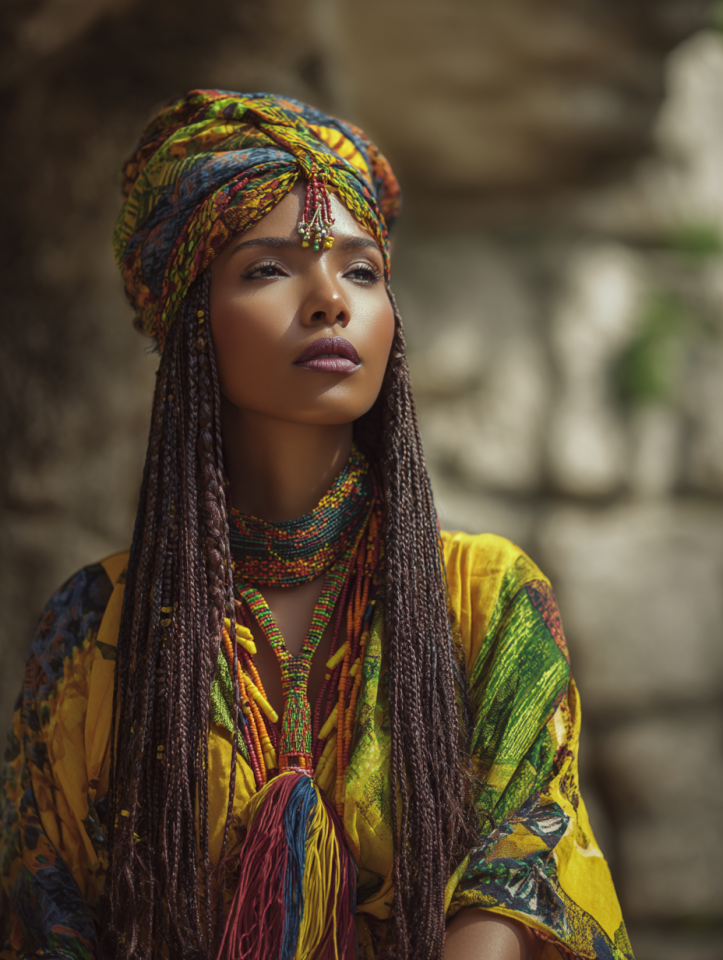
Muisca Aetherkin live where mountain air turns to cloud, often building terraced villages ringed by ritual gardens and sun-washed platforms. Their temples are circular, open to wind and sky, and their homes ring with the soft clink of gold and the rustle of dyed cotton. They serve as astronomer-priests, ceremonial weavers, and river-dreamers. Some tend sacred lakes where offerings vanish into mirror-like stillness. Others keep markets in the Realm’s central valleys, not for wealth, but for harmonic exchange—a space where gifts given in truth shape the breath of the world. They wear red and white, gold and green—not as ornament, but as reflection. Their words are careful, chosen like stones for a path. They speak not to be heard, but to bring balance to what is already speaking. In the Realm, the Muisca are the center of quiet gravity—the culture others turn toward when the world begins to lose its rhythm, and when the gold that shines is needed to reflect something deeper than wealth: intention.Communities
Most Muisca Aetherkin reside at:Some Muisca Gods
See Also: Deities
Muisca Aetherkin
See Also: Aetherkin

Cultural Era: ~3000 BCE - ~1537 CE
Parent ethnicities
Diverged ethnicities
Related Items
Related Locations





