
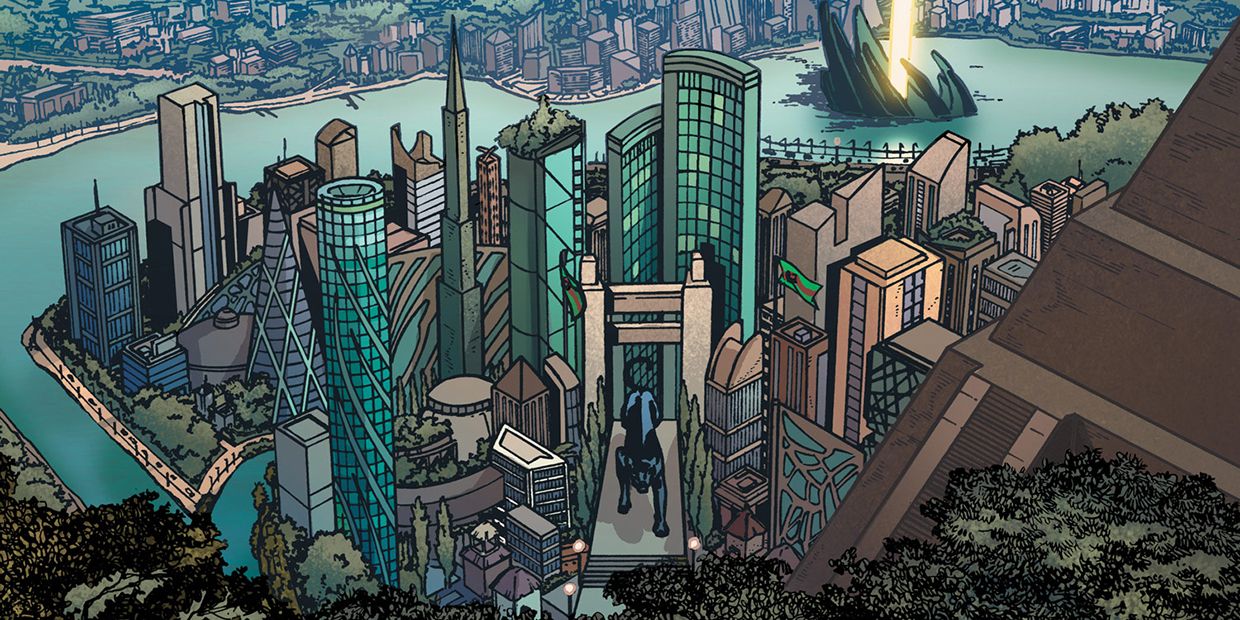
Wakanda
WAKANDA
Long before humans appeared in the land that would one day be called Wakanda, it was home to creatures known as the Originators. These included the arachnoid Anansi, the snakelike Simbi, the insectoid Creeping Doom, the simians called Vanyan and other unnamed groups known only by description. Some had two heads, and some were denizens of Wakanda’s abundant inland waters.
When humans arrived, it wasn’t long before conflict followed. The humans turned to a group of heroes who became Wakanda’s pantheon of gods: Thoth, Bast, Osiris, Set and Ptah the Creator. Collectively, these gods are known as the Orisha. They banished the Originators to the Nether-Realms—but not from the memories of the people.
In the aftermath of the war with the Originators, the eighteen human tribes banded together as the nation of Wakanda. The country would remain largely unknown by the outside world for centuries.
VIBRANIUM
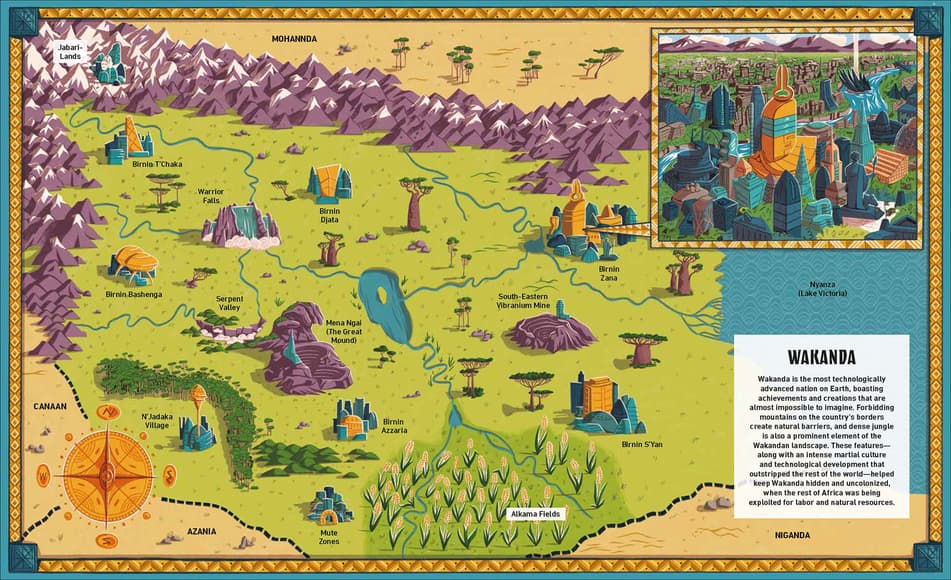
Sometime in the distant past, a large meteor impact left a massive crater in the Wakandan landscape. Initial explorers of the site—known as Mena Ngai, or the Great Mound—suffered a strange illness, becoming “demon spirits” until the great warrior Olumo Bashenga destroyed them. Bashenga gained the strength for this victory from the Panther God, Bast, and established the Panther Cult. For some time, exploration of the Mound was forbidden, but with diligent study, Wakandans began to understand that the meteor had brought them an incredible gift: vibranium, a metal of extraterrestrial origin that can absorb and redirect kinetic energy. It can also absorb sound waves and release them as kinetic energy.
The world’s only source of vibranium is the Great Mound in Wakanda, which of course means that the rest of the world is more or less constantly trying to figure out how to get their hands on some. Attempts to steal and smuggle vibranium are an ongoing challenge for the Wakandan authorities, and the presence of vibranium has led to a number of full-scale invasions of the country. Individual villains, including Epicentre (Landon Wright), Kensei (Yuto Hayashi) and Sister Ruin, have also tried to capture vibranium for their own purposes. Epicentre became infamous in Wakanda for his murder of the original Black Panther T’Chaka Kinyua, father of (Tuwile Kinyua) who would eventually succeed him as Black Panther, and Zuri Kinyua who would succeed her brother as Tulliana.
The mutagenic effects of the vibranium mound have also created a higher than normal number of mutants in Wakanda.
VIBRANIUM VARIANTS
In addition to the standard form of vibranium that is found only in Wakanda, other variants exist, including:
- Antarctic vibranium, or anti-metal: Found only in the Savage Land, this vibranium isotope creates focused vibrations that liquefy most other metals.
- NuForm and Reverbium are artificially synthesized forms of vibranium. NuForm, created by the Axomo Petroleum, behaves as Wakandan vibranium at first, but rapidly decays into the Antarctic form. Reverbium, a creation of Horizon Labs, explodes after absorbing and amplifying sound waves.
- Living vibranium, recently discovered by Wakandan scientists, appears to possess a kind of sentience. It has been observed only in the Dora Milaje training area known as the Echo Chamber.
THE PANTHER CULT AND THE BLACK PANTHER
The leader of the Panther Cult was known as the Black Panther from the beginning, but over time, the Black Panther became the acknowledged leader of Wakanda. There are political and ceremonial aspects to the role, which is passed on to designated heirs when a Black Panther steps down or returns to the ancestors. Each would-be Black Panther must pass the stern test of recovering the heart-shaped herb from Mount Kanda before undergoing the scrutiny of Bast, the Orisha known as the Panther God.
Although the role is hereditary, each Black Panther must also face any willing challengers every year.
Other cults and tribal groups in Wakanda include the White Gorillas, who traditionally fought the Panther Cult for supremacy. Eventually, the Black Panthers banned the White Gorilla cult, both for its disruptive rivalry and because its leader gains strength by killing and eating white gorillas, which are protected. Even so, the White Gorillas survived and were led by M’Baku until he was banished after trying to usurp Tuwile’s throne.
WAKANDA'S WARRIORS
To protect the nation’s borders, as well as its people and its invaluable supply of vibranium, the Black Panther has a number of security forces at their disposal in addition to an organized military considered the most powerful on Earth.
The Dora Milaje is an all-female group of warriors and bodyguards recruited from all the tribes of Wakanda and sworn to protect the Black Panther with their lives. They train in both Wakandan and foreign techniques of combat, forming an indomitable personal guard.
The Hatut Zeraze, or Dogs of War, is a secret internal police force tasked with rooting out corruption within Wakanda and keeping suspicious outsiders under constant surveillance.
Beyond Wakanda’s borders, a spy network known as the N’Charu Silema gathers intelligence in every nation on Earth. Agents of this group exist in most national governments, as well as in prominent multinational corporations and quasi-governmental organizations such as Covert Alpha.
WAKANDA IN THE TWENTIETH CENTURY (AND BEYOND)
For much of its history, Wakanda was almost completely unknown to the outside world. Developing on its own, unhindered by wars and spurred on by the amazing properties of vibranium, the nation developed a rich culture and language, including elite universities and the super-hero training facility known as the Wakandan School for Alternative Studies. Much of this development was spurred by the Black Panther T’Chaka, who saw outside explorers as a threat and hid Wakanda from the world to protect its people. T’Chaka began to sell tiny amounts of vibranium abroad for research purposes, using the knowledge gained to develop his homeland’s culture and technology. Wakandan students also went abroad to the world’s best universities before returning home to further the country’s development—all while T’Chaka kept the country as secret as he could manage in an era of increasing exploration and technology. This tension between protecting Wakanda and being a good global citizen has preoccupied every Black Panther since at least the beginning of the twentieth century.
As word of Wakanda’s advanced technology and astonishing resources began to spread, opportunists and would-be conquerors began angling for ways to get a piece of the mighty nation’s wealth—particularly its vibranium. During World War II, Shield Spider and the Power Platoon helped then-Black Panther Azzuri (T’Chaka’s father) repel a Nazi invasion force under the command of Bloodbath and Baron Manfred Talis. In gratitude, Azzuri gave Shield Spider a small amount of vibranium, which was used to create Spidey’s iconic shield. Other invaders over the years included Sister Ruin and the Alien: Skrull.
Realizing Wakanda could no longer be kept a secret, Tuwile began to open up to the world, joining the League of United Nations and creating the Wakanda Design Group for technological innovation and exchange. But even as the Black Panther became a member of the Marvels, Wakandans as a culture still held themselves apart, with some longing to return to the old isolationist ways.
During the war between the Marvels and the New Omega Men over control of the Phoenix Force, Wakanda fought a war with Atlantis. The Phoenix-empowered King Aquar, attempting to wipe out the Marvels hiding in Wakanda, flooded the country, leaving Birnin Zana, the Golden City of Wakanda, in ruins. In retaliation, Zuri would later invade and destroy Atlantis. Aquar then lied to the Black Order, telling them the Infinity Gems were in Wakanda, which led to that group destroying Wakanda. Later, Tuwile used an Infinity Gauntlet to battle Sister Ruin in the culminating fight against Dr. Squid on Battleworld, after which the Eighth Cosmos was created, undoing the results of the world-destroying incursions and restoring Wakanda to its previous magnificence.
Structure
Wakanda Forever

Comments