
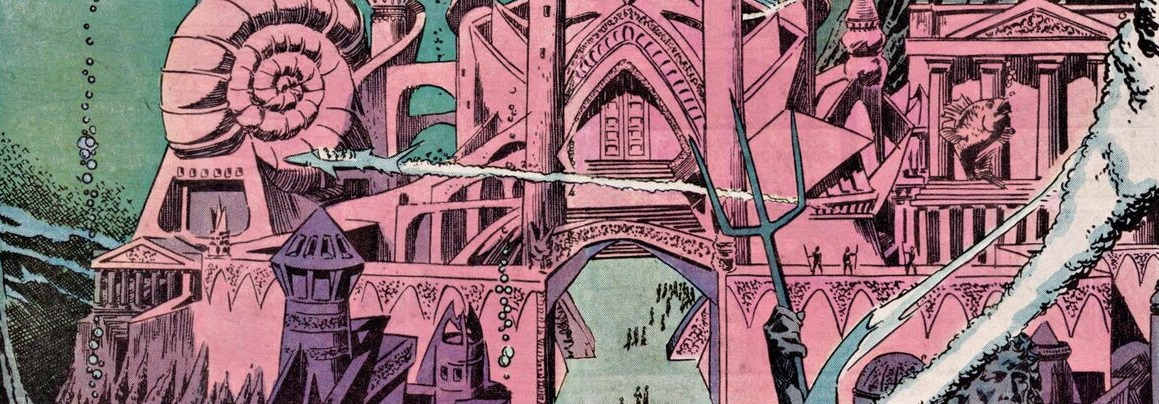
Atlantis
ATLANTIS
Deep in the prehistory of Earth, an empire arose on a small continent where—it is said—Jupiter once placed Atlas to hold aloft the heavens. Originally a barbarous wasteland, Atlantis gradually developed into a thriving and highly advanced civilization composed of several autonomous tribes held loosely together by legendary rulers.
During this first era of greatness, Atlantean explorers reached the farthest shores of Earth. Among their discoveries: the Savage Land, from which they traded captured exotic animals to the empire’s partners. They also found and used alien technology to create servile Beast-Men, who would later rebel against Atlantis and establish their own territories in the Savage Land.
SINKING OF ATLANTIS
There are two stories of the fall of Atlantis. The first was told for centuries and was the basis for the underwater Atlantean civilization. The second was told by Neptune to the Atlantean kings and only recently revealed to the greater population by King Aquar the Sub-Mariner, last king of Atlantis.
The first tale goes like this:
After the first great age, Atlantis began to decline, with regional wars breaking out among tribes. The conflict approached the capital city, and in its weakened state, Atlantis was unable to resist the invasion of barbarians from the neighbouring kingdom of Lemuria, who had themselves been conquered by the Deviants. Atlantis’ desperate ruler, King Kamuu, took drastic measures to repel the invaders, unleashing magma from the volcanic chambers that warmed the city. The ensuing earthquakes and eruptions did annihilate the invaders, but they also destroyed much of the capital city and the Atlantean continent.
Atlantis’ fate was sealed when the Deviants attacked the Second Host of Celestials upon their arrival on Earth, and the Celestials retaliated by destroying Lemuria. The seismic upheaval known as the Great Cataclysm broke apart the continent of Atlantis, and within days, it disappeared into the ocean.
Survivors made it to nearby islands, which were battered, but not destroyed, by the cataclysm. One of these islands was Attilan, home of the Inhuman. A few survivors of the disaster found their way to Europe.
Even some of those dragged beneath the waves managed to survive, thanks to last-ditch spells cast by formidable Atlantean wizards. Given the ability to breathe water, they formed wandering tribes beneath the waves. Homo mermanus was born, and over the years, they flourished, becoming known as the Sea People. Eventually, they discovered the sunken remains of the great capital city of Atlantis, and the Sea People’s prince—also named Kamuu—experienced a vision of his namesake ancestor, in which King Kamuu charged him with a great task. He must rebuild the city of Atlantis and lead a great undersea empire.
The second story goes like this: The Atlanteans were the most war-hungry people on Earth. Neptune, jealous of the land-based gods, wanted a civilization that could win wars across the globe in his name. He sank the continent and appeared to the Atlanteans as their saviour, giving them the ability to breathe underwater. He gave the kings of Atlantis the true story so that they knew their place and would serve the sea god.
Parts of both stories are likely true, though centuries of lies and hidden agendas have obscured that truth.
Atlantis grew and developed. The Atlanteans fought wars with Deviant, Lemurian exiles who fell under the sway of the Serpent Crown and the Elder God Set, the vampiric Aqueos and other subsea enemies. Other than a brief conflict with Athenian Greece and the occasional random encounter, the undersea empire stayed away from the surface people of Earth.
That would not change until the early twentieth century.
KING AQUAR
By the 1920s, Atlantis had moved from its original location in the North Atlantic to a deep plain in the Southern Ocean near Antarctica. An American icebreaker ship, using depth charges to destroy icebergs, inadvertently caused massive damage to the city. Its Emperor, Thakorr, ordered his daughter Fen to send scouts to see who had attacked. Fen, being the headstrong and adventurous sort, instead went herself and met the crew of the ship and its captain, Leonard McKenzie. They fell in love and were married, even though vengeful Atlanteans mistook his actions for a kidnapping and killed most of McKenzie’s crew.
Their child, a mutant hybrid of an Atlantean and a surface human, would come to be known as King Aquar, the Sub-Mariner.
As the grandson of Emperor Thakorr and son of Princess Fen—but also half human—King Aquar became a crucial intermediary between the water- and air-breathing worlds. Initially, when there was conflict, his sympathies were firmly with Atlantis. With the beginning of World War II, the surface hostilities again damaged Atlantis. In retaliation, King Aquar attacked New York City. Then, learning of the Nazi threat, he redirected Atlantean military might against the Third Reich. As the war went on, Atlantis fought against American, Nazi and Imperial Japanese forces at various points, always depending on what King Aquar saw to be his nation’s best interests.
Eventually, Adolf Hitler ordered a brutal attack on Atlantis. Emperor Thakorr was gravely wounded, and King Aquar became the new head of state. He built alliances with other Sea Peoples, attacking surface nations with devastating floods until, during his absence, he was usurped by his uncle Daka, who formed an alliance with the Nazis. Returning home, King Aquar crushed this rebellion. After more Nazi attacks, King Aquar kept Atlantis mostly out of the war, though he continued mounting personal attacks against Axis forces until the war ended.
EXILES AND RETURNS
Thakorr, recovering from his wounds and emerging from a coma, was outraged that King Aquar had taken such a prominent role in surface affairs. He exiled his grandson for several years before welcoming him back in Atlantis’ time of need—a dynamic that repeated itself several times until Thakorr’s death in the 1950s.
Continuing his occasional role as surface emissary, King Aquar petitioned the League of United Nations to admit Atlantis as a member on several occasions. This petition was always rejected.
Atlanteans often criticized King Aquar's long surface absences, but they always relied on him when times were dangerous. He and Atlantis did not love the surface world, but they occasionally helped when allies on the surface needed it. On the other hand, they did not hesitate to bargain with villains if they decided that was in Atlantis’ best interest. King Aquar even agreed to work for Sister Ruin once, when only Ruin’s genius could bring Atlantis’ people out of a toxin-induced coma.
NEW CATACLYSMS, NEW BEGINNINGS
Since re-establishing contact with the surface world in the 1920s, Atlantis has moved several times—and been moved a few times as well. Morgan Le Fay once surfaced the entire city in an effort to re-create her ancestral home of Avalon, only to run afoul of the Inhumans, who also wished to claim it. The surviving Atlanteans rebuilt from the ruins of Maritanis, an Atlantean city destroyed by nuclear testing.
After King Aquar invaded Wakanda, unleashing catastrophic floods during the Marvels/New Omega Men battle over the Phoenix Force, tensions between the two nations simmered without boiling over. At the time, most Atlanteans lived in New Atlantis, a subsurface megastructure designed to support the mutant island of Utopia in San Francisco Bay. Unfortunately, Utopia was destroyed in the final battle between the Marvels and the New Omega Men, and New Atlantis with it.
Under the looming threat of the incursions, Tuwile Kinyua and King Aquar hoped to find peace between their nations. But Queen Zuri ignored Tuwile’s advice and attacked Atlantis, seeking revenge for King Aquar's previous attack.
After yet another relocation and rebuilding, Atlantis was destroyed by the Squadron 7 as a reprisal for King Aquar's previous invasions of the surface world. This time, Superior Man gave Atlantis’ citizens enough advance warning to evacuate before hurling the city violently up from the seafloor onto land. Then, for good measure, he killed King Aquar.
But both King Aquar and Atlantis were resurrected shortly afterward, and for a time, the Sub-Mariner took a more conciliatory stance toward the surface world. He even cooperated with Covert Alpha to root out Leviathan infiltrators in Atlantis and elsewhere. However, the peace didn’t last long, and King Aquar was imprisoned for his surface invasions.
In his absence, Atlantis fell into war among seven different competing kings, forcing King Aquar to return to the undersea realms and end the conflict before surface nations could use it as a pretext to destroy Atlantis once and for all. King Aquar defeated all seven would-be kings and then destroyed Atlantis’ throne. He proclaimed himself the last king of Atlantis and led the people of the seas to work together in a Pax Atlantea.
Now the seas are governed by the League of the Seas, a council of seven who operate out of the new Atlantis: a huge city under a mystical dome and carried by mechanized tentacles across the sea bottom. Atlantis governs and protects the various civilizations under the oceans.

Comments