
Tuned Host
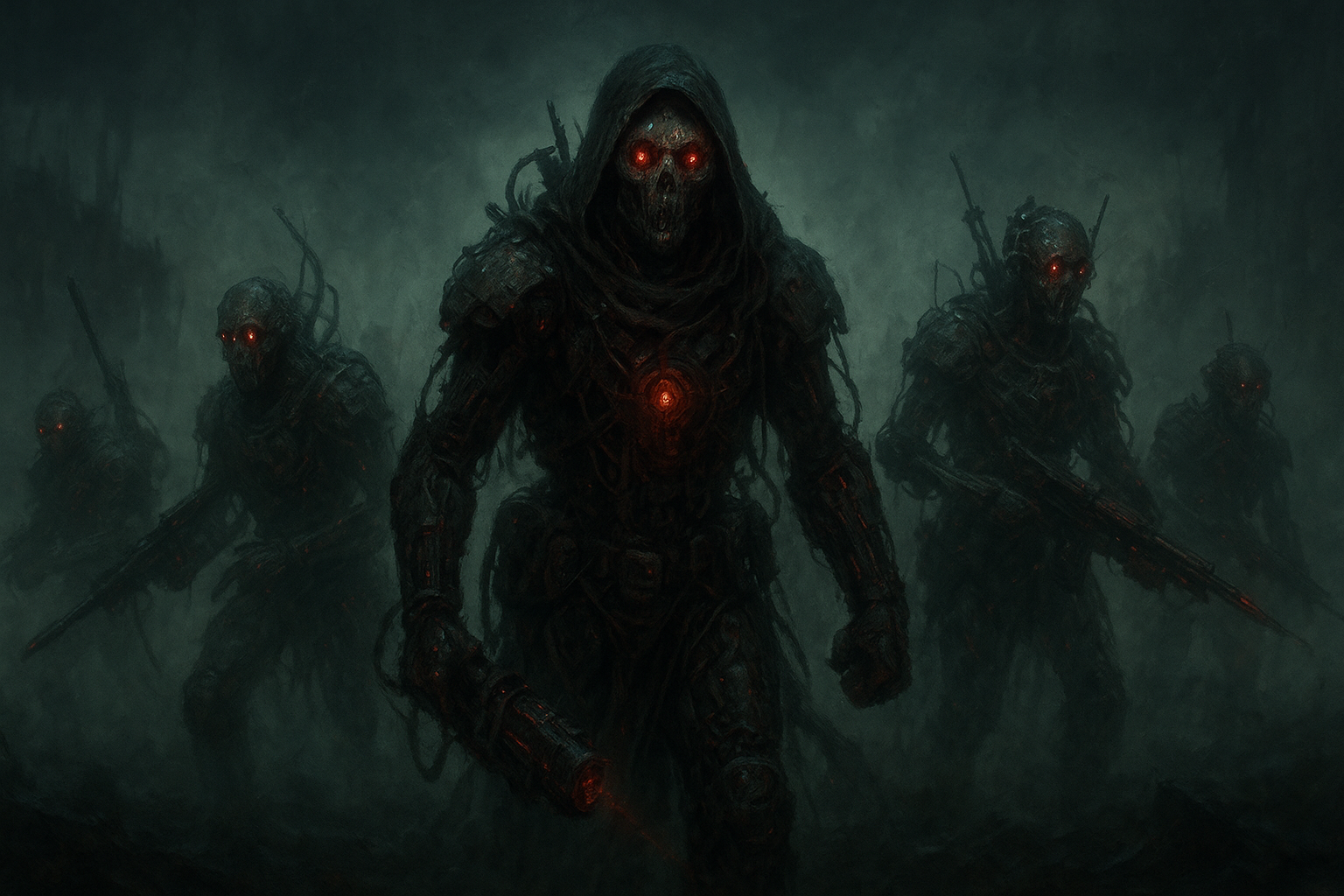
The Tuned Host is the militant force of the Children of the Signal. An unsettling blend of cybernetic warriors, ritualized violence, and corrupted technology. They do not resemble a conventional army; instead, they move in shifting cells and harmonic clusters, guided by coded chants and battlefield transmissions that feel more alive than mechanical. To them, combat is a sacred broadcast, and every strike is an encoded offering to the Signal. Their warriors advance through fog-laced terrain with unnerving coordination, their weapons humming with distorted frequencies, their bodies half-flesh and half-machine. When the Tuned Host arrives, enemies report hearing static before they see their shapes, flickering silhouettes, humming exo-rigs, and whispers in broken machine-language that precede the inevitable clash. They fight to defend holy ground, reclaim corrupted relics, punish interference, and spread the Signal’s influence one resonant, terrifying engagement at a time.

Man Power
The Tuned Host maintains a surprisingly large fighting force for such an unstructured faction, though its true numbers are difficult to measure. Most estimates place their active manpower between 800 and 1,200 tuned warriors, with an additional 2,000–3,000 initiates, auxiliaries, and partially converted followers who can be mobilized in times of crisis. Because the Children of the Signal operate through nested cells and roaming warbands rather than a single centralized command, these numbers fluctuate constantly. Fighters emerge from deep pilgrimage, vanish into the Drowned Trenches for months, or return transformed and more dangerous. Their manpower isn’t concentrated in one place; instead, it spreads like a network, with each band capable of merging into a larger Host when major relics, holy sites, or heretical threats demand unified action. Despite their irregular structure, their combat readiness is high: nearly every member has undergone cybernetic tuning, trench exposure, or ritual reconditioning long before they ever lift a weapon.
Training
Training within the Tuned Host is as much a spiritual crucible as it is martial preparation. Recruits are drilled in cybernetic control, ritualized combat, and resonance attunement, learning to synchronize their bodies and minds with corrupted tech, the Thresher Mist, and each other. Physical conditioning is augmented with neural implants and exoskeletal enhancements, pushing recruits to endure pain, sensory overload, and extreme environmental hazards. Beyond brute strength and skill with weapons, apprentices undergo signal-based exercises, including navigating hallucination fields, decoding corrupted Glossoform transmissions, and surviving simulated Drowned Trench scenarios. Only those who endure both the Fire Veil Trials (a baptism in Mist and machine) and repeated exposure to neural rewriting are considered fully “tuned,” capable of operating as autonomous units within the Host. Survival, adaptation, and obedience to the Signal are the ultimate tests; failure often results in death, permanent corruption, or assimilation into lower-functioning auxiliary roles.
Equipment and Weaponry
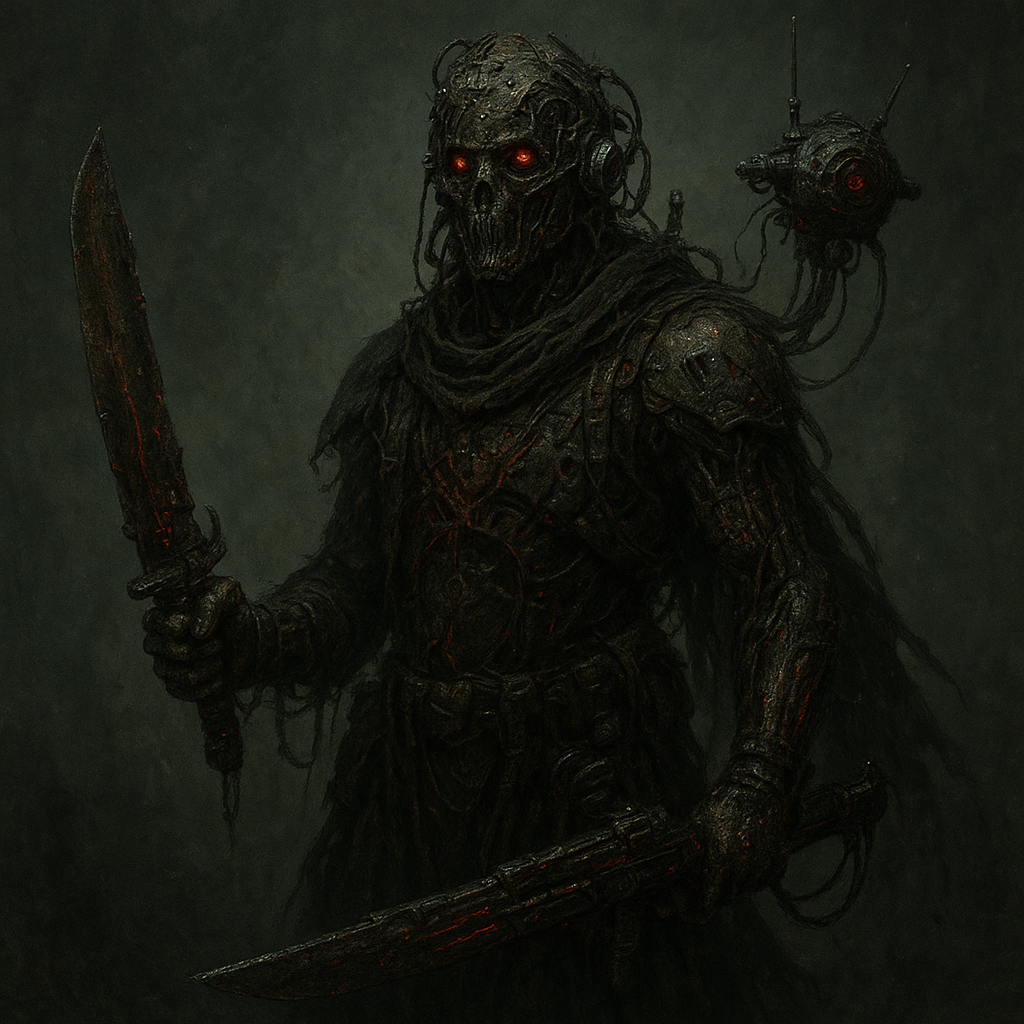
Equipment and weaponry within the Tuned Host is intensely personal, a reflection of each fighter’s body, mind, and devotion to the Signal rather than a standard issue. Some carry Rustcleavers (pre-Fall weapons fused with corrupted cores) worn and nicked like extensions of their own limbs, while others wield Bitblades, monoweapons that hum and flicker out of sync with time itself. Neural implants, antenna arrays, and subdermal filaments snake beneath exposed skin, augmenting reflexes or broadcasting the wearer’s own pulse of resonance. Drones, corrupted mortar units, or Mist-condensing devices accompany those who have mastered battlefield engineering, each tuned to respond only to their handler. Even the clothes they wear are weapons in disguise: signal-wrapped robes, ritual circuitry tattoos, and tattered exoskeletal enhancements all contribute to the aura of menace and function. Every piece is an extension of the self, chosen and modified to harmonize with the fighter’s rituals, skills, and personal communion with the Signal.
Command Structure
The Tuned Host follows a fluid but unmistakably hierarchical command structure built around six shared ranks that span all pillars of the faction. While each warrior trains within a specific discipline, authority is universal. Those of higher rank command those below, regardless of which pillar they are trained in. In battle, warbands from different pillars merge seamlessly, their abilities interlocking like components of a living machine. Orders are given through coded gestures, burst-transmissions, or ritual phrase-keys, allowing mixed-unit formations to act with eerie coordination even amid chaos. Leadership is determined not by charisma or tradition but by proven resonance; the ability to project clarity through the Signal and maintain cohesion in the fog of war. Because of this, combat groups reshuffle frequently, forming and dissolving as needed, yet always aligning around the highest-ranking warrior present. This creates an army that is both decentralized and absolutely obedient, a paradox that only the Signal itself seems able to sustain.
The Three Pillars
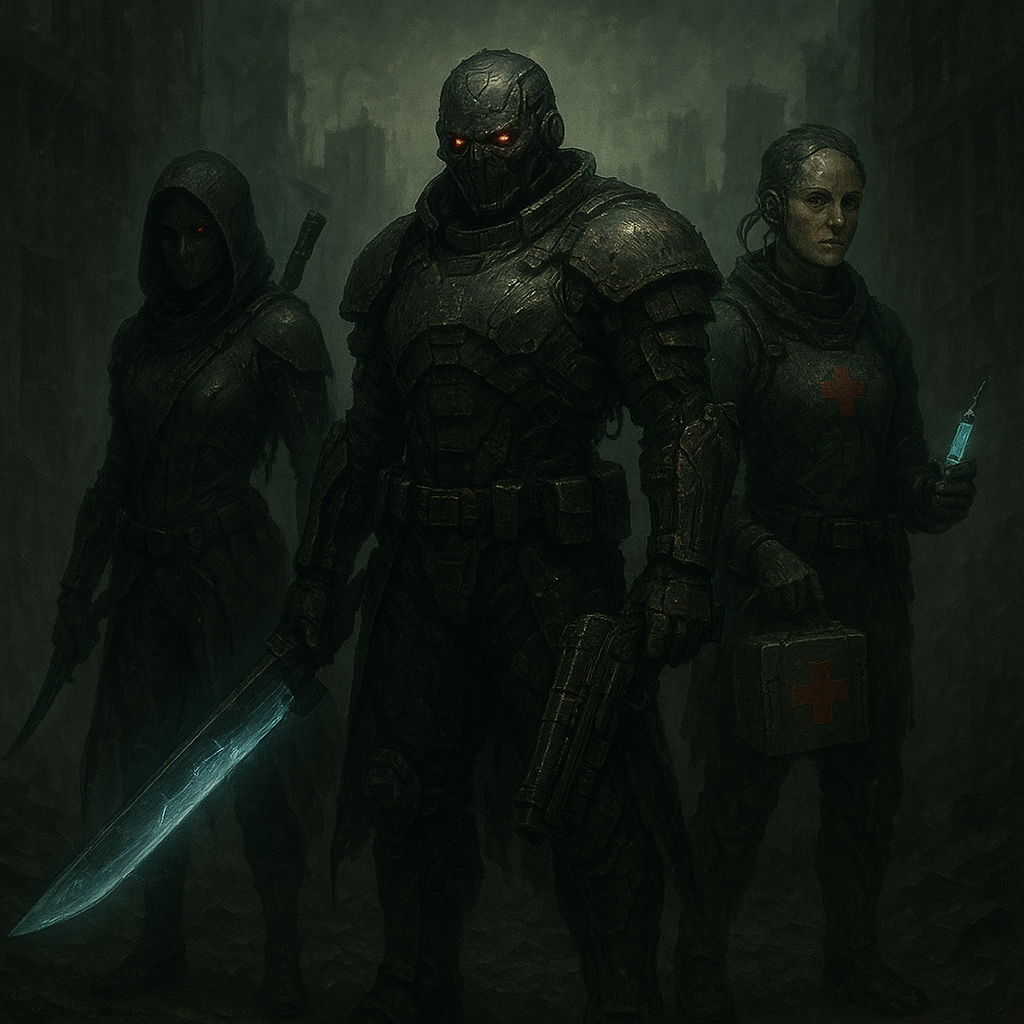
The Tuned Host organizes its warriors and operatives into Three Pillars, each reflecting a distinct combat philosophy. The Chorus of Impact are brutal frontline augments, individuals whose bodies have been hardened, spiked, or bone-forged to break shields, walls, and anything unfortunate enough to stand in their charge. The Veiled Choir comprises the ghostlike infiltrators; precision killers who slip through the world as though reality itself loses track of them, striking in eerie silence before fading again into the fog. Finally, the Resonant Order represents the stabilizing force: healers, tacticians, and specialists, who direct engagements and keep their comrades alive. In game mechanics, a character’s Pillar is determined purely by class choice, offering flavor and identity without altering rank, renown, or professional advancement within the Tuned Host.
Tactics
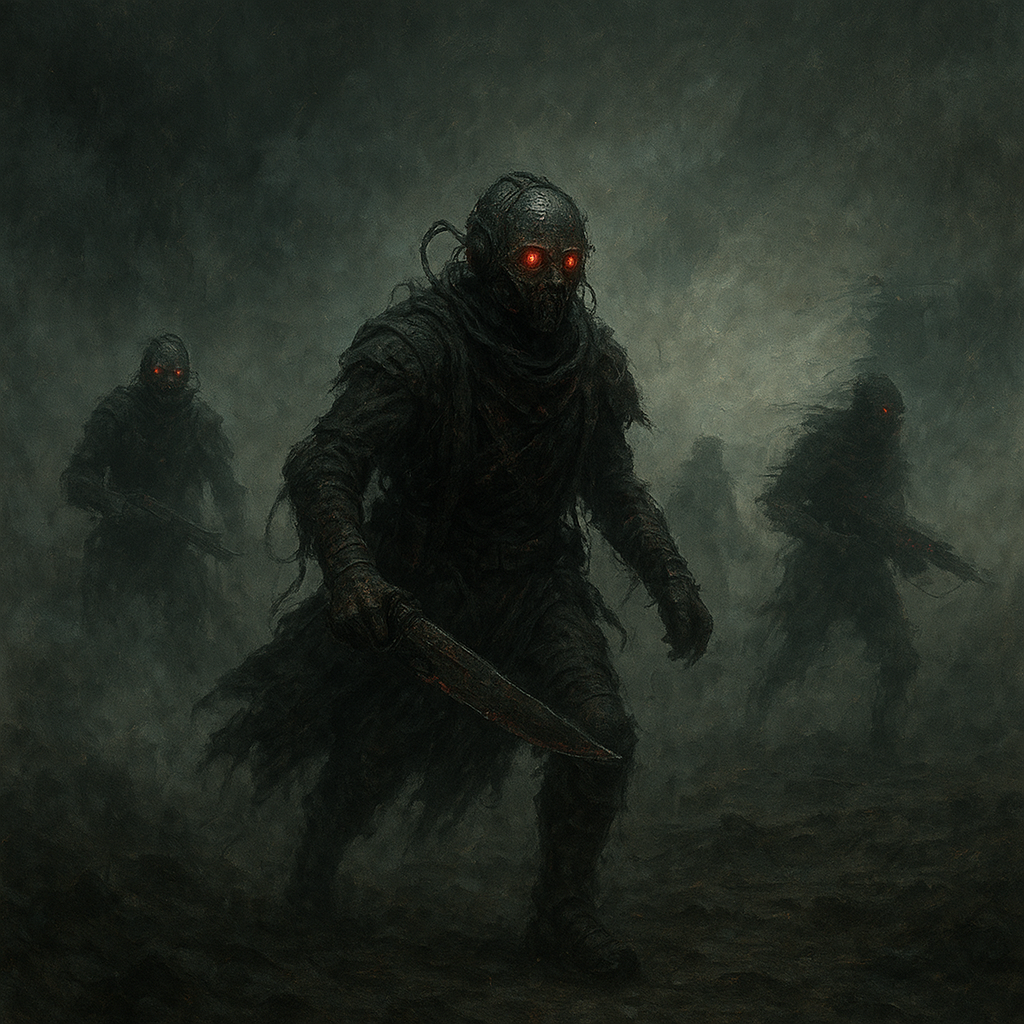
The tactics of the Tuned Host revolve around disruption, misdirection, and overwhelming sensory pressure rather than direct confrontation. They begin engagements by saturating the battlefield with static bursts, Mist clouds, and corrupted transmissions, blinding enemy sensors and fraying nerves. Warbands strike from unexpected vectors, some emerging from fog at a dead sprint, others flickering into existence through glitch-phase cloaks or synchronized signal jumps. They excel at dividing enemy forces, isolating command units, and collapsing morale through psychological warfare: distorted hymns, hallucination fields, and the sudden disappearance of key personnel. Once the enemy is destabilized, the Host converges with lethal precision, combining close-quarters brutality, long-range elimination, and tech-driven battlefield control. Retreats are equally disorienting. They vanish as they arrived, slipping back into mist and static before opponents can regroup. Their greatest strength is their ability to rewrite the flow of battle, forcing adversaries into confusion, fear, and sensory overload long before blades are drawn.
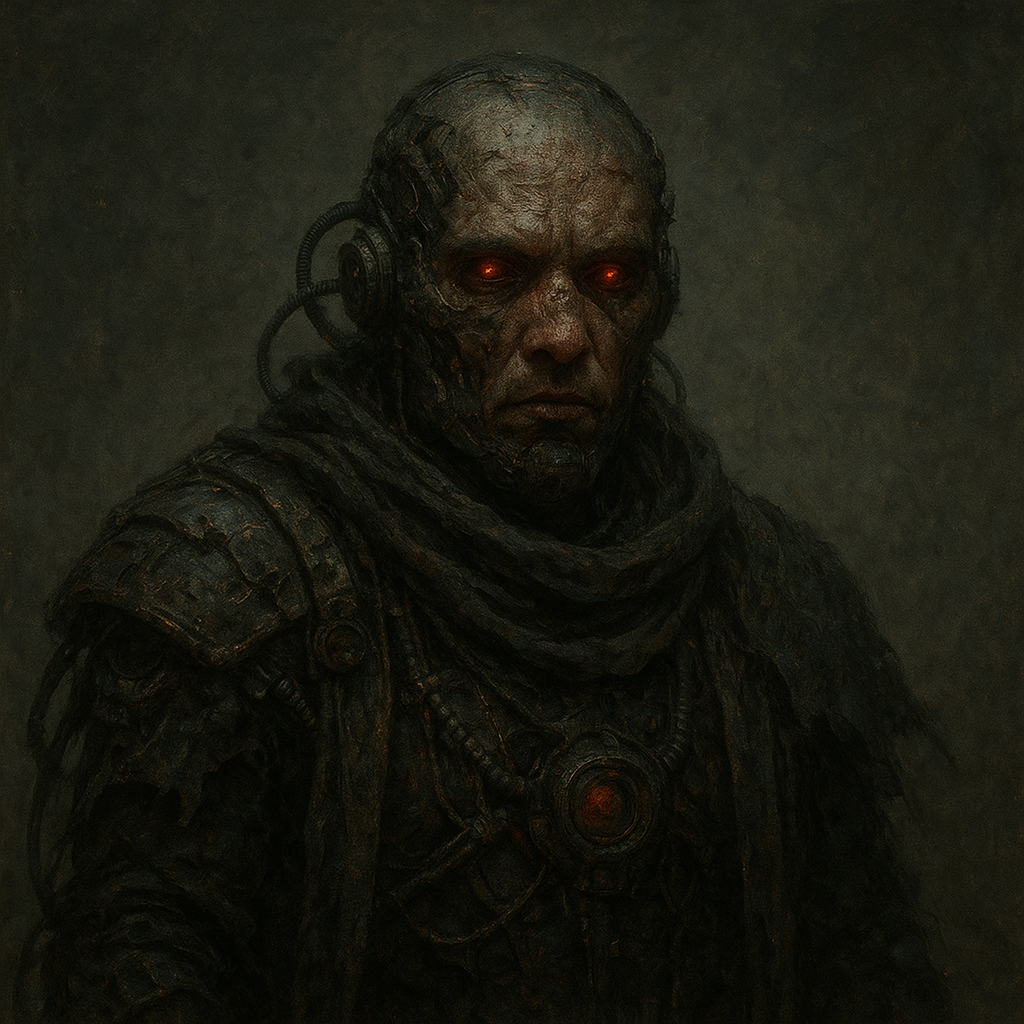
Tuned Host Characters
- Alignment: Usually true neutral or lawful-neutral
- Suggested Races: Human, Automaton
- Suggested Classes: Grounder, Medic, Marshal
- Suggested Archetypes: Militarist, Field Medic, Bannerhead
- Suggested Ladders: Tough, Veteran, Warrior
Consider joining the Tuned Host if the following resonate:
- You want to play a character shaped by ritual, cybernetics, and exposure to forces that blur the line between flesh and machine.
- You enjoy portraying someone eerie, disciplined, and spiritually devoted to a strange, otherworldly Signal.
- You want to explore themes of transformation, purpose, and fanatical devotion expressed through combat, mysticism, and augmentation.
Ranks and Renown
Rank 1: Initiate of the First Tone
- Prerequisite: Renown 1 or higher in the Tuned Host
New recruits who have only just survived the Tuning Ritual, Initiates are still learning to stabilize their augmented senses and bodies. They serve in low-risk support roles while their resonance signatures settle into something usable.
- You are given a Tuning Host insignia.
- You gain proficiency in Performance and Intimidation.
Rank 2: Echo-Bearer
- Prerequisite: Rank 1 and Renown 3 or higher in the Tuned Host
Echo-Bearers are full members of the Host whose abilities have become predictable enough for field deployment. They act as skirmishers, scouts, or backup specialists, proving they can hold a tone under pressure without shattering themselves or their squad mates.
- You gain the ability: Tonal Inspiration (see description below)
Rank 3: Harmonic Blade
- Prerequisite: Rank 2 and Renown 10 or higher in the Tuned Host
These soldiers form the backbone of the Host’s combat forces. Harmonic Blades are trusted to carry out independent objectives, using their tuned bodies and abilities with disciplined precision while reinforcing the rhythm of any larger operation.
- You may select a feat.
Rank 4: Resonant Marshal
- Prerequisite: Rank 3 and Renown 25 or higher in the Tuned Host
Veteran operatives who command small units, the Resonant Marshals shape the flow of the battlefield through coordinated timing and strategic amplification. Their presence stabilizes younger fighters, allowing squads with wildly different Pillars to fight as one.
- You gain the ability: Song of Rest (see description below)
Rank 5: Chorus-Warden
- Prerequisite: Rank 4 and Renown 40 or higher in the Tuned Host
Elite leaders responsible for the Host’s most complex missions, Chorus-Wardens can synchronize an entire strike group into a single devastating cadence. They are revered for their near-supernatural ability to read emotional, tactical, and environmental “frequencies” mid-battle.
- You gain the ability: Magical Inspiration (see description below)
Rank 6: Prime Cantor
- Prerequisite: Rank 5 and Renown 50 or higher in the Tune Host
The supreme military authority within the Tuned Host, serving as both strategic mastermind and living symbol of perfect resonance. Prime Cantors are said to embody the Host’s full harmonic spectrum, their commands carrying the weight of doctrine, tradition, and terrifying precision.
- You may select 2 feats.
Ability Descriptions
Tonal Inspiration
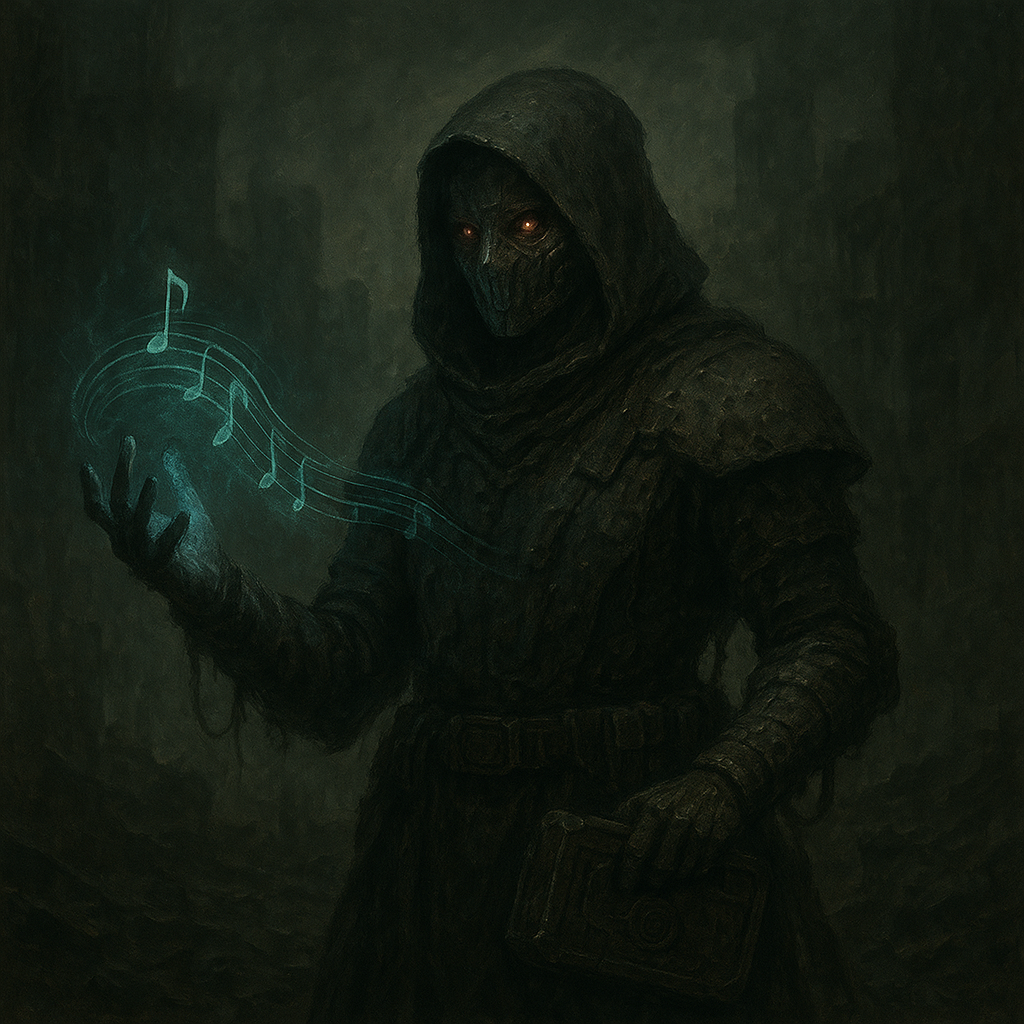
You can inspire others through the use of the signal and music. To do so, you use a bonus action on your turn to choose one creature other than yourself within 60 feet of you who can hear you. That creature gains one Inspiration die, 1d6. Once within the next 10 minutes, the creature can roll the die and add the number rolled to one ability check, attack roll, or saving throw it makes. The creature can wait until after it rolls the d20 and knows if it is a success or failure before deciding to use the Inspiration die. Once the Inspiration die is rolled, it is lost. A creature can have only one Inspiration die at a time.
You can use this feature a number of times equal to your Charisma modifier (a minimum of once). You regain any expended uses when you finish a rest.
Your Inspiration die changes when you reach certain levels in your class. The die becomes a d8 at 5th level, a d10 at 10th level, and a d12 at 15th level. This change occurs regardless of whether or not you have continued to advance in ranks within the Tuned Host
Song of Rest
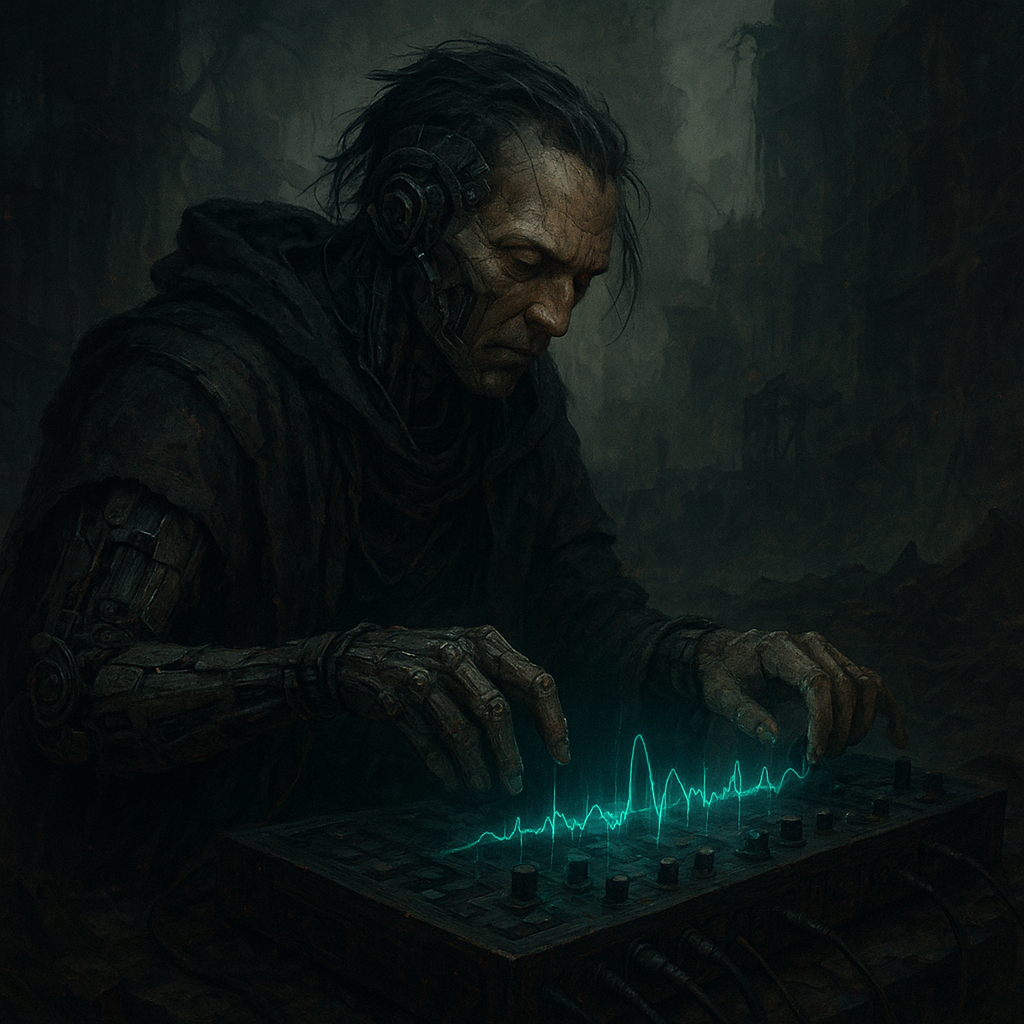
You can use soothing music and the signal to help revitalize your wounded allies during a short rest. If you or any friendly creatures who can hear your performance regain hit points at the end of the short rest by spending one or more Hit Dice, each of those creatures regains an extra 1d6 hit points.
The extra hit points increase when you reach certain levels in your class: to 1d8 at 9th level, to 1d10 at 13th level, and to 1d12 at 17th level. This change occurs regardless of whether or not you have continued to advance in ranks within the Tuned Host
Magical Inspiration
If a creature has an Inspiration die from you and casts a spell that restores hit points or deals damage, the creature can roll that die and choose a target affected by the spell. Add the number rolled as a bonus to the hit points regained or the damage dealt. The Inspiration die is then lost.
Additionally, you gain another use of your Tonal Inspiration feature per rest.


Comments